

With Savannah's unemployment rate hitting a record low of 2.9% in March 2026, a single hiring mistake or a messy termination can cost your business much more than just a few weeks of productivity. You likely already know that Georgia is an at-will state under O.C.G.A. § 34-7-1, but you also understand that legal protection doesn't automatically equal a healthy workplace culture. You are probably searching for how to attract quality applicants Savannah GA while trying to balance federal compliance with the need for a reliable, local workforce in competitive industries like logistics or hospitality.
We're here to help you master the essentials of Georgia’s at-will employment laws so you can protect your business and build a trusted, compliant team. This guide provides a clear roadmap for navigating the $7.25 federal minimum wage, E-Verify requirements for employers with more than 10 employees, and the latest workers' compensation rate changes. We will walk you through practical steps to document performance and lower your legal risk during the termination process, ensuring your Savannah business remains a leader in our regional economy.
Key Takeaways
- Understand the core of O.C.G.A. § 34-7-1 to navigate Georgia's "no reason" doctrine without compromising your business's legal safety.
- Identify the critical federal exceptions and EEOC protections that exist even in an at-will state to prevent expensive litigation.
- Learn how to attract quality applicants Savannah GA by using transparency and clear documentation as tools for local retention.
- Master the difference between offer letters and formal contracts to ensure you don't accidentally override your at-will protections.
- Adopt progressive discipline strategies that help you manage a high-performing workforce in Savannah's competitive logistics and hospitality industries.
Understanding At-Will Employment in Georgia (O.C.G.A. § 34-7-1)
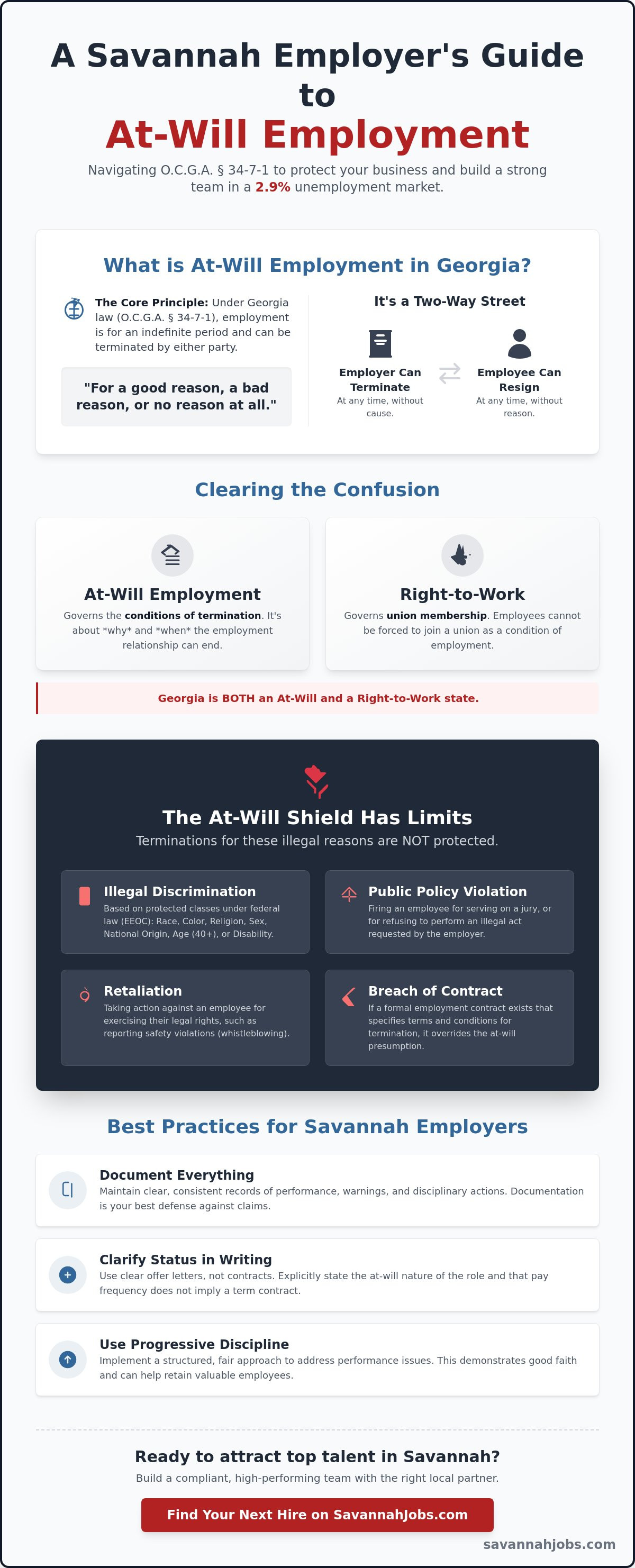
Georgia stands as one of the most employer-friendly states in the country. This reputation is built on the foundation of At-Will Employment, which serves as the default legal relationship for almost every private sector job in the Hostess City. If you don't have a written contract stating otherwise, your relationship with your staff is at-will by law. This means you can terminate an employee for a good reason, a bad reason, or no reason at all. While this sounds harsh to some, it provides the flexibility our local industries need to stay competitive and adjust to market shifts.
This legal doctrine is a two-way street. Just as you can end the relationship without warning, your employees have the reciprocal right to resign at any moment without providing two weeks' notice. In the fast-moving logistics and hospitality sectors of Savannah, this flexibility is a constant reality. When you are looking for how to attract quality applicants Savannah GA, being upfront about these expectations helps build a culture of mutual respect rather than one of legal surprises. Compared to other Southeastern states like South Carolina or North Carolina, Georgia’s courts are much less likely to recognize "implied contracts" from employee handbooks, making our at-will status particularly robust and dependable for business owners.
At-Will vs. Right-to-Work: Clearing the Confusion
We often see local business owners use the terms at-will and right-to-work as if they mean the same thing. They don't. Confusing these two can lead to significant hiring errors and compliance risks that damage your reputation. At-will employment governs why and when you can fire someone. Right-to-work laws, on the other hand, focus on labor unions. Specifically, they ensure that an employee cannot be forced to join a union or pay union dues as a condition of their job. Georgia is both an at-will and a right-to-work state. Understanding this distinction is vital when you are learning how to attract quality applicants Savannah GA, as it allows you to communicate clearly with potential hires about their rights and your company's structure.
The Legal Basis: O.C.G.A. § 34-7-1
The specific statute that governs our local workforce is O.C.G.A. § 34-7-1. This law has deep roots in our state's history. Georgia Code § 34-7-1 was first codified in 1895 and has remained the standard for indefinite hiring for over a century. One nuance you should watch is how your pay frequency might affect this presumption. While the law generally assumes employment is at-will, some older legal interpretations suggest that paying a salary on a monthly or yearly basis could imply a specific term of employment. To protect your business, always clarify in your offer letters that pay frequency does not change the at-will status of the role. We recommend keeping documentation simple and consistent to avoid any ambiguity regarding the length of service.
The Legal Boundaries: Exceptions and Federal Protections
While Georgia law provides significant flexibility, at-will employment is not a blank check to terminate employees for any reason. Federal oversight and specific state exceptions create clear boundaries that every Savannah business owner must respect. If a termination is based on an "illegal reason," the protections of O.C.G.A. § 34-7-1 effectively disappear. Understanding these limits is a critical part of learning how to attract quality applicants Savannah GA, as top-tier talent seeks out employers who prioritize fairness and legal compliance.
The Equal Employment Opportunity Commission (EEOC) enforces federal laws that override state at-will doctrines. Beyond discrimination, you must also be aware of public policy exceptions. For example, you cannot fire an employee for refusing to perform an illegal act or for performing a public duty, such as serving on a jury. Georgia also provides specific whistleblower protections for public employees, and while private sector protections are narrower, retaliating against someone for reporting safety violations can lead to costly litigation. Keeping your hiring and firing practices within these fences protects your local reputation and your bottom line.
Protected Classes and Anti-Discrimination Laws
Compliance begins with Title VII of the Civil Rights Act. You cannot make termination decisions based on race, color, religion, sex, or national origin. For our local hospitality and manufacturing hubs, age and disability discrimination are also major areas of risk. The Age Discrimination in Employment Act (ADEA) protects workers 40 and older, while the Americans with Disabilities Act (ADA) requires you to provide reasonable accommodations. Even small businesses in the Coastal Empire must stay vigilant. When you demonstrate a commitment to these standards, you find it easier to post a featured job and connect with a diverse, skilled workforce that trusts your leadership.
Avoiding Retaliation Claims
Retaliation is currently the most common claim filed with the EEOC. A "protected activity" includes things like filing a workers' compensation claim or participating in an internal investigation. One of the biggest traps for Savannah employers is "temporal proximity." If you terminate an employee shortly after they file a grievance, the timing alone can look suspicious to a judge. Always pause and review the facts if a termination follows a protected event. We recommend documenting every step of the process to prove that your decision was based on performance or business needs rather than payback. This level of professional documentation helps you maintain a stable environment and shows you know how to attract quality applicants Savannah GA who are looking for long-term career stability.
Employment Contracts vs. At-Will Status: Choosing the Right Path
Choosing between an at-will arrangement and a formal contract depends on the specific needs of your Savannah business. While we discussed the at-will default in previous sections, you can legally override this presumption with a written agreement. This is a powerful tool. It allows you to secure high-level talent by offering more stability than a standard at-will position. However, it also limits your ability to terminate the relationship at any time. Balancing these two paths is a major part of learning how to attract quality applicants Savannah GA.
Most local hires should receive an offer letter rather than a formal employment agreement. An offer letter outlines the basics like pay, start date, and job title while explicitly stating that employment remains at-will. In contrast, a formal agreement usually guarantees a specific duration of employment. We see this frequently in Savannah’s tourism and hospitality sectors for seasonal management roles where a fixed term provides mutual security. Be careful during the interview process. Verbal promises like "you'll have a job here as long as you work hard" can inadvertently create an implied contract. These slips can lead to messy legal disputes that damage your local reputation.
When to Use a Formal Employment Agreement
Formal agreements are best reserved for executive hires or specialized roles in Savannah’s manufacturing and logistics hubs. These documents do more than just set a term of employment. They protect your business interests through non-compete and non-solicitation clauses. These are vital if a hire has access to trade secrets or key regional client lists. A well-drafted agreement will also define "for cause" termination clauses. This gives you a clear path to end the relationship if specific, serious misconduct occurs. Using these tools correctly is one of many Effective Employee Retention Strategies that help you keep your best people while mitigating financial risk.
The Role of the Employee Handbook
Your employee handbook is your most important tool for setting daily expectations. It is not a contract; you must make that clear to every new hire. Every handbook should include an explicit at-will disclaimer on the first page. This ensures that your policies on attendance or conduct don't accidentally promise permanent employment. Review your language regularly. Avoid phrases that suggest a "probationary period" ends with a guarantee of a "permanent" role. Clear communication through a handbook helps you manage your team effectively. It also signals to potential hires that you are a professional and organized employer. This transparency is key when you want to know how to attract quality applicants Savannah GA for long-term success. If you are ready to grow your team, consider a 30-Day Job Posting to reach our local talent pool.
Best Practices for Managing an At-Will Workforce in Savannah
Managing an at-will workforce effectively is about more than just knowing the law. It's about creating a system that protects your business while treating people with respect. Even though you have the legal right to terminate without cause, doing so frequently without a clear process can damage your reputation in the Coastal Empire. Top-tier candidates talk to one another. If you want to know how to attract quality applicants Savannah GA, you must build an employer brand known for fair treatment and clear expectations. Consistency is your best defense against both turnover and legal trouble.
Implementing a progressive discipline policy provides a vital safety net for your operations. It shows that you gave the employee every chance to succeed before ending the relationship. This documentation is particularly important for managing unemployment insurance claims. In Georgia, if an employee is fired for "misconduct," they may be disqualified from receiving benefits. Without a clear paper trail, the Georgia Department of Labor is more likely to award benefits. This can eventually push your State Unemployment Insurance (SUI) tax rate toward the 8.1% maximum. Keeping your experienced employer rate closer to the 0.04% minimum requires diligent record-keeping on every performance issue.
Documenting Performance in the Port and Logistics Sector
Savannah’s logistics hub moves at a grueling pace. High-volume hiring for warehouse and shipping roles often leads to high-volume management challenges. You cannot rely on memory when performance slips. Standardize your write-ups to create a consistent paper trail for every member of your team. This protects you if a former employee later claims their termination was discriminatory rather than performance-based. Objective evidence requires documenting specific, measurable incidents such as a missed shift or a documented safety violation rather than relying on vague descriptions of an employee's personality. If you are ready to grow your team with reliable professionals, become a Featured Employer to stand out in our local market.
The Termination Checklist for Georgia Employers
When it's time to part ways, follow a strict checklist to minimize conflict. Georgia law does not require you to provide a final paycheck immediately; you must simply pay the employee by the next regular payday. However, many local businesses choose to provide it sooner to ensure a clean break. Use a formal process for the following steps:
- Collect all company property, including keys, badges, and tools.
- Revoke digital access to email and internal logistics software immediately.
- Provide a clear, brief explanation for the termination without getting into a long debate.
- Consider offering a severance package in exchange for a signed release of claims for high-risk terminations.
Professionalism during these meetings preserves your reputation. It ensures that even when someone leaves, they do so with a clear understanding of the business reasons behind the decision. This level of organization is exactly how to attract quality applicants Savannah GA who value a stable and professional work environment.
Retention and Your Savannah Employer Brand
Transparency about at-will status doesn't have to be a deterrent for new hires. In fact, being upfront about Georgia labor laws can actually help you build a stronger, more professional culture. When you are honest about the legal framework from the first interview, you set a tone of mutual respect and clarity. Candidates in the Coastal Empire appreciate a no-nonsense approach. They want to know exactly where they stand, and providing that information shows you are an established institution that knows what works. This level of transparency is a foundational step in learning how to attract quality applicants Savannah GA.
Your employer brand is your most valuable asset in a tight labor market. Savannah's record-low unemployment rate of 2.9% in March 2026 means that local workers have plenty of options. If your business is known for sudden, unexplained terminations, you will struggle to keep your best people. Successful local employers use at-will status as a legal safety net, not as a primary management style. By focusing on clear communication and consistent documentation, you signal to the community that your business is a stable and reliable place to work. This reputation helps you stand out in competitive sectors like manufacturing and shipping.
Attracting Top Talent in a Competitive Market
To win in Savannah’s logistics and manufacturing industries, you must offset at-will anxieties with clear benefits and growth opportunities. Quality candidates aren't just looking for a paycheck; they are looking for a career path. Use your job descriptions to highlight your commitment to employee development and workplace safety. Leveraging the local reputation of the Savannah Morning News network through SavannahJobs.com gives your listings immediate authority. When you are ready to find your next great hire, learn how to post a job in Savannah GA to reach a pool of reliable local talent.
Building Trust with Your Local Workforce
Building trust requires going beyond what the law strictly requires. While O.C.G.A. § 34-7-1 allows for termination without a stated reason, explaining the "why" behind your business decisions helps maintain morale for the rest of your team. High turnover is a massive drain on financial resources. Reducing it by just a few percentage points can save a Savannah small business thousands of dollars in training and recruitment costs every year. We advocate for using a Featured Employer Upgrade to signal your long-term stability to the regional workforce. This status shows that you are a proactive and helpful guide in the local economy. It reinforces your position as a market leader and is a proven way to master how to attract quality applicants Savannah GA who value stability and professional growth.
Protect Your Business and Build Your Savannah Team
Mastering Georgia's labor laws gives you the confidence to manage your team without the constant fear of litigation. You now understand how O.C.G.A. § 34-7-1 provides essential flexibility while federal protections like Title VII and the ADA ensure a fair workplace for everyone. By combining consistent performance documentation with clear employment agreements, you protect your bottom line from unnecessary risk. This professional foundation is exactly how to attract quality applicants Savannah GA who want to work for a respected and stable local institution.
We are ready to help you grow your workforce in the Coastal Empire. Our platform provides targeted access to the Savannah-Chatham County labor pool and is powered by the trusted reach of the Savannah Morning News and the USA Today Network. Our 30-day postings are designed for local business efficiency, so you don't waste time or resources on unqualified leads. Post your next Savannah job opening with confidence on SavannahJobs.com. Your business is a vital part of our regional economy; let's build a stronger Savannah together.
Frequently Asked Questions
Does at-will employment mean I don’t have to give two weeks’ notice in Georgia?
Yes, at-will employment means neither you nor the employee is legally required to give advance notice before ending the relationship. While two weeks is a standard professional courtesy in the Coastal Empire, Georgia law allows for immediate separation at any time. This flexibility helps local businesses stay agile, though we recommend maintaining clear communication to protect your professional reputation.
Can I fire an employee for a "bad reason" in Georgia?
Yes, you can fire an employee for a "bad reason" as long as it isn't an illegal one. Under the at-will doctrine, a termination can be based on reasons that might seem unfair or illogical, provided they don't violate federal anti-discrimination laws or state public policy. However, firing without a clear business reason can make it harder to learn how to attract quality applicants Savannah GA for future openings.
What are the exceptions to at-will employment for Georgia small businesses?
Exceptions include terminations based on discrimination against protected classes, retaliation for protected activities, or breaches of a formal written contract. You also cannot fire an employee for performing a legal duty, such as serving on a jury. These boundaries are enforced by federal agencies like the EEOC and override the general at-will status of the position.
Is Georgia a "right-to-work" state or an "at-will" state?
Georgia is both a right-to-work state and an at-will state. These are two separate legal concepts that often get confused by local employers. Right-to-work laws prevent employees from being forced to join a labor union as a condition of their job. At-will employment refers to your ability to terminate an employee for any reason that isn't illegal.
Do I have to pay out unused vacation time if I fire an at-will employee in Georgia?
Georgia law doesn't require you to pay out unused vacation or sick time when an employee leaves. There is no state statute mandating this payout unless you have promised it in a written contract or your employee handbook. Review your internal policies carefully, as you are legally obligated to follow whatever rules you have established for your staff.
Can a verbal promise of a job override at-will status in Savannah?
Verbal promises are rarely enough to override the at-will presumption in Georgia courts. However, they can lead to costly legal disputes and damage your standing in the local community. Knowing how to attract quality applicants Savannah GA involves using precise, written offer letters that clearly state the at-will nature of the role to avoid any confusion or implied contracts.
What is the best way to document an at-will termination to avoid a lawsuit?
The best way to document a termination is through a consistent paper trail of objective evidence. Even in an at-will state, having records of performance reviews, write-ups, and specific policy violations protects you if a claim is filed. Focus on measurable facts rather than personal opinions to show that your decision was based on legitimate business needs.
How does at-will employment affect unemployment benefits in Georgia?
At-will status doesn't automatically disqualify a former employee from receiving unemployment benefits. If you fire someone for a reason other than proven misconduct, they will likely be eligible for benefits through the Georgia Department of Labor. This can impact your SUI tax rate, which for experienced employers in 2026 ranges from 0.04% to 8.1% of the taxable wage base.


