

With Savannah's unemployment rate sitting at a razor-thin 2.6% as of April 2026, how do you keep your best people from walking across the street to the Port or Gulfstream? You likely feel the pressure of rising wages every time you post a new opening. We know it's a constant struggle to balance a sustainable budget while meeting the high expectations of our local workforce. Understanding the average salary in Savannah GA for employers is no longer just about looking at a single number. It's about knowing exactly what it takes to compete in the Lowcountry market today.
We're here to help you navigate these shifting tides with confidence. You'll learn how to benchmark Savannah salaries against current market data and calculate the total cost of hiring to protect your bottom line. We will also share how to attract top-tier talent using strategies that go beyond a high base pay. This guide provides the clear, local expertise you need to build a stronger team and grow your business right here in Georgia. Let's look at the numbers that matter for your success.
Key Takeaways
- Analyze how the Savannah Metropolitan Statistical Area (MSA) influences local wage data to ensure your offers are grounded in reality.
- Master the Total Cost of Employment (TCOE) framework to account for Georgia-specific expenses like SUI and Workers Comp beyond the base pay.
- Discover current industry-specific benchmarks and learn how the average salary in Savannah GA for employers is shifting due to the new Hyundai Metaplant.
- Attract top local talent without overextending your budget by highlighting Lowcountry quality-of-life perks that national competitors often overlook.
- Improve your recruitment ROI by focusing on local density through a 30-day job posting rather than getting lost on massive national boards.
Understanding the Savannah Salary Landscape in 2026
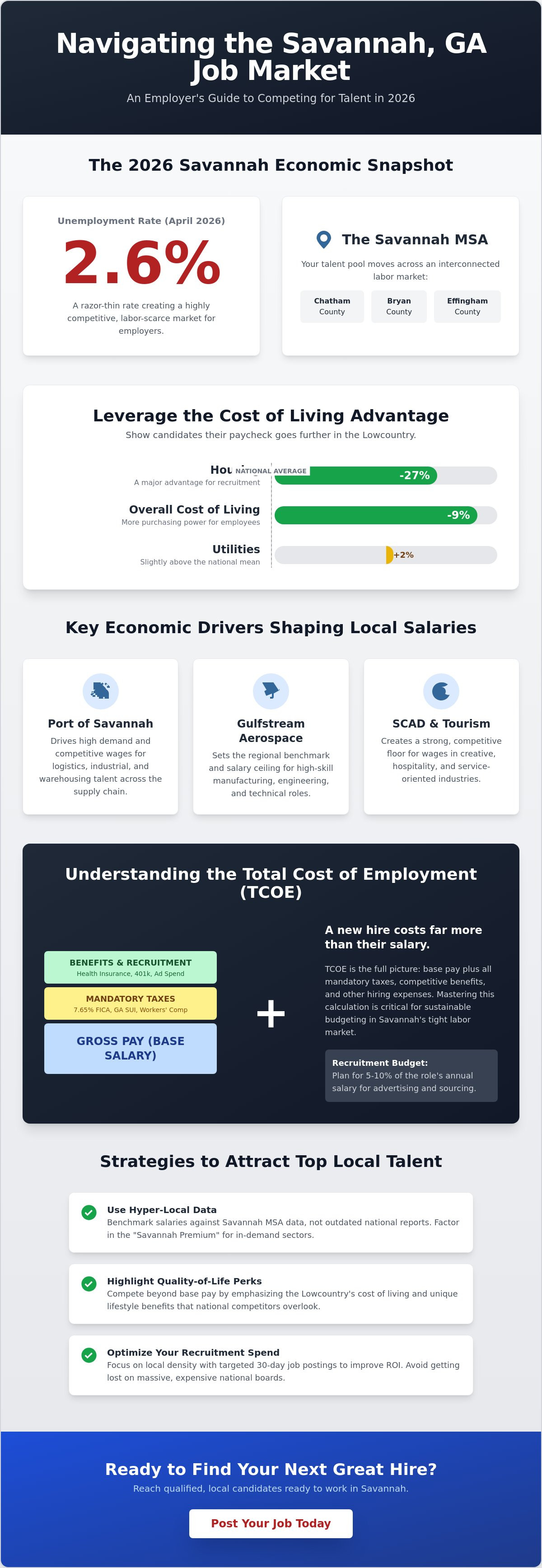
The Savannah metropolitan area economy is the engine that determines what you'll pay your next hire. This region includes Chatham, Bryan, and Effingham counties, creating an interconnected labor market where workers move freely across county lines. When assessing the average salary in Savannah GA for employers, you must look beyond outdated Bureau of Labor Statistics (BLS) reports. While 2024 data suggested a mean hourly wage around $28, the 2026 landscape is much tighter. Our unemployment rate hit a low of 2.6% in April 2026. This scarcity of labor means your wage offers must be more aggressive than they were just two years ago.
Savannah's wages don't always mirror Atlanta or national trends. We're seeing a "Savannah Premium" in specific sectors. This is a wage bump driven by our unique regional growth, which is currently projected to outpace both the state of Georgia and the national economy. Determining the average salary in Savannah GA for employers requires looking at these local spikes rather than broad national averages. You aren't just competing with the shop down the street; you're competing with a regional boom that demands high-precision pay scales.
Key Economic Drivers in the Lowcountry
Our local economy has three massive anchors that dictate pay scales. The Port of Savannah is a primary driver for logistics and warehousing wages. As the port grows, the demand for industrial talent keeps base pay high across the entire supply chain. Gulfstream Aerospace remains the local benchmark for manufacturing and engineering. Their presence sets a salary ceiling that other industrial employers must watch closely. Additionally, the influence of SCAD and our massive tourism sector creates a competitive floor for creative and hospitality roles. These industries don't just provide jobs; they set the expectations for what local talent considers a fair wage.
Savannah vs. National Salary Benchmarks
Savannah offers a unique value proposition for your recruitment efforts. Our cost of living is 9% lower than the national average, and housing is a staggering 27% cheaper than the U.S. mean. You can leverage this data to show candidates that their paycheck goes further here. However, don't let those numbers lead to lowball offers. Savannah is currently paying above the national mean for specialized roles in logistics and aerospace. While utilities are about 2% more expensive than the national average, the overall purchasing power in the Lowcountry remains a powerful tool for your hiring strategy if you benchmark correctly.
Calculating the Total Cost of Hiring in Savannah Georgia
Budgeting for a new team member involves much more than just agreeing on a base salary. While the average salary in Savannah GA for employers provides a starting point, you must account for the additional layers of expense that come with doing business in Georgia. We call this the Total Cost of Employment (TCOE). You need to understand these numbers clearly to avoid overextending your resources in this competitive 2.6% unemployment market. Total Cost of Employment (TCOE) is the sum of gross pay, taxes, and benefits.
Beyond the paycheck, you're responsible for several layers of overhead. In Savannah, typical benefits packages include health insurance and 401k matching, especially if you want to compete with the larger industrial firms in the region. You should also factor in recruitment advertising. Most local businesses find that spending between 5% and 10% of the role's annual salary on recruitment is standard. When you use a 30-Day Job Posting, you can manage these costs more effectively by targeting local talent directly rather than wasting spend on broad national boards.
Mandatory Georgia Employer Taxes and Fees
Every Savannah business must navigate state and federal tax obligations. You'll need to calculate the Georgia State Unemployment Insurance (SUI) for each new hire, which is a critical part of your local tax burden. Additionally, you're responsible for the 2026 federal Social Security and Medicare tax obligations, currently totaling 7.65% of gross wages. Don't forget Workers’ Compensation insurance. Premiums for this vary based on your industry, but it's a legal requirement in Georgia for any business with three or more employees. These costs are fixed, so they must be the first items in your hiring budget.
The Hidden Costs of Turnover
Hiring the wrong person is one of the most expensive mistakes a Savannah small business can make. You aren't just losing the salary paid; you're losing the weeks of training time and the dip in productivity that occurs while a position sits empty. We've seen local firms struggle when they don't account for the cost of a bad hire during their initial planning. It's much more cost-effective to invest in better screening upfront than to repeat the hiring process three months later. High turnover in our local logistics and hospitality sectors makes this a primary concern for regional managers. Protecting your business means understanding that retention is just as vital as the initial recruitment spend.
Savannah Salary Benchmarks by Industry
Savannah isn't a one-size-fits-all town. Your payroll strategy needs to reflect the specific demands of your sector. While the average salary in Savannah GA for employers varies, the 2026 trends show a clear upward trajectory in technical and specialized roles. We're seeing a widening gap between entry-level service positions and skilled trades. A diesel mechanic at the Port now commands a much higher premium than a general laborer. This isn't just inflation. It's a direct result of the specialized skills required to keep our local economy moving at its current record pace.
The historic hospitality district follows its own unique rules. Restaurants and hotels in the downtown core often balance lower base hourly wages with high-volume tip potential. However, to keep back-of-house staff from migrating to logistics jobs, many local owners are raising base pay or adding retention bonuses. You'll find that staying competitive in 2026 means looking at the total take-home pay rather than just the hourly rate. If you don't adjust for these local nuances, you'll likely face the high turnover that plagues the service industry.
Manufacturing and Logistics: The Port Effect
The Port of Savannah continues to be the primary engine for wage growth. Warehouse managers and logistics coordinators are seeing some of the highest year-over-year increases in the region. CDL drivers are in such high demand that sign-on bonuses have become standard practice. The 2026 opening of the Hyundai Metaplant has added even more pressure. This massive facility is pulling talent from across the Savannah-Chatham Manufacturing Center, forcing smaller manufacturers to raise their starting pay just to keep their lines running. You're no longer just competing with local shops; you're competing with global giants.
Healthcare and Professional Services
Our healthcare sector remains a pillar of the local economy. Nursing and specialized administrative staff in Savannah hospitals are seeing competitive benchmarks that rival larger metro areas. In the professional services world, such as law and accounting firms in downtown Savannah, remote work is the new disruptor. Local firms now compete with national companies that offer "big city" salaries for remote roles. To stay ahead, many Savannah employers are leaning into our 9% lower cost of living as a selling point. They're matching competitive base pay with the superior quality of life that only the Lowcountry can provide.
How to Compete for Savannah Talent on a Budget
"I can't match Gulfstream's pay." We hear this from local business owners every week. It's a valid concern when you're looking at the average salary in Savannah GA for employers and trying to compete with the "Big Three" of aerospace, the Port, and tourism giants. However, competing for talent in the Lowcountry isn't always about who has the deepest pockets. Smaller firms have a unique advantage: agility. You can offer a level of personal connection and work-life balance that massive corporations often struggle to maintain. Success in this market requires a strategy that highlights your company's personality and the specific "Quality of Life" perks that only a local business can provide.
Building a strong local employer brand is your best defense against wage pressure. When candidates see your business as a pillar of the community rather than just another job site, salary friction starts to melt away. You can find specific ways to stand out by following these employer branding tips for Savannah. Focus on why people love living and working here. Emphasize your connection to the local culture, whether that's supporting neighborhood events or fostering a tight-knit team environment that feels like a supportive partnership. People want to work for neighbors they trust.
Leveraging Non-Monetary Benefits
Flexible work arrangements are a massive competitive advantage in our region. Savannah's commuting patterns can be a headache, especially for those traveling between Pooler, Richmond Hill, and the downtown historic district. Offering flexible start times or a four-day work week can save your employees hours of frustration on I-16 or Abercorn Street. This convenience often outweighs a slightly higher hourly rate at a job with a rigid, stressful schedule. You might also consider creative perks like professional development stipends or SCAD-adjacent creative workshops. These benefits show that you're invested in your team's growth, not just their daily output.
You can also support your employees by pointing them toward helpful resources for their daily needs. For those who need a more reliable way to navigate their commute, helping them discover CarSeek to find quality new or pre-owned cars is a practical way to show you care about their success both on and off the clock.
Transparency in Job Postings
Honesty is the fastest way to build trust with local candidates. Listing a clear salary range in your job description significantly increases the quality of your applicants. It filters out those whose expectations don't align with your budget and attracts serious professionals who value straightforward communication. When you write your job ad, don't just list the base pay. Clearly explain the total compensation package, including any performance bonuses, health benefits, or paid time off. A significant majority of Savannah job seekers prioritize salary transparency when deciding where to apply. By being open about your pay scale, you position yourself as a fair and reliable employer from the first click.
Ready to find your next great hire? Start by reaching the most dedicated local talent with a Featured Job Upgrade to ensure your opening gets the visibility it deserves across our regional network.
Optimizing Your Recruitment Spend in the Savannah Market
Managing your recruitment budget is just as critical as setting the right pay scale. Once you've benchmarked the average salary in Savannah GA for employers, you've already done the hard work of planning your payroll. Now, you need to ensure those funds aren't wasted on inefficient hiring channels. In a market where unemployment sits at a record low of 2.6% as of April 2026, every dollar spent on recruitment must work harder to find local talent. We focus on helping you maximize your ROI by connecting you directly with the Lowcountry workforce.
Recruitment spend in Savannah should be viewed as a precision tool. If you're hiring for a role that requires local knowledge, massive national platforms often provide diminishing returns. You don't want to pay for clicks from candidates in other states who aren't ready to move to Georgia. By focusing your resources on regional networks, you reduce the noise and find people who are already invested in our community. This targeted approach is the most cost-effective way to fill your open positions without overextending your 2026 budget.
Local vs. National: Where to Post Your Job
National boards often lead to "ghost applicants," which are candidates from outside the region who apply to dozens of roles without researching the location. This wastes your time and increases your cost-per-hire. Using the Savannah Morning News digital recruitment network ensures your opening stays in front of people who already live and work in the Lowcountry. We've seen that local density beats national volume every time. For a deeper look at the numbers, read our comparison of SavannahJobs.com vs national job boards to see which platform wins for regional employers this year.
Maximizing Your 30-Day Posting
A 30-Day Job Posting provides the local density you need to reach passive job seekers who might not be checking boards every day. To get the most out of your ad, write a Savannah-centric description that mentions local landmarks or specific neighborhood benefits. If you're hiring for high-turnover roles, a Featured Job Upgrade ensures your position stays at the top of the search results. You can also use a Featured Employer Upgrade to build long-term local authority, making your company a recognizable name even before a candidate hits apply.
Use this checklist for a cost-effective 2026 recruitment budget:
- Allocate 5-10% of the role's annual salary for total recruitment advertising and screening.
- Prioritize local platforms to eliminate the relocation friction that slows down hiring.
- Use featured upgrades for specialized trades or roles where you're competing with the Port or Gulfstream.
- Track your time-to-hire to identify if your current salary offers are meeting market expectations.
Ready to build your team with the best local talent? Post your next 30-day job listing on SavannahJobs.com today and start seeing qualified applicants from our community.
Secure Your Competitive Edge in the Savannah Market
Hiring in the Lowcountry has never been more competitive. With local unemployment at 2.6%, you now have the tools to navigate this tight market with confidence. You've learned that the average salary in Savannah GA for employers is only one part of the equation. Success comes from calculating your total cost of employment and highlighting the unique quality of life that our historic city offers. By focusing on transparency and leveraging your local brand, you can attract top talent without overextending your budget.
We're here to make your next hire your best hire. As the official digital recruitment portal for the Savannah Morning News and part of the USA Today Network, we connect you directly with the people who call this region home. Our targeted 30-day postings ensure your brand stays visible where it matters most. Post your job opening on SavannahJobs.com and reach local talent today. We look forward to helping you grow your business and strengthen our community together.
Frequently Asked Questions
What is the average hourly wage in Savannah GA for 2026?
The average hourly wage in our region is currently shaped by a tight 2.6% unemployment rate. While historical data from previous years suggested a mean around $28 per hour, the 2026 landscape has seen significant upward pressure. Employers should expect to pay more for skilled trades and logistics roles due to the massive regional growth driven by the Port and new manufacturing developments.
How much does it cost to hire a new employee in Georgia including taxes?
Beyond the base salary, you must budget for mandatory employer-paid taxes and insurance. This includes the federal FICA tax of 7.65% and Georgia State Unemployment Insurance (SUI). You are also required to provide Workers' Compensation insurance if you have three or more employees. These overhead costs typically add 15% to 20% to your total cost of employment for each new hire.
What industries pay the most in Savannah?
Aerospace, logistics, and advanced manufacturing currently lead the market in compensation. Gulfstream Aerospace and the Port of Savannah set a high bar for wages, while the Hyundai Metaplant has created new benchmarks for manufacturing roles. Healthcare and professional services also command top-tier pay as local firms compete with national companies for specialized talent within the Savannah Metropolitan Statistical Area.
Is the cost of living in Savannah lower than the national average?
Savannah remains an affordable place to live, with a cost of living 9% lower than the national average. Housing is the biggest advantage, sitting at 27% cheaper than the U.S. mean. While local utilities are about 2% more expensive than the national average, the overall purchasing power in the Lowcountry is a powerful tool you can use to attract talent from more expensive metro areas.
Does Georgia have a state-mandated minimum wage higher than the federal level?
Georgia's state minimum wage is $5.15 per hour, but the federal minimum of $7.25 per hour applies to most businesses. However, these figures are largely symbolic in today's market. The average salary in Savannah GA for employers is significantly higher across all sectors because local businesses must offer competitive rates to secure reliable staff in a high-demand economy.
How can small businesses in Savannah compete with large employers like Gulfstream?
Small businesses can win by offering the flexibility and personal connection that large corporations often lack. Focus on perks like predictable scheduling to avoid long commutes or professional development stipends. Building a neighborly employer brand allows you to connect with candidates on a community level. Many workers will choose a supportive local environment over a slightly higher paycheck at a massive, impersonal facility.
What are the mandatory employer-paid benefits in Georgia?
The primary mandate for Georgia employers with three or more employees is Workers' Compensation insurance. While the state doesn't require you to provide health insurance or retirement matching, these benefits are standard for competitive roles in the Lowcountry. Offering a solid benefits package is one of the most effective ways to reduce the hidden costs of turnover and build a loyal, long-term team.
Why should I use a local job board instead of massive national platforms in Savannah?
Local platforms focus your recruitment spend on people who already live and work in the Lowcountry. National boards often attract applicants from outside the state who may not actually be willing to relocate, leading to wasted time and "ghost" applications. By using the Savannah Morning News digital network, you reach a trusted audience of local professionals who are already invested in our regional economy.


