

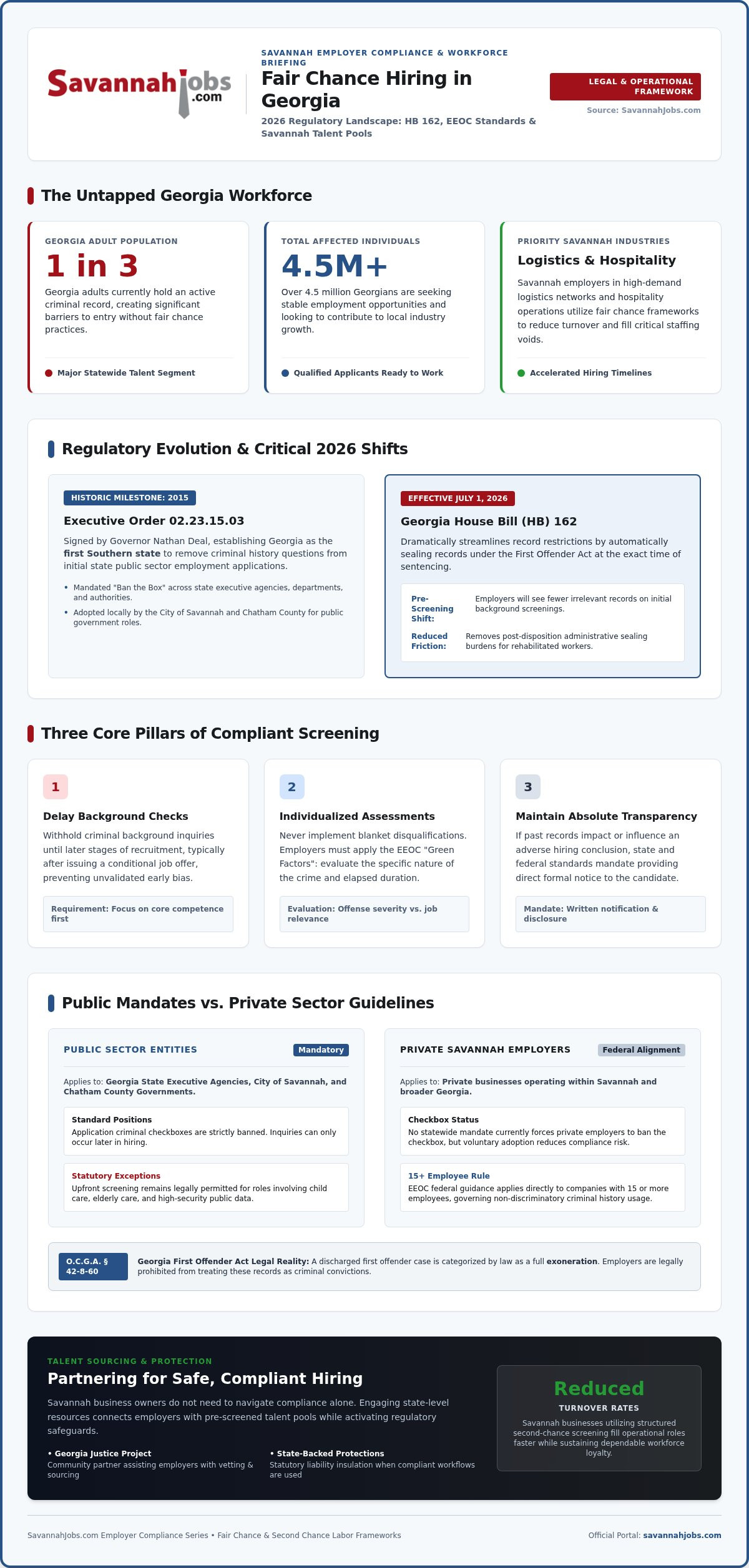
Did you know that roughly one in three adults in our state has a criminal record? That is over 4.5 million Georgians, many of whom are right here in Savannah looking for a way to contribute to our local economy. If you feel hesitant about opening your application process to this group, you aren't alone. Most local business owners worry about the legal fine print or the confusion between federal rules and fair chance hiring laws Georgia enforces at the state level. It is a lot to manage while you're trying to keep your operations running smoothly.
We understand that you need a reliable team without the headache of compliance risks. This guide will help you navigate the 2026 regulatory environment with ease so you can tap into a loyal, underutilized talent pool. We will cover the new HB 162 record sealing rules, Georgia's specific notice requirements, and the local partnerships that connect you with qualified Savannah workers. By the end, you'll have a clear, compliant workflow that protects your business and grows your staff.
Key Takeaways
- Learn how the July 2026 updates to HB 162 impact your background check process and record sealing requirements.
- Navigate the complex intersection of federal EEOC guidelines and the specific fair chance hiring laws Georgia employers must follow.
- Implement a compliant hiring workflow by removing criminal history checkboxes and applying the "Green Factors" during candidate assessments.
- Unlock a reliable local workforce in Savannah’s logistics and hospitality sectors to reduce turnover and fill vacant roles faster.
- Connect with community partners like the Georgia Justice Project to source qualified candidates and leverage state-backed liability protections.
What is Fair Chance Hiring in Georgia?
Fair chance hiring is a commitment to evaluating candidates based on their skills and qualifications before considering their past. It is a set of practices designed to give people with criminal records a genuine opportunity to compete for jobs. While some see this as a legal hurdle, smart Savannah employers view it as a way to solve labor shortages. In 2026, understanding fair chance hiring laws Georgia follows is essential for any business looking to grow.
The fair chance hiring movement started with a simple goal: remove the criminal history checkbox from job applications. This "Ban the Box" initiative gained traction in Georgia when Governor Nathan Deal signed an executive order in 2015. It made Georgia the first Southern state to adopt these policies for state jobs. Today, the movement has grown into a broader framework that supports our regional workforce. You might hear the terms "fair chance" and "second chance" used interchangeably. Fair chance refers to the policy and legal framework. Second chance usually describes the social mission of hiring returning citizens.
2026 is a pivotal year for Georgia labor law transparency because of HB 162. This law, effective July 1, 2026, changes how First Offender Act records are handled by automatically sealing them at the time of sentencing. This shift means your background checks will look different than they did in previous years. You'll see fewer irrelevant records, which helps you focus on the talent that truly fits your company culture.
The Core Principles of Fair Chance Laws
Fair chance hiring relies on three main pillars. First, you should delay background checks until later in the process, usually after a conditional offer. This ensures the record doesn't cloud your initial judgment of a candidate's potential. Second, perform individualized assessments. Don't use blanket bans. Instead, look at the nature of the offense and how much time has passed. Finally, maintain transparency. If a criminal record influences your decision, you must tell the candidate. It's not just fair; it's often the law.
Who is Covered Under Georgia Law?
Georgia's rules vary depending on your organization type. Since 2015, state executive agencies have been required to "ban the box" on initial applications. For private employers in Savannah, there isn't a statewide mandate to remove the checkbox yet. However, the City of Savannah and Chatham County follow these rules for government hiring. Even if you aren't legally required to "ban the box" as a private business, federal EEOC guidelines still apply to companies with 15 or more employees. Following these fair chance hiring laws Georgia standards helps you avoid discrimination claims while accessing a larger pool of local talent.
Georgia's Ban the Box History and 2026 Updates
Georgia has a proud history of leading the South in workforce reform. In 2015, Governor Nathan Deal signed Executive Order 02.23.15.03, making Georgia the first Southern state to remove criminal history questions from initial state job applications. This move aimed to ensure that a past mistake doesn't become a permanent barrier to employment. As we move into 2026, the landscape is shifting again. The Georgia General Assembly recently passed HB 162, which streamlines the process for sealing records under the First Offender Act. Starting July 1, 2026, these records are restricted automatically at the time of sentencing. This update reduces the administrative burden on individuals and provides more clarity for employers during the screening process.
While these mandates primarily target government agencies, we see a significant ripple effect across the Savannah business community. Private employers are increasingly adopting these standards. They recognize that fair chance hiring laws Georgia has established for public roles serve as a blueprint for finding reliable, hardworking staff in a competitive market. By mirroring these state-level practices, local businesses can improve their reputation and access a wider range of qualified applicants.
Public Sector Requirements
State agencies, departments, and authorities must comply with "Ban the Box" rules. This means they cannot ask about criminal history on the initial application. However, exceptions exist. Roles involving the care of children, elderly citizens, or high-security data still require rigorous upfront screening. For most other positions, the focus remains on the candidate's ability to do the job. The Georgia First Offender Act plays a massive role here. Under O.C.G.A. § 42-8-60, a discharged first offender case is legally an exoneration. You cannot treat these cases as convictions.
Private Sector Best Practices
Private businesses in Savannah aren't legally forced to "ban the box" yet, but many do to align with EEOC guidance on arrest and conviction records. Following these guidelines offers a double benefit. First, it provides a "rebuttable presumption of due care" under O.C.G.A. § 51-1-54. This protects you from negligent hiring lawsuits if an employee has a state completion certificate or pardon. Second, it opens doors to financial incentives like the Work Opportunity Tax Credit (WOTC). This federal credit can save you up to $2,400 per eligible hire. The Georgia Department of Labor even offers free fidelity bonding to mitigate perceived risks. If you want to reach this motivated talent pool, consider a 30-day job posting to give yourself enough time for a thorough, fair screening process.
Federal EEOC Guidelines vs. Georgia State Compliance
Federal rules don't always match state ones perfectly, which creates a compliance gap for many Savannah businesses. The U.S. Equal Employment Opportunity Commission (EEOC) enforces Title VII of the Civil Rights Act, which prohibits employment practices that have a disparate impact on protected groups. If your company has a blanket ban on hiring anyone with a record, you might be unintentionally discriminating. This is a common pitfall. While private employers have more leeway under fair chance hiring laws Georgia provides, the federal government expects a more nuanced approach. You can see how other states handle these nuances in this NCSL Ban the Box state policy overview.
Disparate impact occurs when a neutral policy, like a criminal background check, disproportionately excludes members of a protected class. To stay compliant, you must show that your policy is job-related and consistent with business necessity. This is where federal oversight meets local hiring practices. Even if Georgia law doesn't explicitly ban the box for your private business, the EEOC can still investigate if your hiring process leads to systemic exclusion.
Navigating the EEOC 'Green Factors'
The EEOC requires you to use the "Green Factors" to evaluate a candidate's history. First, consider the nature and gravity of the offense. A minor misdemeanor from a decade ago shouldn't carry the same weight as a recent violent felony. Second, look at the time elapsed. Under the federal Fair Credit Reporting Act (FCRA), reporting agencies generally can't show non-conviction records older than seven years unless the salary exceeds $75,000. Finally, weigh the nature of the job. A financial theft record is relevant for a bank teller but perhaps not for a warehouse loader. An individualized assessment is the practice of evaluating a candidate's specific circumstances and rehabilitation efforts before making a final hiring decision.
Georgia-Specific Record Protections
Georgia offers protections that go beyond federal basics. The 2026 amendments to the First Offender Act mean that many records are restricted at the source. If you see a "restricted" record on a background check, you generally can't use it against the applicant. Georgia law O.C.G.A. § 35-3-34(b.1) also requires you to notify the applicant if a GCIC record led to their rejection. This is a state-specific mandate you won't find in federal law. To encourage hiring, Georgia O.C.G.A. § 51-1-54 grants you a rebuttable presumption of due care against negligent hiring claims if the hire has a Program and Treatment Completion Certificate. These shields make it safer and more efficient to hire local talent who have worked hard to move past their history.
Building a Fair Chance Hiring Process for Your Savannah Business
Setting up a compliant hiring workflow doesn't have to be complicated. You can protect your business while reaching more local talent by following a few clear steps. Start with a thorough audit of your digital and paper applications. Remove any criminal history checkboxes to ensure you evaluate skills first. This move aligns your business with the spirit of fair chance hiring laws Georgia uses to promote a stronger economy. It also ensures you don't accidentally filter out qualified workers before they've had a chance to prove their value.
Next, focus on training. Your hiring managers must understand how to apply the 'Green Factors' fairly. They should look at the nature of an offense, how much time has passed, and how it relates to the specific job duties. Standardize the timing of your background checks by moving them to the final stage of the process. Only run these screens after you've made a conditional offer. Finally, document every individualized assessment. Having a written record of your decision-making process is your best defense against potential legal challenges or claims of bias.
Optimizing Your Job Ads for Fair Chance
Your job ads are often the first point of contact for local talent. Use inclusive language that welcomes all qualified applicants to apply. Mentioning your commitment to fair chance hiring in your SavannahJobs.com posting can significantly increase your applicant pool. For more specific guidance on structuring these posts, check out this guide on how to write a good job description. A clear, skill-focused ad helps you filter for the right talent from the start while keeping your process transparent.
The Interview and Background Check Phase
The interview is for assessing fit and capability. Don't ask about criminal history during the initial screening call or the first interview. If the topic comes up later, give the candidate a chance to explain the situation and their rehabilitation efforts. If you decide not to hire someone based on their record, you must follow the law. Under the FCRA, you need to send a pre-adverse action notice and give them time to respond. Remember that Georgia law O.C.G.A. § 35-3-34(b.1) specifically requires you to notify the applicant if you relied on a GCIC record for your decision. To reach the most motivated candidates in our region, post your next opening on SavannahJobs.com and start building a stronger, more inclusive team today.
Connecting with Savannah’s Diverse Talent Pool
Hiring in Savannah is about more than just filling a slot. It is about building a team that stays. Many local employers are discovering that fair chance hiring leads to lower turnover and higher employee loyalty. In our fast-paced logistics and manufacturing sectors, finding dedicated staff is a constant challenge. When you give someone a genuine chance, they often repay that trust with hard work and long-term commitment. While the fair chance hiring laws Georgia enforces set the baseline for legal compliance, your recruitment strategy determines your ultimate success.
Partnering with organizations like the Georgia Justice Project or Goodwill Southeast Georgia can streamline your candidate sourcing. These groups do more than just provide resumes; they offer vocational certifications and placement support that ensure candidates are ready to hit the ground running. By aligning your internal processes with the fair chance hiring laws Georgia maintains, you protect your business while opening doors for others. Using local job boards like SavannahJobs.com allows you to connect directly with these motivated communities. You aren't just looking for any applicant. You're looking for a neighbor who is ready to contribute to our regional economy.
Tapping into Savannah's Logistics and Port Talent
The Savannah GA job market is currently facing critical shortages in logistics, aerospace, and hospitality. Our port is booming, but we need the workforce to support that growth. Fair chance hiring helps bridge this gap. By widening your search, you access a pool of talent that larger, less agile competitors might overlook. This is a strategic move for any Savannah business owner. It builds a brand known for local pride and community support. This reputation resonates with both job seekers and local customers.
Next Steps for Savannah Employers
Review your existing at-will employment Georgia policies to ensure they align with your new fair chance practices. Consistency is key to avoiding legal friction. Once your internal workflow is ready, start your 2026 hiring with a 30-day job posting in Savannah. This duration gives you the necessary time to conduct thorough, individualized assessments without rushing your decision. Compliance is the floor of your business, but talent acquisition is the ceiling. Post your next job on SavannahJobs.com today and find the local talent your business deserves.
Secure Your Savannah Workforce for 2026
Embrace these updated hiring practices to strengthen your business and support our local community. By aligning your internal workflow with the fair chance hiring laws Georgia enforces, you protect your company from compliance risks while accessing a highly motivated local talent pool. Remember that individualized assessments and clear communication aren't just legal necessities; they are effective tools for finding the best fit for your specific team needs. You don't have to navigate this shifting landscape alone.
SavannahJobs.com has been a trusted community partner since 1850, helping regional employers connect with thousands of dedicated job seekers through the Savannah Morning News network. We offer featured placement options to ensure your roles get maximum visibility in a competitive market. Ready to find local talent? Post your job on SavannahJobs.com today! Our platform is designed to make your recruitment process efficient and cost-effective. We look forward to helping you build a stronger, more reliable team for the future of Savannah.
Frequently Asked Questions
Is 'Ban the Box' mandatory for private employers in Georgia?
No, it isn't mandatory for private employers in our state. While Governor Nathan Deal’s 2015 Executive Order prohibits state executive agencies from using a criminal history box on initial applications, private businesses in Savannah can still choose to include it. However, many local companies voluntarily follow these fair chance hiring laws Georgia standards to broaden their applicant pool and align with federal EEOC guidelines for fair and inclusive recruitment.
Can I still run a background check on applicants in Savannah?
Yes, you're still permitted to run background checks on potential hires. Private employers in the Savannah region maintain the legal right to screen candidates, but you must comply with the Fair Credit Reporting Act (FCRA) and state-specific notice rules. If you use a Georgia Crime Information Center (GCIC) report to make an adverse decision, O.C.G.A. § 35-3-34(b.1) requires you to notify the applicant and provide the record details used.
What is the Georgia First Offender Act and how does it affect hiring?
The First Offender Act allows certain individuals to be exonerated without a formal conviction after completing their sentence. Under O.C.G.A. § 42-8-60, these cases aren't considered convictions for employment purposes. Effective July 1, 2026, HB 162 mandates that these records are automatically sealed at the time of sentencing. This means they generally won't appear on standard background checks for Savannah employers, focusing your screen on relevant history.
Are there tax credits for hiring people with criminal records in Georgia?
Yes, you can access federal and state financial incentives. The Work Opportunity Tax Credit (WOTC) provides between $1,200 and $9,600 for hiring qualified individuals, typically those hired within one year of conviction or release. Additionally, the Georgia Department of Labor manages the Federal Bonding Program. This offers no-cost fidelity bonds between $5,000 and $25,000 to protect Savannah businesses during the first six months of an employee's tenure.
What should I do if a candidate has a restricted record?
You should treat a restricted record as if it doesn't exist for standard hiring purposes. In Georgia, "record restriction" is the legal term for expungement. These records are made invisible to private employers on standard GCIC checks. If you happen to become aware of a restricted record, Georgia law prohibits using it as a basis for disqualification unless the role is specifically exempt for safety or high-security reasons.
How do I conduct an 'individualized assessment' as required by the EEOC?
An individualized assessment involves evaluating a candidate's specific circumstances rather than applying a blanket ban. You must consider the "Green Factors," which include the nature of the offense, the time elapsed since the conduct, and the nature of the job. This process gives Savannah applicants a chance to provide evidence of rehabilitation, such as completion certificates or professional references, before you make a final decision on their candidacy.
Can I be sued for 'negligent hiring' if I hire someone with a record?
Georgia law provides specific protections to mitigate this risk. Under O.C.G.A. § 51-1-54, employers receive a rebuttable presumption of due care if the hired individual has a Program and Treatment Completion Certificate or a pardon. These statutory shields aren't just suggestions; they're designed to encourage Savannah businesses to hire returning citizens by providing a strong defense against civil lawsuits alleging negligent hiring or retention during the employment period.
Where can I find more resources for fair chance hiring in Savannah?
You can connect with several local organizations focused on reentry and workforce development. Step Up Savannah and Goodwill Southeast Georgia offer placement support and vocational training for justice-impacted individuals. For legal guidance, the Georgia Justice Project provides excellent employer resources. To start reaching these candidates directly, consider a 30-day job posting on SavannahJobs.com to tap into our city's diverse workforce while staying compliant with fair chance hiring laws Georgia promotes.


