

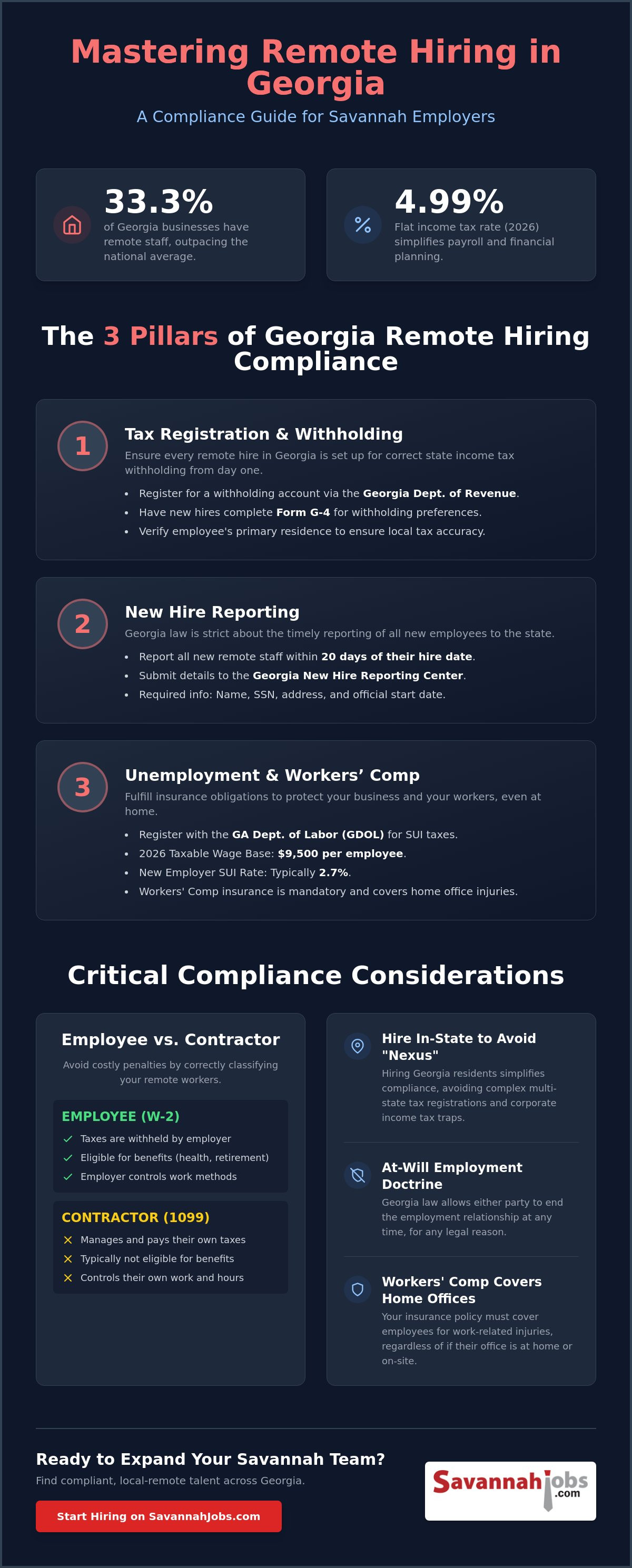
Did you know that 33.3% of businesses in Georgia now have employees working from home, a rate that actually outpaces the national average? It's a clear sign that the local talent pool is shifting. Many Savannah employers want to tap into this wider market, but they often hesitate because they fear a mountain of confusing paperwork. You shouldn't have to limit your search for the perfect candidate just because of complex payroll rules. We know that the tax implications of hiring remote employees in Georgia can feel like a hurdle, especially when you're trying to manage multistate rules alongside our specific state mandates.
This guide will help you master the legal requirements for hiring remote employees in Georgia to ensure compliance while you expand your search beyond the coast. We'll provide a clear compliance checklist and explain the 2026 flat tax rate of 4.99%. You'll gain the confidence to hire anywhere in the state, from Atlanta to Augusta, while staying firm on Georgia's at-will policies and workers' compensation rules. Let's simplify your hiring process and protect your business today.
Key Takeaways
- Define remote roles correctly using the latest 2026 GDOL guidelines to ensure your team is built on a solid legal foundation.
- Navigate the tax implications of hiring remote employees in Georgia with confidence, covering everything from the 4.99% flat rate to specific withholding rules.
- Avoid costly misclassification penalties by learning how the Georgia Department of Labor determines worker status for home-based staff.
- Maintain your rights as an employer by applying Georgia's at-will doctrine and mandatory signage policies to your virtual workspace.
- Streamline your search for compliant talent by targeting candidates who already reside within the state's tax and legal jurisdiction.
Understanding the Georgia Remote Work Landscape in 2026
Georgia's job market is changing fast. The Georgia Department of Labor (GDOL) defines a remote employee as someone who performs their duties from a location other than the employer's physical place of business. For Savannah businesses, this means you can hire talent across the entire state while following a single set of rules. Hiring local-remote workers, those living in Georgia but outside our immediate coastal area, allows you to scale without the headache of managing different state tax IDs. It's a strategic way to grow your team while keeping your administrative burden manageable.
Georgia is widely considered one of the most employer-friendly states in 2026. This reputation is built on a stable regulatory environment and a flat income tax rate of 4.99%. When you stay within state lines, you avoid the complex tax implications of hiring remote employees in Georgia that often plague multistate companies. You keep your payroll predictable and your administrative costs low. Our state's commitment to business growth makes it an ideal place to build a flexible workforce.
The Legal Concept of Nexus in Georgia
Nexus is the legal link between an employer and the state. Understanding the tax implications of hiring remote employees in Georgia is much simpler when the worker resides in-state. Because you're already operating within the state, hiring in a different county doesn't usually require new corporate tax registrations. Our shared Economic Landscape in Georgia makes it easy to expand your team from the coast to the mountains. You won't face the corporate income tax "nexus" traps that often occur when hiring across the border in South Carolina or Florida.
Remote vs. Hybrid: Compliance Differences
You must decide if a role is 100% virtual or a hybrid position. A hybrid role usually requires the employee to travel to your Savannah office periodically. This travel can impact how you handle expense reimbursements and worker classification. Insurance is another key factor. Georgia's workers' compensation laws apply to home offices just as they do to traditional sites. If an employee is injured while performing work-related tasks at home, they're generally covered. As the Savannah GA job market continues to favor flexible arrangements, being clear about these distinctions will protect your business from unnecessary risk.
The 3 Pillars of Georgia Remote Hiring Compliance
Building a remote team starts with a rock-solid compliance workflow. You need a system that works every time, whether you're hiring in Chatham County or Fulton County. Savannah businesses often think local rules apply, but remote work shifts your focus to statewide mandates. By setting up these three pillars now, you protect your bottom line and build trust with your new team members. When you use a 30-Day Job Posting, being clear about these requirements from day one helps you attract the right professional talent without the risk of legal surprises later.
1. Tax Registration and Withholding (Form G-4)
Every remote hire living in the Peach State requires you to withhold state income tax. You must register for a withholding account through the Georgia Department of Revenue. For detailed instructions on rates and filing schedules, consult the Georgia Employer's Tax Guide. Have your employee complete Form G-4 immediately to set their withholding preferences. Verifying their primary residence is vital for local tax accuracy. Understanding the tax implications of hiring remote employees in Georgia ensures you don't face unexpected audits or back-tax penalties.
2. New Hire Reporting Requirements
Georgia law is strict about new hire reporting. You have exactly 20 days from the date of hire to report any new employee to the Georgia New Hire Reporting Center. This applies to every remote worker, regardless of where their home office is located. You'll need their Social Security number, address, and official start date. Failing to report can result in financial penalties for your business. It's a simple step, but it's one that many busy Savannah business owners overlook during the excitement of a new hire.
3. Unemployment Insurance (UI) and Workers’ Comp
Your third pillar involves insurance and unemployment. You must register for a Georgia Department of Labor (GDOL) account to pay state unemployment insurance (SUI) taxes. In 2026, the taxable wage base is $9,500 per employee. New employers typically start with a 2.7% rate. Also, if you have three or more employees, Georgia law requires you to carry workers' compensation insurance. This coverage extends to remote workers. An injury in a home office is generally covered if it happens during work hours while performing work duties. Managing the tax implications of hiring remote employees in Georgia alongside these insurance requirements keeps your business safe and compliant.
Mastering these steps makes you a more competitive employer in a crowded market. If you're ready to find your next great hire, consider using a Savannah job board to reach qualified candidates who understand the local landscape.
Employee vs. Contractor: Avoiding Misclassification
Don't fall into the trap of using contractor status as a shortcut to avoid the administrative pillars we discussed in the previous section. While it might seem easier to skip payroll taxes and workers' comp, the Georgia Department of Labor (GDOL) has increased its scrutiny of 1099 roles across the Savannah labor market. Misclassification is a costly mistake that can sink a growing business. If you get it wrong, you face significant financial risks including back taxes, unpaid overtime, and steep fines. The tax implications of hiring remote employees in Georgia are manageable when done correctly, but trying to bypass them through improper labeling will lead to audits you simply don't want.
The Savannah business community is seeing a shift where local authorities are more proactive in protecting worker rights. This means your classification decisions must be based on legal reality rather than budget convenience. By classifying workers correctly from the start, you build a more stable and loyal team. It's about being a dependable local expert who knows how to play by the rules while tapping into the statewide talent pool.
The Georgia DOL Control and Direction Test
Georgia uses a specific set of criteria to distinguish employees from contractors. The GDOL looks at the degree of control you have over the worker, whether the work is outside your usual course of business, and if the worker is independently established in that trade. Providing equipment like laptops, monitors, or specific software often tips the scales toward employee status because it demonstrates your control over the work environment. Georgia assumes a worker is an employee unless proven otherwise. To stay safe, you should review the current Georgia remote employee laws to see how your specific arrangement stacks up against state expectations.
When to Use 1099 for Remote Roles
There are specific times when a 1099 relationship makes sense for your business. If you need a specialist for a short-term, project-based task, like a graphic designer to create a single marketing campaign, a contractor agreement is appropriate. Your agreement should include essential clauses that define the project scope and emphasize the worker's independence. However, Savannah small businesses should default to W-2 status for core business functions. If the role is central to your daily operations and you expect the person to work exclusively for you, the tax implications of hiring remote employees in Georgia as W-2 staff are a small price to pay for long-term legal peace of mind.
Georgia Specific Policies: At-Will, Sick Leave, and Signage
Managing a remote team means looking beyond the tax implications of hiring remote employees in Georgia. You must also ensure your daily operations align with state-specific labor policies that protect your business. Georgia remains a staunch at-will employment state. This means either you or your employee can end the relationship at any time for any legal reason. While this provides great flexibility for Savannah businesses, you need to be careful with your digital communications. Casual promises made in Slack or email can sometimes be interpreted as implied contracts. These digital paper trails might jeopardize your at-will protections if they aren't handled with professional care.
You should also review your stance on time off. Georgia does not require employers to provide paid sick leave. However, if your business has 25 or more employees and you choose to offer paid sick leave, you must follow the Georgia Kin Care law. This statute allows employees to use up to five days of their earned sick leave per year to care for immediate family members. For staff members entering parenthood, sharing resources like Pregnancy Magazine can demonstrate a supportive company culture. Updating your 2026 employee handbook to reflect these specific Peach State nuances is a smart move for any local business expanding its reach across the state.
At-Will Employment in a Remote Context
Maintaining your at-will status starts with your offer letters. Explicitly state that employment is at-will to avoid any confusion during the onboarding process. For a deeper dive into termination best practices and legal safeguards, see our guide on at-will employment Georgia. Consistency is key here. Ensure your managers understand that remote workers have the same legal status as your in-office staff in Savannah. Clear documentation and regular policy reviews will help you mitigate risk while you tap into the statewide talent pool.
Digital Labor Law Poster Compliance
Federal and state laws require you to display labor posters in a conspicuous place. A physical board in your Savannah headquarters doesn't help an employee working from a home office in Columbus or Macon. You must provide digital access to these mandatory posters, including minimum wage and EEO notices, to stay compliant. Many businesses now use a digital breakroom or a dedicated section on the company intranet for this purpose. This ensures every worker has the same access to their rights, regardless of their physical location. It's a simple compliance step that prevents unnecessary fines during a labor audit.
Staying on top of these local rules is much easier when you have the right resources. If you're ready to grow your team with confidence, post your next job opening on SavannahJobs.com to reach qualified, state-compliant candidates today.
Finding Compliant Remote Talent in Georgia
Now that you understand the compliance pillars and classification rules, it's time to find the right people. Hiring within the state is a smart move. It keeps your administrative work simple and predictable. A local-first job board is your best tool for this. We help you reach professionals who already live under Georgia law. This eliminates the stress of managing different state tax IDs or unfamiliar labor regulations. When you target talent in the Lowcountry or across the state, you ensure your business stays protected. Managing the tax implications of hiring remote employees in Georgia is much easier when your team shares your home state.
Optimizing Your Job Posting for Remote GA Talent
Your job description is your first line of defense against compliance errors. Explicitly state that candidates must reside in Georgia for tax and legal purposes. This simple sentence filters out out-of-state applicants who would complicate your payroll system. Use clear keywords like "Remote Georgia" or "Work from Home GA" in your title to attract compliant candidates. It's a great way to post a job in Savannah GA while tapping into a statewide network. Don't forget to highlight your unique Savannah-based culture. Even remote workers want to feel connected to our local community and its values.
Leveraging SavannahJobs.com Features
We offer specific tools designed to help you find specialized talent quickly and efficiently. A 30-Day Job Posting provides a solid window to find the perfect match for your remote role. If you need to fill a critical position, a Featured Job Upgrade puts your opening in front of more qualified eyes across the region. This increased visibility is vital when you're competing for top-tier remote professionals. You can also use a Featured Employer Upgrade to build instant trust with potential hires. It shows candidates that you are an established, reliable local institution. This helps you manage the tax implications of hiring remote employees in Georgia by attracting people who value local stability.
Screening for remote-readiness is just as important as checking technical skills during the interview. Ask about their home office setup and their experience with digital collaboration tools. If you need professional support in managing your team's technology and security, carolinaitg.com provides comprehensive managed IT solutions. For companies looking to broaden their horizons and tap into a global pool of experts, IMO Talent offers a direct connection to premier remote professionals from Africa. By combining these screening steps with a focus on in-state compliance, you build a resilient and hardworking team. Ready to expand your search beyond the Savannah metro area? Post your remote Georgia opening on SavannahJobs.com today.
Take Control of Your Georgia Remote Hiring Strategy
Mastering the legal landscape of the Peach State is the first step toward building a high-performing, flexible team. You now have a clear roadmap for handling worker classification and maintaining your at-will protections. By staying focused on in-state talent, you simplify the tax implications of hiring remote employees in Georgia while tapping into a skilled workforce that understands our regional economy. You can grow your business with confidence when you have the right compliance tools and a trusted local partner by your side.
We're here to help you bridge the gap between Savannah and the rest of the state. As part of the USA Today Network and a partner trusted by the Savannah Morning News since 1850, we offer the targeted, Georgia-wide reach you need to succeed. Don't let compliance fears hold your business back from its full potential. Reach Georgia’s top remote talent-Post your job on SavannahJobs.com today. Your next great hire is waiting just across the county line, and we're ready to help you find them.
Frequently Asked Questions
Do I need to pay Georgia state taxes for a remote employee living in Georgia?
Yes, you must withhold Georgia state income tax for any employee who lives and works within the state. In 2026, the individual income tax is a flat rate of 4.99%. You are also responsible for paying state unemployment insurance taxes on the first $9,500 of the employee's wages. Staying consistent with these payments ensures your Savannah business remains in good standing with the Department of Revenue.
Is Georgia an at-will state for remote employees?
Yes, Georgia is an at-will employment state for all workers, including those in remote roles. This means either you or the employee can terminate the relationship at any time for any legal reason. You should clearly state this at-will status in your offer letters to maintain your legal protections and avoid any confusion that might arise from informal digital communications.
How do I handle labor law posters for employees who work from home in Georgia?
You must provide remote employees with digital access to all mandatory federal and state labor law posters. Since these workers cannot see the physical board in your Savannah office, you should host these notices on a company intranet or send them via email. This includes required signage for the minimum wage, equal employment opportunity, and workers' compensation rights.
What is the deadline for reporting a new remote hire in Georgia?
You have exactly 20 days from the date of hire to report a new remote employee. All Georgia employers must submit this information to the Georgia New Hire Reporting Center. This requirement helps the state manage child support enforcement and prevent unemployment fraud. Missing this deadline can lead to administrative penalties for your business.
Does a remote worker in Georgia need a written employment contract?
A written employment contract is not a legal requirement in Georgia. Because we are an at-will state, many local employers prefer using a detailed offer letter instead of a formal contract. This letter should outline the role's responsibilities and pay while explicitly confirming that the employment relationship remains at-will to protect your flexibility as an employer.
Can I hire a remote worker as a 1099 contractor to save on Georgia payroll taxes?
You can only use a 1099 classification if the worker meets the strict legal definition of an independent contractor. Attempting to bypass the tax implications of hiring remote employees in Georgia by misclassifying staff can lead to heavy fines and back-tax audits. The Georgia Department of Labor assumes a worker is an employee if you control how and when they perform their work.
What happens if a remote employee in Georgia gets injured while working at home?
Remote employees are generally covered by workers' compensation insurance if the injury occurs during work hours while performing work-related tasks. If you have three or more employees, Georgia law requires you to carry this insurance. You should ensure your policy specifically covers home-based staff to protect your business from the high costs of workplace injuries.
Do I need to pay a remote worker the Savannah minimum wage if they live elsewhere in Georgia?
You must pay at least the state and federal minimum wage of $7.25 per hour. Georgia law does not allow cities like Savannah to set their own local minimum wage rates. While the legal floor is the same across the state, most Savannah employers offer higher competitive wages to attract and keep the best talent from our regional workforce.


