

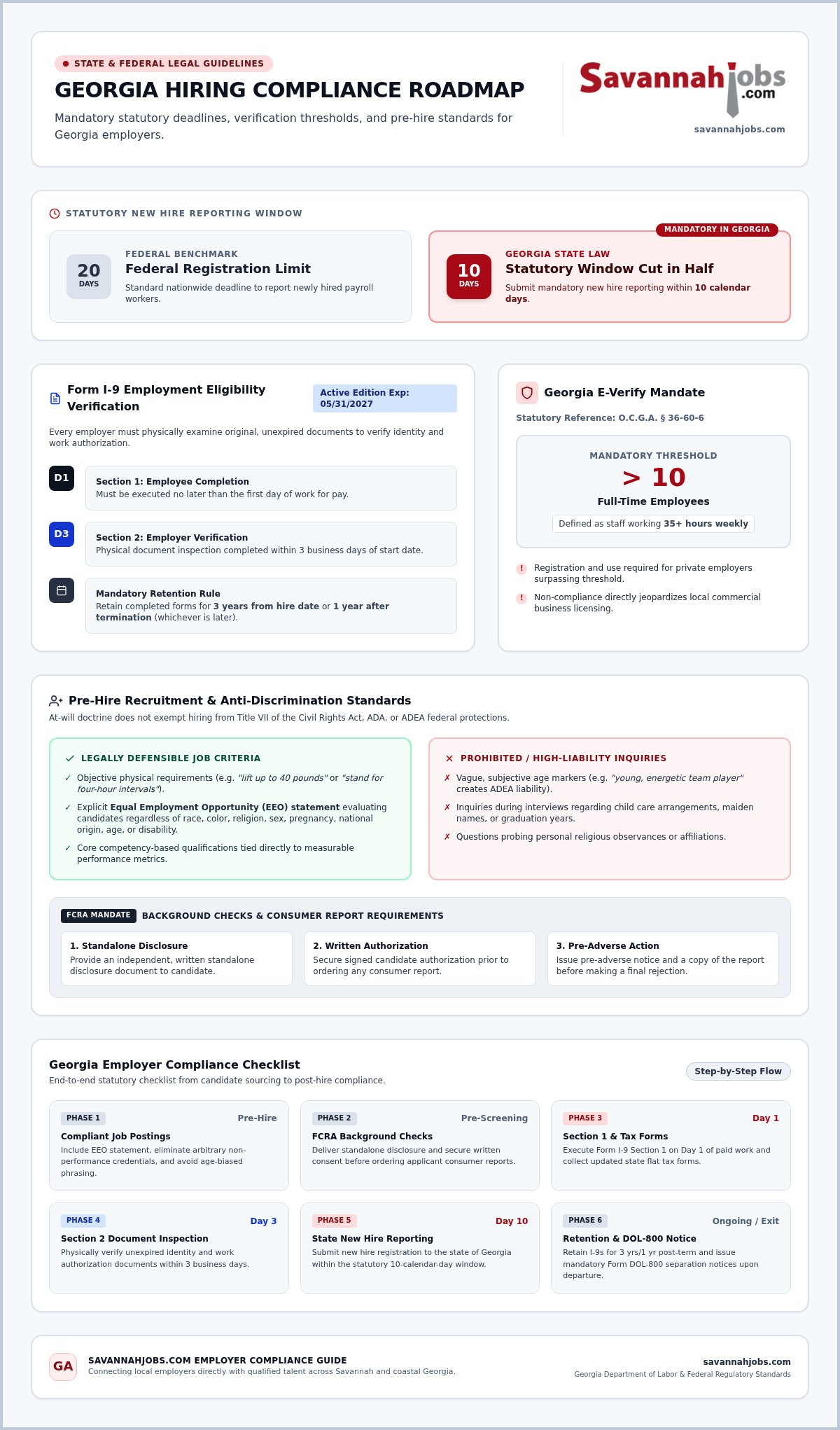
While federal regulations give employers 20 days to register a new hire, Georgia law cuts that statutory window in half to just 10 calendar days. Overlooking a single reporting deadline or missing an E-Verify filing can trigger steep administrative fines and even jeopardize your local business license. Mastering the legal requirements for hiring in Georgia is essential before you publish an open position and bring new workers onto your payroll.
We know how stressful it is to juggle federal wage standards alongside Georgia Department of Labor mandates. Sorting through at-will employment boundaries, state flat tax updates, and workers' compensation thresholds shouldn't derail your business operations. You can protect your organization from compliance penalties while keeping your recruitment timeline swift and competitive. This 2026 employer checklist delivers an actionable, step-by-step roadmap to hiring compliance, showing you exactly how to satisfy state and federal rules from initial candidate screening through Day 1 onboarding.
Key Takeaways
- Draft compliant, non-discriminatory job descriptions that protect your organization against recruitment liability before posting open roles.
- Comply with Georgia E-Verify employee headcount thresholds and federal Form I-9 verification rules to safeguard your local business licensing.
- Meet the legal requirements for hiring in Georgia by submitting mandatory new hire reports within 10 calendar days and collecting updated state tax forms.
- Clarify minimum wage rules, post-vacatur federal overtime exemption thresholds, and mandatory Form DOL-800 separation notices under state law.
- Implement a structured onboarding checklist that satisfies Georgia Department of Labor mandates from Day 1 through long-term records retention.
Pre-Hire Compliance: Georgia Anti-Discrimination and Compliant Job Posting Rules
Hiring liabilities often surface long before an applicant ever walks into an interview room. For employers across the state, managing the legal requirements for hiring in Georgia starts at the recruitment drafting table. While the state's traditional at-will employment doctrine offers broad discretion in organizational staffing, it does not exempt your business from federal anti-discrimination mandates. Federal Title VII of the Civil Rights Act, the Americans with Disabilities Act (ADA), and the Age Discrimination in Employment Act (ADEA) strictly govern how you market vacancies and evaluate applicants.
Drafting Compliant Job Descriptions and Advertisements
Every job description you publish serves as an initial legal record of role requirements. Focus strictly on essential business functions and objective, measurable physical criteria instead of vague preferences. For instance, requiring an applicant to "lift up to 40 pounds" or "stand for four-hour intervals" is legally defensible when relevant to warehouse operations, while requesting a "young, energetic team player" creates immediate age discrimination liability under federal law.
To keep recruitment marketing compliant across coastal Georgia communities, apply these listing rules:
- Feature an explicit Equal Employment Opportunity (EEO) statement: Affirm that your organization evaluates qualified candidates regardless of race, color, religion, sex, pregnancy, national origin, age, or disability.
- Audit role qualifications: Eliminate arbitrary educational thresholds or legacy credentials that do not directly tie to performance metrics.
- Broaden public outreach: Avoid sourcing exclusively through closed, informal networks that may inadvertently restrict protected demographic groups. SavannahJobs.com provides compliant digital reach across Savannah and coastal Georgia, connecting local employers directly with a diverse talent pool.
Lawful Interview Questions vs. Prohibited Candidate Inquiries
Screening conversations must center on core competencies, professional track records, and operational availability. Many managers stumble by using casual conversational rapport to uncover personal details. Inquiring about child care arrangements, maiden names, religious observances, or graduation years risks severe regulatory scrutiny if an unselected candidate files an Equal Employment Opportunity Commission (EEOC) complaint.
Aligning with the legal requirements for hiring in Georgia also demands disciplined background checks. Under the Fair Credit Reporting Act (FCRA), you must provide a standalone written disclosure and secure written authorization before requesting an applicant's consumer report. If an adverse finding leads you to reject a candidate, issue pre-adverse action paperwork alongside a copy of their report before making a final determination.
Verifying Work Eligibility: Georgia E-Verify Mandates and Form I-9 Rules
Confirming legal employment eligibility represents a non-negotiable step in your onboarding sequence. Federal regulations hold every business accountable for verifying identity, but state statutes add distinct local enforcement mechanisms. Meeting the legal requirements for hiring in Georgia means synchronizing standard federal paperwork with strict municipal licensing rules before a new hire completes their first week.
Executing the Form I-9 Process Accurately
Federal law requires every employer to execute Form I-9 for each new hire. Start by ensuring the employee completes Section 1 no later than their first day of work for pay. Employers must ensure they use the active Form I-9 edition displaying the 05/31/2027 expiration date, as previous editions have expired.
Next, physically examine original, unexpired candidate documents to confirm identity and work authorization. Complete Section 2 within three business days of the employee's start date. Keep these records organized and readily accessible; federal rules require retaining completed I-9 forms for three years following the date of hire or one year after termination, whichever is later.
Georgia E-Verify Compliance Thresholds for Employers
Georgia connects immigration verification directly to your commercial operating authority. Under O.C.G.A. § 36-60-6, private employers with more than 10 full-time employees, defined as staff working 35 or more hours weekly, must register with and utilize the federal E-Verify system. If you employ 10 or fewer workers, you aren't mandated to run queries, but you must submit a signed, notarized affidavit certifying your exemption when applying for or renewing your annual city business license or county occupational tax certificate.
For covered employers, run newly hired personnel through E-Verify within three business days of their official start date. Tracking these statutory timelines alongside the broader Georgia Department of Labor employment laws and rules keeps your business fully protected during municipal audits. Once your administrative workflows are established, you can focus on building your team. When you're ready to expand your staff, post an open role on SavannahJobs.com to connect quickly with qualified talent across coastal Georgia.
Georgia New Hire Reporting and Mandatory Tax Documentation Requirements
Bringing a worker onto your payroll triggers immediate administrative obligations with state and federal agencies. While setting up benefits and workspace logistics takes focus, submitting tax withholding and new hire records accurately protects your business from administrative fines. Fulfilling these legal requirements for hiring in Georgia ensures smooth wage processing while keeping your business fully compliant with state registry operations.
Georgia New Hire Reporting Protocol
Under O.C.G.A. § 19-11-9.2, Georgia employers must report every newly hired and rehired employee to the Georgia New Hire Reporting Center within 10 calendar days of their official start date. While federal PRWORA guidelines permit a 20-day window, Georgia enforces this tighter 10-day standard to support child support enforcement and reduce fraudulent unemployment claims.
You can submit reports electronically through the state's online reporting portal, or transmit copies of the employee's Form W-4 by mail or fax. Each filing must contain seven core data elements:
- Employee details: Full legal name, current residential address, Social Security number, and first day of work for pay.
- Employer details: Federal Employer Identification Number (FEIN), legal business name, and payroll registered address.
Pairing these registry submissions with federal E-Verify requirements ensures that work authorization and payroll reporting move forward in tandem without administrative delays.
Collecting Federal and State Withholding Documentation
Every newly onboarded team member must complete standard withholding certificates before receiving their first paycheck. Have workers submit federal Form W-4 to calibrate federal income tax deductions according to their personal filing status. You cannot estimate these allowances on an employee's behalf; workers must declare their own withholding selections.
State compliance requires collecting Georgia Form G-4 alongside federal documentation. Following recent legislative tax reforms, Georgia operates on a flat individual income tax rate of 5.19%. The G-4 determines exact state tax deductions, standard deductions, and personal allowances under current Georgia Department of Revenue withholding formulas. Employers must also monitor Georgia's State Unemployment Insurance (SUI) wage base, which caps at $9,500 per worker annually.
Maintain digital copies of all withholding certificates and reporting confirmations in secure, encrypted payroll files. Retaining these records safeguards your organization during routine Department of Revenue reviews and keeps payroll processing airtight across every operational cycle.
Wage Laws, Overtime, and At-Will Employment in Georgia
Structuring employee compensation requires a clear understanding of where state statutes end and federal regulations take precedence. While Georgia law provides an employer-friendly framework, cutting corners on pay schedules or job classifications creates immediate wage-and-hour exposure. Complying with the legal requirements for hiring in Georgia means aligning your baseline compensation structures with federal Fair Labor Standards Act (FLSA) standards from the start.
FLSA Wage and Overtime Obligations for Georgia Employers
Under O.C.G.A. § 34-4-3, Georgia's statutory minimum wage sits at $5.15 per hour. However, the federal FLSA baseline rate of $7.25 per hour preempts state law for almost all commercial enterprises. Tipped employees may receive a cash wage of $2.13 per hour, provided combined tips and direct pay equal at least $7.25 per hour.
Following the November 2024 federal court vacatur of the U.S. Department of Labor's 2024 overtime rule, the federal executive, administrative, and professional (EAP) salary threshold reverted to $684 per week, or $35,568 annually. Any salaried staff paid below this line, or those who fail the FLSA duties tests, remain non-exempt and must receive one and a half times their regular rate for hours worked beyond 40 in a single workweek.
Keep these operational compensation rules in mind:
- Pay frequency: Under O.C.G.A. § 34-7-2, Georgia requires paying employees at least semi-monthly, though salaried executive or administrative staff can be paid monthly.
- Break periods: Georgia law doesn't mandate meal intervals or rest breaks. However, under O.C.G.A. § 34-1-6, employers must provide paid lactation breaks at the worker's regular pay rate.
- Final wages: Georgia imposes no requirement for immediate final payouts; separated workers must receive their earnings by the next regular payday.
Understanding Georgia At-Will Employment Protections and Limits
Georgia operates strictly as an at-will employment state under O.C.G.A. § 34-7-1. This means either party can terminate the relationship at any time, for any reason, or for no reason at all, provided the dismissal does not violate federal discrimination laws or statutory public policy. State law also requires employers to issue Form DOL-800, the mandatory Separation Notice, to every departing employee, whether they quit voluntarily or were fired.
Spell out at-will expectations clearly in written offer letters and onboarding packets. Maintaining consistent, objective performance logs is your strongest defense against unlawful termination claims under the legal requirements for hiring in Georgia. When expanding your organization, advertise your open positions on SavannahJobs.com to secure dependable talent while maintaining fully compliant hiring practices across the region.
The Georgia Employer Onboarding Checklist: Putting Legal Rules into Action
Translating statutory mandates into everyday office procedures protects your bottom line. When onboarding staff, maintaining a clear sequence prevents missed deadlines and administrative headaches. Organizing the legal requirements for hiring in Georgia into a dependable workflow ensures your leadership team stays compliant from recruitment through an employee's first month on the job.
Mandatory Workplace Posters and Insurance Coverage
Compliance extends directly to your physical and virtual workspaces. Before new personnel walk through your doors, display mandatory state and federal notices in high-traffic staff areas like break rooms or company intranets. Essential postings include Georgia Department of Labor unemployment insurance notices, equal opportunity summaries, and federal wage standards.
Insurance coverage requires prompt attention as your team grows. Under O.C.G.A. § 34-9-2, any employer regularly employing three or more workers must carry workers' compensation coverage. This rule applies to full-time, part-time, and seasonal staff. In addition, you must conspicuously post the Georgia State Board of Workers' Compensation Panel of Physicians (Form WC-P1 or WC-P3). Pair this coverage with clear facility safety manuals and injury reporting workflows that adhere to federal OSHA guidelines.
Deploying Compliant Local Hiring Strategies in Coastal Georgia
A well-structured onboarding pipeline coordinates statutory filings with practical recruitment management. Organize your checklist into these chronological checkpoints:
- Pre-Hire: Publish job descriptions focused strictly on essential duties. Keep interview notes free from protected demographic references.
- Day 1: Have the employee complete Section 1 of Form I-9. Collect federal Form W-4 and Georgia Form G-4 withholding certificates.
- Day 3: Physically verify original candidate identification documents to finalize Form I-9 Section 2. Process work authorization through E-Verify if your organization employs more than 10 full-time staff.
- Day 10: Submit the mandatory reporting file to the Georgia New Hire Reporting Center to meet the statutory deadline.
- Day 30: Confirm the employee received their at-will policy acknowledgment, safety handbooks, and mandatory separation notice guidelines.
Sourcing qualified candidates while adhering to the legal requirements for hiring in Georgia doesn't have to slow down your recruitment cycle. Backed by the Savannah Morning News, SavannahJobs.com connects your organization with motivated job seekers across coastal Georgia through compliant, self-service recruitment options that keep your hiring fast, local, and legally sound.
Take Command of Your Georgia Hiring Workflow
Protecting your organization from administrative fines starts with a clear, disciplined onboarding plan. By auditing your job postings for non-discriminatory language, verifying work eligibility through Form I-9 and E-Verify, and submitting new hire reports within Georgia's strict 10-day window, you position your business for sustainable success. Mastering the legal requirements for hiring in Georgia safeguards your bottom line and builds trust with every incoming employee.
When you're ready to fill an open role, streamline your search with a dependable local partner. Powered by the legacy of the Savannah Morning News, serving regional employers since 1850, and backed by the USA Today Network, our platform provides self-service recruitment advertising designed specifically for Savannah area employers. Connect with qualified local talent on SavannahJobs.com today and recruit your next team member quickly, effectively, and with total compliance confidence.
Frequently Asked Questions
Is E-Verify mandatory for all private employers operating in Georgia?
E-Verify is not mandatory for every private employer. Under O.C.G.A. § 36-60-6, registration and participation are required only for private businesses with more than 10 full-time employees working 35 or more hours per week. Smaller businesses with 10 or fewer staff must instead submit a signed, notarized affidavit confirming their exemption when renewing their local business license or occupational tax certificate in Savannah or other Georgia municipalities.
Can an employer in Georgia terminate an employee without providing advance notice?
Yes, Georgia is an at-will employment state under O.C.G.A. § 34-7-1, meaning employers can discharge an employee without advance notice or cause. However, terminations cannot violate federal anti-discrimination protections or contractual terms. Additionally, Georgia employers must provide a completed Form DOL-800 Separation Notice to every departing worker, regardless of whether the separation was voluntary or involuntary, to remain aligned with the legal requirements for hiring in Georgia.
What happens if a business misses the 20-day Georgia new hire reporting deadline?
While federal law allows a 20-day window, Georgia law is stricter. Under O.C.G.A. § 19-11-9.2, you must report newly hired or recalled workers within 10 calendar days. Missing this statutory deadline can lead to state compliance notices and financial penalties. Late reporting also disrupts state child support wage garnishments and exposes your organization to administrative scrutiny during routine Georgia Department of Labor records reviews.
How much does Georgia state law mandate for hourly minimum wage rates?
Georgia's statutory minimum wage is $5.15 per hour under O.C.G.A. § 34-4-3. However, federal Fair Labor Standards Act provisions preempt state law for almost every commercial enterprise, setting the effective rate at $7.25 per hour. Employers must pay the federal rate unless specifically exempt. Tipped staff must receive at least $2.13 per hour in direct cash wages, provided total tips lift their hourly pay to $7.25.
Is workers compensation insurance legally required for every small business in Georgia?
Coverage is not required for solo operators, but it becomes mandatory once you regularly employ three or more individuals under O.C.G.A. § 34-9-2. This employee count includes full-time, part-time, and seasonal workers, as well as corporate officers unless exempt via Form WC-10. Navigating this threshold is one of the essential legal requirements for hiring in Georgia, alongside conspicuously displaying the state-approved Panel of Physicians.
What posters must Georgia employers physically display in the workplace?
Georgia employers must display several state and federal notices in high-traffic staff spaces. At the state level, you must post the Georgia Department of Labor Unemployment Insurance poster, the Equal Pay Act notice, and the State Board of Workers' Compensation Panel of Physicians. Federal requirements include postings for the Fair Labor Standards Act, OSHA Job Safety, Equal Employment Opportunity, and the Family and Medical Leave Act for eligible firms.
Can an employer in Georgia conduct criminal background checks on job applicants?
Yes, private employers in Georgia can conduct criminal background checks at any stage of recruitment. Georgia has no private-sector "Ban the Box" laws, though public state agencies follow restrictions. When running consumer background checks, private employers must strictly comply with the federal Fair Credit Reporting Act. This requires obtaining standalone written candidate authorization and issuing proper pre-adverse action notifications if background findings factor into an adverse hiring decision.


