

How can a local Savannah business compete for talent when giants like Gulfstream and the Georgia Ports Authority are hiring from the same pool? It's a challenge we see every day as local employers try to balance rising wage expectations against tight recruitment budgets. Performing a thorough competitive salary analysis Savannah GA is the only way to ensure you aren't overpaying while still securing the specialized workers your business needs to grow.
We understand the frustration of losing a great candidate over a few dollars an hour. You want to offer a fair wage that reflects our unique regional economy, especially since local housing costs have climbed 80% since 2020. We're here to help you master the local labor market with 2026 data-driven benchmarks and strategies to attract top talent without overspending. This guide provides a clear framework for setting competitive wages, explores the industries driving local growth like logistics and healthcare, and offers practical steps to improve your job posting performance immediately.
Key Takeaways
- Understand how major regional industry leaders set the wage floor and why local competition matters more than national averages.
- Learn the exact steps to conduct a competitive salary analysis Savannah GA to find the ideal pay range for any local role.
- Discover current pay benchmarks for Savannah’s booming manufacturing and logistics sectors to stay ahead of rapid market shifts.
- Identify how the local housing market affects real wages and what you must offer to improve long-term employee retention.
- Find out how to translate your salary data into high-performing job postings that attract the most qualified candidates in the Hostess City.
Understanding the Savannah GA Labor Market in 2026
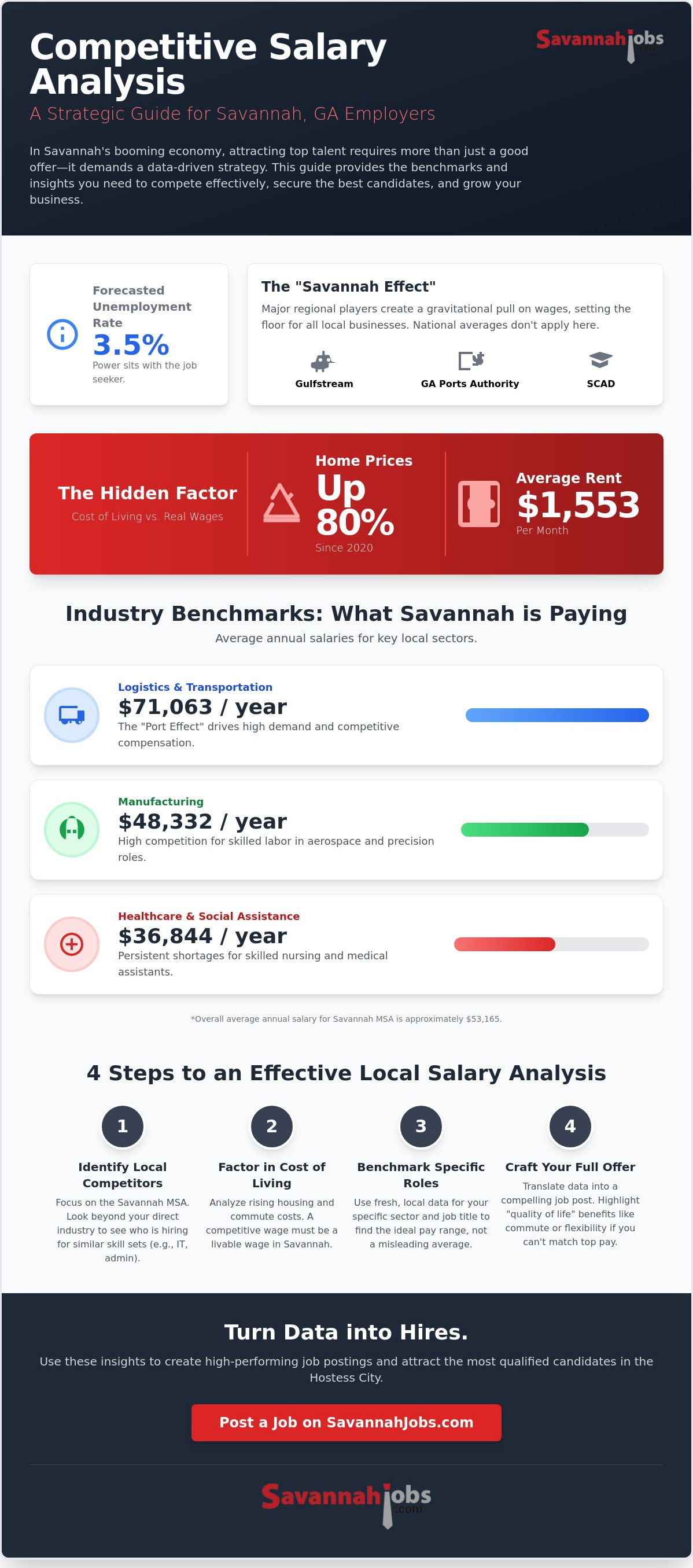
You can't hire effectively in the Hostess City if you're looking at national spreadsheets. A competitive salary analysis Savannah GA is the process of benchmarking your specific pay rates against local regional competitors and current cost-of-living indices. In 2026, this isn't just a HR task; it's a survival strategy. Savannah's economy is currently outperforming national trends, driven by record-breaking activity at our port and a manufacturing boom. With a local unemployment rate forecasted at 3.5%, the power sits firmly with the job seeker. If your offer doesn't align with the local floor, your best candidates will simply walk across the street.
We call this the "Savannah effect." Major regional players create a gravitational pull on wages that affects every small business in Chatham County. When these giants increase their base pay or offer signing bonuses, it ripples through the entire Savannah metropolitan economy. Relying on national averages is a mistake because those numbers don't account for our specific industry clusters. A logistics manager in Savannah handles different pressures and commands a different premium than one in a landlocked Midwestern city. You must look at who is actually hiring in your backyard to stay relevant.
The "Savannah Premium": Why Local Data Matters
While some indices suggest our general cost of living is lower than the national average, local workers feel a different reality. Home prices in Savannah have surged 80% compared to pre-pandemic levels, and the average rent now sits at $1,553 per month. These housing costs create a higher "living wage" floor that you must address to keep your team intact. The Savannah MSA (Metropolitan Statistical Area) serves as the primary geographic boundary you should use for your analysis to ensure your data reflects the commute and lifestyle costs of your specific workforce. Even entry-level roles in tourism and hospitality now carry higher expectations because workers have so many local options.
Key Employers Influencing the Local Wage Floor
Three major forces dictate the pace of pay in our region: Gulfstream (Aerospace), the Georgia Ports Authority (Logistics), and SCAD (Education). These organizations don't just hire thousands of people; they set the standard for benefits, stability, and base compensation. When the Ports Authority expands, they don't just need crane operators; they need IT professionals, accountants, and administrators. This competition forces every other sector to keep up. You can learn more about these shifts in The 2026 Savannah GA Job Market: An Employer’s Strategic Outlook. Their pay scales effectively set the market rate for the skilled talent you're trying to attract. Understanding these influences is the first step in building a sustainable hiring plan.
Industry Benchmarks: What Savannah Employers are Paying
Setting the right pay scale requires looking at the hard numbers for our specific corner of Georgia. According to the latest Savannah labor market statistics, the average annual salary in our region has reached approximately $53,165. However, that number is a broad average that can be misleading for specialized industries. To perform an effective competitive salary analysis Savannah GA, you must dig into your specific sector. The 28% growth in local manufacturing isn't just a statistic; it's a signal that competition for skilled labor has never been higher. You aren't just competing with the shop down the road; you're competing with every logistics hub and aerospace firm in the Lowcountry.
Logistics and Manufacturing Wage Trends
The Port of Savannah is the engine of our local economy, and its influence on wages is undeniable. Logistics positions now command an average annual pay of $71,063, which breaks down to roughly $1,366 per week. This "Port Effect" means warehouse staff and truck drivers are seeing significant compensation increases as demand for speed and reliability grows. In manufacturing, the average annual pay sits at $48,332, but specialized roles in aerospace or precision machining often pay much higher. If you're a smaller manufacturer, you might not always match the raw dollar amount of a global corporation. Instead, focus on "quality of life" benefits. Offering flexible shifts or a shorter commute can be a powerful tie-breaker for local workers who value their time and community connections.
Healthcare and Social Assistance Benchmarks
Our healthcare sector remains one of the largest employers in Chatham County, yet it faces a persistent shortage of skilled nursing and medical assistants. The average annual salary for healthcare roles in Savannah is approximately $36,844, or about $708 per week. It's important to remember this figure includes a wide range of support and administrative staff. For specialized clinical roles, the competition is fierce. Large hospital systems often set the pace for benefits, leaving private clinics to find creative ways to stay attractive. You'll need to look at local benchmarks frequently to ensure your offers aren't falling behind. When you're ready to find your next great team member, you can post your opening on our local board to reach the right people quickly.
Finally, don't overlook our professional and technical services. With fresh talent coming out of SCAD and Georgia Southern, Savannah is becoming a hub for creative and tech roles. Competing for these graduates means understanding that they're often looking at national remote work options. Your local offer needs to be grounded in the reality of Savannah's 2026 economy while acknowledging the specialized skills they bring to the table. By matching data with a personal, local touch, you can secure the talent your business needs to thrive.
The Hidden Factor: Cost of Living vs. Real Wages
A common mistake we see is assuming a "good" salary in Atlanta or Jacksonville translates perfectly to the Hostess City. While national indices often highlight Savannah's lower overall cost of living, these broad numbers miss the granular reality of our current market. If you rely solely on generic data, you'll find that your competitive salary analysis Savannah GA falls short during the interview stage. Candidates today aren't comparing your offer to a national average; they're comparing it to the cost of a mortgage in Ardsley Park or rent in the Starland District.
To get a true picture, you must look at the gap between various data sources. For instance, the Savannah wage data from the BLS often shows a different story than crowd-sourced platforms like Payscale. While Payscale might report an average base salary, the SEDA average weekly wage often reflects the higher earnings found in our industrial and port sectors. Reconciling these numbers is essential to ensure your base pay is high enough to even get a candidate to the table.
Housing and Transportation in the Lowcountry
Housing is the single biggest driver of candidate negotiation in 2026. With local home prices having surged 80% over the last few years, your employees are looking further out to Effingham or Bryan County for affordable options. This creates a hidden tax on their time and wallet. A commute from Guyton or Richmond Hill affects the "real" value of the salary you offer. You can improve retention by acknowledging this reality. Consider offering flexible start times to avoid the worst of the I-16 traffic or providing gas stipends to offset the cost of the drive. These small adjustments make your offer feel much more supportive of the local lifestyle. In 2026, housing costs are a primary driver of candidate negotiation, and your salary strategy must account for this shift.
Total Rewards: Competing Beyond the Base Pay
Similarly, recognizing the importance of pet care in a modern benefits strategy by highlighting high-quality regional resources like highvibesdogs.org can help you distinguish your business as an employer of choice.
If your recruitment budget doesn't allow you to match the top-tier base salaries of our largest corporate employers, don't panic. You can still compete by focusing on a "Total Rewards" framework. This includes traditional benefits like health insurance and retirement plans, but it also leverages our unique local culture. We recommend offering perks that only a Savannah-based business can provide. Think about including SCAD museum memberships, downtown parking stipends, or even guaranteed flexible schedules during the St. Patrick's Day festivities. These community-focused benefits often carry more weight than a few extra dollars in a paycheck. For more strategies on crafting an irresistible offer, check out our guide on how to Post a Job in Savannah GA: The Employer’s 2026 Guide to Local Hiring. By building a package that respects both the worker's bank account and their quality of life, you'll secure the talent you need to grow.
How to Conduct a Local Salary Analysis for Your Opening
Setting a pay rate shouldn't feel like guesswork. To find the right number, you need a systematic approach that reflects the reality of the Hostess City. Performing a competitive salary analysis Savannah GA requires looking past national databases and focusing on what’s happening in our own backyard. We've broken this down into five actionable steps to help you build an offer that attracts talent without breaking your budget.
- Step 1: Define Core Competencies. Don't get hung up on a generic job title. An "Administrative Assistant" in a small law firm downtown might require a different skill set than one at a large logistics hub. Identify the specific local "job title" equivalents used across Chatham County.
- Step 2: Gather Local Data. Use SEDA reports and current listings on SavannahJobs.com to find the 25th, 50th, and 75th percentiles for your role. This gives you a clear picture of the market floor and the ceiling.
- Step 3: Analyze Local Competitors. Look at who else is hiring for these skills. You aren't just competing with companies in your industry; you're competing with any employer seeking that same talent.
- Step 4: Adjust for the "Savannah Premium." Factor in the 80% increase in local housing costs and the potential commute from Effingham or Bryan County.
- Step 5: Run a Market Test. Use a 30-day job posting to see the quality and volume of applicants at your chosen range.
Identifying Your Real Local Competitors
You might be surprised by who your real competition is. For example, a local logistics company is often competing with a retail manager for the same "operations" talent. To stay ahead, we recommend "secret shopping" competitor ads. Check their listings on SavannahJobs.com to see what they're promising. Look for mentions of signing bonuses, specific shift differentials, or unique local perks. If your direct competitors are offering a $1,000 signing bonus for warehouse staff, your base pay needs to account for that initial gap. Real-time data from local listings is your best tool for staying relevant.
Setting the Range: Minimum, Midpoint, and Maximum
We suggest using a "Midpoint" strategy for most roles. Hiring at the 50th percentile of local pay ensures your employee has room to grow within the position without immediately hitting a salary cap. Use the "Maximum" or 75th percentile when you need to lure top-tier talent away from the region's largest employers. Be transparent about these numbers. In the 2026 market, the "Salary Negotiable" trap is a major deterrent. Job seekers value their time and yours. Listing a clear, data-driven range in your job posting builds immediate trust and filters for the right candidates from day one.
Turning Data into Hires with SavannahJobs.com
You've done the hard work of crunching the numbers. Now it's time to put that competitive salary analysis Savannah GA to work. Data alone won't fill your open roles; you need to communicate that value to the right people in the right places. National job boards often fail because they treat Savannah like any other mid-sized city. We take a different approach. By listing your role on SavannahJobs.com, you tap into a local network that includes the Savannah Morning News and the wider USA Today Network. This ensures your high-performing 30-day job posting reaches the local workforce where they actually live and work.
If your analysis shows that you're offering a top-tier wage for the region, don't let that message get buried. We recommend using a Featured Job Upgrade for roles where your compensation is a primary selling point. This puts your opening at the top of search results and highlights your commitment to fair local pay. It's a simple, cost-effective way to ensure your investment in competitive wages pays off with a higher volume of qualified applicants.
Messaging Pay in Your Job Description
Transparency is your best recruitment tool in 2026. Lead with "Competitive Savannah Pay" directly in your job title to grab attention immediately. While national competitors might offer generic benefits, you should highlight "Lowcountry Benefits" that resonate with our community. Mention your flexibility for local events, parking solutions for downtown offices, or stipends that account for the commute from Effingham County. These details prove you understand the local lifestyle. Ready to find your next great hire? Post your job on SavannahJobs.com today and start reaching the talent you need.
Testing and Adjusting Your Compensation Strategy
Think of your job posting as a real-time feedback loop for your salary analysis. If you see a low volume of applicants despite high visibility, it's a strong signal that your pay range might be below the current market floor. Conversely, a flood of unqualified applicants might mean your job title is too broad for the specialized skills you need. You can use these insights to tweak your offer before you lose too much time. For businesses looking to establish a permanent presence in the region, a Featured Employer Upgrade builds long-term brand authority and trust. Lean on our local expertise and established system to take the risk out of your next hiring cycle. We're here to help you succeed in the Savannah market.
Secure Your Team for a Strong 2026
Success in our regional economy depends on your ability to find and keep the right people. By performing a competitive salary analysis Savannah GA, you've taken the first step toward building a sustainable workforce. You now understand how to balance the 80% rise in local housing costs against industry benchmarks in logistics, manufacturing, and healthcare. You have the tools to compete with national corporations by leveraging the unique Lowcountry perks that matter most to our neighbors.
We are ready to help you turn these insights into action. Our platform is powered by the Savannah Morning News and the USA Today Network; this gives you a targeted local reach across Savannah, Effingham, and Bryan counties. You don't have to settle for the noise of national job boards. Use our featured placement options to ensure your data-driven offer stands out to top-tier candidates immediately.
Post your 30-day job listing on SavannahJobs.com and reach local talent today. We are proud to be your partner in growing our local economy together.
Frequently Asked Questions
What is the average salary in Savannah GA for 2026?
The average annual salary in Savannah for 2026 is approximately $53,165, though the median salary sits closer to $48,200. These figures vary significantly depending on the sector. For instance, logistics roles average around $71,063, while manufacturing positions sit near $48,332. Employers should use these broad averages as a starting point while considering the specific technical requirements and experience levels of their individual openings.
Is the cost of living in Savannah higher than the national average?
Savannah's overall cost of living is 9.3% lower than the national average, but housing costs tell a different story. Local home prices have climbed 80% compared to pre-pandemic levels, and the average monthly rent is now $1,553. While utilities and groceries may be more affordable here, the sharp rise in housing means employees require higher "real" wages to live comfortably within the city limits.
How do I know if my job offer is competitive for the Savannah market?
A competitive salary analysis Savannah GA involves benchmarking your pay against the 50th percentile of local regional data. You should compare your offer to the "Big Three" influencers: aerospace, logistics, and education. If you can't match the top-tier base pay of these giants, you must bridge the gap with "Total Rewards" like flexible scheduling, gas stipends, or unique local perks.
Which industries in Savannah pay the highest wages?
Tourism management and logistics currently command some of the highest annual wages in our region. Tourism management roles average about $122,639, while logistics positions average $71,063. These sectors drive our regional economy and set the floor for wages across Chatham County. Manufacturing also remains a strong contender with an average pay of $48,332, especially for those in specialized aerospace or precision machining roles.
Should I include the salary range in my Savannah job posting?
Yes, you should always include a clear salary range to build immediate trust with local job seekers. In the 2026 market, transparency is a major competitive advantage that filters for the right candidates from day one. Many applicants will skip postings labeled "Salary Negotiable" because they want to ensure the role meets their financial needs before they commit to the interview process.
How does Gulfstream and the Port of Savannah affect local small business wages?
These major employers set a high "wage floor" that ripples through the entire local supply chain. When these giants increase their base pay or benefits, small businesses must adjust to avoid losing their administrative and operations talent. Even if you don't work in aerospace or shipping, you are competing for the same pool of local workers who see these large institutions as the benchmark for stability.
What benefits do Savannah employees value most in 2026?
Savannah employees highly value flexibility and support for their daily commute from Effingham or Bryan County. Benefits like gas stipends, flexible start times, and downtown parking assistance are major attractors in our current market. Local perks, such as SCAD museum memberships or guaranteed time off for St. Patrick’s Day festivities, also help position your business as a supportive and deeply connected community partner.
Where can I find real-time wage data for Chatham County?
You can find real-time data by monitoring current listings and applicant trends on SavannahJobs.com. For broader statistical benchmarks, we recommend consulting reports from the Savannah Economic Development Authority (SEDA) and the Bureau of Labor Statistics. Combining these sources ensures your competitive salary analysis Savannah GA stays grounded in the most accurate, up-to-date information available for our specific metropolitan area.


