

A careers page can’t make a workplace culture believable if the employee experience tells a different story. To learn how to build an employer brand from scratch, start with what your people experience, shape that into clear and honest messages, then carry those messages through hiring and careers content.
You may already know that culture matters. The challenge is expressing it in a way candidates can understand without promising more than your workplace can deliver. A strong employer brand reflects your actual values, work environment, and opportunities, not just polished recruiting language.
This guide explains how to gather employee and candidate perspectives, plan the work, and align messages across the employment lifecycle. You’ll also learn to create useful careers content, including job descriptions and visual stories, that helps candidates picture working with your team.
Key Takeaways
- Build your employer brand around the culture employees actually experience, using their feedback to identify credible strengths.
- Give a solo employer-brand effort direction with a six-month roadmap that prioritizes work and sets clear expectations.
- Map consistent, honest messages across each stage of the employment lifecycle, from first awareness through hiring.
- Create useful careers content that helps candidates picture the work, the people, and the opportunities your workplace offers.
1. Aligning employer brand with workplace culture
An employer brand is how employees and job candidates perceive an organization as a place to work. It reflects the culture, values, leadership, policies, and growth opportunities people experience, not just recruitment marketing. Candidates use these signals to judge whether an employer fits their needs, while employees compare public promises with their day-to-day experience.
Start by listening to employees. Use confidential surveys, small-group conversations, and exit feedback to learn what people value about the culture and where their experience falls short. Ask about management, collaboration, learning, and flexibility. Compare their responses with candidate questions and feedback from recent hiring processes. For example, if employees describe supportive managers but candidates report unclear communication, address that gap before turning it into a brand message.
Practical employer-branding strategies in the United States include employee-led stories about real work, clear descriptions of development opportunities, and hiring communication that reflects stated values. For example, an organization that values learning can share how employees build skills and explain those opportunities in job descriptions. This connects a workplace promise with evidence candidates can assess.
Next, align HR leaders and stakeholders around a focused value proposition. Bring recruiting, communications, and business leaders together to agree on the talent the organization needs, the values it can demonstrate, and the evidence behind each claim. Leadership support matters because managers shape the employee experience and must back the time, budget, and people needed to deliver the work.
Finally, connect internal and external branding. If your marketing describes teamwork, onboarding and management practices should reinforce it. For small to mid-sized organizations refining this balance, partnering with an outsourced branding team like Marketing Angels can help shape a cohesive external identity that rings true to your workplace. Treat culture as the foundation, then review messages against employee feedback and workplace actions before publishing. This check helps your organization present a consistent, credible picture to current staff and future hires.
2. Creating a six-month roadmap for a solo employer-brand team
A solo lead needs a strategy that makes priorities clear and protects time for delivery. A six-month roadmap can sequence research, message development, content production, and review without making every request urgent. Set a practical outcome for each phase, such as approving a unified brand vision before creating new recruiting materials.
Start by defining the decisions your strategy must guide: which talent to attract, what the organization offers, and what evidence supports its claims. Assign a stakeholder to approve messages and identify who can provide employee stories or review job content. This helps a one-person team keep moving without turning every department into a separate project.
Make your tagline specific to the workplace, not just polished. If employees value hands-on learning, for example, a message about building skills through real work is more credible than a generic claim about innovation. Test the wording with employees and hiring managers before using it in recruiting materials.
Creative content can show culture in a straightforward way. A short employee Q&A, a day-in-the-life post, or a lighthearted team introduction can make social media feel human. Use real work and voluntary participation as your source material. Entertaining content should clarify the experience, not distract from it.
Build a multi-channel communication plan around a shared message. Map content to your careers site, job descriptions, social media, and hiring communications. Reuse core ideas, but adapt the format for each channel. Review candidate questions and application activity to see which messages help people understand the role.
Keep legal and ethical risks in view. Recruitment marketing can damage your reputation through misleading claims, exclusionary language, or employee stories shared without permission. Use accurate role details, inclusive wording, and clear consent for personal stories or images.
For Savannah-area hiring, local job advertising can complement a consistent employer-brand strategy.
3. Building a message map across the employment lifecycle
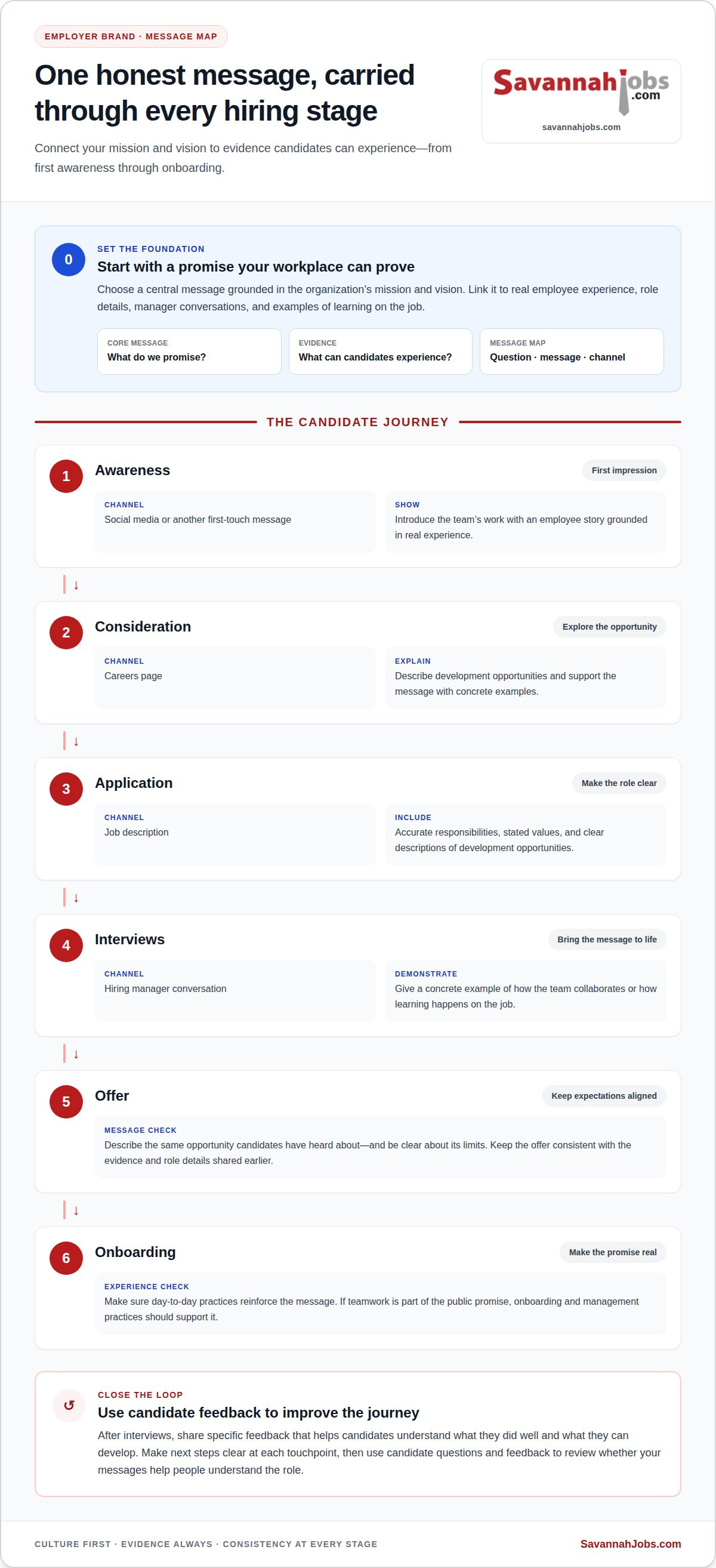
A message map keeps employer-brand messaging consistent from a candidate’s first impression through onboarding. Start with the organization’s mission and vision, then connect each central promise to evidence candidates can experience. For teams learning how to build an employer brand from scratch, this map turns broad values into useful messages at each stage. For example, if the central message is “growth through meaningful work,” support it with role details, manager conversations, and examples of learning on the job.
Map the candidate journey into practical stages: awareness, consideration, application, interviews, offer, and onboarding. At each stage, record the candidate’s question, the message that answers it, and the channel that delivers it. A social media post might introduce a team’s work; a job description should explain responsibilities; an interview should show how the team collaborates.
Keep your language authentic by grounding stories in employee experience. Ask a staff member to describe a project, a challenge, and what they learned. Use those insights to create a short story, then confirm the details with the employee and relevant manager. Don’t turn one person’s example into a promise about every role or team.
Consistency doesn’t mean copying the same text everywhere. Adapt the format while preserving the core message and facts. A careers page can explain a development program, while a hiring manager gives candidates a concrete example of how it works. Both touchpoints should describe the same opportunity and its limits.
Close the loop with candidate feedback. After interviews, share specific feedback that helps candidates understand what they did well and what they can develop. Clear next steps at each touchpoint also reduce uncertainty and show respect for candidates’ time.
Review the map with recruiting, communications, and hiring managers before launch. Then compare candidate questions and engagement across channels with your original messages. If candidates repeatedly misunderstand a role, revise the relevant job description or interview explanation. This makes the map a working tool, not a one-time document, and gives your team a practical foundation for building an employer brand from scratch.
4. Building a careers website and content library
Your careers site should help candidates understand the organization before applying. Clearly present the mission, explain the work and workforce, and make open roles easy to find. A candidate exploring a nursing role, for example, needs more than a broad statement about success. Show the team’s work, the role’s responsibilities, and how the job supports the organization’s mission.
Build your content library around the questions candidates ask during hiring. Organize useful material by role, workplace, and career stage, then connect each resource to relevant vacancies. Keyword research can reveal topics target candidates discuss, such as training, schedules, or team responsibilities. Use those insights to create practical pages that answer real questions instead of filling the site with general slogans.
Use images and videos to show daily operations, employee achievements, and the work environment. Organizations looking to turn complex workplace stories into compelling video assets often collaborate with specialized agencies like VISIOLAB to ensure their message resonates. Choose visuals that represent actual teams and settings, and pair each with a concise explanation. A photo of a production floor, for example, becomes more useful when its caption describes the team’s responsibilities and how its work supports the organization’s goals.
Keep the library manageable. A business doesn’t need a 400-page brochure to tell its story. Start with core pages, such as the organization’s mission, team experience, career development, and hiring process. Review each page when roles or workplace practices change, so candidates don’t encounter outdated details. Clear navigation and readable job information help the site stand out through usefulness, not volume.
Make the site part of a positive candidate experience by matching its content to job descriptions and social channels. In a survey of the Class of 2024, 73% of students said they were more likely to apply after seeing employer content. Give each content item a purpose, such as explaining a role or showing the workplace, then track engagement and applications to guide future updates.
SavannahJobs.com: Featured Employer Upgrade
SavannahJobs.com offers a Featured Employer Upgrade to give your organization more visibility among local job seekers. It can complement a culture-led hiring strategy by helping candidates discover your organization alongside its open roles. Use it when your careers content and employer messages are ready to support the impression you want to make.
For a specific vacancy, a 30-Day Job Posting provides a way to advertise the role to the Savannah workforce, while a Featured Job Upgrade adds a visibility option for that listing. Choose the option that fits your immediate recruitment goal: promote an employer profile, advertise an opening, or give a job listing added visibility.
Keep the job details consistent with the culture and expectations described in your careers content. For local recruitment advertising, contact SavannahJobs.com.
Put your employer brand to work
The next step is to turn your culture into a consistent experience candidates recognize, from their first impression through the hiring process. Treat your employer brand as ongoing work: listen, make thoughtful updates, and keep public messages aligned with employees’ experience. That’s the practical foundation for building an employer brand from scratch without letting the message drift from the workplace.
Once your careers content is ready, make sure local job seekers can find your open roles. SavannahJobs.com offers a 30-Day Job Posting, Featured Job Upgrade, and Featured Employer Upgrade for employers advertising opportunities in the Savannah region. Choose the option that fits whether you’re promoting a vacancy or increasing visibility for your employer presence.
Take the next step at a pace that fits your hiring needs. Contact SavannahJobs.com today to discuss local job advertising. A clear, credible employer brand grows through steady action, and your next hiring effort can put it into practice.
Frequently Asked Questions
How do you define an employee value proposition (EVP) from scratch?
Define your EVP by identifying the distinct experience your organization offers employees and the evidence behind it. Gather input across roles, then group recurring themes such as meaningful work, team support, or opportunities to learn. For example, if employees value autonomy, identify specific ways teams make decisions independently. Keep the final statement grounded in what people can actually experience.
How do you research employee perceptions and competitor employer brands?
Combine employee interviews, anonymous feedback, candidate comments, and observations of workplace practices to understand your current reputation. Then review other employers’ public career pages, job descriptions, and social posts to see how they describe similar roles. Compare themes, not slogans. For a Savannah employer, consider whether local candidates can quickly understand what makes the work and employee experience distinctive.
Which employer branding channels and tools are most effective?
The most useful channels are those that reach your target candidates and answer their questions clearly. A careers page can explain the workplace, job ads can set role expectations, and social media can share employee perspectives. Use a simple content calendar and analytics to track which channels bring relevant visits and applications. Review results by role, since different talent groups may respond to different formats.
How should a company create an employer branding content strategy?
Start with candidate questions, then create an editorial plan linking each question to useful content. For example, a post about a role’s daily responsibilities can link to a detailed vacancy. Assign each item an owner, review date, and intended audience. This keeps materials current and helps recruiting teams reuse reliable content instead of drafting new copy for every opening.
How do you involve employees and leaders in employer branding?
Invite employees to contribute stories voluntarily, and make participation easy with short prompts or brief interviews. Let each person review how their comments will appear before publication. Leaders can support the effort by approving priorities, making time for contributors, and reinforcing the same workplace commitments in team decisions. In a Savannah organization, include perspectives from different roles and locations to avoid a one-team view.
What employer branding metrics and benchmarks should you track?
Track measures tied to your goals, such as career-page visits, job-ad engagement, completed applications, candidate feedback, and offer acceptance. Establish an internal baseline, then compare results across roles, channels, and hiring periods. Also monitor time to fill and recruiting costs, while recognizing that several factors can affect these outcomes. Review the measures together so increased traffic isn’t mistaken for stronger candidate fit.


