

What if your strongest hiring advantage isn’t a bigger salary, but a clearer path for the right candidate to say yes? Savannah employers know that attracting qualified people can be challenging, especially when larger organizations have name recognition and extensive benefits. If you’re searching “how to attract top talent in a competitive market Savannah,” start by making the role’s value clear and removing friction from the application process.
Candidates consider more than pay. Stability, commute, benefits, flexibility, and room to grow can all influence whether they apply. A vague job description or slow follow-up can make a promising applicant lose interest before you’ve had a conversation.
This guide lays out a practical Savannah hiring plan: identify what matters to the candidates you need, write a specific local job ad, communicate the full value of the role, and reach Savannah-area job seekers through suitable channels. It also explains how a 30-day job posting and optional Featured Job or Featured Employer upgrades on SavannahJobs.com can support your local recruitment advertising.
Key Takeaways
- Define top talent by the skills and outcomes each role requires, then tailor your hiring plan to the realities of that job.
- Show candidates the full value of the role, not just its salary, to compete for talent in Savannah.
- Compare pay, benefits, schedule, location, development, and stability to understand what may matter most to the candidates you need.
- Build a local outreach plan that matches channels to the role and includes clear, timely applicant follow-up.
- Use SavannahJobs.com as one local advertising channel, with a 30-day job posting and optional Featured Job or Featured Employer upgrades.
Why attracting top talent in Savannah takes a role-specific plan
A strong candidate for one Savannah opening may not be right for another. The skills, schedule, location, and experience needed for a logistics role can differ from those for a professional, manufacturing, or service position. Employers asking “how to attract top talent in a competitive market Savannah” should begin with the work itself, not a generic idea of an impressive résumé. Clear requirements help suitable candidates recognize the opportunity and give hiring teams a consistent basis for evaluating applicants.
Start with the role and its Savannah hiring context
Before writing an ad, define the responsibilities, essential skills, schedule, and work location. Consider whether the job requires on-site presence, shift coverage, specialized experience, or regular travel. These details affect who can realistically apply and what candidates need to decide whether the role fits their lives.
Use Savannah context to make the description relevant, not to make unsupported assumptions about competition. The Port of Savannah may be useful context for a port-related logistics role, and Gulfstream Aerospace may be relevant to an aerospace position. Neither name alone establishes that a particular employer is competing for the same candidates. Competition varies by role: a professional opening may draw on different experience than a production, customer-facing, or logistics job. Base your hiring plan on the skills and requirements of the specific vacancy.
Define strong candidates by job-relevant evidence
Separate must-have qualifications from preferences. Ask whether each degree, credential, or experience requirement is necessary to do the work, or simply carried over from older job ads. Then describe success through observable duties and outcomes. Candidates get a clearer picture of the job, and hiring teams have a more consistent basis for reviewing applications.
- For a service role, explain the customer-facing tasks and the communication skills needed to handle them.
- For a manufacturing role, name the equipment or processes only when they are genuinely required.
- For an office or professional role, focus on the decisions, deliverables, or collaboration involved.
A prestigious employer, familiar job title, or particular career path isn’t proof of capability by itself. Consider transferable skills and experience from different settings when they meet the role’s needs. Keep requirements realistic, too. An unnecessarily long qualification list can discourage capable applicants before they learn what the job offers.
Use current, reliable information when making claims about local wages or hiring conditions. Check that any figures match the occupation, date, and geographic area you’re discussing. If you can’t verify a comparison, leave it out rather than presenting it as fact.
A role-first approach gives your Savannah hiring plan a practical foundation: make the job’s value easy to understand, state requirements plainly, and remove avoidable application friction. Candidates can then judge the opportunity on its real merits.
What Savannah candidates value when choosing an employer
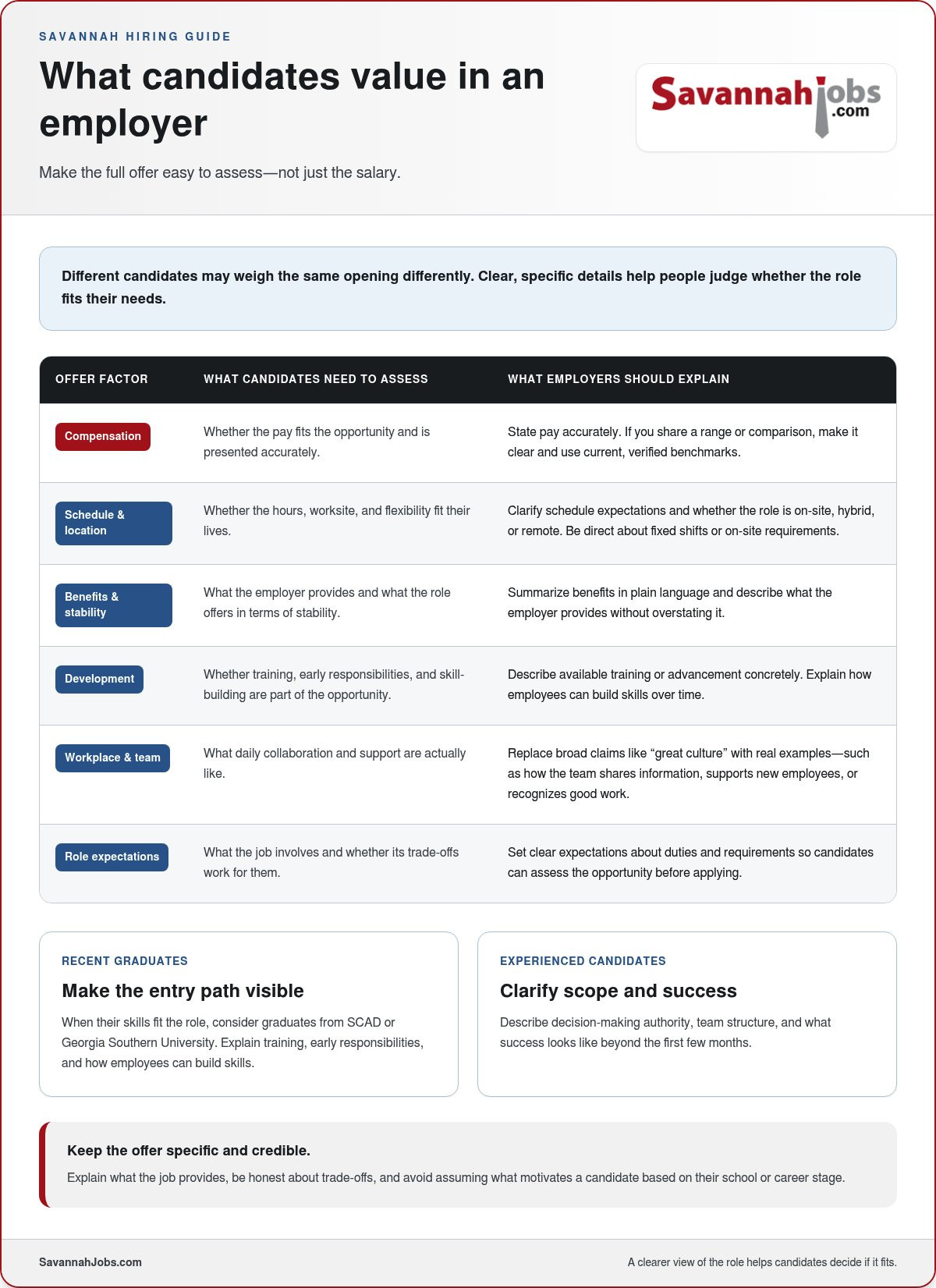
There isn’t one checklist that applies to every Savannah candidate. A recent graduate, experienced specialist, and person seeking a more predictable schedule may weigh the same opening differently. Make the full offer easy to assess: explain compensation, schedule, work location, benefits, development, and stability, then connect each point to what the job actually provides.
Local context can help you understand the range of roles and industries candidates may encounter. ChooseSAV’s overview of Savannah’s job market and industries offers useful background. Treat it as context, not a substitute for understanding the people your opening is meant to reach.
Make the employment offer specific and credible
Give candidates useful facts early. State pay accurately, and use current, verified benchmarks if you make comparisons. Explain whether the role is on-site, hybrid, or remote, clarify schedule expectations, and summarize benefits in plain language. If training or advancement is available, describe what it involves instead of relying on broad promises about growth.
Specific examples make your message more credible. Instead of saying “great culture,” describe how the team shares information, supports new employees, or recognizes good work, if those details reflect your workplace. Be direct about trade-offs, such as a fixed shift or on-site requirement. Clear expectations help candidates decide whether the opportunity fits before they invest time in applying.
Match role value to different Savannah talent groups
Consider recent graduates from SCAD or Georgia Southern University when their skills align with the role’s requirements. Make entry paths visible by explaining training, early responsibilities, and how employees can build skills over time. Experienced candidates may want to understand decision-making authority, team structure, and what success looks like beyond the first few months.
For any audience, avoid assuming that a school, career stage, or personal circumstance predicts motivation. Explain the role’s relevant value and give candidates enough detail to assess it for themselves.
- Compensation: Share accurate pay details and explain any stated range clearly.
- Schedule and location: Set expectations about hours, worksite, and flexibility.
- Benefits and stability: Describe what the employer provides without overstating it.
- Development: Clarify training, skill-building, or realistic progression opportunities.
This specific, evidence-based message is a practical part of how to attract top talent in a competitive market Savannah. For more guidance on presenting your organization consistently, explore the Savannah employer branding guide. A local job posting on SavannahJobs.com can help put your opening in front of Savannah-area job seekers.
Can Savannah employers compete without offering the highest pay?
Sometimes. Higher pay can make an offer more attractive, especially when candidates are comparing similar roles, but salary isn’t the only factor in a job decision. Schedule, benefits, commute, development opportunities, workplace stability, and a clear hiring process can also influence whether a candidate applies or accepts.
For employers researching “how to attract top talent in a competitive market Savannah,” the useful comparison is the whole offer, not salary in isolation. One candidate may value a flexible schedule; another may prioritize a predictable shift or shorter commute. Don’t assume a perk will make up for lower pay. Explain the trade-offs clearly and let candidates decide how the role fits their priorities.
Improve the offer without making unsupported promises
Start with improvements you can deliver consistently. If your team can offer schedule flexibility, explain how it works in practice. Describe benefits accurately, and mention training or advancement only when a real opportunity exists. For salary comparisons, use current, role-specific Savannah data from a reliable source. Broad local averages may not reflect the occupation, experience level, or type of compensation you’re discussing.
For a focused review, compare the opening against these factors:
- Pay: Is the stated compensation accurate and easy to understand?
- Work arrangements: Are hours, location, and any flexibility explained plainly?
- Benefits and growth: Are available benefits and genuine development options described specifically?
- Trade-offs: Are fixed schedules, on-site requirements, or other constraints disclosed early?
This review can reveal manageable changes before you commit to larger recruiting investments. You might clarify a shift pattern, remove an unnecessary requirement, or explain a benefit candidates may otherwise overlook. The goal isn’t to dress up the offer. It’s to make its real value visible.
Reduce candidate drop-off during hiring
A competitive offer can lose appeal if the hiring process feels uncertain or demanding. Tell applicants what the stages involve, who they’ll meet, what materials they need, and when they can expect an update. Set a realistic timeframe, then communicate if plans change. A brief acknowledgment and a clear next step help candidates know their application has been received.
- Review the application: Remove questions or documents that aren’t needed to assess essential requirements.
- Explain the process: Outline the interview stages and what candidates should prepare.
- Follow through: Acknowledge applications, share progress updates, and close the loop after a decision.
These steps can improve the candidate experience without committing your organization to promises it can’t keep. Once your offer is ready to share with local job seekers, a Savannah job posting can support your wider hiring plan.
How to reach top talent across Savannah’s local hiring networks
Strong outreach starts with a clear picture of who can succeed in the role. Choose channels that fit those candidates, publish a consistent description, respond to applicants, and review the results. A local job board can be one part of that plan, but no single channel reaches every qualified person in Savannah.
For employers considering how to attract top talent in a competitive market Savannah, match each outreach step to the vacancy instead of posting everywhere by default. A role requiring specialized experience may call for professional or industry networks alongside job advertising. An entry-level opening may be better suited to education connections and channels used by early-career job seekers.
Connect with relevant Savannah-area talent communities
Choose networks based on the role’s skills and experience requirements. For an appropriate early-career opportunity, consider connections with SCAD or Georgia Southern University. The Port of Savannah may be useful context when shaping outreach for a role related to port activity. Industry associations, workforce connections, and community networks can also be part of the mix when they align with the work. These channels can extend visibility, but don’t treat them as a guarantee of qualified applicants.
Build a focused channel mix before publishing:
- Clarify the audience: Identify the essential skills, experience level, location, and schedule for the opening.
- Select suitable channels: Pair local job advertising with relevant education, professional, workforce, or community networks.
- Publish one consistent description: Keep role details, requirements, and application instructions aligned wherever the opening appears.
- Respond and review: Assign someone to monitor applications, follow up, and assess which channels are contributing relevant interest.
Make the candidate journey easy to complete
Every channel should lead to a straightforward application path. Check that the job title, location, schedule, qualifications, and application instructions match across listings and shared posts. Tell candidates what to submit and how they can expect to hear from your team. Assigning an internal owner to review applications helps prevent promising applicants from waiting without an update.
Track basic funnel measures for each opening: completed applications, qualified applicants, and interview attendance. Compare results across channels. If a channel draws interest but few completed applications, review the application steps and listing clarity. If applicants don’t meet essential requirements, reconsider the audience and channel fit. Treat these results as feedback for this opening, not proof that a channel will always perform the same way.
SavannahJobs.com offers local recruitment advertising, including a 30-day job posting and optional Featured Job or Featured Employer upgrades. These options can support your wider outreach plan while your team manages application review and follow-up. Explore Savannah local job advertising, and post a job for Savannah-area candidates as one step in your hiring outreach.
Turn your Savannah talent strategy into local job visibility
A clear role and a thoughtful candidate experience need a way to reach job seekers. Local job advertising can support your wider hiring plan alongside employee referrals, your own employer channels, and relevant community outreach. It’s a way to distribute the opening, not a replacement for application review, candidate communication, or hiring decisions.
A practical answer to “how to attract top talent in a competitive market Savannah” is to connect a well-prepared job post with channels that fit the opening. For broader context, review the Savannah job market outlook and consider how local conditions relate to your specific role. The Savannah recruitment advertising strategy can also help you plan how job advertising fits into your overall outreach.
Choose local job advertising as part of a wider plan
SavannahJobs.com is a local recruitment advertising platform for employers in the Savannah area. Employers can purchase a 30-day job posting, with optional Featured Job or Featured Employer upgrades. These are advertising options, not promises of applicant volume or hiring results. Use local visibility alongside other suitable channels, then manage applications and hiring decisions within your organization.
Choose a featured upgrade based on your visibility goals and the role. Keep the rest of your outreach consistent: share the same accurate job details through referrals or employer channels, and direct every route to clear application instructions. Consistency helps job seekers understand the opportunity wherever they find it.
Prepare a clear, candidate-ready job post
Before publishing, gather the details candidates need to decide whether to apply. Keep the language concise and grounded in the actual work. Separate essential qualifications from preferences, and make the application steps easy to follow.
- Role: Use a recognizable title and summarize the main responsibilities.
- Requirements: List relevant skills and qualifications accurately.
- Work details: State the location and schedule clearly.
- Compensation: Include accurate pay information that reflects the opening.
- Application: Explain what candidates should submit and how your team will follow up.
Review the post for consistency before it goes live. A title that suggests one level of responsibility while the description asks for another can confuse applicants. So can an unclear location, an unstated schedule, or requirements that don’t match the day-to-day work. Savannah employers can use the Savannah employer job-posting guide for practical help with the posting process.
Ready to put your opening in front of Savannah-area job seekers? Post a job with SavannahJobs.com as one part of your local hiring plan.
Make your next Savannah hire a stronger starting point
Your next opening is a chance to make your hiring approach more reliable. Before posting, agree on what a successful hire needs to accomplish and who will keep the process moving. Afterward, note which parts of the candidate journey were clear and where applicants needed more information. Small, deliberate adjustments can make future opportunities easier to understand and pursue.
That’s the practical heart of how to attract top talent in a competitive market Savannah: give the right people a clear reason to consider the role, make it straightforward to apply, and follow through. Local visibility can help put your opening in front of job seekers, while your team remains responsible for reviewing applications and making hiring decisions.
Put your next opportunity in front of Savannah-area job seekers. Post your Savannah opening with SavannahJobs.com and take the next step toward building a strong local team.
Frequently Asked Questions
Can a small Savannah employer attract top talent without a large recruiting team?
Yes. A small team can make hiring more manageable by assigning one person to coordinate each opening and using a consistent process. Prepare a reusable job description template, a short set of role-specific interview questions, and a simple way to record candidate notes. For example, a hiring manager can review applications twice a week and share decisions with the team in one place. Clear ownership helps prevent applicants from being overlooked.
How can employers attract candidates who are not actively looking for a job?
Make the opportunity easy to share and worth a closer look. Ask employees and professional contacts to pass along a concise description covering the work, location, and strongest reasons to consider the role. Someone who isn’t job hunting may still be open to a conversation if the fit is relevant. Keep outreach respectful, avoid pressure, and give interested candidates a clear next step.
What makes a job offer attractive besides salary?
A compelling offer can include dependable scheduling, useful benefits, a supportive manager, a convenient work location, or meaningful responsibility. Which factors matter most depends on the candidate and the role. Make the value tangible: explain how a new employee learns the work, who provides guidance, or how the team plans schedules. Specific details are more credible than general claims about culture or opportunity.
How quickly should employers respond to job applicants?
Respond as soon as your team can provide a useful update, and set a realistic timeframe at the start. If a decision will take longer, let candidates know rather than leaving them to guess. A simple process can help: confirm receipt, identify who is responsible for the next review, and send an update when the status changes. Consistency matters more than promising a timeline you can’t meet.
Should employers hire candidates who do not meet every listed qualification?
Yes, if the missing qualification is a preference rather than a true requirement and the candidate can demonstrate the core skills. Compare applicants against the work they’ll perform, not just a checklist. Someone may have learned a relevant skill through a different role or hands-on experience. A focused interview question or job-related exercise can help you assess capability without treating every preference as a pass-or-fail condition.
How can employers tell whether their hiring process is losing candidates?
Look for where participation drops. If people begin an application but don’t finish, check whether the form asks for information you don’t need at that stage. If candidates withdraw after interviews, review whether the role’s expectations or next steps were clear. Track candidate progress from initial interest through interview and decision, then ask withdrawing applicants for brief feedback when appropriate. Patterns can point to a fixable bottleneck.
Can local job advertising help an employer reach Savannah-area candidates?
Yes. Local job advertising can put an opening in front of people searching for opportunities in the Savannah area as part of a wider outreach plan. SavannahJobs.com is a local recruitment advertising platform, not a staffing agency, so employers manage applicant review and hiring decisions. If you’re researching how to attract top talent in a competitive market Savannah, consider whether a local listing fits the role and the other channels you’re using.


