

An inclusive job description shouldn’t lower the bar. It should remove obstacles that have nothing to do with doing the job. For Savannah employers, writing inclusive job descriptions means explaining the role’s real expectations clearly and avoiding wording or requirements that could discourage qualified people from applying.
Changing familiar wording can feel risky if you worry the posting will become less precise. The solution isn’t to make every requirement broad or vague. Separate genuine must-haves from preferences, describe the work in plain language, and explain what success in the role looks like.
This guide offers a practical editing process you can use for your next opening and repeat for future hires. You’ll learn how to review qualifications, spot potentially exclusionary wording, describe responsibilities and workplace expectations, and check that application details are accessible and fair. The goal is to keep the bar where the job requires it while welcoming a broader range of qualified applicants.
Key Takeaways
- Learn how unclear expectations, inflated qualifications, and jargon can create avoidable barriers for Savannah-area applicants.
- Use an ordered audit to connect each qualification to an essential task or business need before revising the posting.
- See how writing inclusive job descriptions can make role expectations more welcoming without making them less specific.
- Apply a final review for accessibility, consistent criteria, factual accuracy, and alignment with current policies.
- Build a repeatable process for publishing, reviewing candidate questions, and improving future postings.
Why inclusive job descriptions matter to Savannah-area employers
A job description is often a candidate’s first practical picture of a role. If key expectations are unclear or the posting adds qualifications the work doesn’t require, a qualified person may decide not to apply. For Savannah-area employers seeking local talent, clear wording helps candidates understand the opportunity and gives hiring teams a sound basis for comparing applicants fairly.
An inclusive job description explains the role and its essential requirements while removing wording and barriers that could unnecessarily discourage qualified candidates. That doesn’t mean changing the job’s real performance standards. State those standards in terms candidates can understand, then assess applicants against consistent, job-related criteria.
What makes a job description inclusive and clear?
Clarity supports accessibility. Use descriptive headings, short paragraphs, and plain language. Explain responsibilities, qualifications, and working expectations, and define terms that may be familiar inside your organization but unclear to people outside it.
Inclusive language also avoids assumptions about who can do the work or what a “good fit” looks like. Understanding Inclusive Language offers a broader overview of communication that avoids bias across different groups. For a job ad, ask whether each phrase helps candidates understand the role or adds confusion or an irrelevant barrier.
How exclusion can enter an otherwise well-meant job ad
Barriers can appear without anyone intending to exclude. Consider a degree requirement. If a particular degree is genuinely necessary, explain its connection to the work. If relevant experience or training can demonstrate the same knowledge, requiring the degree may screen out people who could meet the role’s needs. Make the qualification fit the work, not habit.
Check for other avoidable hurdles:
- Vague expectations: “Must be a self-starter” says little about daily responsibilities. Name the work, such as organizing a schedule or resolving routine issues independently.
- Insider jargon and acronyms: Spell out specialized terms or replace them with plain language where possible.
- Culturally narrow examples: Check whether references to particular social activities, communication styles, or backgrounds are genuinely relevant to success in the role.
- Inflated qualifications: Separate skills needed on day one from those a person can learn after starting.
These are review points, not judgments about individual applicants. Savannah employers work across different industries and communities, and candidates bring varied experiences. A clear description lets each person assess the opportunity against its stated requirements. It also helps hiring teams ask consistent, job-focused questions and evaluate applicants against the same expectations.
Audit job requirements before rewriting inclusive language
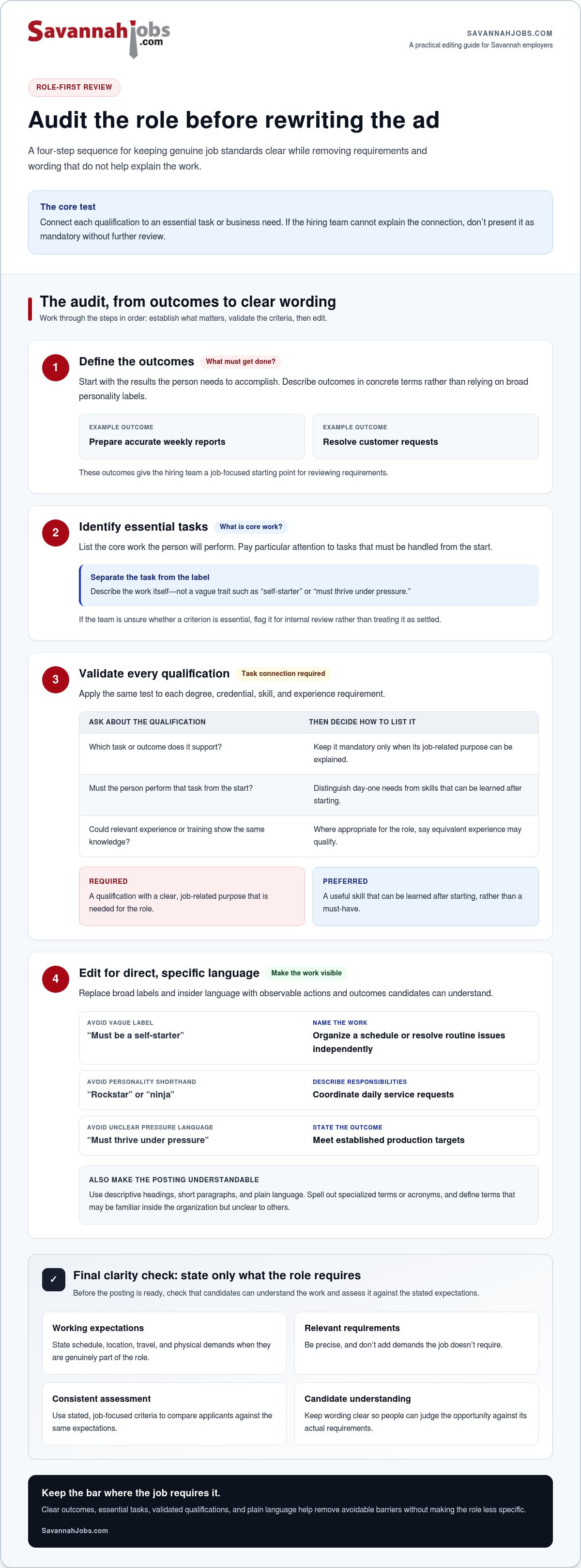
Before editing individual phrases, decide whether each criterion belongs in the posting. A simple audit helps Savannah hiring teams retain standards that matter and reconsider requirements added through habit. Ask the people who know the work to connect each qualification and responsibility to a real task or business need. If they can’t explain the connection, don’t present it as mandatory without further review.
- 1. Define outcomes. Describe what the person needs to accomplish, such as preparing accurate weekly reports or resolving customer requests.
- 2. Identify essential tasks. List the core work the person will perform, especially tasks required from the start.
- 3. Validate qualifications. Match each degree, credential, skill, or experience requirement to a task or outcome.
- 4. Edit the wording. Once the criteria are sound, make the language direct, readable, and specific.
How to separate essential qualifications from preferences
For each qualification, identify the task it supports and whether the person must perform that task from the start. If the posting requires a degree, ask what knowledge it represents and whether relevant experience or training could demonstrate the same capability. Apply the same test to years of experience and credentials. Keep a requirement mandatory only when the hiring team can explain its job-related purpose. Where appropriate for the role, say that equivalent experience may qualify. If a skill is useful but learnable, label it as preferred rather than required.
This approach is also reflected in Government Guidelines for Inclusive Job Postings, which offer practical recommendations for focusing postings on skills and avoiding biased language.
How to describe responsibilities without hidden expectations
Replace broad personality labels with observable work. “Rockstar,” “ninja,” and “must thrive under pressure” can mean different things to different readers. Instead, name the actions and outcomes, such as “coordinate daily service requests” or “meet established production targets.” Concrete wording gives candidates a better basis for deciding whether the work fits their skills.
State the schedule, location, travel, and physical demands when they are genuinely part of the role. Be precise, and don’t add demands the job doesn’t require. If the team is unsure whether a criterion is essential, flag it for internal review rather than treating it as settled.
Use this sequence as a repeatable first pass for writing inclusive job descriptions. For broader posting context, see our Savannah recruitment advertising strategy guide. Once your requirements are clear and approved, you can publish a Savannah-area opening.
Rewrite job-description language to welcome qualified applicants
Once the role’s requirements are validated, revise the wording so candidates can quickly understand the work and decide whether their experience fits. Plain, specific language makes both the job requirements and application process easier to follow. There’s no universal list of words that makes every posting inclusive; meaning depends on the role and context. Review each phrase for clarity, relevance, and respectful tone.
Replace coded or vague phrases with observable requirements
Personality labels rarely explain what someone will do. Replace them with skills or behaviors the hiring team can recognize and assess. “Perfect fit” is also unclear; name the collaboration or communication the role actually calls for. Terms such as “young” or “native speaker” deserve careful job-related review. If language proficiency is essential, describe the level needed for the work rather than making assumptions about a candidate’s background.
| Original wording | Revised wording | Reason for the edit |
|---|---|---|
| “We need a rockstar who thrives under pressure.” | “Prioritize service requests and communicate delays to customers.” | Replaces a vague personality label with observable responsibilities. |
| “Must be a perfect fit for our close-knit team.” | “Work with the team to share updates and coordinate project handoffs.” | Explains the collaboration involved without asking candidates to guess what “fit” means. |
| “Young, energetic team member.” | “Manage the scheduled tasks and customer requests listed below.” | Removes an age-related descriptor and focuses on the work. |
| “Native English speaker required.” | “Communicate clearly with customers in spoken and written English,” if required for the role. | Describes a job-related communication need instead of making assumptions about background. |
Make qualifications, benefits, and application steps understandable
Use descriptive headings and short sentences. Explain acronyms the first time they appear, and list required and preferred qualifications separately. Describe benefits and flexibility accurately, including any relevant limits or conditions. Don’t imply remote work, schedule choices, or other options the employer can’t provide.
Tell applicants what to submit and what happens next. For example, specify whether they should provide a résumé, application form, or work sample, and identify any required steps. If your organization has an accommodation process for applicants, explain clearly how to request an accommodation. These details help candidates prepare and give everyone a consistent understanding of the process.
Review accessibility, fairness, and compliance before publishing
A final review can catch unclear instructions, inconsistent criteria, and details that don’t match the role. Savannah employers should review job advertisements against applicable law and current company policies before publishing. The U.S. Equal Employment Opportunity Commission (EEOC), Title VII, and the Americans with Disabilities Act (ADA) are relevant references for employment-related review. Requirements and guidance can change, so verify current information before publication and seek qualified legal advice for specific compliance questions.
For related Georgia context, see our Georgia employment law guide. It provides background information, not legal advice or a substitute for reviewing how current laws and policies apply to your organization.
An accessibility and readability check for job ads
Make the posting easy to scan and understand, including for people using assistive technology. Use headings in a logical order, concise paragraphs, plain language, and readable formatting. For digital postings, check that the structure works with a screen reader. Don’t rely only on visual styling, such as bold text or spacing, to show how information is organized.
Review each qualification and task for relevance to the job. Avoid physical or other requirements that could unnecessarily exclude candidates with disabilities when they aren’t essential to the work. If a task is essential, describe it accurately and focus on the function required. Explain how applicants can request an accommodation during the application process, using a process your organization can follow.
How Savannah employers can review for consistency
Ask a second reviewer to compare the posting with similar roles and identify differences that lack a clear reason. Reviewers should assess whether criteria relate to the role, not whether a candidate seems personally familiar or culturally similar to the team. Record meaningful changes and the reasons for them. This creates a useful reference for future openings and keeps decisions grounded in the work.
- Clarity: Are responsibilities, qualifications, and application steps easy to understand?
- Accessibility: Is the structure readable, and is the accommodation process explained?
- Consistency: Are requirements applied evenly across comparable roles?
- Accuracy: Do the schedule, location, duties, benefits, and qualifications reflect the actual position?
- Review: Have current policies and applicable legal guidance been considered?
Use this checklist as the last step in writing inclusive job descriptions, then publish a clear Savannah-area opening on SavannahJobs.com.
Publish an inclusive Savannah job description and improve it over time
A strong description is a useful starting point, not a finished hiring process. Before publication, have the hiring team approve the role and its requirements. Proofread the full advertisement, publish it, and review candidate questions and responses. Revise the posting when evidence points to unclear wording or a mismatch between the description and the actual work.
What to learn from applicant responses
Look for job-related signals, not assumptions. Note whether applications meet the stated essential qualifications and keep track of recurring questions. If candidates repeatedly ask about the schedule, location, responsibilities, or a listed requirement, the posting may need more detail.
Use these patterns as prompts for review, not proof of who applied or why someone chose not to. Don’t infer applicants’ protected characteristics from names, résumés, or response rates. Instead, check whether the requirement is genuinely needed and whether the description explains it clearly. Record what you changed and why. That gives your team a practical reference for the next opening and makes improvements in writing inclusive job descriptions more consistent.
Turn the finished description into a local job posting
Keep the job title, work location, schedule, responsibilities, and qualifications consistent throughout the advertisement. A mismatch between sections can cause confusion, even when each detail is accurate on its own. Savannah employers can also consider how a clear description fits into a local recruitment advertising strategy.
SavannahJobs.com is a local recruitment advertising platform for employers in the Savannah area. Employers can use it to promote an opening through a 30-day job posting. Optional Featured Job and Featured Employer upgrades provide additional visibility placements, but don’t guarantee a particular number or type of applicants.
For each opening, approve the role, proofread the advertisement, publish it, monitor job-related responses, and revise responsibly. A clear, inclusive description is ready to share with local job seekers when its requirements and application instructions are accurate and easy to follow.
Put a Clear, Welcoming Job Description to Work
Writing inclusive job descriptions starts with a practical question: does each requirement reflect the actual work? Keep essential standards clear, separate must-haves from preferences, and use plain language so candidates can understand the role and application steps. Before publishing, check accessibility, factual accuracy, and consistency with your hiring policies.
Then keep learning. Candidate questions and application patterns can point to unclear details or requirements worth reviewing, but they aren’t proof of who applied or why. Make thoughtful revisions based on job-related evidence, and carry those improvements into future openings.
Once your description is ready, publish it for Savannah-area job seekers through SavannahJobs.com, a local recruitment advertising platform connected to the Savannah Morning News and USA TODAY Network. Employers can choose a 30-day job posting, with optional Featured Job and Featured Employer placement. These options support local visibility without promising hiring outcomes.
Post your Savannah-area job and reach local candidates. A clear, welcoming description is a strong next step toward building your team in Savannah.
Frequently Asked Questions
What is an inclusive job description?
An inclusive job description explains a role, its essential responsibilities, and its genuine qualifications without unnecessary barriers that may discourage qualified candidates. It uses clear, respectful language and makes expectations easy to understand. Inclusive doesn’t mean lowering job-related standards. For Savannah employers, it means describing the work so candidates can assess the opportunity and hiring teams can evaluate applicants against consistent criteria.
How do you write an inclusive job description?
Start by defining the outcomes the role must deliver and the tasks needed to achieve them. Connect every qualification to a real responsibility, then separate essential requirements from preferred ones. Use plain, specific wording instead of jargon or vague personality labels. Explain the schedule, location, application materials, and next steps accurately. As part of writing inclusive job descriptions, review the final posting for accessibility, fairness, and consistency with current policies.
What words should employers avoid in job descriptions?
Review vague labels such as “rockstar,” “ninja,” or “perfect fit,” along with age-related terms such as “young,” when they don’t describe a genuine job requirement. Don’t rely on phrases like “native speaker” if the role’s actual need is a specific level of language proficiency. No word is automatically inclusive in every context. Replace unclear wording with concrete, job-related skills, actions, and expectations candidates can understand.
Should a job description list every qualification a candidate might need?
No. Include qualifications genuinely needed for the role, especially those required from the start. For each degree, credential, or experience level, ask how it connects to the work. If equivalent experience or training can demonstrate the same capability, say so when appropriate. Put useful but nonessential qualifications under “preferred” rather than presenting them as mandatory, and remove criteria with no clear job-related purpose.
How can employers make a job description accessible?
Use descriptive headings in a logical order, short paragraphs, plain language, and readable formatting. Explain acronyms the first time they appear, and structure digital content so assistive technology can interpret it. Describe only physical or other requirements genuinely relevant to the work. State how candidates can request an accommodation during the application process, and ensure the instructions reflect a process the employer can follow.
Do inclusive job descriptions have to meet legal requirements?
Yes. Job advertisements should be reviewed against applicable law and current employer policies. U.S. employers may need to consider relevant guidance from the Equal Employment Opportunity Commission and requirements associated with laws such as Title VII and the Americans with Disabilities Act. How these apply can depend on the circumstances. This general information isn’t legal advice; check current guidance and seek qualified legal review for questions about a specific posting.
How often should employers review a job description?
Review it before each publication, and revisit it when the role, responsibilities, schedule, location, or hiring policies change. After posting, track job-related indicators such as recurring clarification questions and whether applications align with the stated requirements. Treat these patterns as prompts to check clarity and role relevance, not as proof of applicant demographics or bias. Savannah employers can use each review to make the next posting clearer and more consistent.


