

A virtual interview can save a trip, but it won’t make hiring consistent on its own. The virtual interview best practices 2026 employers need start with a repeatable process that helps interviewers assess candidates fairly, even when technology or communication styles differ. For Savannah-area employers, a clear interview process can make hiring more welcoming and help the team focus on what matters for the role.
Interviews can vary from one candidate or interviewer to the next. Technical issues can disrupt a conversation, and it can be difficult to assess job-related skills through a screen. A simple structure helps: candidates know what to expect, and hiring teams can compare evidence instead of relying on impressions.
This checklist covers how to prepare for the call, guide the conversation, evaluate responses against job requirements, and follow up. It also offers steps for handling common technical problems and keeping communication clear from invitation to decision. Use it to make virtual interviews more consistent and useful when hiring in the Savannah region.
Key Takeaways
- Set a clear hiring goal and choose a consistent interview format so candidates can be compared on job-related evidence.
- Use a before-call checklist to share the schedule, platform, participants, and preparation details with candidates.
- Apply virtual interview best practices 2026 by asking each candidate the same core questions and recording evidence against role-specific competencies.
- Agree on a backup plan for connection or audio issues before the interview begins.
- Debrief promptly, document assessments, and keep Savannah-area candidates updated if next steps or timing change.
Virtual Interview Best Practices: Define a Consistent Hiring Goal
A virtual interview is a job interview conducted remotely, usually through video. A live video interview is a scheduled, two-way conversation where the interviewer and candidate ask and answer questions in real time. A recorded screening asks candidates to respond to prompts on their own, with the interviewer reviewing those responses later. These formats serve different purposes, so choose one based on what you need to learn at that stage of hiring.
Definition: Structured virtual interview
A structured virtual interview uses a consistent format and shared, job-related questions to assess candidates against agreed competencies. It helps interviewers compare relevant evidence instead of relying on memory or first impressions.
Structure makes the conversation more useful for your team and clearer for candidates. For a broad overview of the job interview process, including video and virtual interviews, consider how the format supports the hiring decision, not just how the call is hosted. The virtual interview best practices 2026 approach starts by defining what you need to learn, then using that goal consistently.
What should a virtual interview help you decide?
Start with the role’s essential duties and stated requirements. Choose a focused set of competencies to assess for every candidate, such as customer communication, problem-solving, or role-specific technical knowledge. Separate required qualifications from preferences, and make sure each requirement connects directly to the work. A preference shouldn’t quietly become a deciding factor if it isn’t necessary for the role.
Write questions that invite specific evidence. To assess problem-solving, for example, ask candidates to describe a work-related challenge, the steps they took, and the result. Note what they say that demonstrates the competency. Avoid scoring vague qualities such as “culture fit” unless you have defined observable, job-related behaviors. This gives Savannah-area hiring teams a shared basis for discussion, even when interviewers have different styles.
When does a virtual interview make sense?
Use live video when two-way discussion will help you clarify experience, explore a candidate’s approach, or answer questions about the role. It can be practical for Savannah teams interviewing candidates across the region or coordinating decision-makers who can’t meet in person. A recorded screening can suit an early-stage review when candidates need to respond to the same initial prompts, but it doesn’t provide a real-time exchange.
Choose the format according to the role, the candidate’s location, and what the next hiring step needs to establish. A virtual conversation can support an interview, but it doesn’t need to replace every assessment. If the role calls for a practical demonstration or another task-based evaluation, plan that separately and explain how it relates to the job.
Prepare for a Virtual Interview with This Before-Call Checklist
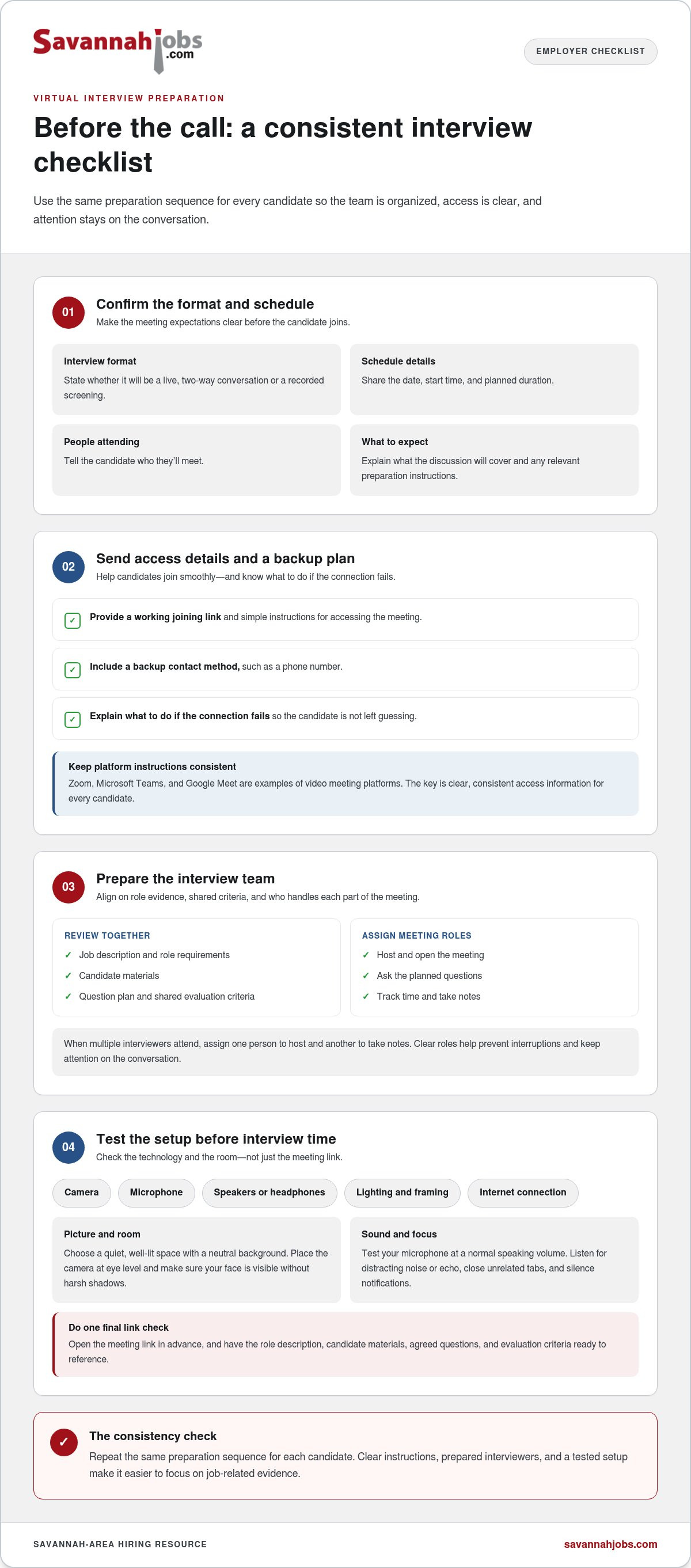
A reliable virtual interview starts before anyone joins the call. Follow the same preparation sequence for each candidate. If multiple interviewers are attending, assign one person to host and another to take notes. Clear roles help prevent interruptions and keep attention on the conversation.
- Confirm the format and schedule. Tell the candidate whether the interview is live or recorded, the date and start time, planned duration, who will attend, and what the discussion will cover.
- Send access details. Provide a working joining link and simple instructions. Include a backup contact method, such as a phone number, and explain what to do if the connection fails.
- Prepare the interview team. Review the job description, candidate materials, question plan, and shared evaluation criteria. Agree on who will open the meeting, ask questions, track time, and take notes.
- Test the setup. Check the camera, microphone, speakers or headphones, lighting, framing, and internet connection. Open the meeting link in advance and choose a quiet, professional setting.
Keep the process tool-neutral. Zoom, Microsoft Teams, and Google Meet are examples of video meeting platforms, but the important thing is to give every candidate clear, consistent access instructions.
How should employers set up the interview?
Choose a quiet, well-lit space with a neutral background. Place the camera at eye level and check that your face is visible without harsh shadows. Test your microphone at a normal speaking volume, then listen for distracting noise or echo. Close unrelated tabs and silence notifications so the candidate gets your attention, not your screen’s alerts.
Before the call, have the role description and candidate materials ready. Keep the agreed questions and evaluation criteria in a shared document or another easy-to-reference format. This preparation helps Savannah-area interviewers stay organized and assess each person against the same role requirements.
What should candidates know before joining?
Give candidates enough information to prepare without leaving them to guess what the meeting involves. State who they’ll meet, how long the conversation is planned to last, and whether it includes a general discussion, role-specific questions, or another activity. Make any preparation instructions clear and relevant to the interview.
Include a direct joining link and backup contact method in the invitation. Let candidates know how to request an accommodation through the appropriate employer contact, and provide that contact’s details. Clear communication helps create a welcoming experience for candidates considering opportunities in Savannah and the surrounding area.
Once your interview process is set, make sure the job advertisement accurately reflects the role and its requirements. Employers can use Savannah job postings to share open opportunities with local job seekers.
Run Virtual Interviews with Structured Questions and Fair Evaluation
A consistent interview doesn’t have to feel scripted or impersonal. Give every candidate the same core questions and assess responses against the same job-related criteria. This gives your Savannah hiring team a fairer basis for comparing answers, even when candidates have different communication styles or interviewers bring different perspectives.
Consistent criteria turn separate conversations into a fair comparison of evidence.
How can interviewers assess candidates consistently?
Before the first interview, agree on a shared rating scale and define what each level means. A low rating might indicate that an answer lacks relevant evidence, while a strong rating might reflect a specific example that demonstrates the required skill. Ask each candidate the same core questions, then invite them to explain the situation, the actions they took, and the result. Take concise notes that capture examples rather than impressions such as “seemed confident.”
The table below shows how to connect a competency to evidence and a rating note. Adapt the competencies to the role.
| Competency | Evidence to listen for | Rating note |
|---|---|---|
| Problem-solving | Explains a relevant challenge, steps taken, and outcome | Record the example and how clearly it demonstrates the skill |
| Customer communication | Describes adapting communication to address a customer need | Note the approach and its connection to the role |
| Role-specific skill | Gives a concrete example of applying a required skill | Compare the evidence with the stated job requirement |
Use follow-up prompts to clarify an answer, not to give one candidate extra coaching or change the standard. Ask, “What was your role in that outcome?” or “What would you do differently next time?” Assess the substance of the response against role requirements, not personality, camera presence, or presentation style. These virtual interview best practices 2026 keep the evaluation focused on what candidates can demonstrate.
How do you keep the conversation engaging?
Start with brief introductions and a simple agenda. Explain how the conversation will flow, then leave time for the candidate’s questions. Listen without rushing. Video-call delays can create awkward pauses, so leave a moment before speaking and avoid interrupting when someone appears to have finished. A warm, steady pace helps the exchange feel like a conversation while keeping the assessment focused.
After each interview, complete rating notes independently before discussing candidates as a group. This preserves each interviewer’s evidence-based assessment and gives the team a useful record for the next hiring discussion.
Handle Virtual Interview Access, Tech Problems, and Candidate Concerns
A connection problem shouldn’t become a test of a candidate’s patience or ability. Agree on a response plan before interviews begin, then apply it consistently. A shared plan keeps technical glitches from unfairly disrupting the conversation or affecting how you assess a candidate.
Use this quick response sequence:
- If video freezes or disconnects: Pause the interview and try rejoining through the original link. Confirm by chat or phone whether both participants can hear and see each other.
- If audio fails: Check the selected microphone and speakers, then reconnect. If the issue continues, switch to the backup contact method shared in advance, such as an agreed phone call.
- If an interruption occurs: Pause, acknowledge it, and offer a moment to resolve the disruption before continuing.
- If the interview can’t continue fairly: Reschedule rather than rushing through the remaining questions or evaluating incomplete answers.
Tell candidates beforehand how long you’ll try to reconnect and what the fallback option is. Use the same plan across your Savannah hiring process. These virtual interview best practices 2026 help separate a candidate’s qualifications from circumstances outside their control.
What should you do if video technology fails?
Stay calm and explain the next step plainly: “We’ve lost the connection. Let’s try the link again, and if that doesn’t work, I’ll call the number we agreed on.” If the conversation resumes by phone, confirm that the candidate is comfortable continuing in that format. If the disruption affects the candidate’s ability to participate or the team’s ability to assess answers, arrange another time and use the same interview criteria.
How can employers make virtual interviews more accessible?
Share the platform, participation instructions, and interview format ahead of time. Include a clear way to discuss accommodation needs with the appropriate employer contact before the meeting. Respond respectfully, keep the conversation focused on what will support participation, and consult current applicable guidance when deciding how to handle a request. Apply the same job-related criteria while making appropriate adjustments to the interview setup.
Protect candidate trust, too. Don’t record an interview or collect sensitive information without appropriate notice and review. If recording is being considered, establish the purpose, handling, and notice process before inviting candidates, and follow applicable employer policies and guidance. Avoid asking candidates to share personal details that aren’t needed to assess the role.
A clear job advertisement sets expectations before the interview stage. Post your Savannah-area job with accurate role details so candidates can make an informed decision about applying.
Follow Up After Virtual Interviews and Keep Savannah Hiring Moving
A consistent process doesn’t end when the call closes. Prompt follow-up helps your team make a reasoned decision and lets candidates know what to expect. Before interviewers leave the debrief, agree on next steps and assign someone to communicate them.
What should happen immediately after the call?
Ask interviewers to complete their notes independently before discussing candidates as a group. This preserves each person’s evidence and reduces the chance that an early opinion shapes everyone else’s assessment. Then compare examples with the shared requirements and evaluation criteria. Note where evidence supports a rating and where relevant information is still missing.
- Document evidence: Record job-related examples and ratings, not general impressions.
- Agree on next steps: Decide whether to advance the candidate, gather more relevant information, or close the application.
- Assign communication: Name the person responsible for updating the candidate and set a realistic date for that update.
Give candidates a timeline you can meet. If a decision takes longer than expected or the process changes, send a brief update instead of leaving them to guess. Clear communication reflects the care you put into the interview and supports a positive experience for people considering roles in Savannah.
How can employers connect interviews to local recruitment?
Keep the job advertisement aligned with the criteria used in the interview. If clear customer communication is essential, describe that expectation in the posting and assess it consistently during candidate conversations. Accurate details help applicants understand the role and make the hiring process more coherent from first impression through follow-up.
Strong employer communication also shapes how candidates experience your organization. For more ideas, explore Savannah employer branding tips and guidance on recruitment advertising in Savannah. Clear job information and respectful follow-up help local candidates understand the opportunity and what happens next.
SavannahJobs.com is a self-service platform where employers can advertise open roles to job seekers in the Savannah region. A 30-day job posting gives employers a way to share role details, with featured visibility upgrades available for job listings and employer profiles.
Ready to reach local job seekers? Post your Savannah-area job with clear, accurate details about the opportunity.
Build a More Consistent Virtual Hiring Process
Strong virtual interviews rely on a clear, repeatable process. Define what each conversation should assess, ask candidates the same core job-related questions, and compare their evidence against shared criteria. A simple technology backup plan and timely follow-up help candidates know what to expect, even when plans change.
Put these virtual interview best practices 2026 to work in your next hiring process. Keep your job advertisement aligned with the role and the skills your interview will evaluate, so Savannah-area candidates get a clear picture of the opportunity from the start.
SavannahJobs.com is a Savannah-focused recruitment advertising platform where employers can publish 30-day job postings and choose optional featured visibility upgrades. Post your open role on SavannahJobs.com to reach local job seekers. A clear, consistent process gives your hiring team a stronger foundation for thoughtful decisions.
Frequently Asked Questions
How do you prepare for a virtual interview as an employer?
Prepare the invitation, technology, materials, interviewer roles, and backup plan before the candidate joins. State the format, schedule, expected participants, and preparation instructions in the invitation. Test the meeting link, camera, microphone, lighting, and connection. Have the job description, candidate materials, questions, and evaluation criteria ready. Assign who will host, ask questions, and take notes. Share a backup contact method in case the call fails.
What are the best questions to ask in a virtual interview?
The best questions relate to the role’s essential duties and requirements. Ask every candidate the same core questions, such as, “Tell me about a time you resolved a customer issue,” then use consistent follow-ups to clarify their role, actions, and results. Evaluate the evidence against shared criteria. Don’t let camera presence, personality, or unrelated impressions outweigh what the candidate demonstrates about job-related skills.
How can you make virtual interviews fair for every candidate?
Use the same core questions and job-related evaluation criteria for each candidate, and explain the interview format in advance. Share a clear way to discuss accommodation needs with the appropriate employer contact, then make suitable adjustments to support participation. Focus ratings on evidence of required skills, not factors such as background, camera quality, communication style, or interruptions outside a candidate’s control. Consistent preparation supports fairer comparisons for Savannah-area hiring teams.
What should an interviewer do if the video call stops working?
Stay calm, pause the interview, and check whether both participants can hear or see each other. Try rejoining through the meeting link, then use the backup contact method agreed on in advance, such as a phone call. Confirm that the candidate is comfortable continuing that way. If the disruption makes it difficult to participate or assess answers fairly, reschedule and explain the next step clearly.
Can employers record virtual interviews?
Employers should review applicable consent, privacy, and workplace requirements before recording an interview. Requirements can depend on the circumstances, so don’t assume one rule applies everywhere. If recording is being considered, establish its purpose, how it will be handled, and what notice candidates should receive. Consult the appropriate HR or legal resource before proceeding, and avoid recording until the relevant requirements and employer policies have been reviewed.
How long should a virtual job interview last?
There’s no single ideal length. Plan the interview around the role, format, and topics you need to cover. A focused early conversation may need less time than an interview with several participants or a role-specific discussion. Set a realistic schedule that leaves room for candidate questions, and tell candidates the planned duration beforehand. Keep the interview focused so each question supports a clear hiring decision.
How should employers follow up after a virtual interview?
Have interviewers complete their notes independently, then debrief against the shared criteria and document the decision or next step. Assign one person to update the candidate and set a realistic date for that communication. Share the expected timeline at the end of the interview, and send an update if it changes. Timely, clear follow-up helps candidates understand where they stand and what to expect next.


