

Another resignation means a vacant shift, more pressure on the team, and another round of hiring. Replacing people without understanding why they leave can keep that cycle going. Reducing employee turnover Savannah employers face starts with finding the causes, not guessing at them.
Exit feedback can be vague, and the same problems may return after each new hire. Some factors are outside your control, but everyday practices such as scheduling, onboarding, communication, and growth opportunities can influence whether employees see a future with your organization. Candidates also need a realistic picture of the role before they accept it.
This guide shows you how to look for patterns in departures, ask more useful questions, and choose practical changes that fit your operation. You’ll learn how to track whether those changes are helping and set clearer expectations during hiring. By connecting hiring promises, manager habits, and employee development, you can build a steadier Savannah team one improvement at a time.
Key Takeaways
- Start reducing employee turnover Savannah employers face by looking for patterns in exit feedback, stay conversations, attendance, and employee tenure.
- Separate visible symptoms from underlying causes so you can focus on issues that may be driving departures.
- Compare practical retention levers, including pay clarity, scheduling, manager consistency, recognition, and development.
- Use a flexible 30-, 60-, and 90-day plan to set a baseline, prioritize issues, and assign clear ownership.
- Write accurate job advertisements that explain duties and expectations, then support retention with a positive employee experience after hiring.
Reducing Employee Turnover in Savannah Starts with Understanding Why People Leave
A vacancy tells you someone left, but not why, whether the departure was preventable, or what the team needs next. Before choosing a retention fix, define what you’re counting and look for patterns in your workforce. That’s the first step toward reducing employee turnover Savannah employers can address with evidence.
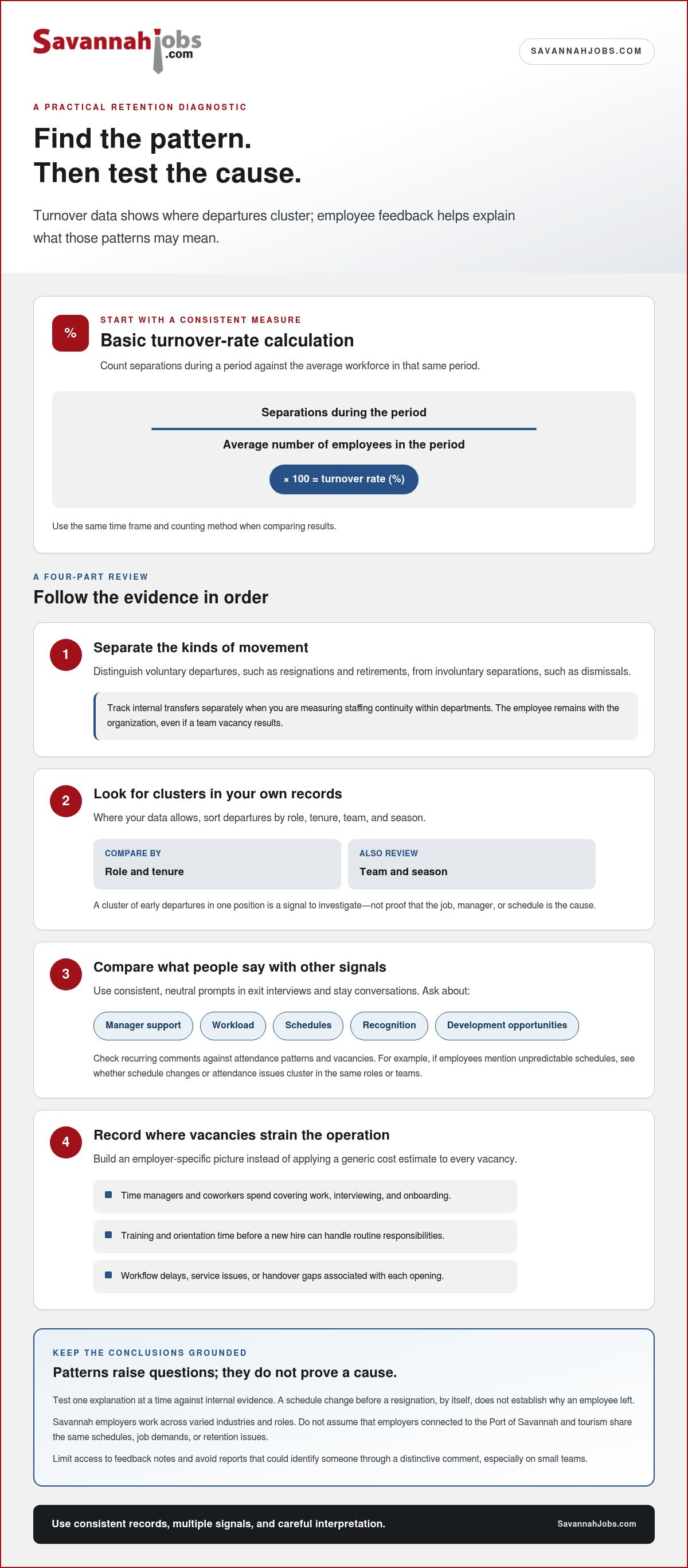
Employee turnover is the movement of employees out of an organization over a defined period; the turnover rate measures those departures against the workforce, while employee retention describes the organization’s ability to keep employees over time. To calculate a basic turnover rate, divide separations during a period by the average number of employees in that period, then express the result as a percentage. Use the same time frame and counting method when comparing results. For a general overview of understanding employee turnover, see how the concept is defined and calculated.
Which turnover patterns should Savannah employers distinguish?
Separate voluntary departures, such as resignations and retirements, from involuntary separations, such as dismissals. An internal transfer is different: the employee stays with the organization, but the move may leave a vacancy on a particular team. Track transfers separately if you’re focused on staffing continuity within departments rather than departures from the business as a whole.
Then sort records by role, tenure, team, and season, where your data allows. A cluster of early departures in one position is a signal to investigate, not proof that the job, manager, or schedule is the cause. Savannah employers work across varied industries and roles, so don’t treat an example from one local industry as a forecast for another. Look for patterns in your own records before drawing conclusions.
Why does turnover affect more than recruiting?
A departure can disrupt routine work. Coworkers may cover shifts or tasks, managers may spend time coordinating temporary handoffs, and customers may notice slower service or less continuity. The departing employee also takes practical knowledge with them, from how a process works to the context behind a customer relationship. Those effects can accumulate when vacancies recur before the team has time to settle.
The impact varies. Replacing a specialized role may involve different recruitment, training, and handover demands than filling a position with a shorter learning curve. Rather than applying a generic cost estimate to every vacancy, build an employer-specific picture by recording:
- Time managers and coworkers spend covering work, interviewing, and onboarding.
- Training and orientation time before a new hire can handle routine responsibilities.
- Workflow delays, service issues, or handover gaps associated with each opening.
These notes won’t explain every resignation, but they can show where turnover creates the most strain. A consistent record of departures and their effects helps you move from reacting to vacancies toward investigating the conditions behind them.
How to Diagnose the Main Causes of Employee Turnover in Savannah
Once you’ve recorded who leaves and when, test possible explanations. A resignation may follow a schedule change, but that alone doesn’t prove scheduling was the reason. Compare what employees say with patterns in attendance, tenure, and vacancies. Turnover data shows where departures cluster; employee feedback helps explain what those patterns may mean.
Use a consistent review process: gather information from more than one source, look for repeated themes, and treat each theme as a question to investigate rather than a settled conclusion. For an overview of commonly discussed causes of employee turnover, Work Institute’s resource can help frame questions about management, growth, and work-life balance.
What should exit interviews and stay conversations uncover?
Ask departing employees what influenced their decision, and ask current employees what helps them stay and what might make them consider leaving. Use the same neutral prompts in each conversation so answers are easier to compare. Ask about manager support, workload, schedules, recognition, and development opportunities. Avoid leading questions that suggest a preferred answer.
Compare comments with other evidence. If employees mention unpredictable schedules, check whether schedule changes or attendance issues cluster in the same roles or teams. Record recurring themes without attributing every departure to one factor. Protect privacy by limiting access to notes and avoiding reports that could identify someone through a distinctive comment, especially on small teams.
How can employers turn local workforce signals into useful questions?
Review current openings for roles like yours and track how long your own vacancies take to fill alongside departure patterns. These signals can inform questions about hiring expectations, but they don’t establish why employees leave. Savannah includes different industries and work arrangements. Employers connected to the Port of Savannah and tourism, for example, shouldn’t assume they face identical schedules, job demands, or retention issues.
Use local context when it helps explain a specific pattern, and rely on current, relevant information rather than broad assumptions. Reducing employee turnover Savannah employers can influence means testing one explanation at a time against internal evidence.
- Compare departures by role, tenure, team, and season.
- Check whether employee feedback aligns with attendance or vacancy patterns.
- Record what supports each possible cause and what remains uncertain.
Keep the findings practical. A cluster of early departures alongside comments about unclear duties may point to an expectations gap, but it still calls for follow-up rather than a quick verdict. If hiring timelines suggest a role is difficult to fill, reviewing how you present the opportunity can add context. A local job posting can help employers present role details to Savannah-area candidates, while workplace feedback remains essential to understanding retention after hire.
Which Retention Changes Matter Most, and Is Pay the Only Answer?
Pay matters, but it isn’t the only part of work an employer can improve. Employees may also consider whether expectations are clear, schedules are workable, managers are consistent, contributions are recognized, and there’s room to develop. The right response depends on what your diagnosis shows. A schedule change won’t solve a compensation concern, and a pay adjustment alone may not address poor communication or an unsustainable workload.
For reducing employee turnover Savannah employers should match each action to a specific concern, then choose a measure that can show whether the change is helping. If you need to understand what made a difference, avoid rolling out several changes at once. Start with the issue employees raised most consistently, and tailor the response to the role and team.
When should compensation or benefits be reviewed?
Review compensation when employee feedback, hiring challenges, or internal comparisons point to a possible concern. Check consistency across comparable roles and consider each position’s responsibilities and requirements before making changes. Use current, role-specific market evidence rather than assuming one Savannah-wide benchmark fits every job. A clear explanation of how pay and benefits are structured can also address confusion before a compensation decision is made.
Separate “Is the pay competitive?” from “Do employees understand how compensation works?” Those questions may call for different responses. Track relevant hiring and departure patterns alongside feedback, and don’t treat a single comment as proof that compensation is the main cause.
What can managers improve without changing compensation?
Managers can make day-to-day work clearer and more predictable. Set expectations for responsibilities and priorities, give regular feedback, and raise workload concerns before they become persistent frustrations. Explain schedule changes promptly and consistently. Make recognition specific and fair, and use development conversations to identify realistic next steps without implying that a promotion is guaranteed.
Connect employee concerns with a response and a measure to watch. These measures are signals, not proof of cause, so review them alongside employee feedback.
- Concern: Unclear priorities. Response: Confirm responsibilities and near-term goals. Watch: Repeat questions, missed handoffs, and employee feedback about role clarity.
- Concern: Difficult scheduling. Response: Improve how schedules and changes are communicated. Watch: Schedule-related feedback and attendance patterns.
- Concern: Workload pressure. Response: Review task distribution and competing priorities. Watch: Ongoing workload concerns and whether coverage is manageable.
- Concern: Limited recognition or development. Response: Give specific acknowledgment and discuss practical skill-building steps. Watch: Feedback on recognition and participation in development opportunities.
- Concern: Pay confusion or perceived inconsistency. Response: Explain compensation criteria and review comparable roles. Watch: Recurring pay questions and relevant departure feedback.
Choose one or two priorities that fit your Savannah organization, assign an owner to each action, and revisit the evidence after implementation. You don’t need to apply every possible retention tactic. Focus on a practical change that responds to what employees are experiencing.
A 90-Day Employee Retention Plan for Savannah Employers
A 90-day plan gives your team time to move from observation to action without promising a quick fix. Treat the timeline as a flexible review structure, not a guarantee of lower turnover. Start with a baseline, choose one or two issues supported by evidence, and assign an owner to each action. Reducing employee turnover Savannah employers can use this process to keep the work focused and make progress visible.
What should happen in the first 30 days?
In the first month, gather the records you already have and invite confidential employee feedback. Tell employees what you’re reviewing, how their input will be used, and how you’ll protect their privacy. Choose a manageable priority based on repeated evidence, not a single comment or assumption. Assign one person to coordinate the work and set a check-in date.
- Establish a baseline: Record departures by role and tenure, relevant absence patterns, and current stay-conversation themes. Note gaps in the records so later comparisons are fair.
- Select a priority: Choose one or two concerns that appear across more than one source, such as recurring onboarding questions or difficulty communicating schedule changes clearly.
- Name an owner: Identify who will carry out the response, who will review progress, and which teams are included. Make the action specific enough to check, such as confirming responsibilities during onboarding.
How should employers review progress after 60 and 90 days?
At day 60, check whether the planned actions are happening consistently across teams. Ask employees whether they’ve noticed a difference, and review the same indicators you used for the baseline. At day 90, compare the records again, note limitations such as small groups or incomplete information, and decide whether to keep, adjust, or stop each action.
- By day 30: Set the baseline, explain the review, choose priorities, and assign owners.
- By day 60: Confirm actions are being carried out and gather early feedback. If a manager agreed to hold regular check-ins, verify that they’re taking place instead of assuming the plan is in motion.
- By day 90: Review early-tenure departures, absence patterns, and stay-conversation themes against the baseline. Focus on the roles and teams involved, and don’t treat a short-term shift as proof of lasting change.
Give managers a simple reporting format: action completed, indicator reviewed, employee themes heard, and next step. Share patterns, not identifiable comments or details that could reveal who spoke. If feedback is mixed, revisit the original diagnosis before expanding the intervention. A practical plan adapts as evidence comes in.
As you review hiring needs alongside retention work, post a job on SavannahJobs.com with clear role expectations for Savannah-area candidates. A local job posting supports recruitment; the employee experience after hiring remains central to retention.
Build Retention from the First Job Ad: A Local Hiring Next Step
Retention work starts before a candidate accepts an offer. A job advertisement sets expectations about the work, schedule, and workplace. If those details differ from the employee’s day-to-day experience, the mismatch can create early frustration. Clear, realistic hiring messages help candidates make informed decisions, but advertising is only one part of reducing employee turnover Savannah employers can influence. The experience after hiring matters just as much.
How can a realistic job posting support stronger retention?
Write the posting as a practical preview of the role, not just a pitch. Describe the main responsibilities in plain language, distinguish essential requirements from preferred qualifications, and include relevant schedule, location, and reporting expectations. If the role involves varied duties or changing priorities, explain that clearly. Candidates can then judge whether the opportunity fits what they’re looking for.
Keep the message consistent through interviews, the offer, and onboarding. If a position requires a particular shift or regular customer interaction, for example, explain that before a candidate accepts. A job ad can’t promise a perfect match or prevent every departure, but accurate information can reduce avoidable surprises. After someone joins, managers still need to deliver on the expectations set during hiring.
- Duties: Explain what the employee will handle in a typical workday.
- Schedule and location: State the relevant hours, work setting, and location expectations.
- Requirements: Identify the skills or qualifications the role genuinely needs.
- Workplace expectations: Describe reporting relationships and other relevant conditions plainly.
How can Savannah employers take the next hiring step?
For Savannah-area employers recruiting locally, a 30-day job posting on SavannahJobs.com puts an opening in front of local candidates. Optional Featured Job and Featured Employer upgrades provide additional visibility when they fit your recruitment goals. These are advertising tools, not retention fixes. Use them alongside accurate job details and a thoughtful employee experience once someone joins the team.
Before publishing, review the posting from a candidate’s point of view. Can someone understand the core duties, schedule, location, and requirements? Does the language describe the job as it is, rather than as you hope it might be? Coordinate the hiring message with the people who will interview, supervise, and onboard the new employee.
Plan how local recruitment advertising fits alongside your other hiring efforts. Consider the roles you need to fill, the candidates you want to reach, and how the posting supports your wider recruitment plan. Make the next opening an opportunity to set honest expectations from the start.
Explore local job advertising on SavannahJobs.com when you’re ready to share an opening with Savannah-area candidates.
Make Your Next Hiring Decision a Stronger Starting Point
Retention grows through steady follow-through. Use what you learn from employees to shape a workplace they can trust, and make sure the picture candidates receive before hire matches the role they’ll step into. That alignment is central to reducing employee turnover Savannah organizations can influence.
Your next opening is a chance to reach local candidates with clear expectations from the start. SavannahJobs.com offers Savannah-area employers 30-day job postings, with optional Featured Job and Featured Employer upgrades for added visibility. Advertising can support recruitment, while lasting retention depends on the experience your team creates after hiring.
Post a job with SavannahJobs.com to take a practical next step toward reaching Savannah-area candidates. Build a team that can grow stronger together, one thoughtful hiring decision at a time.
Frequently Asked Questions
What is a good employee turnover rate for a small business?
There’s no single turnover rate that’s “good” for every small business. Compare your rate with your own past results and consider whether the roles, staffing model, and measurement period are similar. A small team can see its rate shift sharply after only a few departures, so pair the percentage with the number and type of separations. Reducing employee turnover Savannah businesses face means focusing on trends they can investigate, not an arbitrary target.
How do you calculate employee turnover?
Divide the number of separations during a chosen period by the average number of employees during that period, then multiply by 100. For example, if a business had four separations and an average workforce of 40, its turnover rate for that period would be 10%. Use the same time frame and rules each time. Decide in advance whether internal transfers count, and report them separately if you also track turnover within teams.
Can better management reduce employee turnover?
Stronger management practices can help employees feel supported and understand what’s expected, though no single change will prevent every departure. For example, a manager who checks in after a shift change can catch confusion before it becomes a recurring frustration. Small businesses can make expectations more consistent by giving supervisors shared guidance on feedback, workload discussions, and follow-up. Then ask employees whether communication feels clearer and watch for recurring concerns.
Is pay the main reason employees leave their jobs?
Pay can influence a decision to leave, but it isn’t automatically the main reason for every employee or role. An employee may value compensation and still leave because the job differs from what they expected or the schedule doesn’t fit their needs. In a departure conversation, ask what alternatives the employee considered and what mattered most in the decision. Compare answers across roles before deciding whether a pay review is the right response.
How can a small business find out why employees are quitting?
Use a short, consistent set of questions in exit conversations, then compare the answers with information from current employees. Ask what made the job harder than expected, what might have improved the experience, and whether the employee felt comfortable raising concerns. Keep notes focused on themes rather than personal details. Review those themes periodically with a limited group of decision-makers, and avoid sharing comments that could identify an individual.
What should an employer do when a new hire leaves quickly?
First, stabilize the work and make sure immediate responsibilities have an owner. Then review the hiring and onboarding experience while the details are fresh. Check whether the employee understood the schedule, duties, training plan, and reporting relationship, and whether the role matched what was discussed before hire. If possible, invite candid feedback without pressuring the person to reconsider. Use what you learn to correct one specific gap before recruiting again.
How can a job description help reduce employee turnover?
A clear job description helps candidates judge whether the role fits before they apply. Describe core tasks, required qualifications, schedule expectations, work location, and who the employee reports to. If a position includes regular customer-facing work, for example, state that rather than leaving candidates to infer it from the title. Keep the description aligned with the interview and onboarding message so new employees aren’t surprised by basic responsibilities after starting.


