

How many hours did you lose last month sitting across from job candidates who were clearly the wrong fit within the first five minutes? It's a common frustration for busy managers across the Savannah region. You spend your limited time reviewing resumes and scheduling meetings, only to find that the person on the other side of the desk doesn't have the right skills or alignment. We know that your time is your most valuable resource. You need a reliable way to protect your schedule by using effective phone screening questions that identify the right talent quickly.
This article will show you how to master a 15-minute screening call that filters out unqualified applicants before they ever walk through your door. We'll provide a repeatable script that helps you spot red flags early and gauge cultural fit over the phone. You'll learn how to validate competency, compensation, and commute to ensure you're only interviewing the best local talent from your SavannahJobs.com listings. We have compiled 25 targeted questions to help you hire with confidence and reduce turnover for your Savannah-based business. Get ready to streamline your recruitment and focus on the candidates who truly matter.
Key Takeaways
- Save hours of time by using a 15-minute preliminary call to verify basic qualifications and prevent interview fatigue for your team.
- Discover effective phone screening questions that quickly verify technical skills and ensure a candidate's motivation aligns with your Savannah business goals.
- Account for local logistics like the Talmadge Bridge commute and Port of Savannah schedules to confirm a candidate's long-term reliability.
- Spot critical red flags early, such as a lack of local market knowledge, while identifying green flags that signal a top-tier applicant.
- Follow a repeatable speed screening protocol to move from a 30-Day Job Posting on SavannahJobs.com to a successful, high-quality hire.
Why Phone Screens are Essential for Savannah Employers
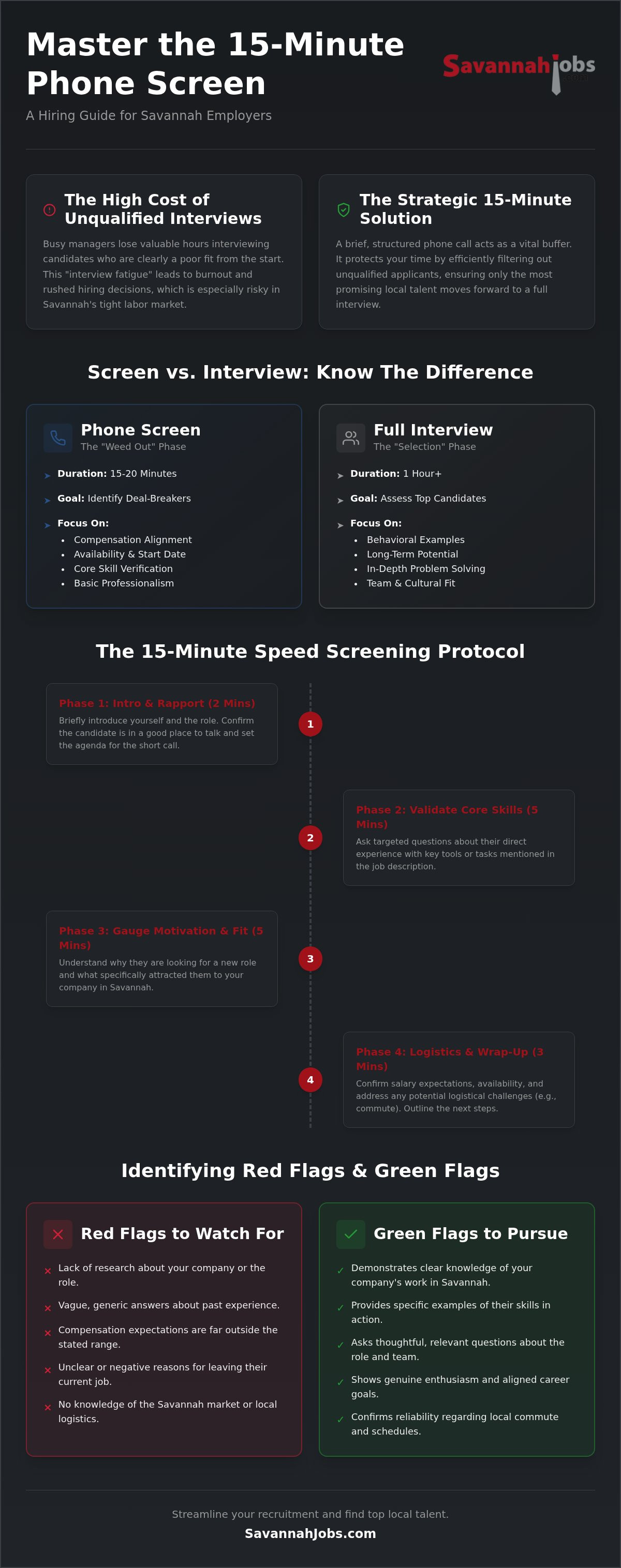
Hiring in Savannah requires speed and precision. A phone screen is a 15 to 20 minute preliminary conversation designed to verify basic qualifications before you commit to a formal meeting. It acts as a vital buffer. Instead of jumping straight into a long interview, you use this time to see if the candidate's reality matches their paper resume. This process relies on effective phone screening questions to filter out those who aren't a fit for your specific team culture or operational needs.
We know how draining it is to spend an hour with someone who lacks the essential skills for the role. This "interview fatigue" can lead to sloppy hiring decisions or burnout for your management team. In a tight labor market like ours, where the Savannah unemployment rate sat at 3.3% in June 2026, the stakes are high. A bad hire doesn't just cost you a salary; it disrupts your workflow and forces you to restart the recruitment process from scratch. Screening mitigates this risk by ensuring only the most qualified local talent makes it to the next round.
The Difference Between a Phone Screen and a Full Interview
Think of the phone screen as a "weed out" phase rather than a final selection. While a full interview dives deep into behavioral examples and long-term potential, the screen focuses on deal-breakers. You're checking for alignment on the basics to ensure neither party wastes their time. During this call, you should focus on:
- Compensation expectations and budget alignment
- Immediate availability and start dates
- Verification of core technical requirements
- Basic communication style and professional demeanor
You should maintain a neighborly, welcoming vibe that reflects our Savannah hospitality, but keep the boundaries professional and the pace brisk. The goal is to move quickly so you can focus your energy on top-tier candidates.
Why Local Context Matters in the Initial Call
Savannah has a unique economic pulse. Whether you're hiring for the Port of Savannah or a boutique on Broughton Street, local context is everything. During the call, verify that the candidate can handle specific local shifts, especially in our 24/7 logistics and hospitality sectors. Because many of your applicants come from our deep-rooted network at SavannahJobs.com and the Savannah Morning News, mentioning local landmarks or industry hubs builds immediate trust. It shows you aren't just a faceless corporation; you're a partner in the regional economy. Using effective phone screening questions tailored to our area helps you find people who are truly committed to working and growing here in the Hostess City.
Core Phone Screening Questions for Competency and Fit
The goal of a phone screen isn't just to hear a candidate talk. It's to validate the claims they made on their application. While a resume lists duties, effective phone screening questions reveal the depth of their actual experience. You need to know if they can do the work and if they'll be happy doing it in our specific local environment. Start with the basics of their daily output before moving to their long-term goals.
Experience and Skill Validation Questions
Generic questions often lead to rehearsed answers. Instead, ask for specific workflows. Try asking, "Walk me through your experience with [specific tool/software] used in our office." This forces the candidate to describe their process rather than just confirming they've used the program. Another powerful prompt is, "What is the most challenging project you've handled in a similar role?" Listen for how they define a challenge and what steps they took to resolve it. Asking a broad "tell me about your background" is a dangerous trap because it encourages candidates to give a long, unfocused history that wastes your limited screening time.
Motivation and Cultural Alignment
Retention in the Hostess City often depends on why someone wants to be here. Ask, "What do you know about our company's presence here in Savannah?" This quickly separates candidates who did their homework from those who are mass-applying to every 30-Day Job Posting they see. You want to know what they are looking for in their next role that they don't have now. This helps you identify if they are looking for any paycheck or if they genuinely want this specific job. If you've used a Featured Job Upgrade to attract more eyes, you'll likely have a larger pool, making these motivational filters even more important.
Applying effective phone screening questions to the compensation talk ensures you don't waste hours on a candidate you can't afford. Georgia law does not require you to disclose ranges or prevent you from asking about history, but handling compensation early saves everyone time. Ask what their target range is for their next move. If their expectations are far beyond your budget, you can politely end the process before scheduling a full interview. Finally, listen for soft skills. Are they enthusiastic? Do they communicate clearly? A candidate who sounds bored or disorganized on a scheduled call will likely bring that same energy to your team.
Savannah-Specific Screening: Commute, Logistics, and Local Ties
Savannah's geography creates unique hurdles that national job boards often ignore. When you use effective phone screening questions, you must account for the local reality of the Lowcountry. A candidate might look perfect on paper, but if they haven't considered the daily reality of the Talmadge Bridge or the tourist traffic on Bay Street, they might not stay long. You need to know if they're prepared for the specific rhythms of our city before you move them to the next stage of the hiring process.
The Commute and Reliability Screen
Ask candidates: "How would you describe your typical commute to [Neighborhood/Business Park]?" This isn't just about distance; it's about their understanding of local traffic patterns. For early morning hospitality shifts in the Historic District or late-night manufacturing roles in Garden City, reliability is non-negotiable. If the role is outside Chatham County, confirm they have dependable transportation that can handle the mileage. We've seen many hires fail simply because a candidate didn't realize how much time they'd spend sitting in traffic near the Port during shift changes.
Industry Hub Specifics: Logistics and Tourism
Our local economy runs on the Port of Savannah and the millions of visitors who flock to our squares. For Port-adjacent roles, ask: "Are you familiar with TWIC requirements?" or "How do you handle the 24/7 nature of logistics schedules?" You can find more targeted advice on logistics recruitment in Savannah GA to help refine these technical probes. These industry-specific details are what separate a generic applicant from a professional who understands the Savannah market.
In the tourism sector, the pressure changes with the seasons. Ask: "How do you handle the peak tourist season pressure in Savannah?" You want someone who understands that St. Patrick's Day isn't just a holiday; it's the busiest work week of the year. Their answer will tell you if they have the stamina for our high-volume hospitality environment.
Relocation and Local Education Ties
If a candidate is relocating to the Lowcountry, their timeline is your biggest risk. Ask about their specific move date and housing status. Moving to Savannah is popular, but a "plan to move" is different from a "signed lease." On the other hand, don't overlook our local talent pipelines. Ask about their ties to SCAD or Georgia Southern. Alumni from these institutions often have deep roots here and a higher likelihood of long-term retention. By integrating these effective phone screening questions into your initial 15-minute call, you ensure your 30-Day Job Posting leads to a hire that actually fits the Savannah lifestyle.
Identifying Red Flags and Green Flags During the Call
Once you've deployed your effective phone screening questions, your focus shifts from speaking to listening. You aren't just looking for the right words; you're looking for the attitude behind them. In Savannah's competitive market, a candidate who hasn't researched your specific business is a major red flag. If they can't tell you why they want to work for your team specifically, they likely won't stay long. Conversely, a candidate who asks insightful questions about your local market share or team dynamics shows they're already thinking like a partner. We want to find the people who are eager to contribute to our regional success.
Listening Between the Lines
Handling the salary question is an art. You don't want to scare off top talent, but you must be firm about your budget to avoid wasting time. Listen for inconsistencies between their resume and their verbal story. If their dates don't line up, or if their description of a past role changes mid-call, pay attention. Savannah Professionalism means maintaining a polished, hospitable demeanor that balances high-level business competence with the neighborly warmth our region expects. If they lack this presence on the phone, they'll likely struggle in a client-facing role here in the Hostess City.
The 'Small Town' Warning
Savannah is a small town in a big city's body. Our business community is tight-knit, and reputations travel fast. If a candidate badmouths a local competitor or a former manager during the screen, consider it a disqualifying red flag. It shows a lack of discretion and professional maturity that can poison a team culture. Instead, look for green flags like clear, concise explanations of career transitions or gaps. Honesty about a short stint at another local firm is much better than a vague or defensive answer.
Because we operate under at-will employment Georgia laws, you have the flexibility to move on quickly if the fit isn't right. Use this initial call to verify local references and ties naturally. A candidate who can speak knowledgeably about their previous Savannah-based roles often has the local network you need. If you're ready to find candidates who truly understand our local culture, start with a Featured Employer Upgrade to highlight your brand to the best talent in the area. By using effective phone screening questions to spot these markers early, you protect your business from the high cost of a bad hire.
The 15-Minute Speed Screening Protocol
Efficiency is the hallmark of a successful hiring manager. You don't need an hour to know if someone is right for your Savannah team. By following a structured 15-minute speed screening protocol, you can process more candidates without sacrificing quality. This system relies on a tight sequence of effective phone screening questions that move from a warm welcome to hard facts in under twenty minutes. It's about protecting your schedule while ensuring you don't miss out on top-tier talent.
Step 1 begins with a 2-minute intro. This is your "hook." Briefly describe your company's role in the local economy and why this position is open. You're selling the role just as much as they're selling their skills. Step 2 moves into the "Big Three" qualification questions. These should be your heaviest technical or experience-based probes. If they can't answer these, the call is essentially over. Step 3 is the "Deal-Breaker" check. Confirm the salary range, the specific shift schedule, and the commute reliability we discussed earlier. Finally, Step 4 allows the candidate to ask questions. This reveals their level of preparation and interest in our specific market.
Managing Your Screening Schedule
To maintain momentum, we recommend batching your calls. Schedule three or four screens in a single afternoon. This keeps your comparisons fresh and your energy high. Use a simple scorecard to rate each response immediately after you hang up. Don't wait until the end of the day when details start to blur. If a candidate clearly isn't a fit during Step 2, it's okay to end the call early. Be polite but firm. You might say, "Based on our conversation, we're looking for someone with more specific experience in this area." This respects their time and yours.
Moving from Screen to Hire
Once you've identified a top-tier candidate, set clear expectations for the next step. If you're moving to an in-person interview in the Historic District or a site visit near the airport, provide the details immediately. Use the management tools available on SavannahJobs.com to move the applicant through your pipeline and keep your records organized. A well-run screen builds candidate confidence and proves your business is a professional leader in the region. Using effective phone screening questions ensures your final interview pool is small, focused, and ready to work.
Ready to find your next great hire? Post a job in Savannah GA today and start building your shortlist with the best local talent.
Build Your Best Savannah Team Today
Mastering the 15-minute phone screen is the most efficient way to protect your schedule and ensure you're only meeting with top-tier candidates. By integrating effective phone screening questions into your process, you can quickly validate technical skills while accounting for local logistics like the Talmadge Bridge commute and Port of Savannah schedules. This proactive approach helps you spot red flags early and identify candidates who truly understand our unique regional economy. You'll spend less time on unqualified interviews and more time building a team that's ready to grow.
You don't have to navigate the hiring market alone. SavannahJobs.com has been the trusted local resource since 1850 as part of the Savannah Morning News network. We help you reach thousands of local job seekers who are already rooted in the Lowcountry. Whether you need a standard post or a Featured Employer upgrade for maximum visibility, we have the utilitarian tools to help your business thrive. Post your next 30-day job listing on SavannahJobs.com and start connecting with the best talent in the region today. Your next great hire is closer than you think.
Frequently Asked Questions
How many candidates should I phone screen for one position?
Screen between five and eight candidates for a single opening. This range provides enough variety to find top talent without overwhelming your schedule. If you use a Featured Job Upgrade on SavannahJobs.com, you might have a larger pool, so prioritize the top-tier applicants first. Aim to move two or three of these people to the final in-person interview stage to keep your hiring process brisk and efficient.
Is it legal to ask about salary expectations during a phone screen in Georgia?
Yes, it's legal to ask about salary expectations in Georgia. There is no statewide law preventing private employers from asking about salary history or current requirements. Asking early is one of the most effective phone screening questions you can use to ensure your budget aligns with the candidate's needs. This prevents wasting time on applicants you simply cannot afford to hire for your Savannah-based team.
What is the best time of day to conduct phone interviews for local candidates?
The best time is typically mid-morning between 10:00 AM and 11:30 AM or mid-afternoon between 2:00 PM and 4:00 PM. Avoid the early morning rush when managers are setting their daily tasks. In Savannah, consider the shift changes at major hubs like the Port or manufacturing plants. Scheduling during these windows ensures both you and the candidate are focused and free from the immediate distractions of the workday.
How do I handle a candidate who is overqualified during the screen?
Address the overqualification directly by asking about their long-term motivation. You need to know if they'll be satisfied with the role's responsibilities and compensation over time. Ask why they are interested in this specific level of work right now. If they are looking for a bridge job until something better comes along, it might be a red flag for retention. Honesty here protects your business from high turnover costs.
Should I use a script or let the conversation flow naturally?
Use a standardized script to ensure consistency and fairness across all applicants. A script helps you compare candidates accurately when reviewing your notes later. While you can allow for brief natural detours, sticking to a set list of effective phone screening questions keeps the call within the 15-minute budget. This structured approach is essential for maintaining a professional recruitment process that respects your time and the candidate's schedule.
What should I do if a candidate doesn't pick up for the scheduled screen?
Wait five minutes and try calling one more time. If they still don't answer, send a brief follow-up email giving them one chance to reschedule. Reliability is a major indicator of future performance. In a tight market with 3.3% unemployment, top talent is in high demand. However, a complete no-show without a valid excuse is usually a disqualifying red flag that saves you from a bad hire later.
How can I screen for 'cultural fit' without being biased?
Focus on shared values and work styles rather than personal hobbies or backgrounds. Ask questions about their preferred environment and how they handle specific challenges common in your office. For example, ask how they manage the fast-paced nature of Savannah's peak tourist seasons. By tying fit to operational needs and core values, you identify candidates who will thrive in your company culture while maintaining a professional and fair process.
Can I conduct phone screens via video call instead?
Yes, video calls are a great alternative if you need to see a candidate's professional presence. This is especially useful for client-facing roles in the Historic District where professional demeanor is key. However, keep the same 15-minute time limit to maintain efficiency. Video calls can sometimes feel like full interviews, so stay focused on the preliminary screening goals to protect your management team's schedule and keep the process moving.


