

A four-day work week can give employers a practical edge in hiring and retention. The benefits of a 4-day work week for recruiting include a more appealing schedule for job seekers, a stronger reason for current employees to stay, and the potential to reduce the time and effort spent replacing staff. The results depend on how well the schedule fits the work and employees’ needs.
It’s understandable to focus on pay and traditional benefits when filling open roles. But schedule flexibility can also shape whether candidates apply and employees see a future with your organization. A four-day week won’t suit every role or workplace, so weigh its appeal against coverage and workload needs.
This article explores four ways the schedule may support retention, appeal to younger workers, attract candidates, and help manage hiring and turnover costs. It also explains how Savannah employers can promote open positions to local job seekers when they’re ready to recruit.
Key Takeaways
- Consider whether a four-day schedule could give employees a stronger reason to stay, while planning carefully for workload and coverage.
- Use schedule flexibility to make roles more appealing to younger candidates who value work-life balance.
- Present a four-day work week as a recruitment benefit, but match the schedule to the demands of each role.
- Weigh potential savings from fewer vacancies and less turnover against the operational changes needed to make the schedule work.
1. Employee retention
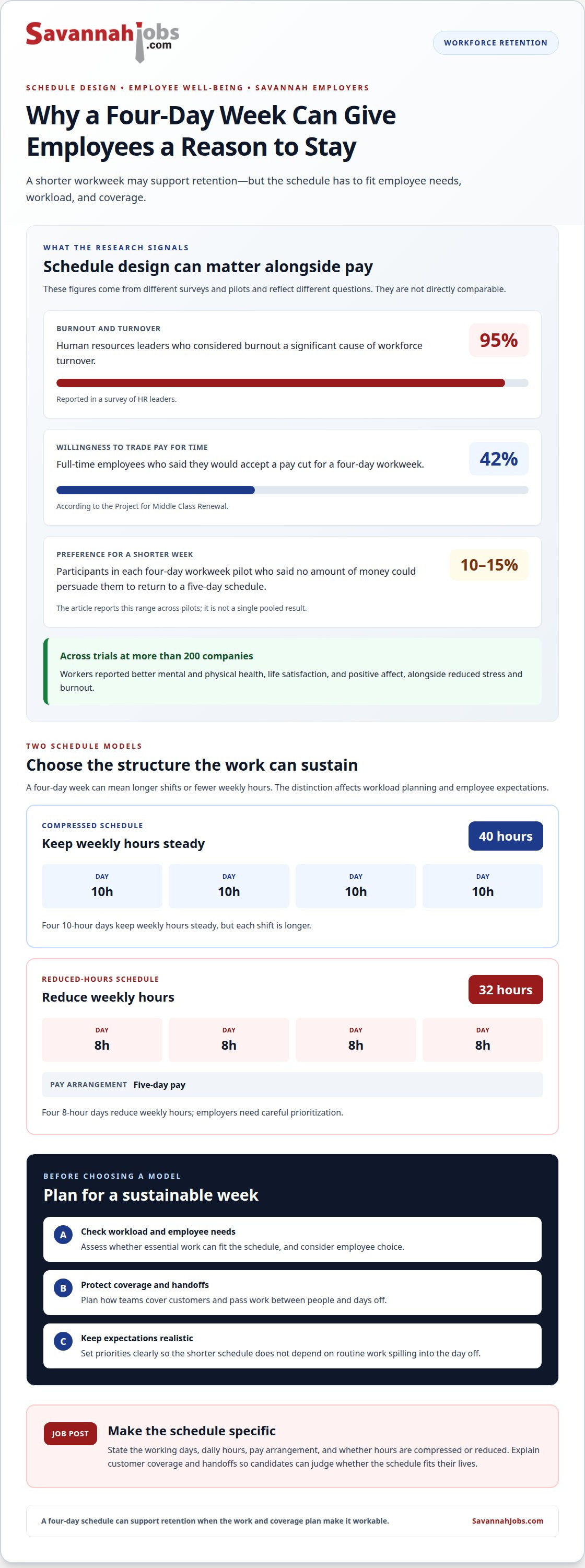
A four-day workweek can give employees a reason to stay beyond pay. In each four-day workweek pilot, between 10% and 15% of participants said no amount of money could persuade them to return to a five-day schedule. According to the Project for Middle Class Renewal, 42% of full-time employees said they would accept a pay cut for a four-day workweek. These findings suggest that schedule design can influence job satisfaction and retention.
Well-being also matters. A survey found that 95% of human resources leaders considered burnout a significant cause of workforce turnover. Across trials at more than 200 companies, workers reported better mental and physical health, life satisfaction, and positive affect, alongside reduced stress and burnout. Those improvements can help employees feel their workweek is more sustainable.
Employee choice and workload planning are essential. A compressed schedule might mean 40 hours across four 10-hour days, while a reduced-hours model can mean 32 hours across four days with five-day pay. The first keeps weekly hours steady but lengthens each shift; the second reduces hours and requires careful prioritization. Employers should assess coverage, handoffs, and workload before choosing a model.
For Savannah employers, a four-day schedule must still comply with applicable federal and Georgia requirements for pay and hours. Changing the workweek does not remove those obligations.
What percentage of job seekers prefer a four-day workweek? A survey found that 8% of people preferred a five-day workweek, but that does not establish a job-seeker-specific preference for four days. Treat the schedule as a potential attraction, not a substitute for understanding candidates’ needs.
Describe the schedule clearly in each job posting: specify working days, daily hours, pay arrangement, and whether the model compresses or reduces hours. Explain how teams handle customer coverage and handoffs. Remote work may offer flexibility, but it is a separate arrangement. Clear details help candidates decide whether the schedule fits their lives and help new employees start with accurate expectations.
2. Younger generations’ preferences for flexibility and work-life balance
A shorter workweek can signal that an employer values time beyond the job. In Spark Market Research, 78% of UK people aged 18-34 believed a four-day workweek would become the norm within five years. That finding reflects expectations among younger adults in the UK, not a measure of Savannah candidates. Still, it shows why schedule flexibility can help a role stand out to talent comparing workplace benefits.
Work-life balance is a practical recruiting draw, not just a slogan. In the UK pilot, 62% of participants found it easier to combine work with their social life. For candidates weighing a new job, an extra day away from work may make time for family, appointments, rest, or personal goals. Employers can explain which schedule model they use and how employees can plan their days off.
How does a four-day workweek help companies attract candidates? It gives applicants a concrete schedule benefit to compare with other roles. Clear details about working days, hours, pay, and coverage help them judge whether the arrangement fits their needs.
Flexibility may also matter to employees concerned about burnout and mental health. In a UKRI study of four-day workweek trials, 71% of employees reported less burnout. A reduced schedule can support life balance, but the work still needs realistic priorities. Employers should identify essential tasks, set clear handoffs, and protect the day off from routine work demands.
Productivity depends on how teams organize the shorter workweek, not simply on fewer scheduled days. For example, a team can agree on response coverage and shared deadlines before adopting the schedule. State those expectations in the job description, then use interviews to explain how the arrangement works in practice. To reach local candidates, employers can also share Savannah-area job openings with people seeking a better fit between work and personal time.
3. Four-day work week as a recruiting and retention benefit
A four-day workweek can help organizations stand out when candidates compare roles. For employers weighing the benefits of a 4-day work week for recruiting, the schedule can offer a distinct alternative to familiar workplace perks. In a survey, 63% of employers said offering one helped attract and retain talent. About 80% of respondents to the American Psychological Association’s Work in America survey believed they would be happier and just as effective working four days. These findings point to a potential advantage, not a hiring outcome every employer can expect.
Does offering a four-day workweek increase job applications or offer acceptance rates? Atom Bank reported a 500% increase in job applications after introducing the schedule. That example shows applications can rise, but it doesn’t establish a typical result or confirm higher offer acceptance rates. Track both measures separately, alongside candidate quality and retention, to see what changes in your hiring process.
Compare the schedule with higher pay or remote work based on what candidates value and what the role requires. A four-day week offers time away from work; higher pay changes compensation, while remote work changes where work happens. One option may matter more to a candidate than another. State the schedule, pay arrangement, location expectations, and coverage requirements clearly so applicants can assess the full offer.
Performance measures help protect engagement and retention after hiring. Before a trial, define the work that must be completed, then monitor output, quality, service response, and employee feedback. A 1999 meta-analysis of compressed workweeks found higher performance ratings and job satisfaction, but no changes in absenteeism or productivity. That distinction is useful: satisfaction may improve even when productivity does not.
Which industries and roles benefit most? Roles organized around planned deliverables and predictable handoffs may be easier to schedule across four days. Healthcare, emergency services, manufacturing, and retail often require continuous operations, making coverage more complex. In Savannah, organizations should map customer needs and shift coverage before presenting a shorter week as a recruiting benefit. The benefits of a 4-day work week for recruiting depend on clear expectations and a schedule the role can support. In UKRI trials, 92% of participating businesses retained the model after the trial, an outcome that supports testing the schedule against clear expectations.
4. Recruitment and turnover costs
Replacing an employee can cost more than recruiting a replacement. In the UK pilot, reported replacement costs ranged from 50% to 200% of an employee’s annual salary. That range illustrates why retention can affect workforce budgets: departures may require recruiting, onboarding, and time for a new hire to become effective. It isn’t a Savannah-specific estimate, but the underlying cost categories are relevant when employers assess turnover.
A shorter workweek may help reduce those costs if employees stay longer. That estimate reflects UK businesses, not a forecast for Savannah employers. Compare your own hiring and turnover patterns before and after a schedule change rather than assuming the same savings will apply.
Start with a simple workplace review. Track vacancies, time spent recruiting, onboarding effort, and employee departures. Compare those measures with employee feedback on workload, coverage, and the schedule. If workers are happier but service or output suffers, the model may need adjustments. If retention improves while core work continues smoothly, the schedule may support staffing stability and recruitment.
Just over half of companies operating on a four-day workweek reported cost savings. That result suggests savings are possible, not automatic. A business may need to reorganize shifts, redistribute tasks, or maintain coverage on the fifth weekday. Those choices can affect the balance between potential retention gains and operating needs. For Savannah employers, define the measures that matter before a trial, then review them consistently.
Use the findings to make a grounded hiring decision. Compare turnover and recruiting effort alongside service, output, and employee feedback. Share a clear description of the schedule with local candidates so they understand the offer before applying. To advertise open roles to Savannah-area job seekers, post a local job opening.
SavannahJobs.com
SavannahJobs.com helps employers advertise open roles to the local workforce as they put a hiring plan into action. A 30-Day Job Posting gives you a way to share an opportunity with Savannah-area job seekers. For added visibility, employers can choose a Featured Job Upgrade or Featured Employer Upgrade.
Use these options when your schedule, workload, and coverage plans are clear enough to explain in a job ad. Describe the four-day arrangement accurately, including workdays, hours, pay structure, and how the team handles coverage. Clear details help candidates decide whether the role fits before they apply.
Ready to promote an open role to Savannah job seekers? Post it on SavannahJobs.com to reach local candidates.
Put a clear hiring plan into action
A four-day schedule is a workforce design choice, not just a line in a job ad. Before making it part of your recruiting approach, identify which roles can meet their goals within the arrangement and where dependable coverage matters most. Set practical measures for workload, service, and employee feedback. This gives managers a shared basis for deciding whether the schedule fits, rather than relying on enthusiasm alone.
The benefits of a 4-day work week for recruiting are strongest when the offer matches the day-to-day reality of the role. Keep the hiring message aligned with how the team actually works, and review candidate responses alongside workforce needs. A thoughtful plan can help Savannah employers present opportunities with clarity and build trust with local job seekers.
Ready to promote an open position? Contact SavannahJobs.com about hiring and take the next step toward reaching Savannah-area candidates.
Frequently Asked Questions
What is a Four-Day Work Week?
A four-day workweek can mean four days totaling 32 hours, with five-day pay, or four 10-hour days totaling 40 hours. The first reduces weekly hours; the second compresses the same total into longer shifts. In a Savannah job posting, state which model applies, along with workdays, hours, pay arrangement, and coverage expectations. That gives applicants a clear picture of the schedule.
What recruiting and retention benefits have companies reported after adopting a 4-day workweek?
Businesses operating on a four-day workweek have reported happier, less-stressed employees. In one survey, 78% said employees were happier, and 70% said employees were less stressed. Those reported experiences may help employers make roles more appealing and support retention. They don’t establish that every workplace will see the same results, so compare applicant flow and employee departures with your own baseline.
What are the costs of offering a 4-day workweek to recruit employees?
There’s no single cost for adopting the schedule; the main expense depends on how work and coverage change. A compressed schedule keeps weekly hours steady but uses longer shifts, while a reduced-hours model keeps pay steady despite fewer hours. Employers should consider staffing coverage, workload distribution, and operational changes needed to serve customers. These decisions shape the cost more than the schedule label alone.
What recruiting risks or candidate concerns come with a 4-day workweek?
Candidates may want to know whether the schedule means longer days or fewer weekly hours, and how pay is handled. They may also ask which day is off, whether it stays consistent, and how the team handles customer needs during that time. Address these points in the job description and interviews. Clear expectations help applicants judge fit and reduce confusion after hiring.
What evidence from 4-day workweek trials shows effects on hiring and retention?
Trial results offer evidence about employee acceptance and work-life experience, though they don’t predict every employer’s hiring results. In a compressed-workweek study in Zorra, Ontario, 73% of participating government employees said they would continue the schedule if given the chance. A 2024 study of 247 construction workers found improved work-life harmony without increased fatigue. Employers can use similar measures to assess fit.


