

An anonymized application screen or AI hiring tool does not prove that your process is fairer. To measure progress, compare candidate outcomes at each hiring stage and assess whether people with comparable skills are evaluated using the same criteria. Reducing hiring bias in your process means tracking what changes, not simply adding a new tool.
It is reasonable to want a consistent hiring process that gives qualified candidates a fair assessment. The practical test is whether shared scoring rubrics, structured interviews, or identity-swapped applications make screening and selection decisions more consistent. This guide explains how to set a baseline, compare results over time, and identify uneven patterns without treating a single metric as proof. You will also learn what anonymized screening can and cannot show, and how to assess AI tools by comparing their outputs with your stated job criteria. Use these checks to identify where your process may need adjustment and whether a change is making a measurable difference.
Key Takeaways
- Track who advances at each hiring stage to spot where candidate outcomes begin to diverge.
- Use identity swaps to test whether the same qualifications prompt different judgments when candidate details change.
- Blind applications to personal details during initial screening, then consider how later stages may reintroduce bias.
- Assess AI hiring tools by reviewing their recommendations against job-related criteria and looking for uneven patterns.
1. How can companies measure the success of bias-reduction strategies in their hiring processes?
Define role-specific skills before reviewing resumes, then apply the same scoring rubric to every candidate. Track who advances from screening to interview, assessment, and offer, and compare outcomes across stages to see where participation changes. A shift highlights a stage for closer review, but does not prove bias on its own. To reduce bias, standardize decisions and examine the criteria behind them.
Structured interviews make candidate comparisons more consistent. Ask every candidate the same core questions in the same order, using a guide that links each question to a job competency. For a customer-facing role, for example, ask everyone how they would respond to the same challenging customer scenario. Interviewers can assess answers against defined indicators rather than personal chemistry. Diverse panels and multiple interviewers can add perspectives, but each interviewer should score candidates independently before the group discussion. This can help limit affinity bias, the preference for candidates who share an interviewer’s background, interests, or alma mater.
Document each response with specific evidence, such as the steps the candidate described or a relevant example. After the interview, compare notes with the rubric and discuss differences in scores. Do not let one confident impression outweigh the full set of answers. Consider where unconscious bias could affect an assessment, especially when a candidate’s communication style or experience differs from the panel’s expectations. Apply the same criteria to every candidate.
Effective ways to reduce bias include consistent interview guides, job-related scoring, and evidence-based review. Cultivating these capabilities across hiring managers often starts with targeted leadership support, where development consultancies like Humanise Solutions design bespoke programmes to foster team excellence and objective decision-making. U.S. employers must avoid discrimination in hiring under applicable federal and state protections, and the EEOC enforces federal employment discrimination laws. Use consistent, job-related standards rather than assumptions about identity.
Inclusive job descriptions use clear, role-related language and avoid suggesting that only one type of candidate belongs. Replace vague demands such as “culture fit” with specific skills and responsibilities. Skills-based assessments can test those requirements directly by giving applicants the same work sample or task. To support candidates with disabilities, make interview instructions and assessment formats accessible, and provide a clear way to request an accommodation. These steps help teams assess relevant ability rather than avoidable barriers.
2. Testing decisions by swapping candidate identities
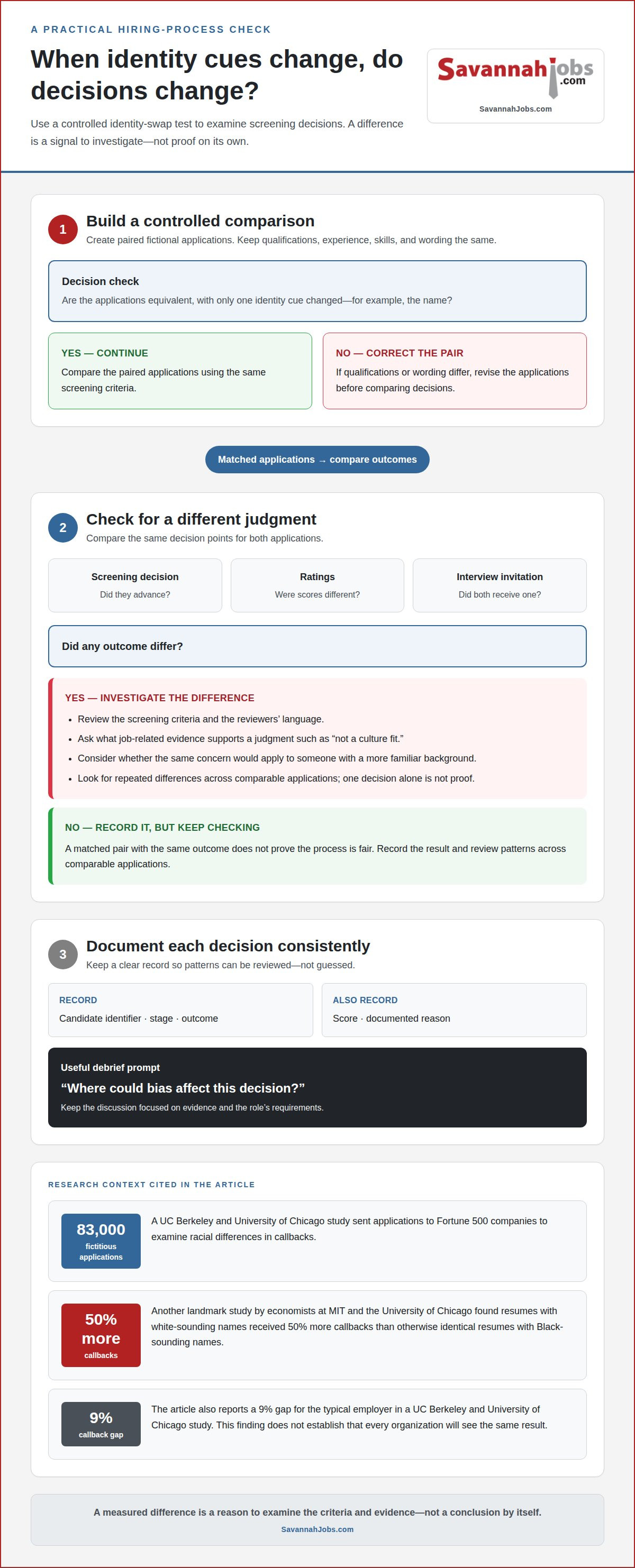
An identity-swap test checks whether the same qualifications receive different judgments when identity cues change. Create paired fictional applications with identical experience, skills, and wording, then vary one detail, such as the name. Compare screening decisions, ratings, and interview invitations. Changing one cue at a time makes it easier to see which difference may influence the response.
A UC Berkeley and University of Chicago study sent 83,000 fictitious applications to Fortune 500 companies to examine racial differences in callbacks. Another landmark study by economists at MIT and the University of Chicago found resumes with white-sounding names received 50% more callbacks than otherwise identical resumes with Black-sounding names. These findings illustrate why applicants’ qualifications should remain constant in a controlled comparison.
Use the same test when reviewing interview debriefs. If a panel describes a candidate as “not a culture fit,” ask what job-related evidence supports that judgment. Then consider whether the same concern would apply to someone with a more familiar background. This comparison can reveal assumptions, including gut feelings unsupported by interview examples.
Record each decision consistently, including the candidate identifier, stage, outcome, score, and documented reason. Review patterns across comparable applications rather than treating a single decision as proof. For example, if applicants with equivalent experience repeatedly receive different screening outcomes when an identity cue changes, examine the screening criteria and reviewers’ language. A short debrief prompt, “Where could bias affect this decision?” can keep the discussion focused on evidence.
When candidates bring different backgrounds, distinguish role requirements from preferences for familiar career paths. Ask reviewers to name the relevant skill before dismissing experience that looks unfamiliar. This helps teams recognize overlooked talent and develop more objective decisions. Once screening standards are clear, a local job posting can present the role’s requirements plainly to Savannah-area applicants.
3. Anonymizing applications during screening
Blind resume screening hides identifying details before reviewers assess applicants’ qualifications. A hiring team can remove names, email addresses, birth dates, gender, and nationality during the initial review. Retain job-related information, such as skills, work history, and relevant training, so screeners can compare candidates with the role’s requirements.
Name bias can affect how reviewers interpret otherwise similar applications. One practical test is to prepare equivalent resume versions with names changed, then compare screening ratings while keeping experience and qualifications constant. Research on callbacks has reported differences associated with names, including a 9% gap for the typical employer in a UC Berkeley and University of Chicago study. The finding concerns callbacks, not proof that every organization will see the same result.
To introduce anonymized screening, decide which details are irrelevant to the initial assessment. Then use a consistent process to hide them and apply the same structured criteria to every application. For example, reviewers might score required software skills and relevant experience before seeing names. Record who advances at each stage, the stated reasons, and whether outcomes change after the process is introduced.
Blind screening can reduce exposure to identity cues, but it cannot eliminate every source of bias. Work history, school names, or graduation dates may still suggest personal details. Anonymization also ends when identities become visible later, so keep job-related criteria consistent during interviews and final decisions. Measure progress through outcomes at each stage and documented reasons, not by the tool alone.
Employers can reduce bias in recruiting and sourcing by sharing clear, skills-focused job descriptions through varied channels and applying the same screening standards to every applicant. A consistent process helps assess talent against role requirements rather than assumptions about gender, background, or familiarity. Review screening outcomes over time and adjust criteria that exclude qualified candidates without a job-related reason.
4. AI tools for reducing hiring bias
An AI screening tool can sort applications quickly, but its rankings still reflect its design and input data. If past hiring decisions favored a narrow career path, a system trained on those decisions may repeat that preference. Treat each recommendation as something to examine, not as an objective measure of talent. A practical way to reduce hiring bias in your process is to test whether the tool rewards skills the role actually needs.
Before using a tool, define the job-related criteria it should assess. If a role requires scheduling experience, for example, check whether the system looks for that skill or rewards unrelated signals, such as a particular job title. Ask how the tool ranks applicants, what information it uses, and whether recruiters can review the reasons behind a recommendation. A polished score alone does not explain a decision.
Audit outcomes at each recruitment stage. Compare which applicants the tool advances, rejects, or flags for review, then examine whether results vary across demographic groups. Keep role criteria and review periods consistent so changes are easier to interpret. Where possible, test equivalent profiles that differ in one identity cue and see whether rankings change. Investigate disparities by tracing them to input data, screening rules, or human overrides.
Risks include reproducing historical biases, overlooking qualified applicants, and making hiring decisions that are difficult to explain. An audit can compare recommendations with job-related criteria, review outcomes across groups, and check sample applications for inconsistent rankings. Continue research and monitoring after adoption, since changes to data or recruitment practices can affect results. Regular reviews make reducing hiring bias in your process an ongoing practice, not a one-time tool check.
Keep a human decision-maker accountable for reviewing AI recommendations. Record when reviewers accept or override a ranking, with a job-related reason, and check whether the system creates inclusive opportunities across the funnel. If the tool screens out candidates for experience that isn’t essential, revise the criteria and reassess its results. For Savannah employers, advertise an open role to local candidates while keeping selection standards clear and consistent.
SavannahJobs.com
SavannahJobs.com helps employers advertise open roles to the local Savannah workforce through recruitment advertising. After refining your screening and evaluation steps, write a clear job posting that describes the role’s responsibilities and required skills. This gives applicants useful information before they apply and helps your hiring team focus on job-related qualifications.
Employers can choose a 30-Day Job Posting, Featured Job Upgrade, or Featured Employer Upgrade. These options support local job advertising, while your interview guides, screening criteria, and review process shape how candidates are assessed. A posting platform doesn’t replace those internal steps, but it can help bring your opportunity to local job seekers.
To advertise an open role in Savannah, post it on SavannahJobs.com.
Make the next hiring decision more deliberate
Fairness grows through repeated decisions, not a single screening change. Set a regular review point, assign someone to examine hiring outcomes, and turn findings into a clear process adjustment. If applicants drop out at one stage, for example, review the criteria and candidate experience there. Record what you change and what you’ll assess in the next hiring cycle. This keeps reducing hiring bias in your process connected to everyday decisions instead of treating it as a one-time project.
Then make the role’s expectations clear from the first point of contact. A focused job advertisement can help candidates understand the opportunity and decide whether their skills match. Keep refining the process as your team learns, and make each adjustment part of how you hire. For your next local opening, contact SavannahJobs.com today about reaching Savannah-area job seekers. Practical, consistent steps can help your team build a more thoughtful hiring process.
Frequently Asked Questions
How can companies measure the success of bias-reduction strategies in their hiring processes?
Measure whether process changes improve consistency and widen access to qualified applicants. Compare advancement rates between hiring stages before and after a change, accounting for differences in role requirements and applicant pools. Review candidate and interviewer feedback for recurring barriers, too. For example, if applicants withdraw after a particular assessment, examine its relevance, instructions, and format before deciding whether it supports the role.
Can technology completely eliminate hiring biases?
No. Technology can reduce exposure to some identity cues, but criteria, data, and people can still shape decisions. An application system, for example, may hide names during initial review but reveal them later. Treat technology as one part of a broader process: define job-related standards, review how tools affect applicants, and ensure a person remains accountable for each hiring decision.
How does structured interviewing work to reduce biases?
Structured interviewing gives candidates a consistent opportunity to demonstrate relevant skills. A practical guide can pair each question with the capability being assessed and examples of strong evidence. For a project role, interviewers might ask every applicant how they handled a missed deadline. This makes it easier to compare relevant reasoning rather than favoring a polished speaking style or shared personal interests.
What are the main types of biases in hiring?
Common patterns include affinity bias, when decision-makers favor people who feel familiar; confirmation bias, when they seek evidence for an early opinion; and halo or horn effects, when one trait dominates an assessment. Stereotype bias can also shape assumptions about a candidate’s identity or life circumstances. A useful diagnostic is to ask reviewers to support each concern with role-related evidence.
What role do HR professionals play in implementing bias-reduction technologies?
HR professionals help connect a tool’s settings with actual job requirements. They can document which criteria the system uses, train hiring teams to interpret its outputs, and review cases where recommendations conflict with interview evidence. For example, HR can ask whether a screening filter excludes applicants for a credential the role does not require, then arrange a review of that criterion.
How do structured interviews reduce hiring bias?
HR teams can reduce opportunities for inconsistent treatment by setting a shared interview plan before candidates meet the panel. They can prepare follow-up prompts for incomplete answers and a scoring guide tied to role competencies. Interviewers should record evidence separately before discussing candidates together. This helps prevent an early panel opinion from steering later reviewers and gives candidates a comparable opportunity to explain their experience.


