

A résumé shows where someone has been, but not everything they could bring to your team. The practical answer to how to hire for potential, not just experience, is to separate the skills a role needs on day one from those a candidate can learn, then assess transferable strengths, adaptability, and willingness to grow.
Experience still matters. Someone who has handled similar responsibilities may need less training, while a candidate from another industry could bring useful problem-solving skills and a fresh perspective. The goal isn’t to choose potential over experience every time. It’s to weigh both against the role’s actual needs.
This guide explains how to identify transferable skills, evaluate potential with focused questions and practical assessments, and balance growth-minded candidates with experienced hires. You’ll also learn how a clear job description and consistent selection criteria can support stronger hiring decisions for your Savannah team.
Key Takeaways
- Separate must-have requirements from skills that can be learned, then look for transferable abilities across a candidate’s work and life experience.
- Use consistent interview questions and practical assessments to evaluate adaptability, curiosity, problem-solving, and openness to feedback.
- Match hiring choices to the role: experienced hires can address immediate needs, while potential-focused hires may bring fresh perspectives and room to grow.
- Build a balanced team by pairing experience with potential, and use clear job postings to reach candidates across the Savannah workforce.
1. Evaluating transferable skills
Experience-based hiring can narrow your choices when qualified candidates come from other industries. Around 40% of employees will require reskilling in six months or less, so a résumé built around familiar job titles may miss people who can learn new tasks. Start by separating essential, day-one requirements from skills that training can develop.
Match each essential requirement to evidence of a transferable skill. A retail supervisor, for example, may have managed schedules, handled customer complaints, and coordinated a team, all relevant to a service-team lead role. The U.S. Department of Labor identifies adaptability, problem-solving, and critical thinking as soft skills. Look for specific examples of these abilities on a résumé rather than relying on a candidate’s industry label.
Demonstrated skills and behaviors offer a better basis for assessing future performance than credentials alone. Use the same behavioral questions and work-related assessment for every candidate. Ask how they solved a problem, learned a task, or responded to feedback. To reduce bias, set job-related criteria before reviewing applications, score answers against a shared rubric, and don’t treat a familiar career path as proof of ability.
Skills-first hiring can broaden the talent pool to include people with different industries, educational experiences, or career paths. For AI-related roles, a skills-based approach can increase the global talent pool by 8.2 times. On a resume, leadership may appear in examples such as training coworkers, coordinating a project, or taking ownership of results, even without an executive title.
To measure success, track whether hires meet role-specific performance goals, complete training, and remain with the organization. Compare outcomes across hiring approaches using the same criteria. This gives your team practical evidence of whether assessing transferable skills helps fill roles and support growth, rather than relying on impressions of who seemed promising in an interview.
2. So… How do you actually hire for potential?
Potential-focused hiring can work well for entry-level roles, new positions, and jobs where responsibilities are changing. Candidates for an entry-level opening may have limited direct experience but show curiosity, adaptability, and motivation. A new role may also suit someone with related skills and a fresh perspective, rather than a familiar industry playbook.
Start by aligning leaders and hiring managers on which capabilities matter now and which can be taught. A small group can pilot the approach and share what worked with the wider team. Before reviewing applications, have managers agree on the same selection criteria. A shared approach makes potential part of the decision from the outset, not an afterthought.
To assess learning agility, give candidates a realistic new problem and observe how they gather information, adjust their approach, and use feedback. Ask, “Tell me about a time you had to learn something quickly,” and “What changed after you received feedback?” Specific examples reveal more about adaptability than broad claims on a CV.
Design a work sample around an actual task, such as prioritizing customer requests or drafting a response to a routine workplace problem. Give every candidate the same instructions, time, and scoring rubric, then assess the work against role-related criteria. This keeps the exercise focused on demonstrated ability rather than polish, familiarity, or access to specialized resources.
Experienced candidates bring clear advantages. Someone who has handled similar responsibilities may need less training and supervision, which can help meet immediate team needs. But a CV alone doesn’t show how a candidate thinks today. Use structured interviews, relevant work samples, and consistent reference checks to understand both past performance and potential contributions.
For hires with less direct experience, set learning goals, provide role-specific training, and pair new employees with a knowledgeable teammate. A growth-oriented onboarding plan helps translate promise into day-to-day performance. A clear job description can also explain trainable skills and attract candidates across Savannah; increase local employer visibility as you share the opportunity.
3. Balancing potential hires with experienced hires
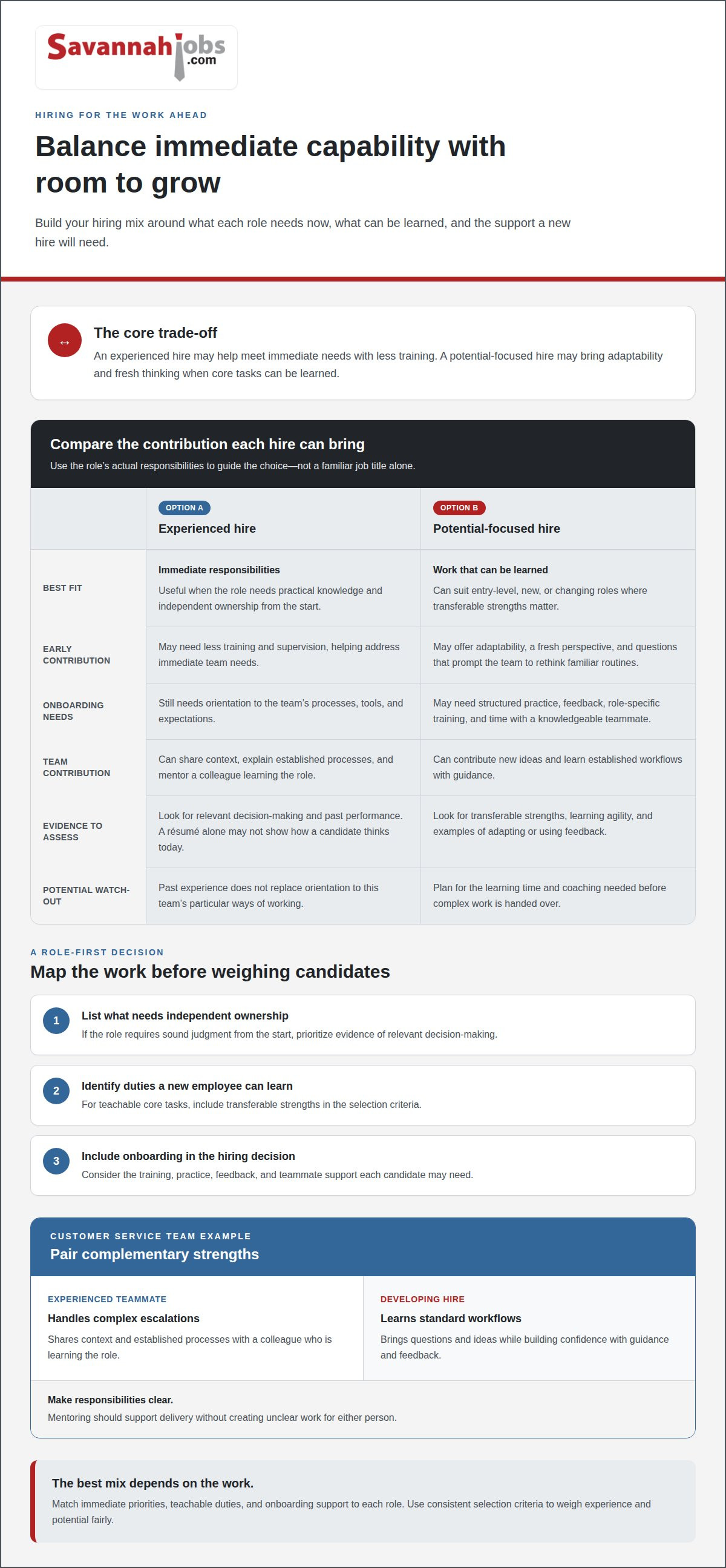
Build your hiring mix around the work each role must handle. For immediate responsibilities, an experienced employee can bring practical knowledge and may need less time to get up to speed. For work that can be learned, a candidate with potential may offer adaptability and fresh thinking. In a customer service team, for example, an experienced employee might handle complex escalations while a developing hire learns standard workflows.
Pair complementary strengths deliberately. An experienced team member can explain established processes, share context, and mentor a colleague learning the role. The newer hire can contribute questions and ideas that prompt the team to reconsider familiar routines. Define responsibilities clearly so mentoring supports delivery without adding unclear work to anyone’s day.
During recruitment, map each opening to immediate priorities and future opportunities. List the tasks that need independent ownership, then identify duties a new employee could learn with guidance. If a role requires sound judgment from the start, prioritize evidence of relevant decision-making. If its core tasks are teachable, include transferable strengths in the selection criteria.
Account for onboarding, too. A potential-focused hire may need structured practice, feedback, and time with a subject-matter expert before taking on complex work. Include that learning plan in the hiring decision. An experienced hire may reduce the initial coaching load but still needs orientation to team processes, tools, and expectations.
Assess the mix through role-specific results, not assumptions about either group. Track whether experienced hires handle priority work and whether developing employees gain the skills assigned to them. Review workload, collaboration, and progress in regular manager check-ins. If a new hire is progressing slowly, identify whether the gap involves training, unclear expectations, or a mismatch between the role and their strengths. Adjust recruitment criteria as team needs change.
4. Potential versus prior experience
Prior experience shows what candidates have done; potential points to what they may learn and contribute next. That difference matters when an organization faces a new challenge, such as adopting unfamiliar technology or changing how it serves clients. An experienced employee may bring immediate expertise, while someone from another background may offer adaptable thinking and fresh ideas.
The risk of hiring for potential is choosing someone who lacks skills essential to the role or needs more training than the team can provide. The opposite risk is treating a familiar résumé as proof of future success while overlooking motivation, learning ability, or a mismatch with team expectations. When deciding how to hire for potential, not just experience, set essential requirements first and assess potential against clear evidence.
Consider the work itself. If a position requires specialized judgment from the start, relevant experience can shorten the learning curve. If the organization can teach the technical tasks, curiosity, problem-solving, and openness to feedback may matter more. Two Lotus Cars paint shop workers, for example, had McDonald’s as their only previous work experience before joining the company. Their path shows why an industry-specific background isn’t the only evidence worth considering.
Use a balanced decision process: identify must-have capabilities, test candidates against realistic job tasks, and examine how they respond to coaching. Then consider the support available from current employees. A candidate with potential may need structured training and time to build confidence; an experienced hire may contribute sooner but still needs to learn your organization’s processes and culture.
A practical decision about how to hire for potential, not just experience, connects the evidence to the job’s immediate demands and future direction. Keep the same standards for every candidate. If you’re ready to reach local applicants, share your open role with Savannah job seekers.
SavannahJobs.com
SavannahJobs.com helps employers reach the local workforce through recruitment advertising. If you’re hiring for potential, make your job posting clear about essential skills, trainable tasks, and opportunities to grow. This helps candidates from different backgrounds understand how they could contribute to your Savannah team.
A 30-Day Job Posting advertises an open position, while the Featured Job Upgrade and Featured Employer Upgrade provide additional visibility options. These tools can support your recruitment efforts as you seek experienced applicants and candidates with transferable skills. Use the job description to explain what the role requires and what employees can learn after joining.
For your next Savannah-area opening, contact SavannahJobs.com to discuss advertising the opportunity.
Make your next hiring decision a deliberate one
Use your next vacancy to turn hiring priorities into a practical decision. Before applications arrive, agree on what the new employee must handle immediately and what they can learn with support. Use those priorities to shape the job description, interview discussion, and final decision. This gives your hiring team a consistent basis for weighing readiness alongside room to grow.
Deciding how to hire for potential, not just experience, doesn’t mean lowering the bar. It means choosing evidence that fits the work ahead rather than relying on a familiar career path alone. Keep reviewing whether your criteria serve the role as your team’s needs change, and make each hiring decision with a clear purpose.
For your next Savannah-area opening, contact SavannahJobs.com about hiring. A thoughtful search can help you connect with candidates ready to contribute and develop. Take the next step with confidence.
Frequently Asked Questions
So… How do you actually hire for potential?
Start with the work the role must deliver, then decide which capabilities can develop after hiring. For example, a small Savannah business hiring an operations coordinator might prioritize organization, sound judgment, and follow-through over experience with a specific scheduling platform. Ask candidates how they handled a comparable responsibility, then assess their reasoning against the role’s actual demands.
What Can High-Potential Employees Offer You?
High-potential employees can bring learning agility, resilience, and perspectives shaped by different work or education backgrounds. For a growing team, someone who has learned new systems quickly may adapt well as responsibilities shift. Their value isn’t automatic: connect their strengths to a defined role, provide useful feedback, and offer opportunities to take on work as their capabilities grow.
What does hiring for potential mean compared with hiring for experience?
Hiring for potential weighs a candidate’s capacity to learn and take on future responsibilities; hiring for experience emphasizes evidence of having performed similar work. For a role with established procedures and immediate independent duties, prior experience may carry more weight. For a role with teachable tasks or changing needs, demonstrated learning and transferable abilities can also inform the selection.
What does research say about hiring for potential versus experience?
Hiring guidance increasingly emphasizes assessing job-related skills and capabilities rather than relying on credentials or job titles alone. This approach can bring candidates with relevant strengths from other industries into consideration. It doesn’t mean experience has no value: experience can show role-specific knowledge, while assessments and behavioral examples help reveal how candidates learn and respond to unfamiliar challenges.


