

A résumé is a starting point, not proof. Knowing how to verify employment history means checking a candidate’s reported employers, job titles, and dates against information from former employers and relevant payroll records. To confirm current employment, ask whether the candidate still works for the listed employer and compare the answer with available records.
Don’t rely on a job title alone. Differences in dates or employer details may have a straightforward explanation, so verify the facts and give the candidate an opportunity to clarify discrepancies before drawing conclusions.
This guide explains how to verify employment history, review employer and payroll information, and identify inconsistencies in candidate-reported records. It also distinguishes work-history verification from employment eligibility checks, helping Savannah employers focus on the information relevant to hiring.
Key Takeaways
- Compare reported employers, job titles, and dates with employer and payroll records, and verify current job status separately from past employment.
- Keep work-history checks distinct from work-eligibility checks: according to U.S. Citizenship and Immigration Services, employers must complete Form I-9 before using E-Verify to check employment eligibility.
- When details don’t align, identify the specific discrepancy and give the candidate a chance to explain it before reaching a conclusion.
- When you’re ready to advertise an opening to Savannah-area job seekers, SavannahJobs.com offers a 30-Day Job Posting.
Employment and income data from employers and payroll providers
Employer and payroll records can help confirm a candidate’s work dates, role, and reported income. Keep work-history verification separate from employment eligibility checks, which follow a different process.
Check Cost and Timing
The cost of an employment background check depends on its scope, including which employers and payroll records need review. Timing depends on how quickly those organizations respond and whether their records match the candidate’s details. Before choosing a check, clarify what it covers, which sources it uses, and how it handles missing or conflicting information.
For example, checking one former employer may take fewer steps than reviewing several jobs and income records. A payroll provider may respond differently from an employer contacted directly. Choose a scope that matches the information you need, rather than selecting a check by name alone.
Requesting Former Employment Records
To request records from a former employer, ask the candidate to identify the employer and relevant dates, then contact its human resources or payroll department. Specify the information you need, such as job title, employment dates, or recorded pay, and provide any authorization the employer requires.
If the former employer directs verification requests to a payroll provider, follow that process and compare the response with the candidate’s résumé. Be clear about whether you need an employment record or a pay record. A pay statement, for example, can show earnings for a period but may not confirm a job title.
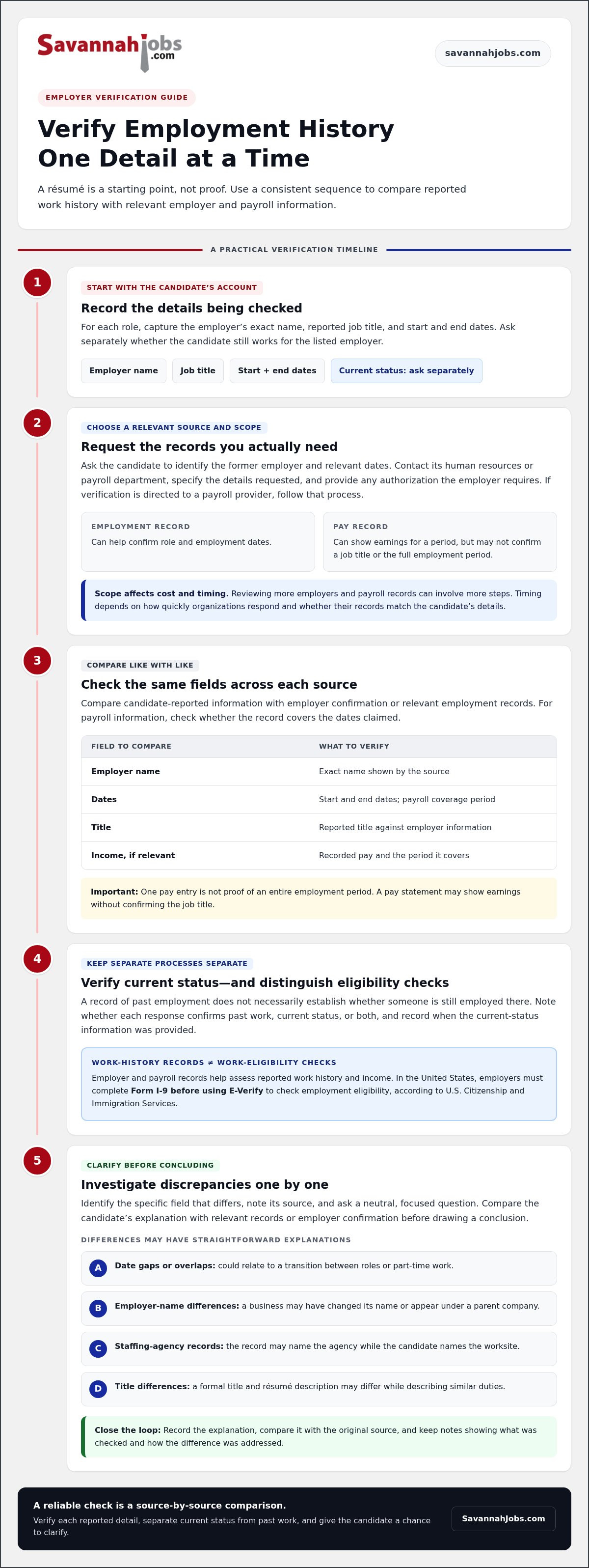
Compare the same details across each source: employer name, start and end dates, title, and income period. Check whether a payroll record covers the dates claimed, and don’t treat one pay entry as proof of the entire employment period. If a date differs, note the specific discrepancy and ask the candidate for context before deciding what it means.
Handle income verification carefully. State rules vary: some allow salary verification, while others prohibit employers from asking candidates about salary history. Be clear about the purpose and use income information only when it is relevant to the hiring decision. Past pay is not a substitute for assessing a role’s requirements.
Employment eligibility is separate. In the United States, employers must complete Form I-9 before using E-Verify to check employment eligibility, according to U.S. Citizenship and Immigration Services. Form I-9 and E-Verify address work eligibility, while employer and payroll records help assess reported work history and income.
Confirming past work history and current job status
To verify your own employment history in the United States, list each employer, job title, and employment dates. Compare the list with your pay statements, tax records, and written confirmations from former employers. Employers can use the same details to organize and verify each candidate’s work history.
Check current employment separately from past work. Ask whether the candidate still works for the listed employer, and record when the information was provided. A past employment record may confirm a former role without showing whether the person is still employed there.
Use a consistent process for every workplace. Start with the candidate’s reported details, then compare them with a source connected to the employer. For example, a résumé might list a role at a Savannah business from March through October. Confirmation from the employer can help establish whether the dates and title are accurate.
- Record the employer’s exact name, reported job title, and start and end dates.
- Compare each detail with employer confirmation or relevant employment records.
- Note whether the response concerns past employment, current status, or both.
For current and former U.S. Department of Labor employees, the department’s automated employment verification service allows third parties to verify employment and salary information. It applies to DOL employment only, not a candidate’s work history with other employers. Note the source and the specific details it confirms.
A reliable way to verify employment history is to check each reported detail against an appropriate record. If information differs, identify the field and ask the candidate to explain. A gap, revised title, or employer name change may have a reasonable explanation. Record the response and compare it with the original source before making a hiring decision.
Savannah employers planning their next hiring round can explore local hiring resources alongside their verification process.
Detecting inconsistencies in candidate-reported history
Compare each reported role with source records, then look into discrepancies individually. A mismatch calls for clarification, not an automatic conclusion about the candidate.
Look for common explanations. Overlapping dates may reflect part-time work or a transition between roles. An employer may have changed its name or appear under a parent company. Payroll records may list a staffing agency while the candidate names the worksite. Job titles can also differ while describing similar duties.
- Check for unexplained date gaps or overlapping positions.
- Compare employer names with business names shown on records.
- Separate the staffing agency from the company where work occurred.
- Note differences between formal titles and résumé descriptions.
For each discrepancy, record the specific detail and its source. Ask the candidate a neutral, focused question, such as whether the role was through a staffing agency. Compare the response with relevant records or employer confirmation, and include the explanation in your notes so the hiring team can see what was checked and how the difference was addressed.
To correct inaccurate employment history in a background check, identify the incorrect entry and contact the screening company that prepared the report. Provide supporting documents, such as pay statements or employer correspondence, and notify the hiring employer which item is disputed.
Use the same review process for every candidate. If a record names a parent company while the résumé lists its local division, for example, confirm whether both refer to the same employment. If dates remain inconsistent after follow-up, distinguish verified details from unresolved questions in your notes. This gives Savannah hiring teams a clear basis for reviewing the history without treating an unexplained discrepancy as proof of misconduct.
Employment verification by most recent employers
A recent employer can help clarify a candidate’s latest role, employment dates, and current status. Use the same request process each time, and note what each source confirms.
Verification Through Recent Employers
Begin with the most recent employer listed to clarify the candidate’s latest work dates and title. Ask a focused question, such as whether the person currently works there. Record when the employer responded and distinguish confirmed details from information it could not provide.
Permission to Contact Former Employers
Can an employer contact a former employer without permission? Consider telling the candidate which former employer you may contact before reaching out. This makes the request transparent and helps avoid unexpected disclosure, particularly if the candidate has not told a current workplace about a job search.
Employment Verification Rules
Federal and state rules may apply to employment verification, references, screening reports, and candidate information. Requirements depend on the process and information involved. For Savannah hiring, define what you will ask, keep requests job-related, and use the same documented steps for every candidate.
Employer Verification Methods
Employers verify work history by contacting the former employer’s human resources or payroll team, or by using the employer’s designated verification process. Ask about dates, title, and current status separately; a reference about performance isn’t the same as confirmation of employment. Keep the questions consistent so responses are easier to compare.
If a former employer has closed or does not respond, record the unanswered request and compare other documents, such as pay statements, tax records, or an offer letter. These may help clarify the history, but check which dates or role details each document supports. Give the candidate a chance to explain any remaining gaps before reaching a conclusion.
As you plan your next Savannah hire, reach local job seekers with your opening.
SavannahJobs.com: 30-Day Job Posting
SavannahJobs.com gives employers a practical next step after they’ve reviewed a candidate’s work history and are ready to advertise an opening. A 30-Day Job Posting lets you present the role to job seekers in the Savannah region, helping local candidates learn about the opportunity and its requirements.
Choose a Featured Job Upgrade to give a particular opening added visibility, or a Featured Employer Upgrade to highlight your organization. These options support recruitment advertising, but they do not replace employment verification or the hiring decision. Include clear role details so applicants can assess whether the opportunity fits their experience and interests.
Ready to reach job seekers in Savannah and the surrounding area? Visit SavannahJobs.com to explore job posting options.
Build a Consistent Hiring Process
Knowing how to verify employment history is most useful when the process is built into a clear hiring workflow. Decide who reviews records, how findings are documented, and how candidates can respond to questions. A consistent approach helps your Savannah team apply the same standards across roles and keep verification focused on relevant information.
Once verification is complete, focus on the next hiring need. A clear job description helps candidates understand the role before applying, and focused recruitment advertising can help local job seekers discover the opportunity. Keep verification and promotion connected but distinct: one supports informed hiring decisions, while the other brings the opening to candidates’ attention.
If you’re preparing to recruit in Savannah, explore local recruitment advertising and take the next step toward reaching area candidates.
Frequently Asked Questions
What is employment verification?
Employment verification checks facts about someone’s work; it does not assess ability or character. Confirming that a person held a role at a Savannah business, for example, does not establish how well they performed. Keep verification findings separate from interview notes and reference opinions so each type of information has a clear purpose.
What information is included in an employment verification?
Employment verification may cover the employer’s name, position, employment dates, and whether the person currently works there. The response may also identify its source and confirmation date, helping you track where each detail came from. Its scope depends on what you request; a reference about work quality is separate from factual employment details.
What federal and state laws govern employment verification and reference checks?
Federal and state rules may apply to employment verification, references, screening reports, and candidate information. Requirements depend on the process and information involved. Keep requests job-related and use the same documented steps for every candidate.


