

Local recruitment advertising works best when your message appears where suitable candidates already look for work, especially in the communities where they live, work, and commute. Savannah employers can use local print and digital media, radio, social platforms, and job boards to build visibility. Options include time-based ads that run for a defined period and job-slot advertising that provides a set amount of posting capacity.
Start with the audience and the role. A position tied to a specific workplace or shift may call for a different channel mix than a remote role, and commute patterns can affect where candidates search. The right approach depends on who you need to reach and what the job requires, not simply how many channels you use.
Learn how to match recruitment messages with candidates’ preferred channels, compare time-based advertising with job slots, and understand how job distribution tools connect openings with job boards. You’ll also see where a focused local job posting fits into a broader recruitment advertising plan for Savannah.
Key Takeaways
- Match recruitment channels to the communities and media your ideal candidates use, including the places they live, work, and commute.
- Choose media with the role in mind: local channels can help reach nearby candidates, while remote openings may suit broader consumer media.
- Understand the difference between a time-based posting and a job slot to align advertising with your hiring needs.
- Use job distribution tools to share openings across multiple boards, and consider focused local listings when hiring in the Savannah area.
How Can I Jump on the Recruitment Advertising Train?
Begin with the audience and the role, then choose channels that can put the opening in front of suitable candidates. For a Savannah position, local news, social platforms, search ads, and streaming media offer different ways to reach people.
Comparing Local Boards and Paid Ads
A local job board presents openings to people who visit specifically to find work. Social media and search ads, by contrast, place job messages in broader feeds or search results. Consider whether you need to reach active job seekers or build awareness among people who may not be browsing listings. A Savannah employer, for example, could post on a local board and use social ads to introduce the same opening to a wider audience. Search and social advertising can also use cost-per-click or cost-per-apply-click models. If you're also exploring ways to improve how your organization surfaces across digital channels and search engines, YourProfitWeb helps businesses optimize for AI-driven search results.
In the U.S., recruitment advertising must comply with applicable federal, state, and local employment and anti-discrimination laws. Focus ads on genuine job requirements, apply selection criteria consistently, and avoid wording that signals a preference based on protected traits.
Location-Based Ad Targeting
Location-based targeting directs ads toward communities relevant to the workplace instead of treating every nearby area as interchangeable. Define the practical hiring area by considering where suitable candidates live, work, and commute. For a shift-based Savannah role, commute routes and public transport links may matter as much as city boundaries. Local newspapers, regional digital news, radio, and mobile-first platforms can reach people in those communities, including passive candidates who do not regularly browse job boards.
Digital options include social media posts, display ads, email, and text messages. Streaming TV, video, music, and radio can extend reach beyond job-search sites; local radio may reach listeners during commutes. Match each channel and message to the role rather than copying one ad everywhere. Track responses, completed applications, and hires by channel, then compare results with campaign resources. For organizations looking to elevate their broader digital presence and campaign assets, agencies like Web Bridge specialize in developing high-performance websites and digital content that engage audiences effectively. Common mistakes include targeting too broad an area, overlooking commute realities, and judging an ad by clicks alone. Many clicks but few relevant applications may signal a mismatch between the message, audience, and job requirements.
Reaching candidates through their preferred media
Local labor market conditions shape which candidates you need to reach and where they look for work. In Savannah, a role tied to a local workplace calls for messages that reach nearby communities, while a remote opening may suit broader consumer media. Tailor the channel and message to the role, audience, and hiring area.
Candidate search habits vary. Active job seekers may use job boards and social networks, while passive candidates may encounter openings in local news, email newsletters, podcasts, or streaming media. Regional publishers can combine print, website content, social posts, video, newsletters, and programmatic audience targeting, helping employers reach people through multiple familiar channels.
Give each channel a clear purpose. A local newspaper or regional news placement can introduce an employer to readers who recognize the publication. Social media lets candidates engage with job ads on the platform, while email and text messages can deliver an opening directly to an audience. For example, an employer could share a role through local news, then use social posts to highlight the work environment and application details.
Engagement continues after someone first sees an ad. Clear job details, relevant content, and a recognizable employer voice can give candidates a reason to learn more. Employees can also act as culture ambassadors by sharing what the work involves and what the team values. Keep messages consistent as candidates move from awareness to application, and adapt the format to their interests and goals. For Savannah-area openings, a local job board can complement broader media; explore Savannah job listings as one focused touchpoint.
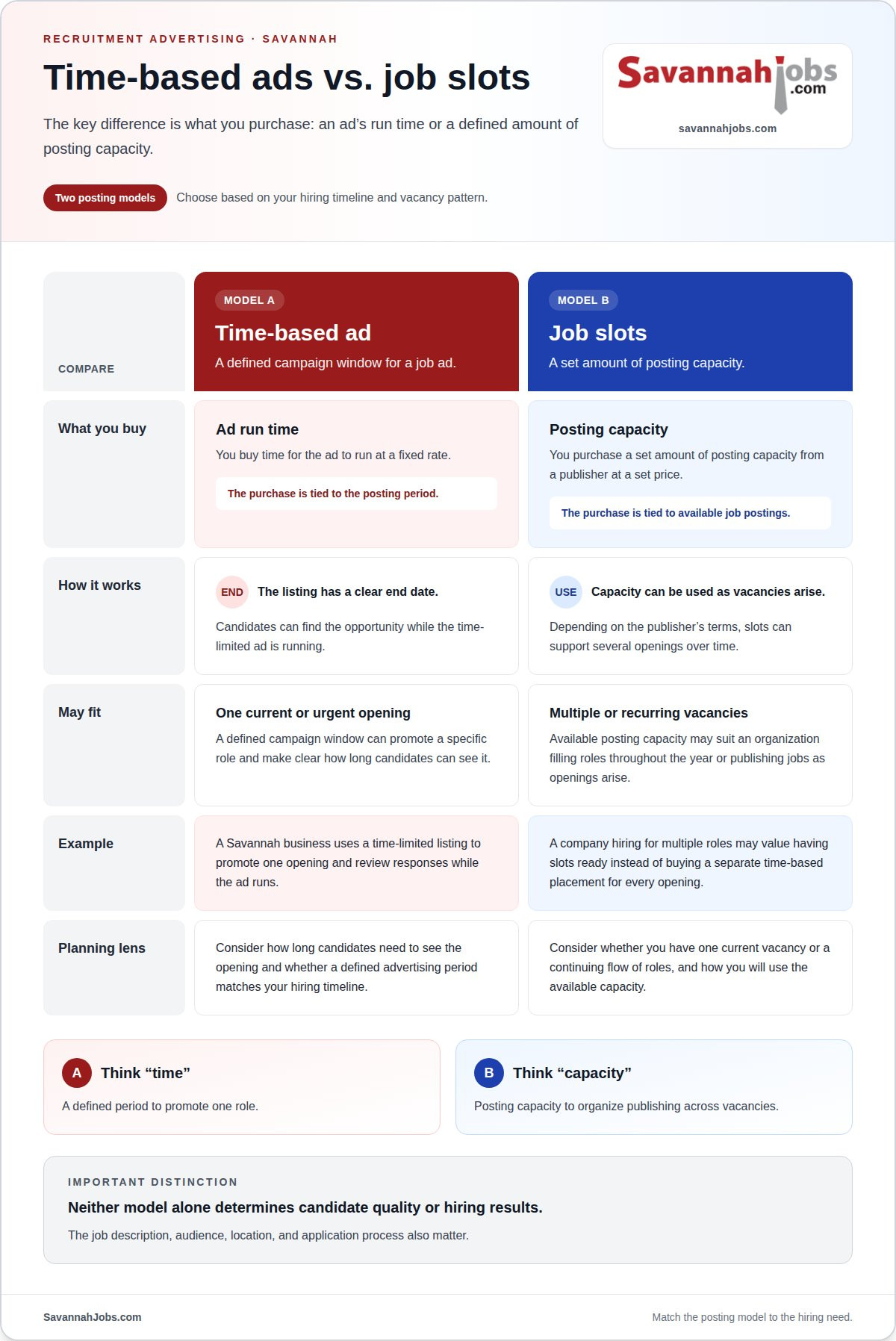
Duration-based job postings and job slots
Time-based advertising keeps a job ad active for a defined period at a fixed rate. The employer buys time, not a guaranteed number of applicants or hires. A Savannah business, for example, can use a time-limited listing to promote an opening and review responses while it runs. The end date makes clear how long candidates can find the opportunity.
Job-slot advertising works differently: the employer purchases a set amount of posting capacity from a publisher at a set price. Depending on the publisher’s terms, those spaces can support several openings over time. A company hiring for multiple roles may value having slots available as vacancies arise, rather than buying a separate time-based placement for every opening.
The key difference is what you purchase. A time-based placement buys an ad’s run time; a job slot buys a defined amount of posting capacity. This matters when hiring plans are clear or likely to change. For one urgent Savannah opening, a time-based ad provides a defined campaign window. For recurring vacancies, a slot arrangement may better suit the ongoing need to publish jobs.
Before choosing a model, match the advertising format to your hiring timeline. Identify whether you have one current vacancy or a continuing flow of roles, then consider how long candidates need to see each opening. A seasonal employer, for example, may plan postings around its hiring period. An organization filling roles throughout the year may prefer capacity it can use as openings arise.
Keep the posting’s purpose clear. A time-based ad creates a defined period to promote one role, while slots organize posting capacity across multiple vacancies. Neither model alone determines candidate quality or hiring results. The job description, audience, location, and application process all shape responses. For a Savannah-area role, align the posting period or use of slots with when suitable local candidates are likely to consider the work.
Job distribution tools and job boards
A job distribution tool sends an opening to multiple job boards through one publishing workflow. This can reduce repeated data entry, but each board has its own audience and focus. For a Savannah employer, the key question is not just how many sites receive a listing, but whether those sites reach candidates suited to the role and location.
Job boards publish openings for candidates to browse. Aggregators collect postings from across the web and display them through direct links, affecting where applicants encounter an ad. A role may appear on its original board and surface through an aggregator, which directs interested candidates to the source posting to continue.
Niche job sites serve a narrower audience, such as people in a particular industry, job type, or candidate group. A specialized opening may fit that audience better than a general board. A local board can add geographic relevance when an employer needs candidates in the Savannah area. Consider the role, location, and intended audience together when choosing where to post.
Distribution does not make every posting identical. Boards may display job details differently, and candidates may follow different application paths. Keep core information consistent across placements, including responsibilities, qualifications, work location, and application instructions. For example, a Savannah opening posted on a regional board and an industry-specific site should clearly describe the same role and hiring location.
Some publishers also provide branded online career centers and specialized job boards. Russell Johns represents publication-branded career centers aimed at professional and specialized job seekers. This shows how a publisher’s identity and audience can shape a job board’s reach. Match distribution choices to the candidates you need rather than treating posting volume as the only measure of reach.
Ready to reach candidates through a focused local job board? Post a Savannah-area job.
SavannahJobs.com
SavannahJobs.com helps employers advertise open positions to the local Savannah workforce. If you’re hiring in the area, a 30-Day Job Posting provides a defined period to present your opening to local candidates. For employers seeking added visibility, the Featured Job Upgrade and Featured Employer Upgrade offer premium options for job or employer promotion.
These tools fit a local advertising plan when you want to connect an opening with people looking for work in Savannah. Choose a posting approach that matches your hiring priorities, then provide clear details about the role, location, and application process so candidates can assess the opportunity.
Contact SavannahJobs.com to discuss advertising an open position in Savannah.
Put Your Next Local Hiring Campaign in Motion
Effective local recruitment advertising starts with a clear decision about who needs to see your opening and what candidates should do next. Keep the role’s requirements, location, and application instructions aligned, then use candidate responses to guide future hiring decisions. Each campaign can help refine how you present opportunities to Savannah’s workforce.
For local employers, SavannahJobs.com offers a 30-Day Job Posting, Featured Job Upgrade, and Featured Employer Upgrade. These options support employers looking to advertise openings and build visibility for their organization in the Savannah area.
Take the next step when you’re ready to put a local opening in front of candidates. Contact SavannahJobs.com about local hiring, and move your next recruiting effort forward with a clear plan.
Frequently Asked Questions
…And why is it important?
Local advertising helps employers connect open roles with people who can realistically work in the area. For a Savannah business, that focus can make an opportunity relevant to candidates considering commute, schedule, and workplace location. It also gives employers a way to explain what makes a role and workplace worth considering, rather than relying on the job title alone.
What is local recruitment advertising?
Local recruitment advertising promotes job openings to candidates in a defined community or regional labor market. In Savannah, an employer might emphasize the worksite location, shift expectations, and the team’s connection to the area. The aim is to make the opportunity easy for nearby candidates to recognize and assess, while presenting accurate details about the position and employer.
What local recruitment advertising channels are most effective?
The right channel depends on the role and the people you need to reach. A specialized position may benefit from an industry-focused audience, while a community-facing role may suit local media. For Savannah employers, compare where likely candidates look for opportunities, then assess responses by source. Relevant applications matter more than exposure alone.
How do you create an effective local recruitment advertising campaign?
Begin with a clear hiring objective, then define the role’s essential qualifications and the audience most likely to meet them. Write a specific, accurate ad that explains duties, schedule, work location, and how to apply. Make the Savannah location easy to identify. Track candidate sources and application quality, then use those findings to refine your next campaign.


