

Did you know that a single hiring mistake for a mid-level position could cost your Coastal Georgia business up to $330,000 in 2026? You've likely felt the sting of a new hire who just doesn't click, especially with our local unemployment rate sitting at a tight 2.7%. It's exhausting to watch your management team spend weeks retraining underperforming staff while morale in your tight-knit Savannah office begins to dip. Calculating the true cost of a bad hire Savannah employers face is the first step toward protecting your company’s future. Rushed decisions in a competitive market often lead to long-term financial headaches that are difficult to reverse.
We know that in the fast-paced logistics and hospitality sectors of the Coastal Empire, you can't afford to get it wrong. This guide will help you uncover the hidden financial drains and operational risks that threaten your 2026 bottom line. We'll provide a clear dollar-amount estimate for these hiring risks, compare your turnover against specific regional industry standards, and share practical strategies to sharpen your screening process without slowing down your recruitment momentum.
Key Takeaways
- Learn why a poor hiring decision can cost up to three times an employee's annual salary and how to define performance failure before it drains your resources.
- Understand how the Hyundai Metaplant and Port of Savannah expansion have created a high-stakes talent vacuum in the Coastal Empire that makes every recruitment choice critical.
- Discover how to calculate the true cost of a bad hire Savannah employers encounter, including hidden spikes in your Georgia State Unemployment Insurance (SUI) tax rates.
- Navigate the legal nuances of Georgia’s at-will employment laws to minimize termination risks and protect your operational stability.
- Master local branding and job posting strategies that prioritize candidate quality and long-term retention over simply filling a seat.
Defining the Cost of a Bad Hire in Savannah for 2026
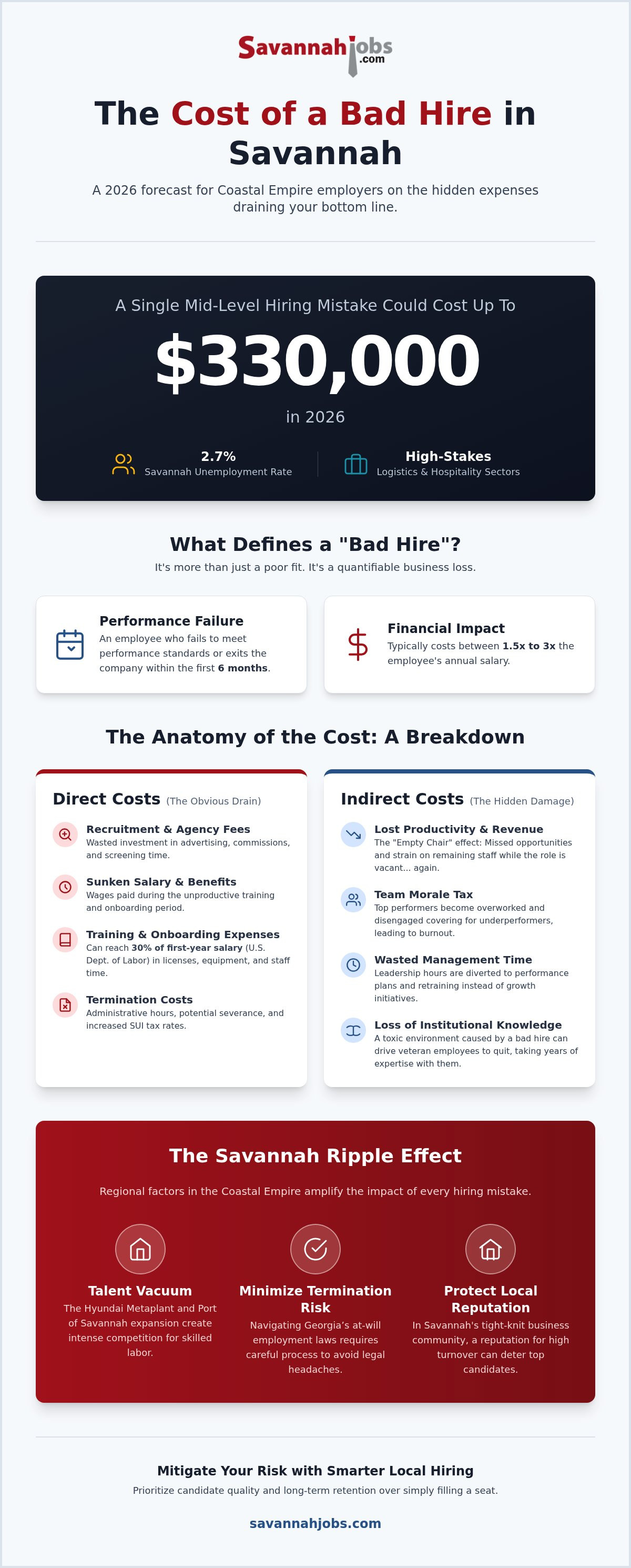
In Savannah’s current business climate, we define a bad hire as an employee who fails to meet your performance standards or exits the company within their first six months. It's a frustrating experience for any manager in the Coastal Empire. Industry benchmarks indicate that the financial cost of a bad hire Savannah businesses face typically ranges from 1.5x to 3x the person's annual salary. As we look at the 2026 market, these mistakes carry a heavier price tag than ever before. With our local unemployment rate hovering at a record low of 2.7%, every open seat represents a missed chance to capture our region's rapid economic growth. This is particularly true in our booming logistics and hospitality sectors where speed and reliability are everything. Ultimately, the cost of a bad hire Savannah employers calculate is the total sum of your recruitment expenses, the candidate's salary, and the value of lost opportunities during their tenure.
The Direct Financial Drain
When a hire doesn't work out, the direct cash loss is immediate and measurable. You've already invested in recruitment advertising fees and perhaps external agency commissions that are now essentially wasted. We often call the wages paid during this period the 'Sunken Salary.' This is money spent on a worker during their least productive months of training and onboarding, where they are consuming resources rather than generating them. Additionally, you must account for the administrative hours required to process a termination in Georgia and any severance pay provided. These costs of employee turnover stack up quickly. It's a cycle that drains your 2026 budget before the year even gets into full swing, forcing you to pay for the same position twice without seeing the expected return on investment.
The Indirect Damage to Local Teams
Money isn't the only thing you lose. We see a 'Morale Tax' hit small, tight-knit Coastal Georgia offices when a poor fit joins the team. Your top performers often end up doing double duty to cover for underperforming staff, which leads to burnout and quiet resentment. Management time is another massive drain. Instead of focusing on expansion or new client projects, your leadership team spends dozens of hours on performance improvement plans (PIPs) and extra retraining. Perhaps the most painful loss is institutional knowledge. When a bad hire creates a toxic environment that causes a veteran employee to quit, your business loses years of local expertise that's nearly impossible to replace overnight. In a city where reputation and relationships are everything, the damage to your internal culture can take years to repair.
Calculating the Financial Sting: From Recruitment to Productivity Gaps
Analyzing the Savannah GA job market for 2026 shows that turnover trends are becoming increasingly expensive for local firms. We often see businesses losing thousands of dollars to 'The Empty Chair' when a position sits vacant for a second time. It isn't just about the missing person; it's about the lost revenue and the mounting strain on your remaining staff. When a hire fails, you're forced back to square one, which resets your timeline and doubles your recruitment effort in a very tight labor market.
Training and onboarding expenses represent a significant upfront investment that you simply can't recover. You've already paid for software licenses, specialized uniforms, and dozens of hours of senior staff time. According to U.S. Department of Labor estimates, these costs contribute to a total loss that often reaches 30% of an employee's first-year salary. In a high-demand market like the Coastal Empire, the risk of candidate ghosting adds another layer of financial stress. You might spend weeks preparing for a new team member only to have them disappear before their first shift is complete.
Recruitment ROI and the Savannah Premium
We often compare the cost-per-hire of massive national aggregators against targeted local boards. While national sites offer volume, they often lack the regional nuances of the Coastal Georgia workforce. Choosing local versus national platforms shows that a regional focus provides much better long-term stability. You avoid the high expense of re-advertising a role after a failed 90-day probation. Using a Featured Job Upgrade can help you attract higher-quality talent from the start, which significantly reduces your total risk exposure.
Lost Productivity and Customer Impact
The cost of a bad hire Savannah employers face eventually hits your reputation. In our bustling service industry, poor customer reviews can lead to a permanent loss of repeat business. For logistics firms, the financial impact of errors in the Port of Savannah supply chain is even more severe. One wrong move can lead to missed deadlines and expensive contractual penalties. Small businesses often find that a single bad hire can delay their 2026 expansion plans by months. It's a heavy price to pay for a rushed decision in a competitive economy.
The Savannah Ripple Effect: Why Regional Factors Amplify Hiring Mistakes
Savannah's business environment is uniquely interconnected. The massive expansion at the Port of Savannah and the ripple effects of the Hyundai Metaplant have created a 'talent vacuum' that pulls skilled workers from every corner of the Coastal Empire. This means the cost of a bad hire Savannah businesses experience is amplified by the sheer scarcity of available replacements in 2026. When you make a mistake, you aren't just losing money; you're losing time in a race where your competitors are moving at breakneck speed. Every failed hire puts you further behind in a market that doesn't wait for anyone to catch up.
Cultural fit also carries more weight here than in anonymous national markets. Our business community is tight-knit, and reputation travels fast from Broughton Street to the Southside. A bad hire who doesn't respect local norms can quickly damage your standing with vendors and long-term clients. Perhaps most frustrating is the opportunity cost. While you are distracted by managing a poor performer, a top-tier local candidate you recently interviewed might sign with a competitor in Pooler or Garden City. You've essentially handed a competitive advantage to your rival while paying for the privilege of a bad investment.
Logistics and Manufacturing Pressures
In Garden City and surrounding industrial hubs, the physical risks of a bad hire are staggering. Poorly screened employees in 24/7 port-related operations can lead to safety errors or expensive equipment damage that halts production. The U.S. Department of Labor notes that training costs and productivity losses are just the beginning of the financial sting. In a logistics-heavy economy, a single error can disrupt a complex supply chain. With current wage pressures, you simply can't afford a 'do-over' at 2026 rates when the margin for error is so slim.
The SCAD and Georgia Southern Factor
We are lucky to have institutions like SCAD and Georgia Southern nearby, but they present a unique hiring challenge for local firms. There's a persistent risk of hiring 'over-qualified' talent who view Savannah as a temporary stop before moving to a larger metro area. To protect your bottom line, you must balance technical skills with local roots to ensure long-term retention. High turnover in entry-level professional roles is a quiet drain on resources that many managers overlook. Finding someone who truly understands the Coastal Empire ensures they'll stay long enough to provide a real return on your investment.
Compliance and Onboarding: Hidden Costs of Georgia Employment
While general turnover statistics provide a baseline, the cost of a bad hire Savannah businesses face is often driven by Georgia-specific taxes and regulatory requirements. Every time a hiring decision fails, your business is on the hook for more than just a lost salary. You must account for mandatory employer contributions like FICA, FUTA, and workers' compensation premiums that accrue from the first day of employment. Perhaps most importantly, a bad hire who ends up claiming unemployment benefits can negatively impact your Georgia State Unemployment Insurance (SUI) tax rates. These rates are based on your company’s experience rating, meaning a single poor fit can increase your tax burden for several years to come.
Legal and Regulatory Risk Mitigation
Understanding at-will employment Georgia is vital for every local manager. While the law allows for flexibility in termination, the cost of defending against even a baseless wrongful termination claim in a Savannah court can be financially devastating. Beyond legal fees, you face strict Georgia new hire reporting requirements; failing to comply with these state mandates can lead to avoidable fines. We recommend a standardized interview process as your best financial defense. It creates a clear paper trail of objective evaluation that protects your business from legal scrutiny if a hire doesn't work out.
The First 90 Days: A Critical Budget Period
The first three months are the most expensive phase of any new role. We estimate the 'learning curve' cost for a new Savannah hire involves paying a full salary for roughly 50% to 75% productivity during the onboarding phase. You also incur non-recoverable expenses like hardware setups and specialized software licenses that are often billed annually. In industries like skilled trades and healthcare, the cost of mentor-shadowing programs is significant. When a hire leaves early, you lose the wages of both the trainee and the high-value senior staff member who was diverted from their primary duties to teach them.
Protecting your 2026 bottom line requires a proactive approach to candidate quality. You can reduce your risk of these compliance headaches by using a 30-Day Job Posting to attract candidates who are already established in the Coastal Empire and understand our local work culture. This small upfront investment helps ensure you aren't paying for a hiring mistake for years to come.
Mitigating the Risk: How to Lower Your Cost-Per-Hire Locally
We have established that the financial impact of a poor selection is significant. To protect your 2026 budget, you need a strategy that prioritizes local precision over national volume. Learning how to post a job in Savannah GA with a focus on local requirements is your first line of defense. By targeting candidates who already live in the Coastal Empire, you eliminate the high risk of 'out-of-market' hires who may struggle with relocation or fail to integrate into our unique regional culture. This targeted approach ensures your recruitment dollars are spent on people who are already invested in our community.
Predictability is the key to managing your 2026 recruitment spend. Unlike national platforms that often use fluctuating pay-per-click models, a 30-Day Job Posting allows you to budget with absolute certainty. You know exactly what your investment is from day one. This approach also gives you access to local talent networks that national aggregators often miss. Many 'passive' candidates in the Lowcountry aren't actively scrolling through massive national sites; they are looking for opportunities within their own community and through trusted local channels.
Better Screening, Lower Costs
Effective screening starts long before the first day on the job. We recommend implementing behavioral interview questions that specifically test for cultural fit and long-term commitment. This helps you identify potential red flags that technical skills alone might hide. To speed up the process for critical roles, the ROI of a Featured Job Upgrade is clear. It puts your opening in front of high-quality talent faster, which helps reduce the 44-day average time-to-fill. By closing the gap quickly, you minimize the cost of a bad hire Savannah businesses often face when positions sit vacant. Active local engagement is also the best way to reduce the financial drain caused by candidate ghosting.
Building a Talent Pipeline in the Lowcountry
Long-term success in the Savannah market depends on your reputation as an employer of choice. Utilizing employer branding tips Savannah professionals trust will help you build a pipeline of vetted talent. Partnering with regional institutions and using a local job board is the most cost-effective risk management tool for 2026. A Featured Employer Upgrade further establishes your brand as a pillar of the community, building the trust necessary to attract top-tier professionals. By focusing your efforts on the local market, you ensure that every dollar spent on recruitment is an investment in a candidate who will stay and grow within the Coastal Empire.
Protect Your Coastal Empire Business from Hiring Risks
The real cost of a bad hire Savannah employers face goes far beyond a single wasted paycheck. It's a combination of lost productivity, damaged team morale, and rising state tax rates that can stall your 2026 growth. By understanding the unique pressures of the Coastal Georgia market, you can shift from reactive hiring to a strategic, local-first approach. Focus on cultural fit and long-term retention to ensure your next team member contributes to our city's thriving economy instead of draining your resources.
We're here to help you find the right match the first time. Our platform is powered by the Savannah Morning News network, giving you deep regional roots and the ability to reach thousands of verified Savannah candidates. We offer predictable 30-day fixed pricing to keep your recruitment budget on track and stress-free. Your business deserves a partner that understands the Lowcountry as well as you do.
Success in the Hostess City is built on strong relationships and reliable teams. Let's work together to build yours.
Frequently Asked Questions
What is the average cost of a bad hire for a small business in Savannah?
The cost of a bad hire Savannah small businesses face usually ranges from 30% to 200% of the employee's annual salary. For a mid-level professional earning $110,000, the total financial impact can climb between $165,000 and $330,000 once you factor in recruitment and lost productivity. These figures represent direct cash outflows and the value of management time diverted from your core business operations in the Coastal Empire.
Does a bad hire affect my Georgia unemployment tax rates?
Yes, a hiring mistake can directly increase your Georgia State Unemployment Insurance (SUI) tax rates. When a terminated employee successfully claims benefits, it impacts your company’s experience rating with the Georgia Department of Labor. A higher rating leads to increased tax percentages on your payroll. This means a single poor fit can create a recurring financial burden that lasts for several years after they have left your team.
How can I calculate the productivity loss of a hiring mistake?
You can calculate productivity loss by totaling the wages paid during the 'learning curve' period and adding the value of senior staff hours spent on retraining. For a more accurate picture, subtract the actual output of the bad hire from the expected output of a standard performer. Don't forget to include the 'Empty Chair' cost, which is the daily revenue lost while the position remains vacant during your second search.
Is it cheaper to use SavannahJobs.com or a national job board for risk reduction?
Using a local platform like SavannahJobs.com is typically more cost-effective for risk reduction because it targets candidates already living in the Coastal Empire. National boards often attract out-of-state applicants who may ghost the process or fail to relocate successfully. Our predictable 30-day fixed-cost advertising helps you avoid the fluctuating pay-per-click fees of national aggregators. This local focus ensures your budget is spent on candidates who understand our regional culture.
What are the warning signs of a potential bad hire during the interview?
Watch for candidates who speak negatively about previous Savannah employers or show a lack of research into our local market. Inconsistent work histories and an inability to provide specific examples of past problem-solving are also red flags. During the interview, pay close attention to their attitude toward teamwork. Since 89% of hiring failures are due to poor cultural fit rather than technical skills, these behavioral cues are your best defense.
How much does a background check cost for a new hire in Georgia?
Standard background checks in Georgia typically cost between $20 and $100 depending on the depth of the screening. A basic criminal record search through the Georgia Crime Information Center (GCIC) is more affordable than comprehensive reports that include credit history and drug testing. While this is an upfront expense, it's a small price to pay compared to the massive cost of a bad hire Savannah businesses endure when screening is skipped.
Can I fire a bad hire immediately under Georgia's at-will laws?
Yes, Georgia is an at-will employment state, which means you can terminate an employee at any time for any legal reason. However, you must ensure the termination doesn't violate federal anti-discrimination laws or retaliation protections. We recommend documenting performance issues clearly and maintaining a standardized process to protect your business from potential legal claims. This objective record is your best financial defense if a quick exit becomes necessary for your team's stability.
What is the 'opportunity cost' of a bad hire in the Savannah Port industry?
In the Savannah Port industry, opportunity cost is the revenue you lose by missing out on our region's rapid growth while managing a poor performer. This includes delays in supply chain operations and potential damage to high-value client relationships. While your team is distracted by a bad hire, you may also lose the chance to recruit top talent from the talent vacuum created by the Port expansion and the Hyundai Metaplant.


