

Diversity and Inclusion Hiring Guide for Savannah Employers
What if a broader candidate pool and consistent, job-related hiring decisions could go hand in hand? For employers hiring for diversity and inclusion Savannah teams can put into practice, the work starts with the whole hiring process, not just the job ad. Where could bias affect who sees an opening, who applies, or how candidates are assessed? Those are useful questions when you want to widen your reach without changing the qualifications a role requires.
This guide offers practical ways to make hiring fairer and more accessible while keeping evaluation consistent. You’ll learn how to clarify job information and application steps, reach a broader range of qualified candidates across the Savannah area, and assess applicants against clear, job-related criteria.
We’ll cover steps from writing an inclusive job post to structuring interviews and reviewing screening tools. You’ll also see how a locally focused job advertisement can support broader outreach. SavannahJobs.com provides a place to advertise openings; your organization remains responsible for recruiting, evaluating, and selecting candidates. The aim is to welcome more qualified people and give each applicant a fair chance to show what they can do.
Key Takeaways
- Define fair hiring around role-related criteria so broader access and consistent individual evaluation work together.
- Use a practical checklist to make Savannah job postings clearer, more accessible, and focused on essential qualifications.
- Set evaluation criteria before reviewing applications, then use them to support consistent comparisons while retaining professional judgment.
- Map the candidate journey from finding the opening through interview follow-up to spot barriers and improve communication.
- Start hiring for diversity and inclusion in Savannah with one role: revise its process, then track stage completion and candidate withdrawals using clearly defined measures.
What inclusive hiring means for Savannah employers
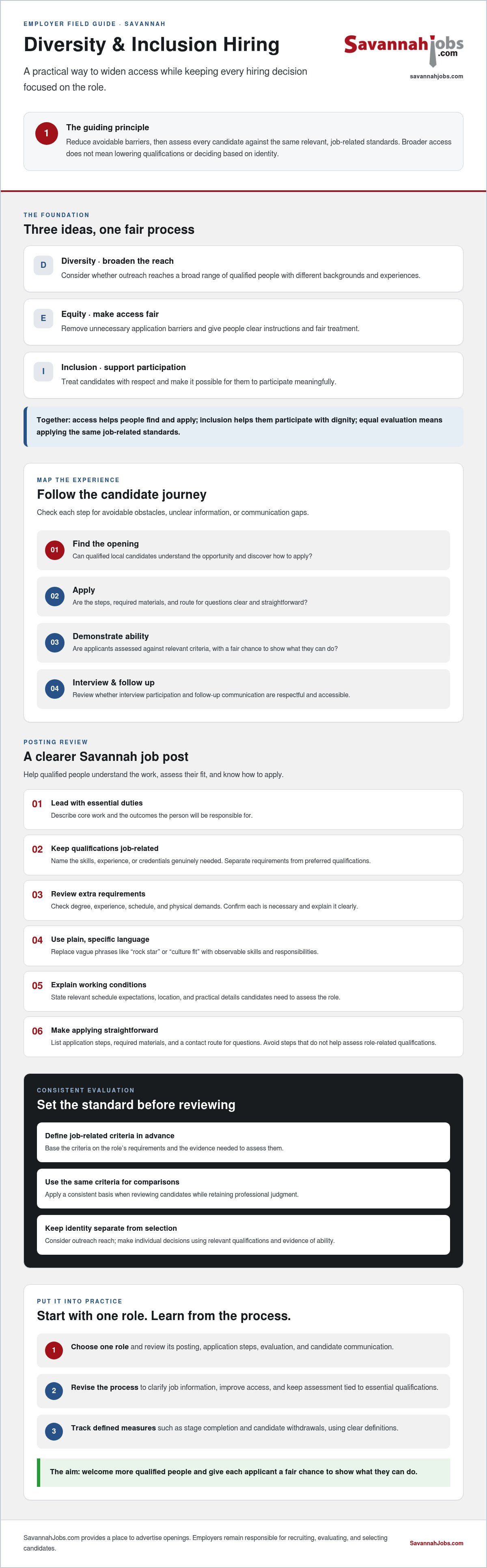
Inclusive hiring means reducing avoidable barriers while assessing every candidate against the requirements of the role. That can start with making an opening easier to understand and apply for, then using relevant criteria to compare applicants. The goal isn’t to lower standards or make decisions based on identity. It’s to give qualified people a fair opportunity to be considered.
In brief: Access helps people find and apply for an opportunity; inclusion helps them participate with dignity; equal evaluation means judging each candidate by the same job-related standards.
These ideas work together, but they aren’t interchangeable. An employer can welcome a wide range of applicants and still create barriers through unclear requirements or a difficult application process. For a foundational overview, Diversity, equity, and inclusion offers helpful context for understanding how these concepts relate.
How are diversity, equity, and inclusion different in recruitment?
Diversity describes representation across different backgrounds and experiences. In recruitment, it can prompt employers to consider whether their outreach reaches a broad range of qualified people. Equity focuses on fair access and treatment, such as removing unnecessary application barriers or providing clear instructions. Inclusion concerns whether candidates and employees are treated with respect and can participate meaningfully.
These principles don’t mean favoring or rejecting someone because of identity. Assess each person on relevant qualifications and evidence of their ability to do the work. A diversity goal can help an employer examine the reach of its process; it shouldn’t replace consistent, role-related decisions about individual candidates.
Why does inclusive hiring matter in Savannah?
Savannah employers recruit across a regional labor market with varied communities, career paths, and work experiences. If a posting relies on unclear jargon, treats preferences as strict requirements, or offers only one hard-to-use application route, qualified local candidates may decide not to apply. Removing avoidable obstacles can help more people understand the opportunity and decide whether their skills fit.
The aim is to find a strong match, not simply to increase the number of applicants. Clear, role-focused hiring helps candidates assess the opportunity and gives employers a consistent basis for reviewing applications. For broader local workforce context, see The 2026 Savannah GA Job Market: An Employer’s Strategic Outlook. In practice, hiring for diversity and inclusion Savannah employers can sustain starts with a straightforward question: does each step give qualified people a fair chance to take part and demonstrate their ability?
How to make a Savannah job posting more inclusive
A job posting is often a candidate’s first look at a role. Make it clear enough for qualified people to understand the work, assess their fit, and know how to apply. A practical approach to hiring for diversity and inclusion in Savannah starts with reviewing the requirements, not simply changing a few words.
A checklist for a clearer job posting
- Lead with essential duties. Describe the core work and the outcomes the person will be responsible for.
- Keep qualifications job-related. Identify the skills, experience, or credentials genuinely needed to perform those duties. Separate requirements from preferred qualifications.
- Review extra requirements. Check degree, years of experience, schedule, and physical demands. Confirm each is necessary for the role and explain it clearly rather than removing requirements automatically.
- Use plain, specific language. Replace vague traits such as “rock star” or “culture fit” with observable skills and responsibilities, such as resolving customer questions or maintaining accurate records.
- Explain the working conditions. State relevant schedule expectations, location, and other practical details candidates need to assess the opportunity.
- Make applying straightforward. List the application steps, required materials, and a contact route for questions. Avoid adding steps that don’t help assess role-related qualifications.
Accessible, specific job information helps candidates assess fit before they apply. It also sets clearer expectations from the start. Review wording for avoidable exclusion, but don’t assume that changing a phrase guarantees compliance. The job description should reflect the actual role, and legal questions should be checked with qualified counsel.
How can employers improve access to Savannah job opportunities?
Consider whether the opening is visible through more than one appropriate channel. A locally focused job advertisement can be part of a broader Savannah-area outreach plan, alongside other relevant ways to share the opportunity. For more on channel planning, see Recruitment Advertising in Savannah: The 2026 Employer’s Strategy Guide.
Access doesn’t end with the posting. Make application instructions easy to find, explain how candidates can ask questions, and avoid suggesting that applicants disclose personal information unrelated to the role. As you plan the next steps, the U.S. Department of Labor’s guidance on interviewing applicants with disabilities can help inform an accessible candidate experience beyond the job ad.
A SavannahJobs.com job advertisement is one local distribution option, not a substitute for fair recruiting and selection. Explore Savannah-area job advertising as part of your broader outreach plan.
How to reduce bias with consistent candidate evaluation
A consistent evaluation process gives each applicant a comparable opportunity to demonstrate relevant skills. It doesn’t remove professional judgment; it gives interviewers a shared basis for using it. That helps the team focus on evidence instead of first impressions, personal preferences, or assumptions. For employers hiring for diversity and inclusion in Savannah, consistency supports fair assessment without losing sight of what the role requires.
Before reviewing applications or scheduling interviews, write down the criteria that matter for the job. Tie each one to a stated responsibility or qualification, then decide what evidence would demonstrate it. For example, if the role involves resolving customer concerns, define what a strong response might show: listening, clear communication, and a practical next step. Avoid relying on a general impression such as “seems polished.”
How can structured interviews support fairer decisions?
Structured questions make candidate comparisons more consistent when they’re tied to role requirements. Ask every candidate the same core questions, then use a shared scoring guide that describes observable evidence at each rating level. Interviewers can still ask relevant follow-up questions, but should record why they asked them, especially if one candidate’s interview differs materially from another’s.
After each interview, note specific answers or examples that support the rating. Separate observations from interpretations: “described a process for resolving a delayed order” is more useful than “seemed like a good fit.” Where practical, have interviewers score independently before discussing candidates. This makes it easier to spot differences in interpretation and return to the agreed criteria.
How should employers review assessments and selection criteria?
Use an assessment only when it measures a skill or task relevant to the work, and give candidates a consistent explanation and process. A job-related writing exercise may be appropriate for a role that requires routine written communication; a test unrelated to the actual duties may add friction without useful evidence. Consider whether each screening step is necessary, accessible, and applied consistently.
Review the full sequence, not just the final interview. Does an early filter screen out qualified applicants for a reason unrelated to the role? Are assessment instructions clear? Do evaluators know how to score the results? These checks can help employers spot avoidable barriers and make comparisons more useful.
Document the criteria, questions, and evidence behind decisions. If you use automated screening or other selection tools, examine how they operate and whether their results are relevant to the job. For sensitive or regulated decisions, consult qualified HR or legal professionals. A clear process won’t guarantee a particular outcome, but it can make decisions more consistent, explainable, and grounded in the work.
How to make interviews and applications more accessible
A candidate’s experience begins before they submit an application and continues through interview follow-up. Map each step, from finding the opening to receiving a decision. At every stage, ask: Is the next step clear? Is there an avoidable barrier? Does the candidate know whom to contact for help? This review can reveal friction that’s easy to miss when you already know how the process works.
What can employers do to make the application process easier to navigate?
Keep the application route straightforward. Before candidates begin, explain what materials they’ll need, how to submit them, and what happens next. Check that the posting and application are readable and usable on common devices. Make key details easy to find instead of burying instructions in long blocks of text or requiring candidates to search through multiple pages.
Give applicants a clear contact route for questions or access needs, and handle requests thoughtfully. Ask only for information relevant at that stage of hiring. For example, an application form should focus on information needed to evaluate qualifications, not personal details that have no bearing on the role. Follow applicable guidance when responding to accommodation requests, and consult qualified professionals if you’re uncertain how to proceed.
How can Savannah employers improve the interview experience?
Before an interview, tell candidates what format to expect, where to go or how to connect, who they’ll meet, and how much time to set aside. Share preparation instructions in advance. Provide a clear way to raise access needs or ask practical questions, without requiring candidates to disclose more personal information than necessary.
Keep communication consistent. Acknowledge applications, explain the next step when possible, and send updates if the timeline changes. Close the loop with candidates after interviews, even when a decision takes longer than expected. Reliable communication helps people plan and reflects well on your organization in the Savannah job market. For related candidate-experience ideas, see Building a Strong Employer Brand in Savannah.
After each hiring round, document which steps caused confusion, delays, or withdrawals. Review candidate feedback for patterns, but don’t collect sensitive personal data simply to measure accessibility. Focus on process improvements you can make, such as clearer instructions, a more usable application route, or better interview details. Those adjustments can make hiring for diversity and inclusion in Savannah part of everyday recruiting.
Ready to share an opening with Savannah-area job seekers? Post your Savannah job opening as one part of a clear, accessible candidate journey.
How Savannah employers can put inclusive hiring into practice
Keep the first step manageable: choose one open or recently filled role, review its hiring process, and make a focused improvement. A first-month plan gives your Savannah team a way to try practical changes and learn from the process without trying to overhaul every role at once.
- Week 1: Review the job description, application route, outreach channels, evaluation criteria, and candidate communications for that role.
- Week 2: Revise unclear requirements or instructions, then brief everyone involved in reviewing or interviewing candidates.
- Weeks 3 and 4: Use the updated process and record agreed-upon measures, such as how many candidates complete each stage and how many withdraw.
- At the end of the month: Review what changed, where candidates encountered friction, and what your team would adjust next time.
Define each measure before collecting or interpreting it. For example, specify what counts as completing an application stage and how your team will record a withdrawal. Compare process information carefully: a change in a count alone doesn’t explain why it happened or prove that a particular revision caused it. Protect candidate privacy, limit access to records, and seek qualified HR or legal advice before collecting sensitive information or drawing conclusions about groups of applicants.
What should an inclusive hiring checklist include?
Before a role goes live, confirm that its description reflects necessary duties and clearly stated qualifications. Check that outreach channels, application instructions, and interview steps are understandable and accessible. Make sure evaluators use consistent, job-related criteria, and document the evidence supporting selection decisions. Keep the checklist practical: it should help your team follow the same sound process, not add steps that don’t improve hiring decisions.
How can local job advertising support broader outreach?
A Savannah-focused job listing can complement referrals and other suitable outreach channels. It gives employers another local place to advertise an opening, but it doesn’t replace thoughtful recruiting or a consistent selection process. SavannahJobs.com advertises roles; employers remain responsible for candidate communication, evaluation, and hiring decisions. For more local posting guidance, see Post a Job in Savannah GA: The Employer’s 2026 Guide to Local Hiring.
A SavannahJobs.com 30-day job posting can be one channel in your broader outreach plan. Explore local posting options as you put your revised process into practice. For hiring for diversity and inclusion in Savannah, steady review matters: make a change, assess how the process worked, and use what you learn to improve the next search.
Make your next Savannah hire more accessible
Inclusive hiring is built through practical choices at every stage. Clear, role-focused job descriptions help candidates understand the opportunity, while consistent evaluation criteria keep decisions anchored to qualifications and evidence. Accessible application and interview steps make it easier for qualified people to take part.
Start with one role. Review its requirements, candidate communications, and selection process, then use what you learn to guide the next search. That steady approach can make hiring for diversity and inclusion in Savannah part of your team’s everyday practice, rather than a one-time initiative.
Local outreach can be one part of the plan. SavannahJobs.com offers local recruitment advertising focused on Savannah-area career opportunities, including 30-day job postings and optional featured job and featured employer upgrades. The platform is associated with the Savannah Morning News and USA TODAY Network. Employers remain responsible for recruiting, evaluating, and selecting candidates.
Explore job posting options for Savannah employers and take the next step toward a fairer, more accessible hiring process. With clear standards and thoughtful outreach, your Savannah team can keep improving how it connects with qualified talent.
Frequently Asked Questions
What does inclusive hiring mean for employers?
Inclusive hiring means reducing avoidable barriers while assessing candidates against relevant requirements for the role. For hiring for diversity and inclusion in Savannah, focus on making job information and application steps accessible, then use consistent criteria to evaluate each person’s qualifications. For example, separate essential skills from preferences and ask candidates comparable interview questions. The aim is fair access and job-related decisions, not favoring or rejecting anyone because of identity.
How can a small business make its hiring process more inclusive?
A small business can start by reviewing one job opening from posting through interview follow-up. Confirm that listed qualifications are genuinely needed, make application instructions easy to follow, and provide a clear contact route for questions. Before interviews, decide which job-related criteria matter and how interviewers will assess them. After the hiring round, review where applicants had difficulty or withdrew, then choose a practical improvement for the next search.
Can inclusive hiring help Savannah employers reach more qualified candidates?
It can help remove unnecessary obstacles that may discourage qualified people from applying, such as unclear requirements or confusing application steps. Clear job information also helps candidates decide whether their skills match the role. Pair accessible postings with outreach through more than one suitable channel in the Savannah area. Broader reach doesn’t guarantee more applicants or a particular hiring result, but it gives more qualified people a fair chance to consider the opportunity.
How do you reduce bias in a job interview?
Define job-related criteria before interviews begin, then ask candidates the same core questions about the role’s responsibilities. Use a shared scoring guide with clear descriptions of what different levels of evidence look like. Interviewers should record specific answers and examples rather than general impressions such as “good fit.” Relevant follow-up questions are still appropriate, but document why they were asked if they create a material difference in the interview.
What should employers avoid including in an inclusive job description?
Avoid vague traits such as “rock star” or “culture fit” when you can describe the actual skills and duties instead. Review degree, experience, schedule, and physical requirements to confirm each is relevant and necessary for the work. Don’t present preferred qualifications as mandatory or leave candidates guessing about key expectations. Clear, plain language helps applicants understand the position, but wording changes alone don’t guarantee compliance with applicable requirements.
How can employers make interviews more accessible?
Tell candidates in advance whether the interview is in person, by phone, or online, and share the location or connection details, expected timing, and who they’ll meet. Offer a clear, respectful way to raise access needs or ask questions. Keep communication consistent and provide updates if plans change. Ask only for personal information relevant to the hiring stage, and seek qualified guidance when you’re unsure how to respond to an accommodation request.
Where can Savannah employers advertise jobs to local candidates?
Savannah employers can include locally focused recruitment advertising in a broader outreach plan alongside referrals and other suitable channels. SavannahJobs.com advertises Savannah-area career opportunities through paid 30-day job postings, with optional featured job and featured employer upgrades. It’s associated with the Savannah Morning News and USA TODAY Network. The platform advertises openings; employers remain responsible for recruiting, evaluating, and selecting candidates. Advertising can support outreach, but it doesn’t guarantee applicant volume or hiring outcomes.


