

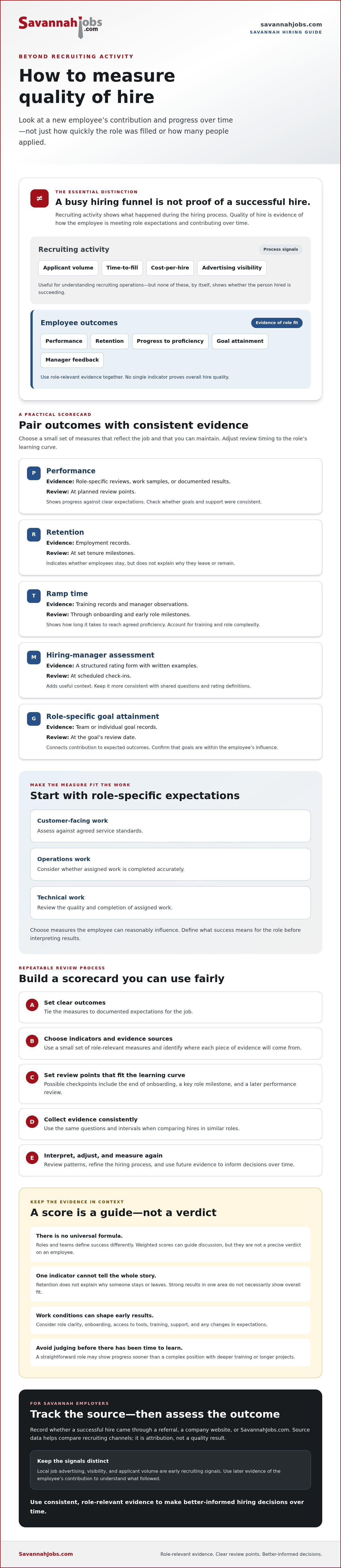
What if your busiest recruiting channel brings in plenty of applicants but not the hires who thrive? If you’re asking how to measure quality of hire, look beyond application volume, time to fill, and other activity metrics. They show what happened during recruiting, not whether a new employee is succeeding.
There’s no universal score or formula that fits every role. Teams may define success differently, and smaller employers may not have a formal analytics system. A fair measure depends on what the job requires, when you assess the new hire, and what evidence you can collect consistently.
This guide explains how to choose a small set of role-relevant indicators and build a repeatable scorecard with clear review dates and data sources. It covers how performance, retention, and manager feedback can work together, and how to interpret results without claiming they prove more than they do.
For Savannah employers, the process can include tracking candidate sources, such as local job advertising, while treating visibility and applicant volume as early recruiting signals rather than proof of hire quality. The aim is practical: use the evidence to make better-informed hiring decisions over time.
Key Takeaways
- Learn how to measure quality of hire with evidence tied to a new employee’s role and progress over time.
- Compare practical measures, including performance, retention, ramp time, manager feedback, and goal attainment.
- Build a repeatable scorecard by setting clear outcomes, review dates, and data sources.
- Use weighted scores as a guide, not a universal formula or a precise verdict on an employee.
- Turn results into better hiring decisions by reviewing patterns, adjusting your process, and measuring again.
What Does Quality of Hire Measure, and Why Do Hiring Metrics Miss It?
Quality of hire is evidence of a new employee’s contribution and fit over time. It helps you assess whether someone is meeting the expectations of the role, rather than simply whether recruiting moved quickly. A quality of hire metric can combine evidence such as performance, contributions, and adaptability. The right signals depend on the job.
Time-to-fill measures how long it takes to fill a vacancy. Applicant volume shows how many people applied, while cost-per-hire tracks recruiting expenses. These measures help explain the hiring process, but none shows on its own whether the person hired is succeeding. A busy job posting or a fast hire may be useful operationally, but neither confirms a strong match.
Context matters. A new employee’s results can depend on clear role expectations, effective onboarding, access to tools, and support from the team. If expectations shift or training is delayed, early performance may reflect the work environment as much as the hire. When considering how to measure quality of hire, treat the score as evidence to investigate, not a verdict on one person or hiring decision.
Which outcomes can indicate a successful hire?
Start with performance against role-specific expectations. For a customer service position, that might mean meeting agreed service standards. For an operations role, it could mean completing assigned work accurately. Retention, progress toward proficiency, and hiring-manager feedback add perspective. Someone may be learning quickly before reaching full productivity, or meet targets while struggling to work effectively with the team. No single indicator proves overall hire quality.
Keep candidate source separate from these outcomes. Recording whether a successful hire came through a referral, a company website, or SavannahJobs.com helps you compare sourcing channels. But source is attribution data, not a quality result. Applicant volume and advertising visibility are earlier steps in the process. Assess the employee’s later contribution to understand what followed.
When should employers assess a new hire?
Set checkpoints that fit the role’s learning curve. You might review progress at the end of onboarding, at a key role milestone, and during a later performance review. A straightforward role may show progress sooner than a complex position that requires deeper training or longer projects. Avoid judging too early, before the employee has had a reasonable chance to learn and perform.
Use the same questions and intervals when comparing hires in similar roles. Compare like with like, and record changes in expectations, training, or available support. This gives Savannah employers a more dependable view of outcomes without mistaking timing or workplace conditions for differences in candidate quality.
Which Quality-of-Hire Metrics Should You Track?
Choose measures that reflect the work, not a long list of numbers that’s difficult to maintain. A useful scorecard pairs quantitative results with structured feedback. The table below is a starting point. Adjust the timing to fit the role and its learning curve.
| Metric | Data source | Timing | How to interpret it |
|---|---|---|---|
| Performance | Role-specific reviews, work samples, or documented results | At planned review points | Shows progress against clear expectations; check whether goals and support were consistent. |
| Retention | Employment records | At set tenure milestones | Indicates whether employees stay, but doesn’t explain why they leave or remain. |
| Ramp time | Training records and manager observations | Through onboarding and early role milestones | Shows how long it takes to reach agreed proficiency; account for training and role complexity. |
| Hiring-manager assessment | Structured rating form with written examples | At scheduled check-ins | Adds useful context, but can be subjective unless questions and rating definitions are consistent. |
| Role-specific goal attainment | Team or individual goal records | At the goal’s review date | Connects contribution to expected outcomes; confirm goals are within the employee’s influence. |
How do you choose measures for different roles?
Begin with documented outcomes for the job. A customer-facing role might be assessed against agreed service standards, while a technical role may be reviewed on the quality and completion of assigned work. Choose a few measures the employee can reasonably influence. Savannah employers can tailor indicators to local roles and their operating needs, but shouldn’t assume one industry’s benchmark fits another. A measure that works for one team may be misleading for a different job.
What belongs in a balanced scorecard?
Combine performance or goal attainment with retention and ramp-up context. Identify who provides each data point, such as a manager, training lead, or HR contact, and use the same rating definitions across comparable hires. For feedback, ask consistent questions and request specific examples rather than relying on a general impression. Cornell’s research on enhancing hiring outcomes offers a broader basis for considering multiple measures together.
Keep the scorecard manageable, and record limitations alongside the results. A small cohort can make patterns unstable, while changing job duties can make comparisons unfair. If you assign weights to metrics, describe them as choices your organization made for that role, not universal standards. Employers tracking SavannahJobs.com alongside other candidate sources can record attribution, then compare sources with later outcome data. Explore local Savannah job advertising as one candidate-source option to track.
How Do You Calculate a Useful Quality-of-Hire Score?
There’s no universal formula for how to measure quality of hire. A practical scorecard gives your team a consistent way to combine evidence while keeping the underlying results visible. Use this five-step process:
- Define outcomes: Write down what success looks like for the role.
- Select measures: Choose a few indicators tied to those outcomes, such as goal attainment, ramp progress, retention, or a structured manager assessment.
- Set timing: Choose review checkpoints that allow enough time for onboarding and meaningful work.
- Gather evidence: Record each result, its source, who reviewed it, and any missing information.
- Review context: Consider changes in responsibilities, training, support, or targets before drawing conclusions.
How can you build a repeatable scorecard?
Set observable criteria before evaluating individual hires. For example, define what “meets expectations” means for a role instead of relying on a manager’s general impression. A simple rating scale might use 1 for needs improvement, 3 for meets expectations, and 5 for exceeds expectations, with written anchors explaining each rating. Record evidence sources and review owners, and mark missing data instead of treating it as a low score.
Illustrative weighted formula, not an industry standard: Score = (performance × 50%) + (ramp progress × 20%) + (retention × 20%) + (manager assessment × 10%). The weights are employer-selected and should reflect the role’s priorities. Apply the same 1-to-5 scale to each measure.
Hypothetical example: At the chosen review point, a new hire receives a 4 for performance, 3 for ramp progress, 5 for retention, and 4 for manager assessment. The calculation is (4 × 0.50) + (3 × 0.20) + (5 × 0.20) + (4 × 0.10) = 4.0 out of 5. This illustrates the arithmetic, not a benchmark or a claim that a 4.0 means the same thing across employers.
How should you interpret the result?
Use the total to prompt a conversation, not to rank employees mechanically. Look at each component. A strong overall result can hide a ramp-up concern, while a lower score may reflect a changed role or delayed training. Compare cohorts only when roles, review periods, and scoring rules are sufficiently similar. If any of those differ, explain the limitation rather than presenting the comparison as like-for-like.
A quality-of-hire score needs role and timeframe context because expectations, learning curves, and available evidence vary. Keep that context beside the number so the score supports better decisions instead of false precision.
How Can You Keep Quality-of-Hire Measurement Fair and Useful?
A single score can look more precise than the evidence behind it. A manager’s rating may reflect different expectations, while missing records can make one employee appear to have less progress simply because fewer details were documented. Treat the score as a summary, not a complete account. Keep the underlying measures visible and note where evidence is incomplete or based on judgment.
How do you reduce bias in quality-of-hire reviews?
Set job-related criteria before reviewing individual hires, then use the same rating anchors and review questions for comparable roles. Ask managers to support ratings with examples, such as completed work or progress against documented expectations. Check whether one reviewer consistently rates more strictly than another, and note changes in responsibilities or onboarding. Look for patterns across comparable cohorts, but avoid firm conclusions from very small groups. For legal questions about hiring evaluations or recordkeeping, consult qualified counsel.
How do you attribute outcomes to recruiting channels?
Track candidate source consistently from application through hire and later review checkpoints. Record SavannahJobs.com as a source alongside other channels when applicable, but remember that source attribution shows where an applicant came from, not why an employee succeeded. Outcomes may also reflect role requirements, interview steps, manager support, and onboarding. For a local perspective on channel planning, see this guide to recruitment advertising in Savannah.
To measure quality of hire fairly, compare channel outcomes only when roles, evaluation periods, and scoring rules are similar. If one group received different training or had different expectations, record that limitation rather than crediting or blaming the source. Applicant volume and advertising visibility can help assess reach, but they aren’t proof of post-hire performance.
Use the findings to ask practical questions: Are the role criteria clear? Do managers apply them consistently? Is onboarding helping new employees build the skills the job requires? These checks make the data more useful without turning a score into a verdict. If you’re reviewing candidate sources for Savannah roles, explore Savannah job posting options and track resulting applicants through your own hiring process.
How Can Savannah Employers Turn Quality-of-Hire Data Into Better Hiring?
Measurement matters when it leads to a useful change. For a Savannah employer, the cycle is straightforward: review outcomes, identify a process gap, adjust one part of hiring or onboarding, then measure the next comparable group. Avoid changing several things at once if you want to understand which adjustment may have mattered.
How can local employers use findings to improve recruiting?
Start with the point where results appear to fall short. If new employees aren’t meeting a clearly defined goal, check whether the expectation was realistic and understood. If qualified applicants are scarce, review how the role is described and where it’s advertised. If hires start well but struggle during ramp-up, examine onboarding and manager support. Compare candidate sources using consistent role and outcome definitions, and treat any pattern as a prompt for further review, not proof that a channel caused the result. For regional context, read the Savannah job market outlook for employers.
For example, a Savannah business hiring for an operations role might find that applicants respond to its posting, but new hires need more training than expected. Applicant response helps assess reach. Later performance and ramp-up records help assess how hires are progressing. The next step could be clarifying required skills in the job description or improving training, then tracking the next comparable hires to see whether the evidence changes.
What should you do in your first measurement cycle?
Keep the first cycle manageable. Choose one role or comparable hiring cohort, define a few success indicators, and decide when each will be reviewed. Record candidate sources consistently, assign someone to collect each data point, and note missing evidence or changes in duties. If you’re assessing local candidate sourcing, this Savannah-focused job posting guide offers a related starting point.
Then complete the loop. Review results with the people closest to the work, agree on one process adjustment, and set the next review date. This keeps how to measure quality of hire tied to practical decisions rather than a score that sits unused. Over time, consistent records can help you spot useful patterns while leaving room to account for different roles and workplace conditions.
Local job advertising can help employers reach candidates, but visibility and applicant volume remain early-stage signals. If you’re considering another source to track in your next cycle, explore Savannah job advertising and assess its applicants alongside the same post-hire measures you use for other channels.
Make Your Next Hiring Decision Better Informed
Learning how to measure quality of hire starts with defining success for the role, then tracking a few meaningful outcomes at consistent checkpoints. Performance, retention, ramp-up progress, and structured manager feedback can give you a fuller picture than recruiting activity alone. A scorecard can organize that evidence, but its numbers need context. Role expectations, onboarding, timing, and data quality all matter.
Use what you learn to spot a process gap, make a focused adjustment, and measure again with comparable hires. Track candidate sources, too, but treat visibility and applicant response as early recruiting signals, not proof of post-hire success.
For Savannah-focused recruitment advertising, SavannahJobs.com offers 30-day job postings with optional featured visibility. Add it to the candidate sources you track, then evaluate outcomes through your own hiring process. Explore local job posting options with SavannahJobs.com.
Start with one role and a manageable scorecard. Each careful review can help your team make more confident, better-informed hiring decisions.
Frequently Asked Questions
What is the best way to measure quality of hire?
The best way to measure quality of hire is to assess a few role-specific outcomes over consistent timeframes. Combine evidence such as performance against agreed expectations, ramp-up progress, retention, and structured manager feedback. Set the criteria before reviewing individual hires, and document the evidence behind each rating. This gives Savannah employers a practical view of new-hire outcomes without treating one score as a complete or universal verdict.
What are the most important quality-of-hire metrics?
The most useful metrics depend on the role, but performance, retention, ramp time, hiring-manager assessment, and role-specific goal attainment are common starting points. Pair measurable results, such as completed goals, with structured qualitative feedback that explains the circumstances behind them. Make sure each indicator is relevant to the employee’s responsibilities and reasonably within their influence. No single measure can confirm overall hire quality on its own.
How do you calculate quality of hire?
Choose several role-relevant measures, give each a consistent rating, and combine them using weights your organization selects. For example, you might weight performance more heavily than manager feedback for a role with clear output goals. Multiply each rating by its weight, then add the results. Label the formula as your own framework, not an industry standard, and keep the individual ratings visible so the total doesn’t hide important differences.
When should you measure quality of hire?
Set review checkpoints that match the role’s onboarding and learning curve. An early check-in can capture training progress, while a later review may show performance against established goals. Use consistent intervals for comparable hires, and avoid judging a complex role before the employee has had reasonable time to learn and contribute. Record changes in responsibilities or support, since these can affect what the results mean.
Is quality of hire the same as time-to-fill?
No. Time-to-fill measures how long it takes to fill an open position, while quality of hire looks at a new employee’s contribution and fit over time. A vacancy can be filled quickly without evidence that the hire is succeeding. Track time-to-fill to understand recruiting speed, then use post-hire measures such as performance, retention, and ramp-up progress to assess outcomes.
Can small businesses measure quality of hire without HR software?
Yes. A small business can start with a spreadsheet or shared document. Record the role, agreed success criteria, review dates, evidence sources, and results for each checkpoint. Use the same rating definitions for comparable hires, and note missing information rather than guessing. A simple, consistently maintained scorecard is more useful than a complicated system the team can’t keep up to date.
How do you measure quality of hire by recruitment source?
Record each candidate’s source consistently, then connect that information to later outcomes such as performance, retention, or ramp-up progress. Compare sources only across sufficiently similar roles, hiring periods, and evaluation rules. The source tells you where an applicant came from, not why the employee succeeded. Savannah employers can track SavannahJobs.com alongside other channels, while treating posting visibility and applicant response as early recruiting indicators rather than proof of hire quality.


