

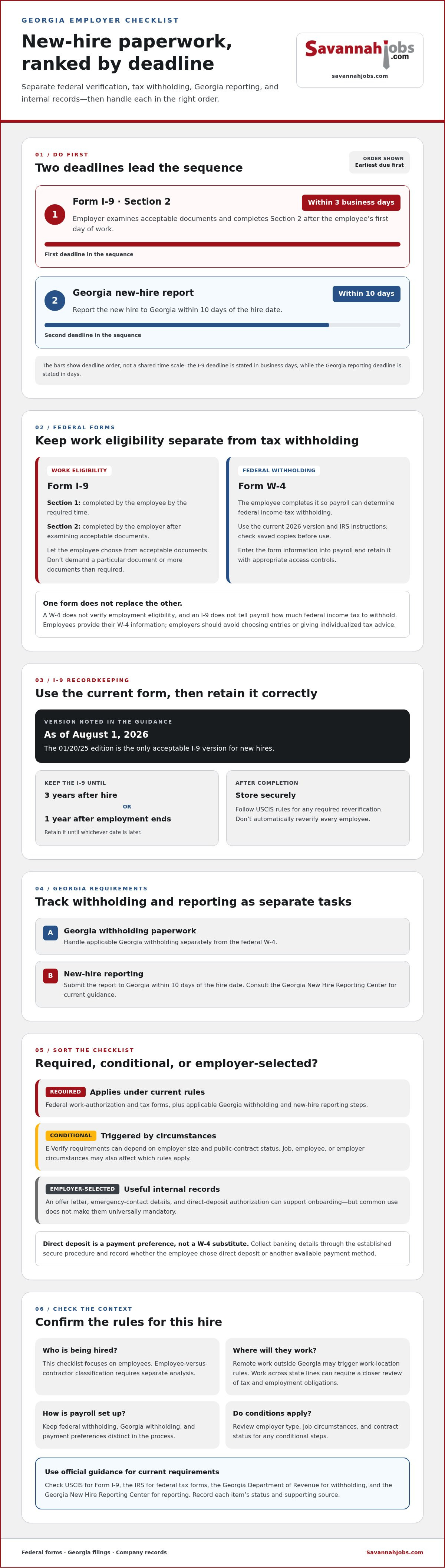
Could a routine first day leave you scrambling over which forms belong to the federal government and which are Georgia-specific? Georgia new hire paperwork requirements include deadlines at both levels. Employers must complete Form I-9 Section 2 within three business days of an employee’s first day of work and report the new hire to Georgia within 10 days of the hire date.
When onboarding gets busy, it’s easy to confuse required filings with useful company records. This checklist separates what to collect, what to submit, and when, so you can build a clear process for each new employee.
It covers work eligibility verification, federal and Georgia tax forms, new-hire reporting, and workplace policies and records. You’ll see which items are mandatory and which support your internal process, along with where to find current guidance from USCIS, the IRS, and Georgia’s New Hire Reporting Center.
Key Takeaways
- Use a Georgia new hire paperwork requirements checklist to organize federal forms, state filings, and onboarding records in a clear sequence.
- Keep employee onboarding separate from contractor classification, which requires its own analysis.
- Handle federal and Georgia tax withholding paperwork separately, and track new-hire reporting as its own employer responsibility.
- Distinguish government-required forms from useful company records, such as offer documentation, emergency contacts, and direct-deposit details.
- Build a repeatable collect, verify, report, store, and review process, then check current federal and Georgia agency guidance.
Georgia new-hire paperwork requirements: what employers should prepare
New-hire paperwork comes from different authorities, and each item has its own purpose, deadline, and recordkeeping rules. A reliable checklist separates federal forms from Georgia filings and company-selected documents instead of treating every onboarding page as a legal requirement.
This checklist focuses on employees. Whether a worker is an employee or an independent contractor affects which rules and forms apply, so classification requires separate analysis. Don’t use an employee onboarding checklist as a substitute for making that determination.
Required, conditional, and optional forms are not interchangeable
Label each checklist item required, conditional, or employer-selected. Federal work-authorization and tax forms, along with applicable Georgia withholding and new-hire reporting steps, belong in the required category for covered hires. For an overview of the Form I-9, Employment Eligibility Verification, see this reference, then follow current USCIS instructions for the form and its completion. A federal W-4 is separate from Georgia’s withholding paperwork.
Conditional items depend on the employer’s circumstances or rules that apply to the job. For example, E-Verify requirements can depend on employer size and public-contract status. Employer-selected records may include an offer letter, emergency contact details, or direct-deposit authorization. These can support consistent onboarding, but common use doesn’t make a document universally mandatory.
A Georgia checklist starts with the employee and employer context
Before collecting forms, note who you’re hiring, where the employee will work, how payroll is set up, and what kind of employer is hiring. These details help identify the rules that apply and whether any conditional requirements need attention.
Remote work and multistate employment can add another layer. An employee working outside Georgia may trigger rules tied to the work location, while someone working across state lines may require a closer review of applicable tax and employment obligations. Don’t assume that a Georgia-based employer means every hire follows only Georgia rules.
Check current rules before setting the sequence
For each checklist item, record its status and the source that supports it. Verify federal forms and instructions through agencies such as USCIS and the IRS. For Georgia withholding and reporting, consult the Georgia Department of Revenue and Georgia New Hire Reporting Center. Official guidance is a better reference than a previous hire’s file or a remembered deadline.
- Required: A form or filing that applies to the employee and employer under current rules.
- Conditional: A step triggered by specific employer, employee, job, or contract circumstances.
- Employer-selected: A useful internal record that supports company processes but isn’t automatically a government-required form.
Using these categories from the start makes Georgia new hire paperwork requirements easier to manage and helps keep onboarding organized. Work through the checklist for each hire, then revisit official guidance when requirements or circumstances change.
Complete federal new-hire forms and verify work authorization
Federal onboarding includes two distinct tasks: confirming that an employee is authorized to work in the United States and collecting information for federal income-tax withholding. Keep them separate. A completed tax form doesn’t replace employment eligibility verification, and an I-9 doesn’t tell payroll how much federal income tax to withhold.
Form I-9 verifies employment eligibility; Form W-4 guides federal income-tax withholding.
Form I-9: complete employment eligibility verification correctly
The employee completes Section 1, and the employer completes Section 2 after examining the employee’s acceptable documents. Use the current USCIS form and instructions. As of August 1, 2026, the 01/20/25 edition is the only acceptable version for new hires. Section 2 is due within three business days of the employee’s first day of work.
Let the employee choose which acceptable documents to present from the I-9 lists. Don’t demand a particular document or ask for more documents than the form requires. USCIS instructions also explain retention: keep each I-9 for three years after the hire date or one year after employment ends, whichever is later.
- Have the employee complete Section 1 by the required time.
- Review acceptable documents and complete Section 2 within the deadline.
- Store the form securely and follow USCIS rules for any required reverification. Don’t reverify every employee automatically.
Form W-4 and payroll details for a new employee
The employee completes Form W-4 so payroll can determine federal income-tax withholding. Use the current 2026 version and its IRS instructions. Because the form reflects updates for 2026, check that a saved copy is current before using it. Employees provide their withholding information on the form; employers should avoid choosing entries or giving individualized tax advice.
Keep tax withholding separate from payment preferences. Direct-deposit enrollment, for example, is an employer-selected payroll process, not a substitute for a W-4. Collect banking details through your established secure procedure and record whether the employee has chosen direct deposit or another available payment method.
A practical sequence is to collect the employee’s W-4, enter its information into payroll, and retain the form with appropriate access controls. If an employee has questions about completing it, point them to current IRS instructions or a qualified tax professional rather than interpreting their personal tax situation.
Track Georgia’s new-hire report as a separate task. Employers can find reporting instructions and submission options at the Georgia New Hire Reporting Center. Check the current state deadline when setting reminders. Federal form deadlines and Georgia reporting deadlines are separate.
With onboarding records in order, you can focus on recruiting for your next opening. Savannah-area employers can use a job advertisement to reach local candidates.
Georgia tax forms and new-hire reporting: what employers need to check
Georgia onboarding adds two distinct responsibilities to federal paperwork: collecting state income-tax withholding information and reporting a new or rehired employee to the state. Entering an employee in payroll doesn’t complete Georgia’s new-hire report, and a federal W-4 doesn’t replace Georgia Form G-4.
Georgia Form G-4 and state income-tax withholding
Ask each new employee to complete Georgia Form G-4, the Employee’s Withholding Allowance Certificate. Payroll uses the employee’s state withholding information to calculate Georgia income-tax withholding. Form W-4, by contrast, supplies information for federal income-tax withholding. Keep the forms separate in your onboarding workflow and payroll records.
Use the current G-4 and follow the Georgia Department of Revenue’s instructions for completing, submitting, or retaining it. If an employee doesn’t provide a G-4, Georgia guidance says to withhold as if the employee were single with zero allowances. Check the latest instructions rather than relying on an older saved form or assumptions about how to handle the state form.
Georgia new-hire reporting and employer responsibilities
Georgia employers must report new and rehired employees to the Georgia New Hire Reporting Center within 10 days of the hire date. Assign this its own owner and reminder. A payroll entry or completed G-4 doesn’t automatically satisfy the reporting obligation.
Use the Georgia New Hire Reporting Program for current reporting instructions and submission details. Review the latest official guidance before applying a deadline to a particular situation. Requirements can change, and hiring circumstances may affect which steps apply.
This comparison ties each document or action to its purpose and the source to check for current forms and instructions.
| Form or action | Purpose | Official source |
|---|---|---|
| Federal Form W-4 | Provides employee information for federal income-tax withholding. | IRS instructions |
| Georgia Form G-4 | Provides employee information for Georgia income-tax withholding. | Georgia Department of Revenue and Georgia Tax Center |
| Georgia new-hire report | Reports new and rehired employees to the state within the required time. | Georgia New Hire Reporting Center |
File federal and state forms under separate labels, then record the reporting date for each hire. For broader federal employment documentation, USCIS provides Form I-9 guidance on work-authorization verification, not tax withholding. This separation makes Georgia new hire paperwork requirements easier to track and helps prevent one completed form from being mistaken for another required step.
Build a practical onboarding checklist beyond required tax forms
Government forms address specific reporting, eligibility, and tax duties. Other documents help your team communicate expectations and manage the employment relationship, but they’re generally employer-selected rather than universally required by a government agency. Keep these categories separate in your Georgia new hire paperwork requirements checklist so staff can see what must be completed and what supports internal processes.
Company-selected records may include an offer letter, emergency contact details, direct-deposit enrollment, and an employee handbook acknowledgment. For each record, decide what purpose it serves, who collects it, and where it belongs.
Employee handbook essentials and acknowledgment records
A handbook can explain workplace expectations, including conduct standards, attendance procedures, and how employees can raise concerns or report problems. Review its language regularly so it reflects current law and matches your organization’s practices. Georgia employers can also consult this Georgia at-will employment and labor-law guide when reviewing related workplace policies.
An acknowledgment can document that an employee received or reviewed the handbook. It doesn’t, by itself, make every policy enforceable or replace legal compliance. State clearly what the employee is acknowledging, and don’t present the acknowledgment as proof that all workplace obligations have been met.
Organize onboarding records without collecting unnecessary information
Make the checklist useful to the person managing onboarding. Track each document or task, its owner, completion status, and storage location. That makes outstanding steps easier to spot and records easier to locate later.
- Offer documentation: Keep the signed offer or other relevant hiring record with appropriate personnel files.
- Emergency contact: Collect the contact information your organization needs for workplace emergencies.
- Direct deposit: If offered, collect payment details through a secure process and limit access.
- Handbook receipt: Record delivery or acknowledgment separately from required government forms.
Collect only information needed for a legitimate onboarding or employment purpose. Limit access to people who need the records for their work, and keep sensitive information separate where appropriate. Follow applicable privacy and retention requirements for each record type rather than applying the same storage or deletion rule to every document.
Review the checklist when your procedures or relevant requirements change. A short, consistent process helps Savannah-area employers welcome each new team member without confusing internal paperwork with official filings. When you’re ready to recruit for another role, advertise the opening to reach Savannah-area candidates.
Use a repeatable Georgia new-hire checklist for every onboarding
A consistent workflow shows what’s complete, what still needs action, and which source supports each step. Assign an owner, track reporting separately from form collection, and verify current agency instructions before relying on an older checklist. This turns Georgia new hire paperwork requirements into a repeatable routine instead of a last-minute document hunt.
A reusable first-day-to-follow-up workflow
Give each step a clear owner. Employees complete their assigned forms, hiring managers coordinate onboarding and policy records, and payroll administrators handle withholding setup and related follow-up. One person can hold multiple roles in a small business, but every task should have a named owner and status.
- Collect: Request required federal and Georgia forms, then gather employer-selected records that serve a clear purpose.
- Verify: Review forms for completion and follow current instructions for work-authorization verification. Don’t choose documents on an employee’s behalf.
- Report: Complete applicable state and federal reporting as separate tasks. Record confirmation or submission details when available.
- Store: File records securely in the appropriate location, with access limited to people who need it.
- Review: Check the completed file, note outstanding items, and update the checklist when official forms or guidance change.
Track completion separately from storage and reporting confirmation. A form marked “collected” doesn’t prove that a required review or separate report is finished. Include fields for the owner, due date where applicable, completion status, storage location, and confirmation reference so the next person can continue without guessing.
When to get qualified compliance guidance
Some hiring situations warrant individual review. Consider qualified legal or HR guidance when worker classification is uncertain, an employee will work across state lines, or the arrangement involves circumstances outside your standard process. A general checklist helps organize tasks, but it can’t determine how every rule applies to a particular employer or worker.
For federal requirements, verify current instructions with agencies such as USCIS and the IRS. For Georgia forms and reporting, check the Georgia Department of Revenue and Georgia New Hire Reporting Program. Revisit these sources periodically and whenever a form or instruction changes. Don’t rely on a previous hire’s paperwork as proof that your current process is up to date.
For recruitment context in Savannah, see the Savannah employer guide to local hiring. SavannahJobs.com helps employers advertise openings through local job postings. When your hiring steps are ready, post a local job with SavannahJobs.com to reach Savannah-area candidates.
Put your next hiring plan into motion
A dependable onboarding routine gives your team a strong start, while recruitment helps connect your business with potential employees. Keep your Georgia new hire paperwork requirements process separate from recruitment, and make your next opening easy for Savannah-area candidates to find.
SavannahJobs.com offers employers self-service 30-day job postings, with optional featured job and featured employer placement. As a digital recruitment portal associated with the Savannah Morning News and USA TODAY Network, it helps local employers put opportunities in front of candidates in the Savannah region.
Ready to reach local candidates? Post a job with SavannahJobs.com.
Frequently Asked Questions
Do all new employees in Georgia need to complete Form I-9?
Employers generally must complete Form I-9 for employees hired to work in the United States, subject to exceptions in federal instructions. The form documents identity and work authorization, not tax withholding. A W-4 or Georgia withholding form cannot substitute for I-9 completion. Check the current USCIS Handbook for Employers and form instructions for employee and employer responsibilities, timing, acceptable documents, and any exception that may apply.
Does Georgia require a new-hire report for every employee?
Georgia employers generally have new-hire reporting responsibilities, including reporting new and rehired employees within 10 days of the hire date. Treat the report as a separate task, even if payroll is already set up. Check the Georgia New Hire Reporting Program’s current employer instructions for covered hires, required information, and submission methods. This helps keep your Georgia new hire paperwork requirements process aligned with current state guidance.
Is Georgia Form G-4 the same as the federal W-4?
No. The federal W-4 gives payroll information for federal income-tax withholding, while Georgia Form G-4 provides information for state income-tax withholding. For example, an employee starting work in Savannah may need both forms so payroll can address each jurisdiction separately. Use current versions and follow their respective instructions. Employees deciding what withholding information to enter should consult official form guidance or a qualified tax professional.
Can an employer require a new employee to sign an employee handbook acknowledgment?
An employer may use an acknowledgment to record that an employee received or reviewed workplace policies. It’s an internal company record, not a government form or a replacement for required onboarding steps. Make clear what the acknowledgment documents, then store it with appropriate access controls. If you have questions about its legal effect, have the wording reviewed by a qualified professional.
Is direct-deposit authorization required new-hire paperwork in Georgia?
Direct-deposit authorization is generally an employer payroll document, not a universal federal onboarding form. Applicable payment rules may depend on the employer’s situation, so don’t assume electronic payment can be the only option without checking current requirements. Explain the process and any alternatives clearly. Collect only the banking details needed to administer the employee’s chosen payment method, and protect that information with limited access and secure storage.
How long should an employer keep new-hire paperwork?
There isn’t one retention period for every new-hire record. Form I-9, payroll tax records, and internal documents may follow different requirements. For example, a handbook acknowledgment shouldn’t automatically inherit the retention schedule used for a tax form. Check current USCIS, IRS, and Georgia agency instructions for each record type, document the applicable schedule, and limit access while records are stored. Dispose of records securely when retention rules permit.
Do Georgia employers need E-Verify for every new hire?
No. E-Verify isn’t a universal requirement for every Georgia employer. Under Georgia rules, private employers with more than 10 full-time employees generally must use it, and separate requirements apply to certain public-entity contracts. Check current Georgia and federal guidance against your workforce and contract circumstances. Keep E-Verify procedures distinct from Form I-9: the systems have related but separate roles in employment eligibility verification.


