

The strongest entry-level candidate may have the shortest résumé. For employers searching “hiring candidates with no experience Savannah,” the challenge is looking beyond job titles to assess what an applicant can do, how they learn, and whether the role is a good fit.
It’s understandable to consider training time and early turnover. Comparing applicants with different backgrounds can also feel uncertain when work history offers few clues. But limited experience doesn’t mean limited potential. A consistent, job-related process helps you evaluate candidates fairly and make a more confident decision.
This guide explains how to identify transferable skills, apply practical screening criteria, and assess qualities such as reliability, communication, and willingness to learn. You’ll also find ways to set clear expectations and give new employees a productive start. With a thoughtful approach, entry-level hiring can be more manageable for your team and create a stronger path for local talent in Savannah.
Key Takeaways
- Look beyond job titles: school, volunteering, caregiving, and personal projects can reveal useful skills.
- For hiring candidates with no experience Savannah, define essential tasks first, then assess applicants against the same job-related criteria.
- Separate must-have skills from preferences, and check whether a missing credential is truly essential to the role.
- Compare candidates by role skills, supporting evidence, readiness to learn, and the guidance they may need to get started.
- Make onboarding practical with clear expectations, necessary tools, manageable learning milestones, and regular check-ins.
Why Savannah Employers Should Consider Candidates With No Experience
A short work history tells you what a candidate has done in formal jobs, but not everything they can do. An inexperienced candidate has limited formal work history, not necessarily limited ability. For employers considering hiring candidates with no experience in Savannah, the useful shift is from counting job titles to looking for evidence of skills relevant to the role.
Work experience is a record of previous employment; job-relevant skills are abilities a person can demonstrate or apply to upcoming work, whether they gained them on the job or elsewhere.
It’s reasonable to consider how much training a new hire may need, whether they can meet the role’s attendance expectations, and how prepared they are for the work. Assess those concerns rather than relying on assumptions. Candidates with little experience aren’t all alike, and a résumé alone may not show how they follow instructions, solve problems, or complete responsibilities.
What counts as experience beyond a previous job?
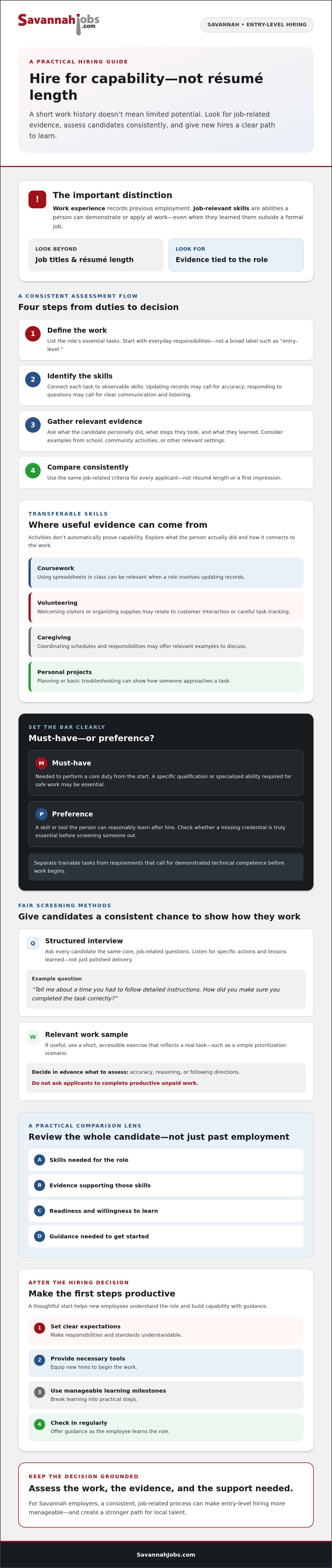
Look for activities that connect to actual job requirements. Coursework may show experience using spreadsheets if the role involves updating records. Volunteering could involve welcoming visitors or organizing supplies, which may be relevant to customer interaction or careful task tracking. Caregiving may involve coordinating schedules and responsibilities. A personal project might show planning or basic troubleshooting.
These activities don’t automatically prove capability. Ask what the candidate personally did, what steps they took, and what they learned. For a shared starting point, the general meaning of an entry-level job can help frame roles designed for people beginning a career. Employers still need to define their own requirements clearly.
Which Savannah roles may suit entry-level applicants?
Start with the duties, not a broad label like “entry-level.” Roles may suit newer workers when core tasks can be taught through clear instructions and practice. If a position involves greeting visitors, sorting materials, or entering routine information, decide which skills matter on day one and which can be learned with guidance.
Separate trainable tasks from requirements that call for a credential or demonstrated technical competence before work begins. If a duty requires a specific qualification or the ability to perform specialized work safely, treat that requirement as essential. This distinction helps Savannah employers set realistic expectations, attract suitable applicants, and identify training needs without lowering essential standards.
How to Assess Skills When Savannah Candidates Lack Work History
Use a consistent sequence to assess potential: define the work, identify the skills it requires, gather relevant evidence, then compare candidates against the same criteria. This keeps decisions tied to the position rather than résumé length or a hiring manager’s first impression.
Structured criteria make entry-level comparisons more consistent by giving every candidate the same opportunity to demonstrate skills that matter for the role.
Translate job duties into observable skills
Start with everyday responsibilities. If the role includes updating records, identify accuracy and attention to detail as relevant skills. If it involves responding to questions, consider clear communication and listening. For each duty, ask what a person needs to do well, then connect each requirement in the job description to an actual responsibility.
Separate must-haves from preferences. A requirement is essential when the person needs it to perform a core duty from the start. A preference is a skill or tool they can reasonably learn after hire. This distinction helps employers hiring candidates with no experience in Savannah avoid screening out promising applicants for qualifications that aren’t necessary on day one.
Use interviews and work samples fairly
Ask every candidate the same core, job-related questions. For example: “Tell me about a time you had to follow detailed instructions. How did you make sure you completed the task correctly?” Candidates can draw on school, community activities, or other relevant settings. Listen for specific actions and lessons learned, not just polished delivery.
If a short exercise would help, use one that reflects a real task in the role and is accessible to candidates. A simple prioritization scenario may show how someone thinks through competing requests. Don’t ask applicants to complete productive unpaid work. Decide in advance what you’ll assess, such as accuracy, reasoning, or following directions, and apply those standards consistently.
- Define: List the role’s essential tasks.
- Identify: Match each task to an observable skill.
- Gather: Use consistent questions or a relevant exercise to collect evidence.
- Compare: Score candidates against the same criteria, and note where training may be needed.
For employers exploring broader workforce resources in the Savannah area, WorkSource Coastal is a local point of reference. A clear description of duties and requirements can also help local job seekers decide whether they’re a fit. Employers can use Savannah-area job advertising to share an entry-level opening, then manage applications and hiring directly.
How to Compare Entry-Level Applicants Without Overvaluing Experience
Compare applicants against the work they’ll actually perform, not the number of years listed on a résumé. A candidate with direct experience may need less initial instruction, while someone new to the workforce may have developed relevant abilities elsewhere. For employers hiring candidates with no experience in Savannah, a fair comparison uses the same role-based standards for everyone and records the evidence behind each assessment.
Separate trainable skills from essential qualifications
Review each requirement against the position’s actual duties. If a role requires a specific license, credential, safety qualification, or technical ability before someone can perform essential work, verify that requirement for the position. Don’t treat a qualification as optional if the work depends on it.
Then identify what can be learned through documented training and supervised practice. Remove experience thresholds that don’t connect to a responsibility. Requiring previous experience with a particular system, for example, may be unnecessary if the employee can learn it after hire and already demonstrates the accuracy needed for the task.
Use a consistent candidate scorecard
Create a short scorecard based on the role’s essential competencies. Apply the same criteria to each applicant, whether the evidence comes from a résumé, interview response, or relevant work sample. A simple comparison can keep the discussion focused:
| Area | What to record | Example evidence |
|---|---|---|
| Role skills | Ability tied to an essential duty | Explains steps used to check work for errors |
| Evidence | Where and how the skill was demonstrated | Coursework, volunteering, or a relevant exercise |
| Trainability | Readiness to learn tasks not yet demonstrated | Describes responding to feedback or learning a new process |
| Support needs | Guidance or training likely needed to get started | Needs instruction on a workplace tool or procedure |
Use a consistent rating scale, such as “not demonstrated,” “some evidence,” and “clear evidence,” and add a brief note to support each rating. Don’t let direct experience automatically outweigh transferable skills. If a candidate has used a similar skill in another setting, assess the evidence against the same competency. When evaluators disagree, discuss what the candidate said or did rather than whether they seemed like a good fit.
For employers planning broader outreach alongside a fair comparison process, see the Savannah recruitment advertising strategy guide.
How Savannah Employers Can Prepare New Hires to Succeed
A strong start takes more than a welcome and a list of rules. New employees need to understand what the role requires, have access to the tools and information they need, and know whom to ask for help. Clear guidance is especially useful when hiring candidates with no experience in Savannah because it breaks training into manageable steps.
Before the employee begins, name a supervisor or trainer as their point of contact. Confirm that logins, equipment, schedules, and role-specific materials are ready. Make sure supervisors can clarify priorities and give timely, specific feedback, such as pointing out which step was missed and how to handle it next time.
Build a practical first-month training plan
Work with the hiring manager to identify what the employee needs to learn first and set realistic milestones for the role. Assign a responsible trainer to each task. Demonstrate procedures, let the employee practise with supervision, then confirm they understand the process before expecting independent work.
- Start with essentials: Cover access, tools, key procedures, and the tasks the employee will handle first.
- Practise with support: Demonstrate each process and give the employee a chance to try it while a trainer is available.
- Review progress: Check understanding against the agreed milestones and adjust the plan if a task needs more practice.
Milestones should reflect the actual position, not an arbitrary timeline. A new hire may be ready to handle a routine task independently before taking on a more complex one. Document what has been covered and any follow-up training needed so supervisors can provide consistent support.
Set expectations and keep communication open
Explain attendance, performance, safety, and communication expectations during onboarding. Be specific about how the employee should raise a concern, ask for help, or report a delay. Schedule regular check-ins that invite questions and surface barriers early. Keep feedback focused on observable work and the role’s stated criteria.
Apply workplace policies and evaluation standards consistently, and keep appropriate notes on training, feedback, and progress. This gives supervisors a clear record and helps keep decisions job-related. Consistent, respectful communication from recruitment through onboarding also helps new hires understand what to expect.
Ready to share an entry-level opening with local job seekers? Post your job on SavannahJobs.com, then manage applications and hiring directly.
How to Reach Entry-Level Job Seekers in Savannah
Reaching entry-level applicants starts with a clear role and a realistic description of what they’ll learn. For employers searching “hiring candidates with no experience Savannah,” a focused process helps make an opening easier to understand and gives your team a consistent way to review applications against the position’s actual needs.
- Define the role: List the day-to-day duties and the skills needed to perform them.
- Explain training: Describe what the new hire will learn and what support is available.
- Choose a local channel: Select an advertising option suited to reaching Savannah-area job seekers.
- Review applications: Use consistent, job-related criteria to assess each applicant.
For a fuller preparation checklist, read the Savannah employer guide to posting a job.
Write an entry-level job ad candidates can understand
Choose a specific job title, then describe the work in plain language. Explain the responsibilities a new employee will handle during a typical day instead of relying on broad phrases such as “various duties.” State which qualifications are essential and which skills can be learned after hire. Include accurate schedule and location details, how to apply, and what training the role provides. Clear information helps applicants decide whether the position fits and gives your hiring team a stronger basis for evaluating applications.
Before publishing, check that every listed requirement connects to a real duty. If prior experience with a tool isn’t essential because you’ll teach it, say so. The employer guide above offers a useful next step for preparing the posting.
Choose a local advertising option and manage applications
SavannahJobs.com is a self-service local recruitment advertising platform. Employers can purchase a 30-day job posting to advertise an opening in the Savannah area, with Featured Job and Featured Employer upgrades available as optional visibility choices. These options don’t guarantee applications or a hire. Employers manage incoming applications and handle their own hiring process.
After your ad is live, review applications using the same role-based criteria, keep candidates informed about next steps, and record relevant evidence consistently. To review the available options, explore SavannahJobs.com job posting options and choose the approach that fits your opening.
Build a Stronger Entry-Level Hiring Process
Hiring candidates with no experience in Savannah starts with looking beyond job titles. Define the skills the role truly needs, use consistent criteria to compare applicants, and separate essential qualifications from abilities that can be taught. Then give new hires clear expectations, practical training, and a named person they can turn to for guidance.
A thoughtful job ad helps local candidates understand the duties, schedule, requirements, and training before they apply. SavannahJobs.com offers local recruitment advertising through 30-day job postings, with optional Featured Job and Featured Employer upgrades for added visibility. It operates as the digital recruitment portal for the Savannah Morning News and is part of the USA TODAY Network. Employers manage applications and hiring themselves, and advertising does not guarantee a hire.
Ready to share an opening with Savannah-area job seekers? Explore Savannah job posting options and choose the advertising approach that suits your role. With a clear process and a supportive start, you can help new employees build skills and contribute to your team.
Frequently Asked Questions
Can I hire someone with no work experience in Savannah?
Yes. You can consider Savannah applicants with limited formal work history if they meet the role’s essential requirements. Focus on the actual duties and look for relevant abilities gained through school, volunteering, caregiving, or personal projects. If the job requires a specific credential or demonstrated technical skill, verify that requirement and assess candidates consistently. Plan training for tasks that can be learned after hire.
How do I assess candidates who have never had a job?
Use the same job-related questions and evaluation criteria for each applicant. Ask for examples of how they followed instructions, handled responsibilities, solved a problem, or learned something new in school or another setting. If useful, offer a short exercise that reflects a real role task. Record specific evidence from answers or exercises, and compare candidates against the position’s essential competencies rather than résumé length.
What skills should I look for when hiring entry-level workers?
Choose skills based on the role’s everyday duties. Depending on the position, useful competencies may include communication, accuracy, following procedures, problem-solving, organization, and responding to feedback. Don’t assume every candidate needs the same strengths. Identify which skills are essential from the start and which can be developed through training. Ask applicants for concrete examples of how they’ve used relevant skills in work, school, or other responsibilities.
Should I require previous experience for an entry-level job?
Require previous experience only when it connects to a genuine need of the position. First separate essential qualifications, such as a required credential or demonstrated technical ability, from preferences that can be learned after hire. If experience with a particular tool isn’t needed on day one, consider whether training can cover it. Clear, job-related requirements help applicants understand what matters and reduce the risk of screening out capable beginners.
How can I help an inexperienced new hire succeed?
Give the employee clear expectations, access to necessary tools, and a named supervisor or trainer to contact with questions. Create a role-specific plan that shows which tasks to learn first, who will teach them, and how progress will be checked. Demonstrate procedures, provide supervised practice, and schedule regular check-ins. Share specific feedback promptly so the new hire knows what’s going well and what to improve.
Where can Savannah employers advertise entry-level jobs?
Savannah employers can advertise local openings through SavannahJobs.com, a self-service recruitment advertising platform. Employers can purchase a 30-day job posting, with optional Featured Job and Featured Employer upgrades for added visibility. These options don’t guarantee applications or a hire. Employers manage their own applications and hiring. Make your listing clear about duties, essential qualifications, schedule, location, application steps, and the training the role includes.


