

What if the salary you budgeted is only the starting point? The cost to hire an employee in Savannah Georgia also includes employer payroll taxes, insurance, benefits, recruiting, and onboarding. Leaving those out can leave your first-year hiring budget short.
Gross wages are an important starting figure, but the total depends on the role, your benefit choices, applicable payroll obligations, and how you recruit. A national estimate may not reflect your Savannah business or the position you need to fill.
This 2026 guide shows you how to build a role-specific budget by separating one-time recruiting and onboarding expenses from recurring employment costs. You’ll see which payroll and insurance items to account for and how to weigh local recruitment options against your hiring timeline. Job advertising can put an opening in front of Savannah-area job seekers, but it is one part of the hiring budget, not a substitute for wages or ongoing employment costs.
Key Takeaways
- See what the cost to hire an employee in Savannah Georgia includes beyond gross wages, from employer obligations to recruiting and onboarding.
- Distinguish recurring employment expenses from one-time costs, so your first-year budget reflects the role and hiring process.
- Use a five-step worksheet to estimate annual and monthly costs with your own pay, insurance, benefits, and recruiting figures.
- Review key federal and Georgia payroll obligations, including how different taxes and workers’ compensation are calculated.
- Understand how local job advertising can support candidate discovery while remaining one part of your overall hiring budget.
What Does It Cost to Hire an Employee in Savannah, Georgia?
The total cost to hire an employee in Savannah, Georgia, includes compensation, employer obligations, benefits, and recruiting expenses. This guide covers Savannah, Georgia, United States, not the country of Georgia. The distinction matters because U.S. federal and Georgia state rules, payroll systems, and currency assumptions differ from those used in other countries.
There’s no universal total for every Savannah employer. A full-time role with health coverage and specialized equipment has a different budget from a part-time position with fewer onboarding needs. Build your estimate from the position’s duties and schedule, along with your business’s actual payroll, insurance, and benefit arrangements.
What counts as the full cost of hiring?
Start with gross wages, the employee’s pay before applicable payroll deductions. Gross wages are not the same as total employer cost. Keep the following items distinct in your budget:
- Employer payroll taxes: Include applicable federal and state employer obligations. For example, the Federal Unemployment Tax Act (FUTA) establishes the federal unemployment tax framework.
- Workers’ compensation: Insurance costs depend on factors such as the work and its risk classification. Applicable requirements also determine whether coverage is needed.
- Benefits: Health coverage, retirement contributions, paid leave, and other benefits depend on what your business offers and the employee’s eligibility.
- Payroll administration: Account for the time and tools needed to process payroll and maintain required records.
- Recruiting and setup: Advertising, interview time, screening, onboarding, and equipment can add costs before or around the employee’s start date.
Separate recurring expenses, such as wages, employer taxes, insurance, and ongoing benefits, from hiring-related expenses, such as interviews, screening, initial training, and equipment. Some costs, including payroll administration or equipment, may recur or vary by role. Classify them according to your own process rather than assuming they are fixed.
Why check the location behind the numbers?
A cost estimate is useful only when its rules match your workplace. Savannah employers need to consider U.S. federal requirements alongside Georgia rules. A calculator built for the country of Georgia may show GEL-denominated amounts and foreign social-contribution assumptions. Those figures don’t apply to hiring in Savannah, Georgia, United States.
Before finalizing your budget, verify current federal payroll guidance with the IRS and Georgia unemployment and employer guidance with the Georgia Department of Labor. Apply those rules to the role and your company’s circumstances. This gives you a stronger basis for estimating the cost to hire an employee in Savannah Georgia than a generic national or international total.
Which Payroll Taxes, Insurance, and Benefits Add to Savannah Hiring Costs?
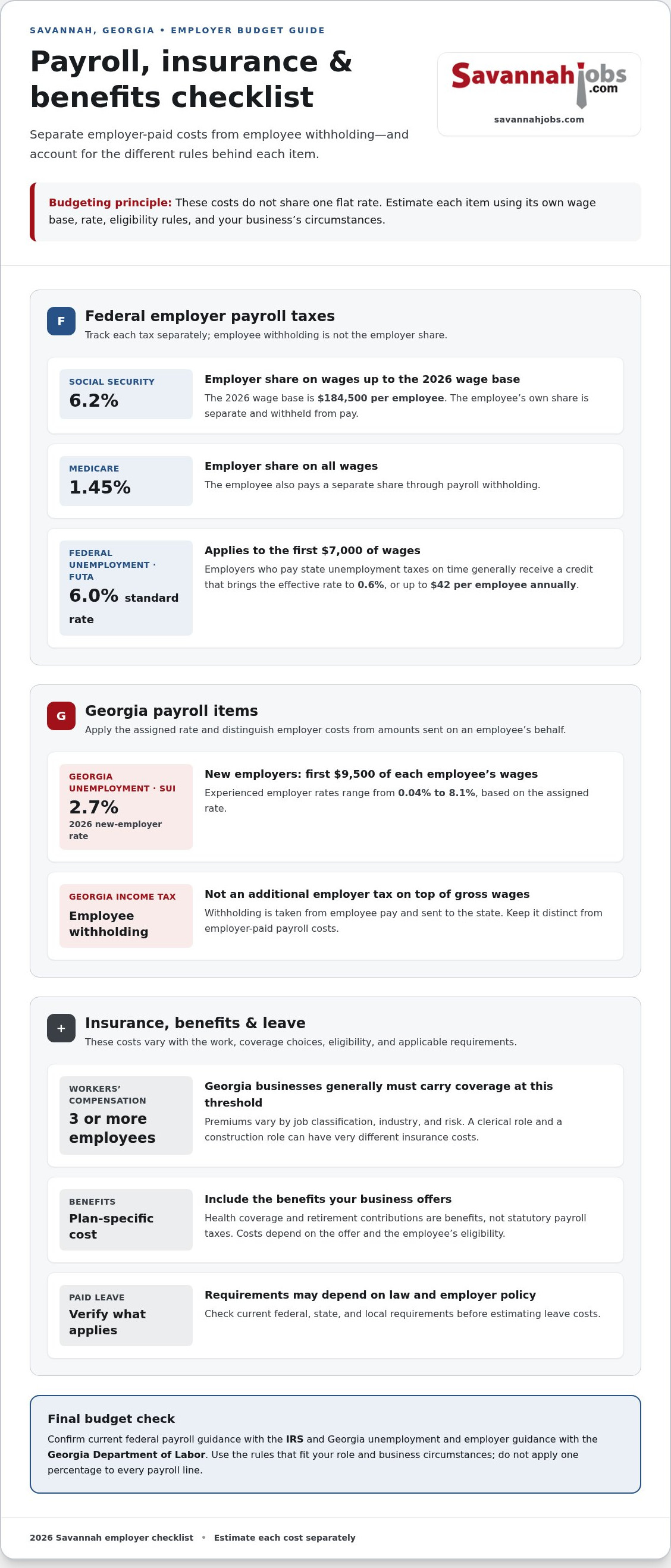
For a Savannah employer, payroll costs are not one flat add-on. Federal taxes, Georgia unemployment insurance, workers’ compensation, benefits, and leave each follow different rules. Separate employer-paid costs from amounts withheld from an employee’s paycheck, then estimate each item using expected wages and your business’s circumstances.
Which employer payroll taxes apply in Georgia, United States?
Use this 2026 checklist as a starting point, and confirm filing details with the IRS and Georgia Department of Labor:
- Social Security: The employer share is 6.2% of wages up to the 2026 wage base of $184,500 per employee. This is separate from the employee’s own withheld share.
- Medicare: The employer share is 1.45% of all wages. The employee also pays a separate share through payroll withholding.
- Federal unemployment tax (FUTA): The standard rate is 6.0% on the first $7,000 of wages. Employers who pay state unemployment taxes on time generally receive a credit that brings the effective rate to 0.6%, or up to $42 per employee annually.
- Georgia unemployment insurance (SUI): The 2026 new-employer rate is 2.7% on the first $9,500 of each employee’s wages. Experienced employer rates range from 0.04% to 8.1%, based on the assigned rate.
- Georgia income tax withholding: Withholding is taken from employee pay and sent to the state. It is not an additional employer tax on top of gross wages.
These taxes have distinct wage bases, rates, and filing rules. Don’t treat employee withholding as an employer-paid tax or assume one percentage applies to every payroll line. Check current IRS and Georgia Department of Labor guidance for your filing responsibilities. For wage planning by occupation, the U.S. Bureau of Labor Statistics provides Savannah area wage data.
How insurance, benefits, and paid leave change the budget
Workers’ compensation is separate from payroll taxes. Georgia businesses with three or more employees are generally required to carry coverage, while premiums vary by job classification, industry, and risk. A clerical role and a construction role can have very different insurance costs.
Employer-sponsored health coverage and retirement contributions are benefits, not statutory payroll taxes. Their costs depend on what your business offers and the employee’s eligibility. Paid-leave obligations can also depend on applicable law and employer policy, so verify current federal, state, and local requirements before estimating them.
Fully loaded labor cost is the combined cost of wages, employer taxes, insurance, benefits, and other employment expenses for a specific role. It isn’t one universal percentage. Once you’ve budgeted those obligations, add recruitment separately. A local Savannah job advertisement can be one part of your candidate outreach budget.
Savannah Hiring Costs: Role, Recruiting, and Onboarding
A new-hire budget has two sides: recurring costs to employ someone and expenses tied to finding and preparing them for the role. Wages, employer payroll obligations, insurance, and benefits recur according to the job and your policies. Advertising, interviews, screening, initial training, and equipment are typically tied to filling a vacancy, though some may recur with future hires.
For local context, Savannah employers can compare occupations using the Savannah salary guide. Treat wage information as a starting point, then budget for the actual responsibilities, schedule, and compensation package. The cost to hire an employee in Savannah Georgia depends on those details, not simply on how many people are on your payroll.
Why the same headcount can cost different amounts
Compare an entry-level office opening with an experienced logistics or manufacturing role. The required experience, credentials, and training time may differ, as can the equipment each person needs. An office position may call for a computer and standard onboarding, while an operational job may require role-specific tools or additional preparation.
Schedules also shape the estimate. A position needing evening or weekend coverage may require a different staffing plan from a standard daytime role. If overtime may apply, include a realistic allowance based on the expected schedule and verify the rules for the position. Benefits and employer contributions can further change recurring costs, so don’t apply one role’s assumptions to another.
For state unemployment planning, review the Georgia Department of Labor’s Georgia unemployment insurance requirements and use the rate assigned to your business when estimating ongoing payroll costs.
Recruiting and onboarding are separate budget lines
Track the steps between approving an opening and having a new employee ready to work. Depending on your process, these can include:
- Job advertising and the time spent reviewing applications
- Interview scheduling and time spent by managers or other staff
- Screening or checks where appropriate for the role
- Orientation, initial training, and required work equipment
Record paid recruitment advertising and other recruiting expenses separately from wages and ongoing compensation. This makes it easier to compare the cost of filling a vacancy with the continuing cost of employing someone. For ideas on reaching candidates in the region, explore this local recruitment advertising strategy.
How Can You Estimate the First-Year Cost of a Savannah Hire?
Build your estimate from the role, schedule, and employer costs rather than relying on a generic salary multiplier. The worksheet below separates recurring employment expenses from one-time hiring costs, so you can see both the first-year commitment and an average monthly view. The cost to hire an employee in Savannah Georgia will vary with your assumptions. Label estimates clearly and update them as details become known.
A five-step first-year budget worksheet
- Estimate wages. Enter planned pay and the expected paid work schedule for the first year. Account for the anticipated start date and hours, using your own compensation plan.
- Add employer payroll obligations. Calculate applicable employer-paid federal and Georgia taxes using current 2026 rates, wage bases, and your business’s assigned unemployment rate. Keep employee tax withholdings out of this line. They come from employee pay and should not be counted again as an employer expense.
- Estimate insurance and benefits. Add your workers’ compensation estimate, employer-sponsored health or retirement benefits, and any other compensation your business plans to provide. Mark variable amounts as estimates, not fixed charges.
- Include payroll administration. Add the role’s expected share of payroll processing and administration costs, based on your actual systems and internal workload.
- List hiring and setup costs separately. Record recruiting advertising, application review, interviews, screening, onboarding, training, and initial equipment. Include only expenses that apply to the role and hiring process.
First-year total: Add expected first-year wages and recurring employer costs to one-time recruiting and setup expenses. For an average monthly view, divide that total by 12. Also calculate ongoing monthly employment costs without one-time expenses. The first figure spreads hiring costs across the year; the second better reflects the recurring run rate.
Stress-test the estimate before opening the role
Prepare a base case using the expected schedule, benefits, and recruitment timeline. Then compare it with alternatives, such as a higher benefit contribution, additional overtime where applicable, or a longer hiring period that requires more recruiting activity. Note which inputs changed. This makes the estimate useful for planning without treating uncertain expenses as guaranteed charges.
Before approving the budget, have your finance or payroll team review current 2026 rates, wage limits, filing requirements, and employer-specific obligations. This worksheet supports planning; it isn’t legal or tax advice. For regional context as you plan the role, read the Savannah job market outlook.
Once you’ve set the budget, include candidate outreach as its own line. Post your opening for Savannah-area job seekers with SavannahJobs.com, a self-service local recruitment advertising platform.
How SavannahJobs.com Fits Into Your Local Hiring Budget
After budgeting wages, employer obligations, benefits, and onboarding, set aside a separate line for reaching candidates. Job advertising supports candidate discovery, but it doesn’t cover payroll or guarantee a hire. Keep advertising distinct from the ongoing cost of employing someone.
SavannahJobs.com is a self-service local job advertising platform for employers and job seekers in the Savannah region. Employers can publish a 30-day job posting and choose optional featured placement for a job or employer profile. These visibility upgrades are advertising options, not a promise of a particular hiring result.
When local job advertising belongs in the hiring plan
Local advertising can fit a role that calls for candidates in or near Savannah, such as an on-site office, service, logistics, or manufacturing position. Add the posting to your recruiting budget alongside other planned outreach and internal hiring time. Don’t include it in wages, payroll taxes, insurance, or benefits.
Featured placement can provide additional visibility for a job or employer profile. Consider it as part of your candidate outreach plan, based on the opening and your recruitment priorities. For practical guidance on preparing and publishing a local opening, read the Savannah employer’s local hiring guide.
Take the next step toward reaching Savannah-area candidates
Before opening the role, validate your wage and employer-cost assumptions, finalize the responsibilities and schedule, and choose a recruitment plan that fits your timeline. Keep advertising costs separate in your first-year estimate, and adjust the plan if the role or hiring needs change.
Ready to put your opening in front of Savannah-area job seekers? Post a job on SavannahJobs.com.
Plan Your Next Savannah Hire With Confidence
A reliable first-year hiring budget starts with more than gross wages. Account for employer payroll obligations, insurance, benefits, and payroll administration, then separate recruiting, onboarding, and equipment expenses from recurring employment costs. Your estimate of the cost to hire an employee in Savannah Georgia should reflect the specific role, schedule, and benefits you plan to offer.
Once your assumptions are clear, review applicable 2026 requirements with your payroll or finance team and adjust estimates for your business. Then choose a recruitment approach that fits the opening and your timeline. SavannahJobs.com offers Savannah-focused recruitment advertising, including 30-day job postings and optional featured visibility for jobs and employer profiles. Advertising is one part of hiring, but it can put your opening in front of Savannah-area job seekers.
Ready to take the next step? Post a job on SavannahJobs.com and move forward with a clearer budget and a focused plan to reach local candidates.
Frequently Asked Questions
How much does it cost to hire an employee in Savannah, Georgia?
There’s no single total that applies to every employer. To estimate the cost to hire an employee in Savannah Georgia, start with expected wages, then add applicable employer payroll taxes, workers’ compensation, benefits, payroll administration, recruiting, and onboarding. The role, work schedule, coverage choices, and your company’s tax circumstances all affect the total. Use current 2026 federal and Georgia rules, and record your assumptions so you can update the estimate.
What payroll taxes do employers pay in Georgia?
Employers may owe the employer share of Social Security and Medicare, federal unemployment tax (FUTA), and Georgia unemployment insurance (SUI). For 2026, the employer Social Security rate is 6.2% up to the $184,500 wage base, and Medicare is 1.45% of all wages. FUTA and Georgia SUI have separate wage limits and rules. Don’t count employee withholdings as employer-paid costs. Verify current rates, taxable wage limits, and filing requirements with the IRS and Georgia Department of Labor.
Is workers’ compensation included in the cost of hiring an employee?
Yes. Include workers’ compensation separately in your hiring budget. In Georgia, businesses with three or more employees are generally required to carry coverage, while premiums can vary with the work, industry, and risk classification. It isn’t part of gross wages, and there’s no single percentage that fits every position. Confirm current Georgia requirements and your business’s expected coverage costs before approving a role’s budget.
How do I calculate the total cost of an employee beyond salary?
Add expected wages to employer payroll taxes, workers’ compensation, employer-paid benefits, payroll administration, and other recurring employment expenses. Then list hiring-related costs separately, including advertising, screening, interviews, onboarding, training, and equipment. Keep employee deductions distinct from employer costs so you don’t count withheld amounts twice. Use your actual benefit and payroll arrangements, and label uncertain figures as estimates. This gives you a clearer first-year total and a separate view of ongoing monthly expenses.
Does the cost to hire an employee include recruiting and job advertising?
It can, but track recruiting expenses separately from the ongoing cost of employing someone. Advertising, application review, interviews, screening, and onboarding can contribute to the cost of filling a vacancy. A job advertisement promotes an opening, but it doesn’t cover wages, payroll taxes, or benefits, and it can’t guarantee a hire. SavannahJobs.com offers local employers 30-day job postings and optional featured visibility as recruitment advertising options.
Are Georgia hiring cost estimates in GEL relevant to Savannah, Georgia?
No. GEL is the currency of the country of Georgia, while Savannah is in the U.S. state of Georgia. A calculator using GEL or another country’s payroll contribution rules won’t estimate U.S. employer costs. For a Savannah hire, use U.S. dollars, applicable federal and Georgia state requirements, and your own compensation and benefit inputs. Check current IRS and Georgia Department of Labor guidance when verifying payroll assumptions.
How much should a Savannah small business budget for a new employee?
Build the estimate around the specific role instead of relying on a generic figure. Include planned wages, verified employer payroll obligations, insurance, chosen benefits, payroll administration, recruiting, and onboarding. The cost to hire an employee in Savannah Georgia varies by role, experience, schedule, and employer choices. Use current local wage information where available, and revisit your estimate if the work schedule, benefit plan, or hiring timeline changes.


