

Sending more applications isn’t always the best way to find your next job. If you’re optimizing job application process Savannah, a clear routine can help you focus on relevant roles and keep each application organized. Savannah-area openings appear on local job boards and employer websites, so it’s easy to spend time on jobs that don’t fit or lose track of where you’ve already applied.
A focused process helps you find suitable Savannah opportunities, show how your experience matches each role, and keep follow-ups from slipping through the cracks. Instead of sending the same materials everywhere, you can spend time on roles that fit your skills and practical needs.
This guide covers how to set search priorities, find local openings through channels such as SavannahJobs.com and employer career pages, and tailor your resume and application. You’ll also learn how to track submissions and plan thoughtful follow-ups. A repeatable system makes it easier to approach each opportunity with clarity and confidence.
Key Takeaways
- Set clear role, skill, employer, and location priorities to focus your Savannah-area search.
- Combine local job boards, employer career pages, and professional networks to find relevant openings.
- Tailor your resume and application to each position by highlighting relevant experience and skills honestly.
- Make optimizing job application process Savannah easier with a simple tracker for application dates, statuses, and next steps.
- Use a repeatable routine to record each submission and follow up thoughtfully without losing track.
What an optimized job application process in Savannah looks like
Savannah job openings are spread across local job boards, employer career pages, and professional networks. Repeatedly applying with the same materials can make a search feel busy without making it more effective. Optimizing job application process Savannah means building a routine to find suitable roles, prepare a focused application for each one, and track what you’ve submitted.
A repeatable process can’t guarantee an interview or an offer, but it can help you use your time deliberately, avoid duplicate effort, and keep deadlines in view. It also gives you a clear record of each opportunity. For a broad overview of the job search process, see Wikipedia’s summary. This guide applies those general steps to a practical Savannah-area routine.
The process has five stages: set your priorities, find and assess local openings, tailor your application, record each submission, and follow up while updating its status. SavannahJobs.com is one local channel for discovering career opportunities, alongside employer pages and relevant professional networks.
Set a realistic Savannah-area job-search goal
Before you search, decide what you’re looking for. List your preferred role types, schedule, commute, and other work priorities. Separate must-haves from preferences: a required schedule is different from a preferred title or workplace perk. Use Savannah and nearby Chatham County as location filters if those areas fit your commute, then focus on work you can realistically pursue.
Choose a process that fits your application pace
There’s no need to set an ambitious application quota that’s hard to maintain. Choose a manageable weekly routine, such as checking new listings on set days and reserving time to prepare applications for the strongest matches. A regular review helps you catch deadlines, identify next steps, and avoid applying to the same role twice.
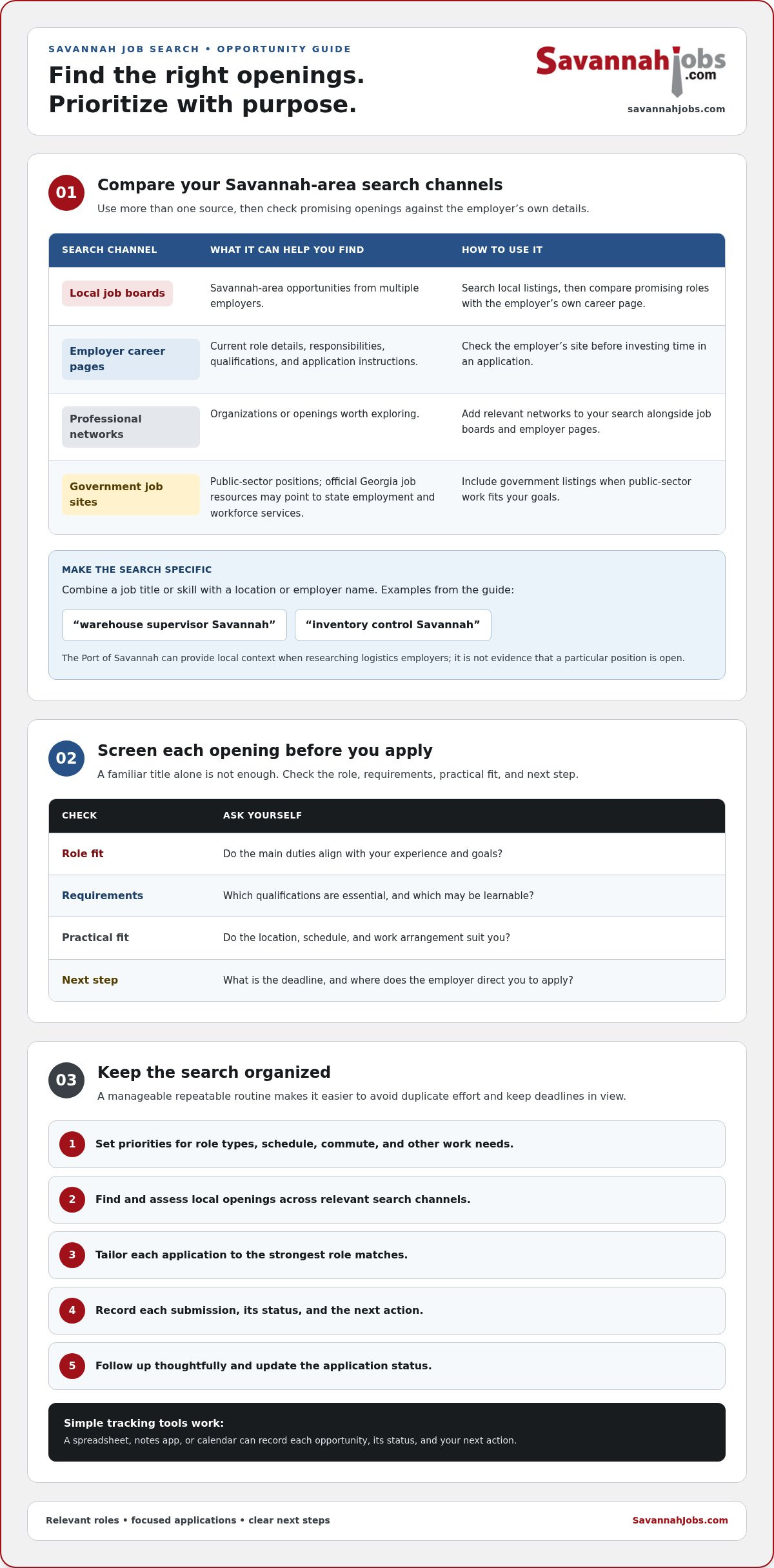
An optimized application process is a repeatable way to find fitting roles, tailor each submission, and track what happens next. Keep the system simple enough to use consistently. A spreadsheet, notes app, or calendar can all work. Record each opportunity, its status, and your next action. With clear priorities and a steady pace, it’s easier to organize a search even when Savannah openings appear across several sources.
Find and prioritize job opportunities across Savannah
Use several search channels without letting them become a pile of open tabs. Check local job boards for Savannah-area opportunities, visit employer career pages for current role details, and use professional networks to learn about organizations or openings worth exploring. Public-sector positions may appear on government job sites, while official Georgia job resources can point you toward state employment and workforce services.
Search with specific terms rather than broad labels such as “healthcare” or “logistics.” Combine a job title or skill with Savannah, a nearby location, or an employer name. For example, search “warehouse supervisor Savannah” or “inventory control Savannah.” The Port of Savannah can provide local context when researching logistics employers, but it isn’t evidence that a particular position is open. Use the same approach to explore hospitality, healthcare, and public service roles.
Build Savannah searches around roles and employers
Start with the work you want to do, then broaden your search carefully. Try titles such as “guest services representative” or “medical assistant,” along with relevant skills such as scheduling, equipment maintenance, or customer support. Add employer names to find career pages, and include public-sector listings if government work fits your goals. Local job boards can surface opportunities from multiple employers, making them a useful part of a wider search.
For a locally focused starting point, browse Savannah-area career listings, then compare promising roles with details on the employer’s own site. Check the responsibilities, qualifications, and application instructions before investing time in an application.
Decide which openings deserve your attention
Assess each listing against your essential qualifications, practical needs, and preferences. Distinguish requirements that appear central to the role from skills that may be learned on the job. If you lack a preferred qualification but meet the core requirements, the position may still be worth considering. Check the location, schedule, responsibilities, and deadline too. A strong match is more than a familiar title: it fits the work you can do and the conditions you need.
Before starting an application, save the posting or record its key details. Listings can change, and keeping the original information makes it easier to tailor your materials accurately. Use this quick check for each promising opportunity:
- Role fit: Do the main duties align with your experience and goals?
- Requirements: Which qualifications are essential, and which may be learnable?
- Practical fit: Do the location, schedule, and work arrangement suit you?
- Next step: What is the deadline, and where does the employer direct you to apply?
This screening step makes optimizing job application process Savannah more practical. It helps you prioritize relevant opportunities instead of treating every search result as equally worthwhile.
Tailor each Savannah job application without starting over
Sending the same resume to every employer may feel efficient, but it leaves the employer to figure out how your experience fits the role. A focused application makes relevant qualifications easier to spot. You don’t have to rebuild every document from scratch. Keep a strong base resume, then make targeted edits for each Savannah opportunity.
Relevant examples help employers see how your experience connects to the work they need done. Select evidence that fits the role and describe it clearly. Don’t simply repeat phrases from the posting or overstate your qualifications. Use the employer’s terminology when it accurately describes your skills and experience.
Match resume evidence to the job requirements
Read the responsibilities and qualifications closely. Note what the posting emphasizes, then make your most relevant experience easy to find. For a role that prioritizes scheduling, for example, highlight genuine scheduling work and explain its scope. A concise bullet describing what you handled or accomplished is more useful than a list of broad traits. Keep dates, job titles, and accomplishments accurate.
A reusable resume saves time, while role-specific edits keep your application relevant. You might maintain a base version with your full work history and skills, then revise the summary, reorder key skills, and select the most applicable accomplishments for each position. This approach makes optimizing job application process Savannah more manageable without making every application look identical.
Write a focused cover letter and complete application
A cover letter can connect your background to a particular role, especially when that connection isn’t clear from your resume alone. Explain why a relevant experience matters for the job and how your skills fit the employer’s stated needs. Adapt your examples and tone to the position, but don’t claim knowledge of the organization or qualifications you can’t support. The UGA Career Center's job search resources offer additional guidance as you prepare for each step.
Before submitting, compare your application with the posting one last time. Complete every required field and attach the correct resume, cover letter, or other requested documents. Check spelling, contact details, dates, and instructions. If the application asks for information already included in your resume, enter it carefully rather than assuming the attachment will fill in the field.
- Keep: a current base resume with accurate details.
- Adjust: the summary, skills, and examples that best match each role.
- Review: every field and requested attachment before submission.
Targeted edits can make an application clearer and more relevant. A final review helps catch avoidable omissions before you submit.
Track applications and follow up with a clear Savannah job-search routine
A simple tracker turns scattered applications into a clear sequence. Use a spreadsheet or notes app you’ll actually revisit. For each Savannah-area opportunity, record the employer, role title, listing source, submission date, current status, and next action. Add a reminder based on the posting’s instructions or a date that makes sense for your own review. There’s no single response timeline for every employer.
Save a copy of the resume and cover letter you submitted for each role, along with the original posting or its key details. If an employer responds, you can quickly review the application they received and prepare a relevant reply.
Create a tracker you will maintain
Keep the fields brief enough to update after each application. A next-action note might say “check application portal,” “prepare for scheduled interview,” or “review follow-up instructions.” Update the status when something changes, such as a confirmation arriving or an employer contacting you. A tracker is useful only if it reflects your current search, so include updates in your regular job-search review.
Follow up professionally and keep improving
Before contacting an employer, reread the posting and any application confirmation for follow-up instructions. If the employer asks applicants not to follow up, respect that direction. If follow-up is appropriate, use the contact channel the employer specified. Keep your message polite and brief: identify the role and when you applied, reaffirm your interest, and ask for an update only when the posting’s guidance makes that appropriate.
A practical routine is to:
- Record: Save the employer, role, source, submission date, and application materials.
- Submit: Complete the application and follow the employer’s instructions.
- Confirm: Check for an on-screen receipt or confirmation message, then note it in your tracker.
- Follow up: Review the posting’s guidance and contact the employer only when appropriate.
- Update status: Log responses and choose a sensible next action.
Over time, your tracker can help you spot useful patterns. If certain role types lead to more conversations, consider focusing your search there. If applications stall before an interview, review whether your materials clearly show the experience each posting asks for. This organized review is one practical part of optimizing job application process Savannah, while recognizing that employers may handle applications differently.
Keep your next search step close at hand. Explore Savannah-area job listings and add promising roles to your tracker.
Turn your Savannah job-search plan into your next application
A good system works best when it leads to a clear next step. Put your priorities into practice with an opening that fits your experience and practical needs. You don’t need to apply to every listing you find. A relevant, carefully prepared application is a better use of time than an arbitrary application count.
Use this first-day checklist to get moving:
- Choose: Identify the role types and locations you’re targeting in Savannah and the surrounding area.
- Find: Search local listings, employer career pages, and other sources that fit your goals.
- Tailor: Select relevant examples and adjust your resume and cover letter for the specific role.
- Submit: Follow the employer’s application instructions and review your materials before sending.
- Record: Add the role, employer, date, status, and next action to your tracker.
SavannahJobs.com is a local place to discover career opportunities across the Savannah region. Pair local listings with employer career pages and other relevant sources to build a broader picture of openings. A listing can help you spot an opportunity, while the employer’s own page provides the application details and instructions to follow.
Use a simple weekly application routine
Set aside recurring time that fits your schedule for finding openings, preparing applications, and updating your tracker. During each review, revisit saved roles, check their application instructions, and remove opportunities that no longer match your priorities. Keep the routine flexible. Some weeks may call for more time to prepare an application, while others may focus on reviewing new listings or following up where appropriate.
Consistency matters more than a rigid schedule. A brief, regular review can help you see what needs attention and prevent promising openings or next steps from getting lost. As you learn more about the roles available in Savannah, adjust your search terms and priorities rather than continuing with a plan that no longer fits.
Make the next step specific and manageable
Pick one suitable opening. Read the posting carefully, prepare materials that show your relevant experience, submit them as directed, and record the application. Completing that cycle gives you a practical starting point for the next one. Over time, this repeatable approach makes optimizing job application process Savannah easier to manage without sacrificing fit for volume.
Ready to take that first step? Explore Savannah-area career opportunities on SavannahJobs.com, then pair a promising listing with the employer’s application details and your own focused routine.
Put your Savannah job-search plan into motion
A focused search starts with clear priorities. Look across local listings, employer career pages, and other relevant sources, then spend your time on roles that fit your skills and needs. Tailor your resume and application to show how your experience matches each position, and keep a simple tracker so submissions and next steps stay organized.
That’s the practical value of optimizing job application process Savannah: you can work through opportunities with purpose instead of sending identical applications and losing track. A steady routine can’t guarantee an interview or offer, but it can help you approach each application with greater clarity and confidence.
SavannahJobs.com is a local recruitment portal associated with Savannah Morning News and part of the USA TODAY Network. Use it to discover Savannah-area career opportunities alongside employer career pages and other sources that fit your goals. Explore Savannah-area job opportunities and choose one suitable opening for your next application. A clear next step can make the search feel more manageable. Keep going, one thoughtful application at a time.
Frequently Asked Questions
How can I optimize my job application process in Savannah?
Build a repeatable routine for finding suitable Savannah-area roles, tailoring your materials, and tracking each application. Start by setting priorities for job type, location, schedule, and essential qualifications. Search local job boards alongside employer career pages, then compare openings against those priorities. Adjust your resume for each strong match, follow the employer’s application instructions, and record the submission date and next step so nothing gets lost.
What is the best way to find jobs in Savannah, Georgia?
Combine local job listings, employer career pages, and relevant professional networks to broaden your Savannah search. SavannahJobs.com is a local place to discover career opportunities, while an employer’s own site can provide role details and application instructions. Search with specific job titles, skills, employer names, and location terms rather than relying on one broad phrase. Include public-sector sources if those roles match your goals.
Should I tailor my resume for every job application?
Make targeted edits for each role instead of sending the same resume everywhere. Keep a current base resume, then adjust its summary, skills, and most relevant examples to reflect the posting’s requirements. Use the employer’s wording only when it accurately describes your experience. Keep all dates, titles, and accomplishments truthful. These focused changes help employers see how your background connects to the work.
How many jobs should I apply for each week?
There’s no ideal weekly number for every job seeker. Choose a manageable pace that leaves time to review each opening, tailor your materials, and complete applications carefully. Your schedule, target roles, and the time each application takes all matter. Focus on suitable opportunities rather than an arbitrary quota. A consistent routine can help you make steady progress without sacrificing the quality of your submissions.
When should I follow up after submitting a job application?
Check the job posting and any application confirmation for instructions before following up. Employers may specify a contact method or ask applicants not to reach out, and those directions should guide your next step. If follow-up is appropriate, use the stated channel and write a brief, polite message identifying the role and when you applied. There’s no universal response timeline, so don’t assume every employer follows the same schedule.
Can I use the same cover letter for multiple applications?
You can use a consistent structure, but adapt the content for each position. A reusable draft can save time, but update the employer and role details, then explain how your relevant experience connects to that job’s responsibilities. Choose examples that support your claims and avoid generic statements that could apply to any opening. Before submitting, check that the letter names the correct employer and role and matches your resume.
How do I keep track of job applications?
Use a spreadsheet, notes app, or another simple tool you’ll maintain. Record the employer, role title, listing source, submission date, status, and next action. Save the posting details and copies of the resume and cover letter you submitted, too. Update the record after applying, receiving a confirmation, or hearing from the employer. Set reminders based on the posting’s instructions or a relevant task, rather than assuming a standard response timeline.


