

A promising applicant interviews for a Savannah hotel role, then stops replying while the schedule still has an open shift. It’s easy to label the silence as a lack of interest, but hotel applicant ghosting can also point to a slow process, unclear next steps, or a candidate who accepted another offer.
That uncertainty is frustrating when unfilled shifts put pressure on your team. The experience works both ways: applicants may disengage when they don’t know where they stand or what the job involves. A clear, timely hiring process gives candidates fewer reasons to drift away and helps your team see where interest is being lost.
This guide explains why hotel candidates may go quiet during hiring and how Savannah employers can make each step clearer and easier to complete. Learn how to identify drop-off points, set expectations for timelines and follow-up, and describe the role accurately from the start. We’ll also cover ways to reach local job seekers, including Savannah-focused job advertising through SavannahJobs.com, while keeping hiring communication in your team’s hands.
Key Takeaways
- Distinguish a delayed reply from a confirmed withdrawal or missed interview before deciding how to follow up.
- Consider possible causes of hotel applicant ghosting, such as unclear timelines or slow communication, without assuming every candidate has the same reason.
- Review applications by hiring stage to identify where candidates stop responding and what friction may be getting in their way.
- Use a consistent handoff: acknowledge the candidate, name their contact, explain the next step, and follow up as promised.
- Pair an accurate job listing with local Savannah advertising to reach area job seekers, while managing candidate communication directly.
What Hotel Applicant Ghosting Looks Like in Savannah Hiring
Hotel applicant ghosting is when a candidate unexpectedly stops communicating during an active hiring process, leaving the employer without a response to a clear, reasonable next step. The term ghosting has expanded beyond personal relationships to describe professional situations, too. In hotel hiring, treat it as a neutral label for a communication pattern, not a conclusion about why someone went quiet.
One missed message isn’t enough to establish a pattern. A candidate may need time to respond, miss a call, or be unavailable during a shift. A withdrawal is different: the applicant tells you they’re no longer interested. A scheduled-interview no-show is a missed appointment, while an unanswered offer means you haven’t received a decision. These situations call for different follow-up, so record what happened rather than treating every gap as the same outcome.
When has a hotel applicant actually ghosted?
Look for sustained silence after a clear follow-up, not a brief delay. Set a reasonable response window, then send a concise message that names the role, explains the next step, and gives the candidate a simple way to respond or withdraw. If there’s still no reply, record the status as “no response after follow-up.” This keeps your notes factual and avoids assigning motive or blame.
Where can candidates disappear in hotel recruitment?
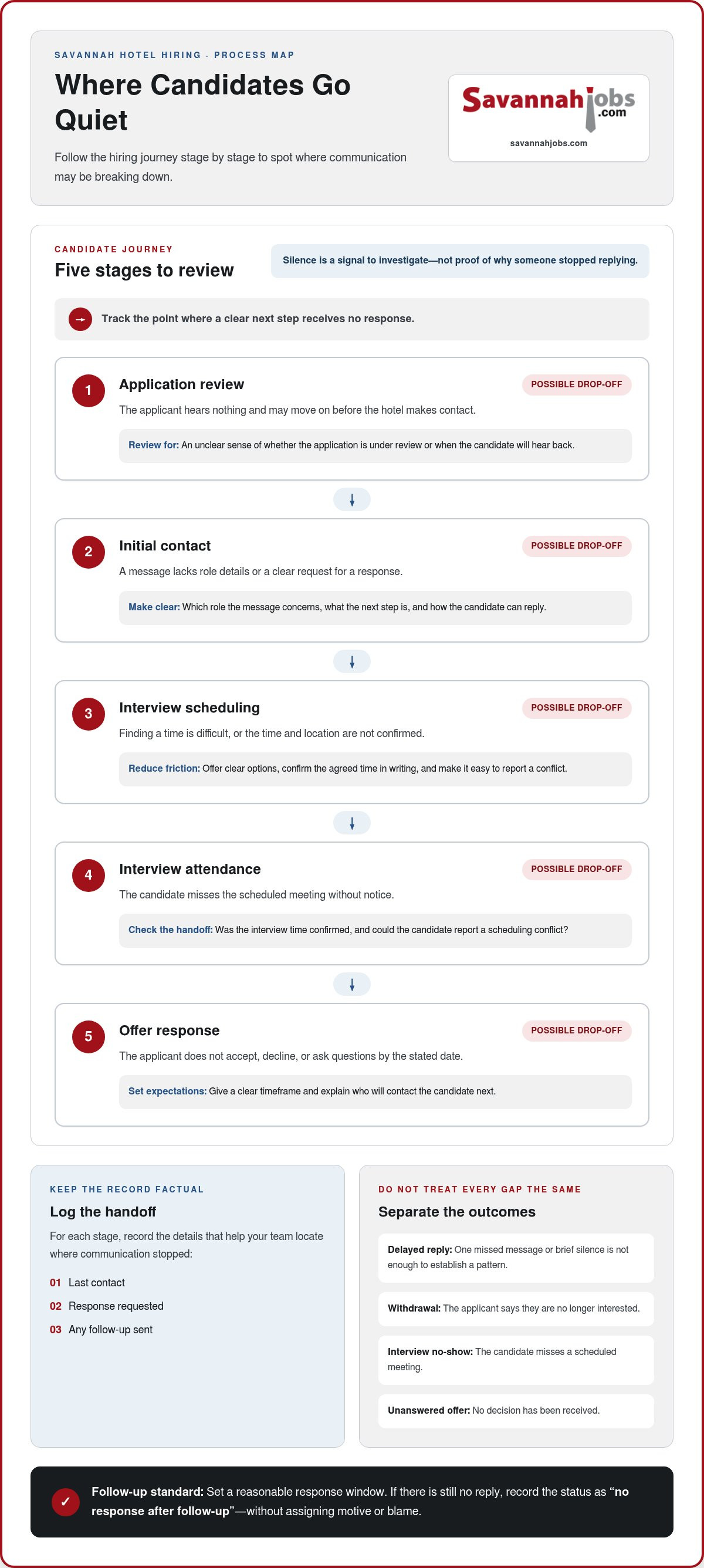
Communication can stop at several points. Tracking the stage helps Savannah hotel teams see where the process may need attention:
- Application review: The applicant hears nothing and may move on before the hotel makes contact.
- Initial contact: A message lacks role details or a clear request for a response.
- Interview scheduling: Finding a time is difficult, or the time and location aren’t confirmed.
- Interview attendance: The candidate misses the scheduled meeting without notice.
- Offer response: The applicant doesn’t accept, decline, or ask questions by the stated date.
Hourly and shift-based hotel roles call for especially clear availability discussions. A housekeeping or front-desk applicant, for example, should understand the expected shift pattern and have a chance to explain which hours they can work. If availability comes up late, a candidate may discover the schedule doesn’t fit and stop responding rather than explain the mismatch.
Savannah hotel teams coordinate hiring around operating schedules, so precise messages make each handoff easier to follow. Record the last contact, the response requested, and any follow-up sent. These details give your team a useful starting point for identifying where applicants disengage, without assuming every quiet candidate has the same reason.
Why Hotel Applicants Go Quiet During the Hiring Process
Silence is a signal to investigate, not a reliable explanation. A candidate’s silence alone doesn’t establish why they stopped responding. They may have accepted another offer, become unavailable, lost interest after learning more about the role, or simply missed your message. Treat each as a possibility, and look for patterns in your process rather than guessing about an individual’s motives.
Communication works both ways. Applicants who don’t know whether their application is under review or when they’ll hear back may turn their attention elsewhere. Clemson research highlights that being ghosted can leave applicants with strong negative reactions. It’s a reminder that timely updates shape how candidates experience hiring, even when they aren’t selected.
How delays and unclear communication affect candidate follow-through
After an application or interview, a vague “we’ll be in touch” gives the candidate no clear expectation. If the review takes longer than planned, a lack of updates can make the opening seem inactive. Give applicants a realistic timeframe and tell them who will contact them next. If plans change, send a brief update rather than leaving them to interpret the silence.
Scheduling can add friction, too. A hotel candidate working another shift may have limited time to answer calls or attend an interview. Several last-minute changes can make coordination harder. Offer clear options, confirm the agreed time in writing, and make it easy to report a conflict.
How role expectations can create avoidable drop-off
Review your listing from an applicant’s point of view. Does it explain the actual duties, work location, expected schedule, and required qualifications? A broad description can attract interest, then create a mismatch when a candidate learns that the role involves different tasks or hours than expected.
Discuss schedule fit early and respectfully. For hourly and shift-based hotel openings in Savannah, state the shifts or availability needs as clearly as possible, then ask what hours the candidate can reliably work. Explain compensation details during the hiring conversation so applicants can assess whether the opportunity fits their expectations. Clear information helps both sides make a practical decision.
For wider context on local hospitality hiring, see our guide to hospitality and retail hiring strategies in Savannah. To share an accurate opening with Savannah-area job seekers, use SavannahJobs.com for local job advertising. A listing can help put the role in front of local candidates; clear communication is still what guides them through your process.
How to Find the Ghosting Point in Your Hotel Hiring Process
You can’t control whether every applicant replies. You can control whether your process makes the next step easy to understand. To find where hotel applicant ghosting may be occurring, review a recent sample of applications and trace each candidate’s progress from submission to final decision. Record the last contact, who owned the next step, and whether the candidate received a clear request or update.
Look for repeated drop-off at the same handoff. If several applicants stop responding after interview invitations, check whether those messages include the interview format, location, time, and a simple way to confirm. Clemson University research highlights how candidate ghosting can affect an organization’s reputation, reinforcing the value of a respectful, consistent process beyond filling one opening.
| Hiring stage | Candidate-facing friction | Practical check |
|---|---|---|
| Application review | No acknowledgment or unclear status | Check when applications are reviewed and whether applicants receive confirmation. |
| Initial contact | Missed call with no context or reply option | Review whether messages identify the hotel, role, contact, and requested response. |
| Interview scheduling | Missing details or repeated changes | Confirm the invitation states format, location, time, and how to reschedule. |
| Interview to decision | No named owner or next-step update | Check who is responsible for follow-up and whether a timeline was shared. |
| Offer | Unclear terms or response process | Review whether the candidate knows what decision is needed and how to respond. |
Compare the listing with the real role
Put the job ad beside your screening questions and interview notes. Do they describe the same duties, work location, schedule, and qualifications? If the listing suggests one shift pattern but the interview reveals another, the mismatch may be driving disengagement. Note recurring questions candidates ask, too. They can point to missing information about shifts, location, or hiring steps. For practical guidance, see our guide to writing a good job description.
For each candidate who stops replying, document the stage and the last clear communication. Then compare cases by role and handoff. A pattern gives your Savannah hotel team something specific to improve, such as clearer listing details, a consistent acknowledgment, or one person accountable for the next contact. Silence may be outside your control; clarity and follow-up aren’t.
How Savannah Hotel Teams Can Reduce Applicant Ghosting
You can’t prevent every candidate from stepping away, but you can make your hiring process easier to follow. Use the same sequence for each opening: clarify the role, acknowledge the application, schedule the next conversation, follow up as promised, and close the loop. Assign one named contact to each candidate, even if other managers take part in interviews. At every handoff, tell the applicant who will reach out and what happens next.
Set expectations and keep each step moving
Start with a clear acknowledgment. Confirm the hotel role and explain when the candidate can expect an update. If that timing changes, send a brief note with the new expectation. A short message is better than leaving someone to wonder whether the opening is still active.
Make candidate communications consistent and easy to act on. An interview invitation should identify the role, interview format, location or meeting details, scheduled time, and a direct way to confirm or request a change. Before sending it, check that the details match the shift and availability discussed during screening.
- Clarify: Explain the role, schedule, and hiring steps.
- Acknowledge: Confirm receipt and identify the contact person.
- Schedule: Offer clear interview details and a reply option.
- Follow up: Send the update you promised, including when plans change.
- Close the loop: Let candidates know when the hotel has moved forward with someone else.
Make interviews and offers easier to respond to
Shift-based workers may need to coordinate around existing work or personal commitments. Offer clear interview options where possible, and make rescheduling straightforward. After the conversation, explain the next step and give a realistic response window. Invite questions about duties, schedule, or offer details so candidates can raise concerns rather than disengage.
Follow up respectfully, not repeatedly. A planned message and a clear response option help keep communication open without putting pressure on the applicant. If you choose another candidate, send a courteous update rather than leaving the outcome uncertain. Consistency at each stage shapes applicants’ impression of your hotel. For more ways to shape that impression, read our employer branding tips for Savannah.
Pair a dependable process with a clear opening that reaches local job seekers. SavannahJobs.com provides local advertising for Savannah hotel jobs, while your team remains responsible for screening, communication, and hiring decisions.
Reach Savannah Hotel Applicants and Improve Your Next Hiring Cycle
Clear communication and relevant local reach address different parts of the hiring challenge. A well-managed process helps candidates understand the role and stay informed; local advertising helps put the opening in front of Savannah-area job seekers. Neither replaces the other, and advertising alone can’t guarantee replies, interviews, or hires.
When local job advertising fits a hotel vacancy
For a hotel opening aimed at applicants in the Savannah area, SavannahJobs.com offers local recruitment advertising. Employers can purchase a 30-day job posting and choose an optional Featured Job or Featured Employer upgrade for added placement. SavannahJobs.com is a job board, not a recruiter or screening service, so your hotel team remains responsible for reviewing applications and communicating with candidates.
Make the listing useful from the start. Describe the duties, work location, schedule, qualifications, and application instructions accurately. If the position includes a particular shift pattern, spell it out so applicants can assess fit before applying. For more posting guidance, see the employer guide to posting a job in Savannah.
Turn lessons from ghosting into your next hiring plan
Use what you learned from past hotel applicant ghosting to improve the next hiring cycle. If applicants disengaged during scheduling, assign someone to review interview invitations and confirm each one includes the necessary details. If the role description raised questions, update the listing before advertising the opening again. Give every improvement a clear owner, then check whether the revised process is being followed.
Choose the advertising option that fits the vacancy: a 30-day job posting provides a defined local advertising period, while featured placement is an optional way to increase the listing’s visibility. These options provide advertising exposure, not candidate screening or a promise of applicant responses or hiring results. Your team’s clear job details and timely follow-up still matter.
When you’re ready to advertise the opening, SavannahJobs.com offers Savannah-focused job postings for local employers.
Make Your Next Hotel Hire Easier to Follow
Hotel applicant ghosting can’t always be prevented, but a clear hiring process gives candidates fewer reasons to disengage. Set expectations at each handoff, keep role details consistent from listing to interview, and review where communication tends to stop. Small improvements, such as naming a contact and explaining the next step, can make the experience more predictable for applicants and your Savannah hotel team.
Reach is another part of the plan. SavannahJobs.com offers Savannah-focused recruitment advertising, including 30-day job postings and optional Featured Job placement. As the Savannah Morning News digital recruitment portal within the USA TODAY Network, it gives employers a local channel to advertise an opening. Advertising provides exposure, not guaranteed replies or hires, so pair it with timely follow-up from your team.
Post your hotel opening on SavannahJobs.com to reach job seekers in Savannah and put your next hiring plan into action.
Frequently Asked Questions
What does hotel applicant ghosting mean?
Hotel applicant ghosting means a candidate unexpectedly stops communicating while an active hiring process is underway. A delayed reply or one missed call doesn’t automatically mean the applicant has withdrawn. Look for sustained silence after a clear follow-up, and record the facts, such as the last contact and the response requested. A missed interview and an unanswered offer are distinct events, so track them separately rather than assuming the candidate’s reason.
Why do hotel job applicants stop responding?
There can be several reasons, and silence alone doesn’t reveal which one applies. A candidate may accept another offer, have difficulty coordinating an interview, or decide the role’s duties, location, schedule, or compensation don’t fit. Unclear timelines and limited updates can also make applicants unsure whether the hotel is still hiring. Use follow-up conversations and patterns across applications to identify possible process issues, rather than assuming every candidate disengaged for the same reason.
How can hotels reduce candidate ghosting during hiring?
Make every step clear and easy to act on. Acknowledge applications, name the person responsible for follow-up, and tell candidates what happens next and when they can expect an update. Include interview format, time, location, and a simple way to confirm or reschedule. Keep promises about follow-up, share timing changes, and close the loop courteously when you move forward with another applicant. These practices improve clarity, though they can’t ensure every candidate will respond.
What should a hotel do when an applicant misses an interview?
Send a calm, brief message asking whether the candidate would like to reschedule, and include a straightforward way to reply. Check that the interview details were clear and that the invitation reached the right contact. If the candidate doesn’t respond after your stated follow-up, record the missed appointment and the contact attempt accurately. Avoid labeling the person’s motive. Keep hiring plans moving while leaving a respectful path for the applicant to reconnect.
How soon should a hotel follow up with a job applicant?
There isn’t one response interval that fits every hotel role or hiring process. Set a realistic timeline for each stage and tell candidates when they can expect to hear from you. Follow up within that stated window, and send an update if the decision or interview schedule takes longer than expected. A predictable message helps applicants plan and reduces uncertainty. For shift-based roles, make interview timing and response options practical for candidates’ schedules.
Can a clearer hotel job description reduce applicant drop-off?
Yes. A clear listing helps applicants assess whether the opportunity fits before they apply or interview. Describe the actual duties, work location, schedule or shift expectations, required qualifications, and application steps. Keep those details consistent during screening and interviews. If candidates repeatedly ask about a missing detail or discover a mismatch later, revise the description. Clear expectations won’t prevent every withdrawal, but they can reduce avoidable confusion and help applicants make an informed decision.
Where can Savannah hotels advertise open positions locally?
Savannah hotels can advertise openings on SavannahJobs.com, a local recruitment advertising platform focused on the Savannah area. Employers can purchase a 30-day job posting and choose optional Featured Job or Featured Employer placement. The platform provides advertising exposure; employers remain responsible for screening applicants and managing communication, and a listing can’t guarantee replies or hires. For clarity, include accurate role details, schedule, location, qualifications, and application instructions in the post.


