

Hiring independent contractors in Georgia depends on the working relationship, not just the label in a contract. For unemployment compensation, Georgia considers whether a worker can take other work, accept or reject assignments, set their hours without minimums or quotas, and perform services with limited instruction and supervision. The test also considers geographic restrictions and whether the business controls how the worker performs the job.
Contracting can offer flexibility, but misclassification may create tax and compliance problems. This guide explains Georgia’s classification factors, the risks of misclassification, tax responsibilities to consider, and practical onboarding steps. It also covers how to define the work clearly and decide whether a contractor arrangement fits the role, helping you make a sound hiring plan for your Georgia business.
Key Takeaways
- Assess the real working relationship, including control over assignments and how the work is performed, rather than relying on the contract label alone.
- Understand how misclassification can affect unemployment obligations and expose a business to penalties.
- Plan for independent workers’ tax responsibilities by clarifying how income is reported and what records the working arrangement requires.
- Set the engagement up clearly with defined services, payment terms, documentation, and any role-specific insurance requirements.
Compliance with Georgian laws
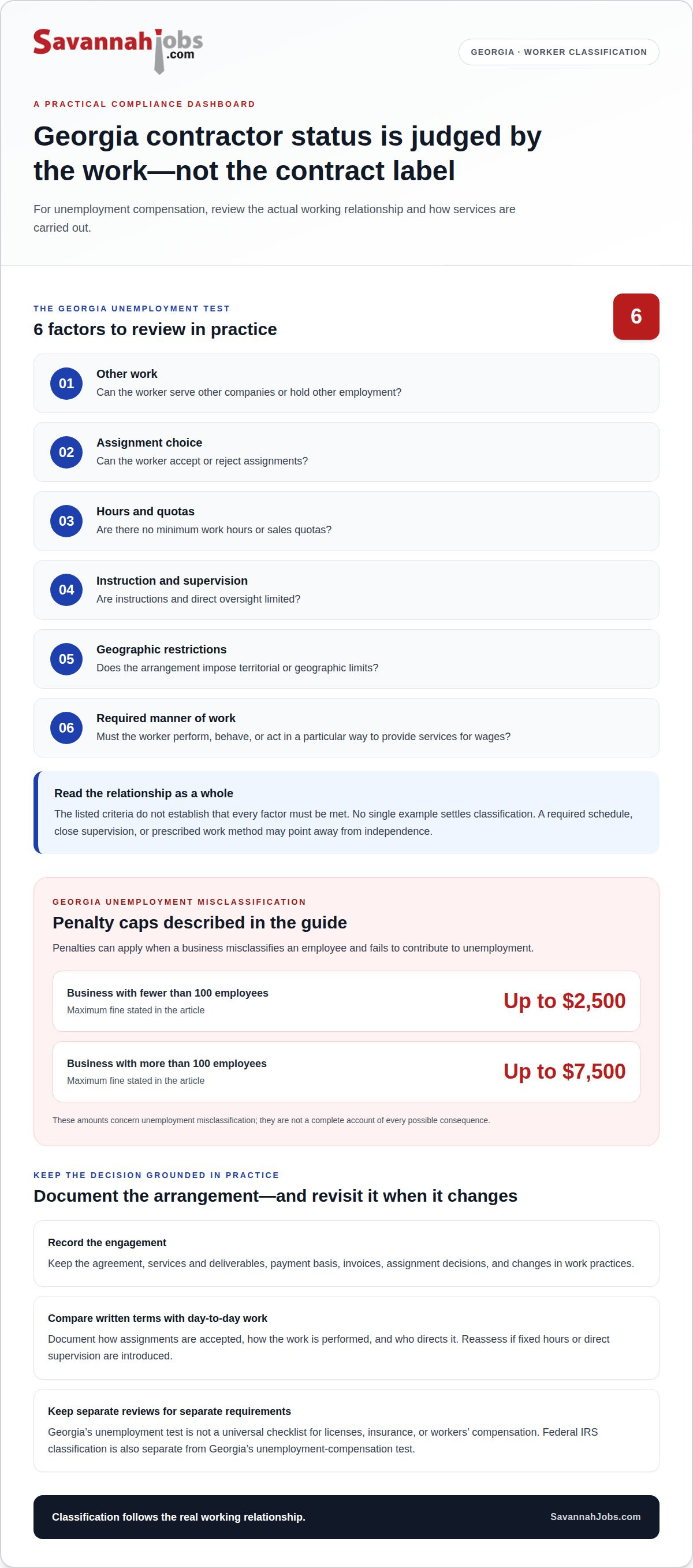
Georgia’s unemployment-compensation test looks at the actual work relationship, not simply the contract title. Before hiring independent contractors in Georgia, review the arrangement and how the work will be carried out. Georgia considers several factors, but the available criteria don’t establish that every factor must be met. Base the decision on the relationship in practice.
Georgia’s test considers whether the worker:
- May work for other companies or hold other employment.
- Can accept or reject assignments.
- Has no minimum work hours or sales quotas.
- Receives only minimal instructions, without direct oversight or supervision.
- Faces territorial or geographic restrictions.
- Must perform, behave, or act in a particular manner to provide services for wages.
Assess each point against the planned work. A contractor who can decline assignments and serve other clients has independence in those areas. A required schedule, close supervision, or prescribed work method may point the other way. No single example settles classification; assess the relationship as a whole.
Georgia’s unemployment test addresses classification, not a universal checklist for contractor licenses, insurance, or workers’ compensation coverage. Identify the work and its requirements, then account for applicable credentials and coverage during onboarding. Don’t treat a contractor agreement as a substitute for that review.
Are there Georgia-specific rules for contractors in construction, transportation, or other regulated industries? The unemployment factors above don’t set out industry-specific licensing or insurance rules. Separate classification analysis from requirements tied to the particular trade and duties, such as construction work or transportation services.
Record the assignment terms, expected deliverables, payment basis, and how the worker controls the work. Compare those terms with actual practices throughout the engagement. If the arrangement changes through fixed hours or direct supervision, reassess it against Georgia’s factors. Consistent documentation makes the decision process clearer.
Contractor misclassification risks
Misclassification can create unemployment-compensation costs and penalties in Georgia. Review the potential consequences and the separate federal tax classification before setting up an engagement.
Recognizing Contractor Misclassification
Risk rises when a contract calls someone independent but the working arrangement treats them like an employee. For example, a business may set regular hours, closely direct daily tasks, and require the worker to follow its procedures. Compare written terms with actual practice, including assignment control and supervision. Georgia courts assess factors such as outside work, rejected assignments, schedules, and oversight.
Applying Federal IRS Rules
Federal IRS classification is separate from Georgia’s unemployment-compensation test. For federal tax purposes, consider the actual relationship and level of control rather than relying only on a “contractor” label. A written agreement can document the intended arrangement, but it does not determine classification on its own. Review federal tax treatment and Georgia unemployment obligations separately.
Georgia penalties can apply when a business misclassifies an employee and fails to contribute to unemployment. A business with fewer than 100 employees can be fined up to $2,500. A business with more than 100 employees can be fined up to $7,500. These amounts concern unemployment misclassification, so don’t treat them as a complete account of every possible consequence.
Review the arrangement before work starts. First, describe the services and expected deliverables. Then document how assignments are accepted, how the work is performed, and who directs it. Compare those terms with day-to-day practices. If a contractor is free to reject a project but later must follow a fixed schedule under close supervision, review the changed arrangement.
Keep records of the agreement, invoices, assignment decisions, and changes in work practices. Revisit classification when duties or supervision change. A consistent file helps explain how the arrangement was structured, while regular review can identify a mismatch before it continues.
Georgia’s tax system for independent workers
Georgia businesses should separate contractor payments from employee payroll records. Form W-9 gathers tax identification details, while Form 1099-NEC is used to report certain nonemployee compensation; which documents apply depends on the payment and relationship.
Contractor Tax Forms and Documents
Build a file for each engagement before payments begin. Include the signed agreement, invoices, payment records, and any tax forms collected. These documents connect the amount paid with the services delivered. For example, an invoice for a completed design project should match the recorded payment and project description.
Keep contractor records separate from employee payroll files. This helps show how the business treated each relationship and makes payment details easier to review. Record the contractor’s legal name, business name when applicable, payment dates, amounts, and service descriptions. Use consistent labels across invoices and accounting records.
Tax documents don’t determine worker status by themselves. A W-9 or contractor agreement cannot make an employee an independent worker if the actual relationship operates differently. Keep classification review separate from tax-document collection, and update records when duties or payment arrangements change.
Preparing Form W-9 and Form 1099-NEC
Form W-9 provides the payer with the contractor’s taxpayer identification information. Collecting it early can help keep payment records accurate. Store the form securely with the engagement file, and use its details to support the contractor’s payment record.
Form 1099-NEC reports certain nonemployee compensation. It isn’t a form for every contractor payment in every situation. The reporting obligation depends on the nature of the payment and the worker’s classification. Keep a clear payment history so the business can determine which amounts relate to reportable services.
If a contractor submits several invoices for one project, record each payment and keep the corresponding invoice. Reconcile those entries with the year-end payment summary before preparing any information return. Don’t guess at tax treatment based on a job title or contract label. Accurate records provide a practical basis for federal reporting and Georgia bookkeeping.
Independent contractor onboarding in Georgia
Use onboarding to define the work, payment process, documentation, and role-specific coverage. A clear agreement gives both sides a shared reference before the first assignment.
Drafting the Contractor Agreement
Describe the services, deliverables, deadlines, and how either side handles changes. A design agreement, for example, can identify the files due, review process, and approval method. State who supplies equipment and how the contractor communicates progress. Keep the terms aligned with actual practices: an agreement that promises independence but requires close daily direction sends mixed signals.
Include the parties’ legal names, project scope, confidentiality expectations, and a process for resolving billing questions. Attach a written project brief when details may change. Keep signed copies with invoices and assignment records so the agreement connects to the work performed.
Setting Contractor Payment Terms
Specify whether payment is tied to a completed deliverable, milestone, route, or another agreed basis. Identify invoice details, submission timing, approval steps, and how to handle disputed items. A project-based arrangement, for example, can connect each invoice to an accepted milestone rather than vague availability.
Document approved expenses and any required receipts. If the work is meant to be independently managed, avoid language that creates an employee-style hourly schedule. Keep payment records consistent with the agreement and services delivered.
Address insurance during onboarding when the work calls for it. National Courier Express requires its medical courier contractors in Georgia to carry bodily injury auto liability coverage of $100,000 per person and $300,000 per accident, plus $50,000 in auto liability property damage coverage. Those are requirements for that company’s medical courier contractors, not a universal rule for every Georgia contractor. Match coverage review to the role and contract.
Before the first assignment, collect the signed agreement, project details, payment instructions, and role-related documents. Give the contractor a named contact for deliverable questions and invoice issues. If you’re preparing to recruit for a Savannah-area role, share your opening with local candidates.
SavannahJobs.com
SavannahJobs.com helps employers advertise open roles to the local Savannah workforce. Once you’ve clarified the role and its working arrangement, use a 30-Day Job Posting to share the opportunity with local candidates. Featured Job and Featured Employer upgrades provide additional visibility options for employers promoting openings.
Write the job posting to reflect the actual engagement. State the work, expected deliverables, and whether the position is structured as employment or independent contracting. Clear details help candidates understand the opportunity before applying.
If you’re ready to advertise an opening in the Savannah area, contact SavannahJobs.com to discuss your posting.
Put your next hiring decision into motion
A contractor engagement starts with a clear business need. Before recruiting, decide what work needs to be done and whether the role genuinely fits an independent arrangement. That choice shapes how you describe the opportunity, what candidates need to understand, and how you organize the work after selection. Treat recruitment and classification as connected decisions. A precise role description can attract people whose experience and working preferences fit the arrangement.
For employers in Savannah, the next step may be reaching local candidates with a clear, well-targeted opportunity. If you’re ready to promote an opening, contact SavannahJobs.com about hiring. A thoughtful approach to hiring independent contractors in Georgia starts with matching the role to the real working relationship. Take that next step with confidence, and build a hiring process that serves your business and the people you bring on.
Frequently Asked Questions
How do you determine whether a worker is an independent contractor or employee in Georgia?
Consider how the work is arranged and carried out, not just the title in the agreement. A specialist who accepts separate projects from several clients, for example, works differently from someone assigned a regular internal schedule and closely directed each day. Compare the intended arrangement with day-to-day practice, and revisit classification if duties or supervision change.
What Georgia laws and tests govern independent contractor classification?
Georgia’s unemployment-compensation classification test considers indicators of independence and control. These include whether a worker can take other work, refuse assignments, and perform services with limited instruction. The test also considers geographic limits and required ways of working. Use these factors to evaluate the relationship rather than relying on a contract label or treating one factor as decisive.
What are the Georgia state and federal tax withholding obligations for independent contractors?
Tax handling depends on the worker’s classification and the payment involved. Don’t assume a document alone determines whether withholding applies. For a contractor arrangement, link payment records to invoices and services, and handle tax reporting separately from employee payroll processing. A business reviewing a project payment, for example, should be able to connect the amount to its invoice and engagement records.
What are the penalties and risks of misclassifying an employee as an independent contractor in Georgia?
Misclassification can expose a Georgia business to unemployment-related fines if it fails to contribute for someone incorrectly treated as a contractor. It can also raise questions about past payments and business records. If an arrangement shifts toward fixed schedules or close daily direction, review it promptly. Keep a clear record of why the classification fits the actual work relationship.
How do independent contractor rules differ from employee hiring rules in Georgia?
The key difference is how the working relationship functions. An employee role may involve regular assigned duties and closer direction, while a contractor engagement is organized around independently delivered services. That distinction affects how the business structures work, records payments, and handles tax administration. Define a project by its deliverables, for example, rather than treating a contractor like a staff member on a recurring shift.


