

A polished résumé can’t show how someone responds to a disagreement, adapts to change, or supports a team. Hiring for soft skills assessment works best when you define the behaviors a role needs and evaluate candidates against the same clear criteria. Use evidence from resumes and structured interviews, not broad impressions or labels alone.
You already know that communication, judgment, and collaboration matter at work. The challenge is assessing those qualities fairly and distinguishing current strengths from skills that can grow. A consistent approach makes hiring clearer for teams and gives candidates a fairer chance to show how they work.
This guide explains how to connect soft skills to job competencies, assess them through resumes and interviews, and understand what assessment results can reveal about people and teams. You’ll also learn how to turn findings into practical development priorities, so hiring decisions rely on role-relevant evidence rather than guesswork.
Key Takeaways
- Define role-specific competencies as observable behaviors so hiring teams can assess candidates against clear, consistent criteria.
- Use structured interview questions to learn how candidates have handled real situations, not just how they describe their strengths.
- Turn assessment findings into practical development priorities by recognizing skills to build and strengths team members can share.
- Choose assessment methods that fit the role, from situational questions to role-play exercises, and use the evidence to make better-informed comparisons.
Using skills on resumes and in interviews
Hiring for soft skills assessment works best when you define role-specific behaviors before reviewing applications. Resumes can offer clues, while structured interviews help determine how candidates applied those skills in real situations.
Screening Skills Before Interviews
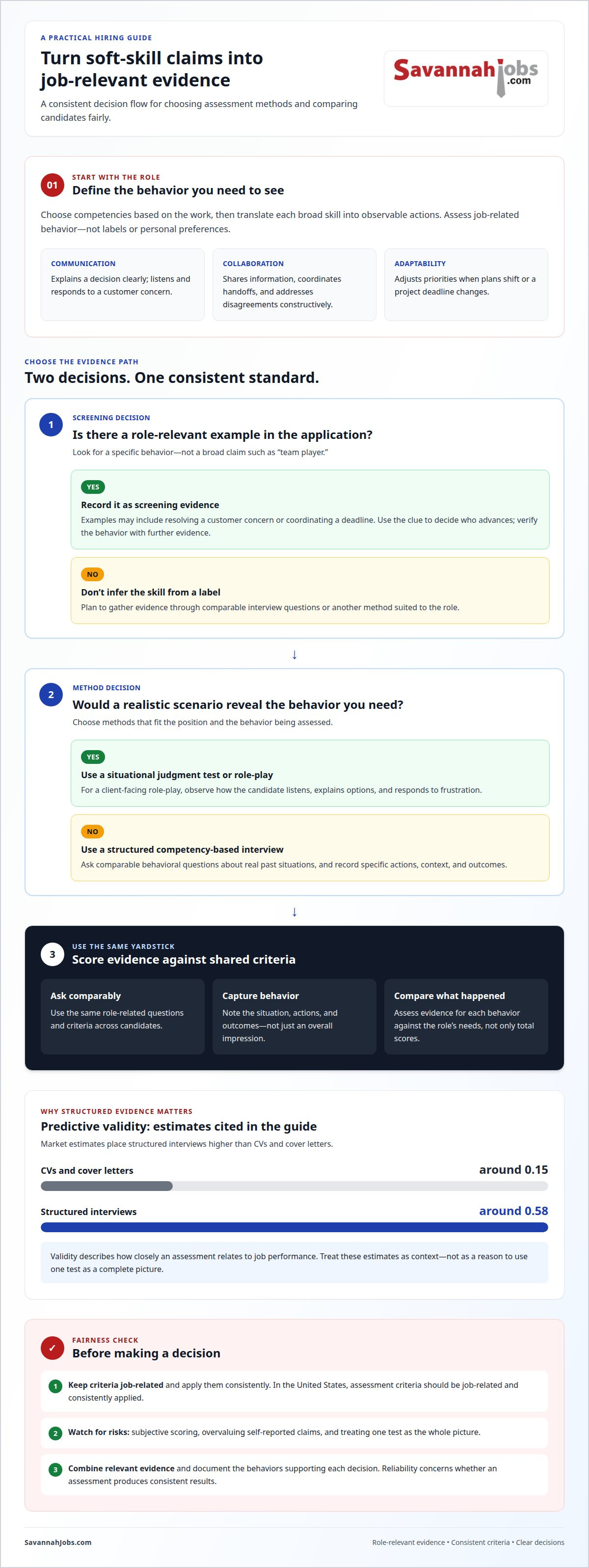
Pre-interview screening looks for evidence of job-related behaviors in resumes and application responses. Start with a competency framework, then note examples such as resolving a customer concern or coordinating a deadline. This helps hiring teams decide who advances based on relevant evidence and gives reviewers a consistent standard instead of broad labels like “team player.”
Behavioral Questions and STAR Interviews
Behavioral questions ask candidates to describe how they handled a past work situation. In a STAR interview, they explain the Situation, Task, Action, and Result. Ask comparable questions, such as how they addressed a disagreement with a coworker, and record specific actions, context, and outcomes. Those details help distinguish demonstrated skills from confident but unsupported claims.
Assessment Tools and Methods
Useful assessment tools include structured competency-based interviews, situational judgment tests, and role-play exercises. A shared scoring framework helps interviewers compare evidence against the same criteria. For example, a client-facing role-play can show how someone listens, explains options, and responds to frustration. Hiring for soft skills assessment should focus on behaviors the position actually requires.
Assessment Validity, Rules, and Risks
Validity describes how closely an assessment relates to job performance; reliability concerns whether it produces consistent results. Market estimates place predictive validity around 0.15 for CVs and cover letters, compared with around 0.58 for structured interviews. In the United States, keep assessment criteria job-related and apply them consistently. Risks include subjective scoring, overvaluing self-reported claims, and treating one test as a complete picture. Combine relevant evidence and document the behaviors supporting each decision.
Using assessment results to identify strengths and improvement areas
Assessment results are most useful when they connect workplace behaviors to specific role expectations. A skills assessment can reveal someone’s strengths, but a score alone doesn’t show how those skills appear on the job. Read results alongside examples from work situations, such as how a team member shares information during a handoff or adapts when priorities change. This turns a general rating into evidence managers can discuss and use.
Employers can compare candidates’ soft skills assessment results by applying the same competencies and scoring criteria to everyone. Compare evidence for each behavior, not just overall scores. If clear communication matters, for example, assess how each candidate explains a decision, responds to questions, and adjusts their message for the audience. Note the situation and actions behind each rating, then compare those observations with the role’s needs.
For current teams, combine assessment findings with behavioral interview feedback, role-play observations, or 360-degree reviews. Input from peers, managers, and clients can show whether a strength appears consistently across working relationships. A manager might use feedback to identify an employee’s strong facilitation skills, then invite them to share that approach with teammates. Pair this recognition with one development area, such as delegating tasks more clearly during a project.
Keep development specific and ongoing. If an employee struggles to adapt when plans shift, set a practical goal around communicating next steps during changing assignments. Revisit examples in regular check-ins and look for changes in behavior, not just a revised assessment score. Soft skills can be learned and improved, so results should guide coaching and team learning rather than label someone permanently. For employers sharing roles with local candidates, Savannah-area job postings can support the next stage of recruitment.
Managers can use a soft skills assessment to identify skills they should improve and strengths they can teach their teams. Feedback from behavioral interviews, role-playing exercises, or 360-degree reviews can guide ongoing professional development.
What soft skills should employers assess when hiring?
Choose soft skills based on the work, not a generic checklist. A customer-facing role may need clear communication, empathy, and conflict resolution, whereas specialized placement services like Phluid Match emphasize adaptability and interpersonal communication when matching domestic helpers. A project coordinator may rely more on organization, adaptability, and collaboration. Identify behaviors that support key tasks, then include those competencies in the job description. This clarifies expectations for candidates and gives hiring teams a consistent basis for evaluation.
Translate each broad skill into observable actions. “Teamwork” could mean sharing relevant updates, inviting input, and following through on agreed tasks. “Adaptability” might mean adjusting priorities when a deadline changes. These examples are easier to assess than a label alone and help interviewers distinguish evidence from personal preferences, such as favoring a particular communication style.
- Communication: Can the person explain a decision clearly? For a support role, assess how they listen and respond to a customer concern.
- Collaboration: Look for actions such as sharing information, coordinating handoffs, and addressing disagreements constructively.
- Adaptability: Assess how someone responds when plans shift, such as reprioritizing tasks after a project deadline changes.
- Problem-solving: Consider how candidates identify options, weigh consequences, and explain their reasoning in a work-related situation.
- Emotional intelligence: Look for awareness of others’ perspectives, such as recognizing frustration and adjusting a response respectfully.
Prioritize skills that connect directly to the position’s responsibilities. A role with frequent client conversations may place greater weight on listening and composure than independent technical work. A team lead may need to communicate decisions, resolve tension, and give useful feedback. Map each priority to a real task, then define effective behavior. This keeps criteria relevant and gives interviewers a practical way to compare candidates’ evidence.
Employers should identify the soft skills required for each position and highlight those requirements in job descriptions. The description can make expectations visible before assessment begins, with requirements tied to the position rather than presented as universal traits. Keeping that connection explicit gives the hiring process a defined reference point when considering whether a candidate’s behavior fits the work.
How can employers assess soft skills in candidates?
Match each assessment method to a behavior the role requires. A situational judgment test can give every candidate the same workplace scenario and scoring framework. For example, ask how they would respond when a teammate misses a deadline. Consistent prompts help hiring teams compare reasoning and priorities, not just polished explanations. A sound hiring for soft skills assessment process ties every exercise to the job.
Psychometric assessments can use situational questions to explore emotional intelligence, adaptability, and resilience. A response scale from “Very Rarely” to “Very Often” captures how candidates describe their usual behavior. Pair those answers with examples from other selection stages. Self-reported preferences provide context, but shouldn’t stand alone as evidence of job-ready behavior.
Role-play simulations let candidates demonstrate skills through a realistic task. For a client-facing position, an interviewer might play a frustrated customer. Observe how the candidate listens, clarifies the concern, and responds, then score each behavior against shared criteria. This produces more specific feedback than simply noting that someone seemed confident or personable.
A 360-degree feedback assessment gathers perspectives from sources such as peers, managers, and clients. Those observations can add context about interpersonal skills in real workplace relationships. For early-career pre-screening, pairing a personality questionnaire with a cognitive ability test can provide complementary information. Keep each method tied to role requirements and interpret results in context.
Use a rubric to organize evidence into “continue,” “hold,” or “do not advance” recommendations. Record observed actions and connect each rating to a required competency. In hiring for soft skills assessment, a consistent rubric helps make candidate comparisons clearer. Soft skills assessments typically take 15 to 20 minutes, while structured interviews take 30 minutes or more. To reach local candidates for roles that use these methods, post your open position.
SavannahJobs.com
SavannahJobs.com helps Savannah-area employers advertise open roles to local candidates. Once you’ve defined the competencies and assessment approach for a position, a clear job listing can explain the role’s responsibilities and the soft skills candidates will use. A 30-Day Job Posting provides a way to promote the opening, while Featured Job and Featured Employer upgrades offer added visibility options.
When your hiring criteria are ready, use SavannahJobs.com to reach people seeking local opportunities. Describe required behaviors plainly, such as adapting to changing priorities or communicating clearly with customers. This helps candidates understand the role before they apply.
Advertise your opportunity to the Savannah workforce on SavannahJobs.com.
Build a stronger hiring process over time
Soft skills expectations can evolve as responsibilities and team needs change. Keep hiring criteria connected to the work, and review whether prioritized behaviors still support the role. A thoughtful approach to hiring for soft skills assessment also gives interviewers a shared standard, so decisions reflect job-related evidence rather than personal preference.
After a hire, observe how expectations show up in day-to-day work. Specific examples can help managers refine future role descriptions and decide which competencies need greater attention. This creates a practical feedback loop between hiring and workplace needs without treating an assessment as a permanent label for a candidate.
For your next local opening, SavannahJobs.com can help you advertise the opportunity to candidates in the Savannah area. Contact SavannahJobs.com about hiring and take the next step toward connecting your role with local talent.
Frequently Asked Questions
Which interview questions reveal a candidate’s soft skills?
Ask candidates to describe specific actions in situations that match the role. For example, “Tell me about a time you received difficult feedback. What did you do next?” can reveal openness, accountability, and follow-through. For a role with competing deadlines, ask how they prioritized requests from different stakeholders. Listen for clear choices and reasoning, not just a polished outcome.
How do behavioral and situational interviews assess soft skills?
Behavioral interviews explore what candidates did in past situations, while situational interviews ask how they would respond to a hypothetical challenge. Ask about a past disagreement, then present a scenario involving conflicting team priorities. Comparing the answers can show how a candidate reflects on experience and approaches an unfamiliar problem. Keep every prompt relevant to tasks the position involves.
How can employers score soft skills consistently and reduce bias?
Use a shared rubric with behavior-based descriptions for each rating, such as whether a candidate identifies others’ concerns before proposing a solution. Have interviewers record evidence and score independently before discussing differences. Avoid treating accent, eye contact, or conversational style as measures of skill unless a specific behavior directly relates to the job. Reviewing notes against the rubric keeps discussion focused on role-related evidence.
What are the legal rules for pre-employment assessments in the United States?
Keep assessment criteria job-related and apply them consistently.


