

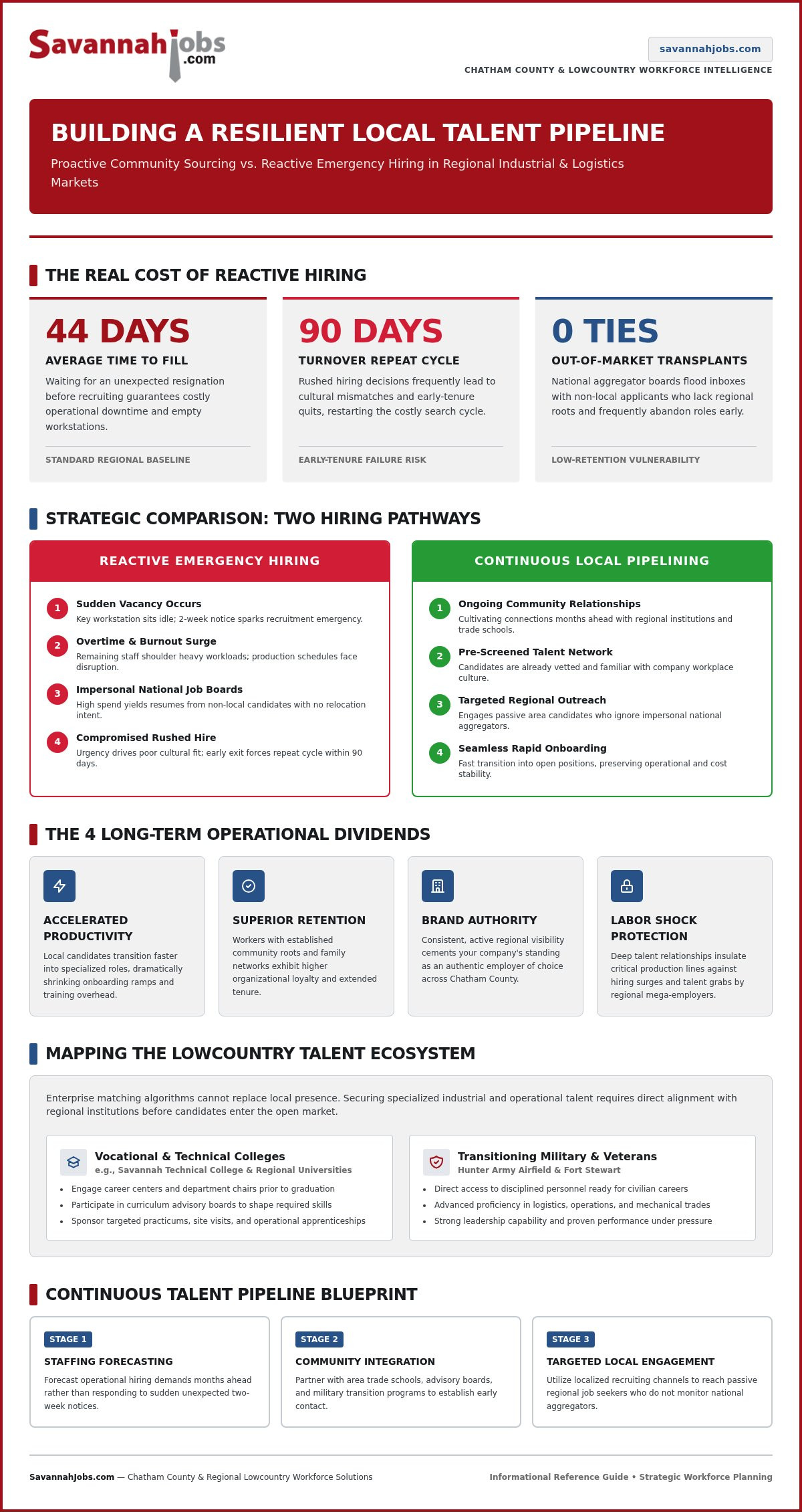
With the average time to fill stretching to 44 days, waiting for an unexpected resignation before you recruit guarantees costly operational delays. Relying on national job platforms often floods your inbox with out-of-market applicants who have no intention of relocating, while major regional industrial competitors snap up nearby workers. If you want reliable staffing in Chatham County and across the Lowcountry, mastering how to build a local talent pipeline is the most critical shift your hiring team can make.
You shouldn't have to scramble, bleed overtime hours, or exhaust your recruiting budget every time an operational position opens up. Sustainable hiring means cultivating genuine connections with qualified candidates long before a workstation sits empty. In this 2026 guide, you'll discover actionable strategies to develop, nurture, and sustain a dependable local talent pipeline for your organization. We'll examine proactive community sourcing tactics, employer branding methods, and practical ways to slash your time-to-hire while keeping local retention high.
Key Takeaways
- Shift from reactive emergency hiring to proactive engagement so your business avoids costly production downtime and sudden operational delays.
- Map regional vocational institutions and technical colleges early to secure qualified operational and specialized talent before graduation season.
- Follow our step-by-step blueprint on how to build a local talent pipeline to forecast staffing needs and cultivate relationships months in advance.
- Trade unpredictable emergency recruiting fees for consistent, structured outreach that protects your bottom line and improves local candidate retention.
- Harness targeted local recruitment advertising platforms to engage passive area job seekers who ignore impersonal national job boards.
What Is a Local Talent Pipeline and Why Does Reactive Hiring Fail?
A local talent pipeline is an engaged network of qualified regional candidates who are pre-screened, familiar with your workplace culture, and ready to step into open roles as your business grows. In practical terms, a structured talent pipeline eliminates costly hiring panics by replacing desperate last-minute recruiting scrambles with continuous community relationships. Rather than waiting for a worker to give two weeks' notice, forward-thinking employers maintain steady contact with qualified area professionals.
Reactive hiring consistently sets regional employers up for failure. When an unexpected vacancy hits, managers often throw money at national aggregation boards, resulting in low-yield campaigns flooded with non-local applicants. In thriving regional markets across Chatham County and the Lowcountry, industrial expansion and logistics hubs create fierce local competition for dependable workers. Sourcing candidates without a coherent plan rooted in strategic human resource planning leaves your business vulnerable to sudden labor deficits. Learning how to build a local talent pipeline keeps your staffing predictable, protecting your operations from economic shifts.
The Hidden Costs of Panic Hiring
Panic hiring drains company resources in ways that rarely show up on an initial balance sheet. When a key workstation sits empty, remaining team members shoulder excessive workloads, which drives up overtime expenses and accelerates burnout among your top performers. Rushed hiring decisions frequently lead to poor cultural fits, and early-tenure turnover forces you to repeat the entire expensive recruitment cycle within ninety days. Furthermore, paying relocation costs or banking on out-of-market applicants for frontline trades rarely succeeds; candidates without regional roots frequently leave when community ties fail to take hold.
The Long-Term Advantage of Proactive Community Engagement
Establishing deep roots in your immediate backyard delivers steady operational dividends. Regional workers already live in the community, understand local industry demands, and experience much shorter onboarding ramps than outside transplants. Cultivating an ongoing presence creates distinct operational advantages:
- Accelerated productivity: Local candidates transition faster into specialized roles, reducing training overhead.
- Superior retention: Candidates with established regional ties show higher loyalty and longer tenure.
- Brand authority: Consistent local visibility cements your reputation as an employer of choice.
- Labor shock protection: Pre-existing talent relationships insulate your production lines against regional hiring surges by mega-employers.
Knowing how to build a local talent pipeline ensures your company remains a resilient fixture in the regional economy, securing dependable workforce continuity year after year.
Mapping Your Regional Talent Ecosystem: Educational and Community Hubs
Enterprise software alone cannot build an authentic talent pool. While national job aggregators scan resumes from hundreds of miles away, understanding how to build a local talent pipeline requires mapping the tangible resources right in your backyard. Chatham County and the broader Lowcountry possess vibrant community institutions that produce steady streams of capable, career-ready candidates. By embedding your brand into these local pipelines early, you secure top candidates before they ever hit the open market.
Partnering with Regional Colleges and Trade Schools
Do not wait for graduation day to introduce your company to emerging professionals. Reach out directly to department heads and career centers at regional institutions like Savannah Technical College and nearby universities. Join curriculum advisory boards to help align classroom coursework with real-world operational needs. Sponsoring targeted apprenticeships and hands-on practicums gives students direct exposure to your facility, turning eager learners into long-term staff the moment they finish their certifications.
Connecting with Transitioning Military and Veterans
Our region is home to disciplined service members transitioning out of installations like Hunter Army Airfield and nearby Fort Stewart. These veterans bring world-class logistics proficiency, advanced mechanical aptitude, and proven leadership under pressure. Establish relationships with military transition assistance programs to translate tactical military experience into your open industrial or operational roles. Back this up with targeted community campaigns that clearly showcase your commitment to veteran employment.
Leveraging Civic and Workforce Organizations
Local business chambers and regional workforce development boards serve as invaluable conduits between expanding employers and motivated job seekers. Many forward-thinking regional operators utilize employer-led frameworks like Talent Pipeline Management (TPM) to forecast joint industry hiring needs and align community resources effectively. Regularly attending local development roundtables and sponsoring community job workshops keeps your company top of mind. To ensure your opportunities reach these engaged area workers every day, consider spotlighting open roles on savannahjobs.com, connecting your brand directly with candidates who already live and work nearby.
Learning how to build a local talent pipeline around these established regional pillars removes the guesswork from staffing, providing your business with a steady, self-sustaining flow of qualified local talent.
Reactive Recruiting vs. Continuous Talent Pipelining: Key Differences
Transactional hiring treats recruitment as an isolated event that starts only after someone walks out the door. In contrast, continuous pipelining treats candidate acquisition as an essential, ongoing business function. When you rely solely on reactive hiring, you compete for active seekers who are applying to dozens of employers at the exact same moment. Pipelining allows you to engage high-caliber local talent before they actively seek change, fundamentally altering candidate quality and hiring economics.
The contrast between these approaches comes down to control. One forces your leadership team into constant firefighting, while the other creates predictable talent availability across every operational shift.
- Reactive Recruiting: Produces sporadic spikes in recruitment costs, attracts high volumes of unvetted resumes, yields slow turnaround times, and results in higher early-turnover rates.
- Continuous Talent Pipelining: Provides predictable recruitment marketing costs, engages pre-vetted regional candidates, enables rapid offers, and secures long-term retention.
Cost Efficiency: Emergency Ad Spend vs. Sustained Presence
Emergency recruitment campaigns are notoriously inefficient. When a role sits open unexpectedly, hiring managers often flood massive national platforms with costly, short-term sponsored listings. These campaigns frequently produce hundreds of unqualified, out-of-market applicants who expect relocation assistance or vanish during initial phone screenings. Sustained local outreach delivers a far better return. By maintaining ongoing visibility with regional job seekers, you attract steady, qualified inquiries from people who already call Chatham County home. To design an effective ongoing budget, review our guide to recruitment advertising Savannah.
Time-to-Fill and Productivity Impacts
Every day a critical machine sits idle or a supervisory post goes unfilled, your daily production output declines. Reactive hiring models leave these gaps open for weeks while your HR team writes job descriptions, weeds out non-local resumes, and arranges interviews from scratch. Organizations with a warm regional pipeline cut this time drastically. Because you have already evaluated potential candidates, vetted their skills, and built rapport, scheduling an interview takes days instead of weeks. To benchmark your current hiring velocity against regional realities, consult our analysis of the Savannah GA job market.
Understanding how to build a local talent pipeline transforms your talent acquisition from an expensive recurring crisis into a predictable, strategic asset that protects operational output.
How to Build a Local Talent Pipeline: A 5-Step Strategic Blueprint
Constructing a dependable candidate reservoir requires a repeatable process rather than disconnected hiring events. When you follow a structured blueprint on how to build a local talent pipeline, your hiring team shifts from reactive triage to proactive talent readiness. This 5-step framework gives your organization the operational discipline needed to source, warm, and activate regional candidates before staffing gaps compromise your bottom line.
- Forecast hiring demand: Project personnel needs across core operational shifts six to twelve months forward.
- Define candidate personas: Clarify daily duties, required technical certifications, and realistic geographic commuting limits.
- Build physical community touchpoints: Engage prospective workers at career workshops, school events, and facility open houses.
- Organize applicant relationship tracking: Maintain regular contact with vetted past applicants and interested passive workers.
- Activate targeted recruitment channels: Broadcast open positions via local media platforms to convert passive regional interest into signed offer letters.
Steps 1 and 2: Forecasting Needs and Defining Personas
Begin by analyzing internal turnover data and operational schedules to spot seasonal production surges. When you pinpoint predictable spikes in advance, you can initiate sourcing months before peak periods arrive. Define local candidate personas by looking closely at Savannah area logistics routes, industrial corridors, and public transit schedules. A candidate living thirty miles outside Chatham County facing bridge traffic will have different long-term retention risks than someone living ten minutes away. Detail required technical skills alongside realistic commuting radiuses to keep your target talent practical and reachable.
Step 3: Establishing Localized Community Touchpoints
Open your doors to the surrounding community. Sponsoring an informal open house at your local warehouse, plant, or office allows prospective candidates to witness your operations firsthand without the formality of an interview. Support trade skills showcases at regional high schools, showing young professionals a clear path toward rewarding employment. Incorporate tested employer branding tips Savannah to ensure your corporate reputation stands out among nearby industrial employers.
Steps 4 and 5: Relationship Management and Pipeline Activation
Never discard promising applicants who narrowly missed prior openings. These "silver-medalist" candidates already understand your organization and represent your fastest route to filling new positions. Maintain consistent contact through brief quarterly email updates highlighting facility expansions, technology upgrades, and new shifts. Proactive applicant nurturing transforms a passive contact list into a dedicated team that is ready to step in when you need them most.
When you are ready to activate your candidate network and drive applications from motivated regional workers, post your next job opening on SavannahJobs.com to secure dependable talent across our community.
Activating Your Talent Pipeline Through Targeted Local Recruitment Advertising
Connecting with regional institutions lays the foundation, but targeted advertising turns passive community awareness into active applications. Establishing an active advertising channel is the cornerstone of how to build a local talent pipeline that converts community interest into consistent applicant volume. Passive professionals don't browse distant job boards daily, but they do consume regional news. Combining digital job advertising with established local news institutions like the Savannah Morning News and the USA Today Network puts your brand directly in front of nearby workers. A self-service 30-day job posting keeps your organization top-of-mind across Chatham County and the Lowcountry, ensuring your applicant pool stays warm.
The Advantage of Dedicated Local Job Boards
National job aggregators cast an excessively wide net. While they deliver volume, they also overwhelm internal recruiters with hundreds of unvetted, out-of-market resumes from individuals who never intend to relocate. Dedicated regional platforms eliminate this screening bottleneck. Candidates browsing community boards possess established regional roots, practical commuting routes, and immediate availability. To evaluate how localized recruitment compares to impersonal corporate aggregators, review our analysis of SavannahJobs.com vs Indeed.
Maximizing Brand Visibility with Premium Local Placements
Continuous visibility separates recognized regional employers from businesses caught in sporadic hiring scrambles. Utilizing visibility enhancements such as a Featured Employer Upgrade or a Featured Job Upgrade elevates your open positions above standard postings. This steady presence reinforces employer credibility, signaling stability and operational strength to active and passive talent alike. When you prioritize continuous regional placement, you capture candidate interest long before critical operational vacancies arise. Knowing how to build a local talent pipeline means maintaining an ongoing recruitment presence rather than starting from scratch every time. To begin building your candidate pipeline, explore our guide to post a job in Savannah GA and list your openings on SavannahJobs.com today.
Take Control of Your Hiring Future Across the Lowcountry
Transitioning away from panic hiring protects your operational rhythm and safeguards your bottom line. By forecasting workforce demands, engaging vocational training partners, and maintaining steady community touchpoints, you build an enduring hiring advantage. Mastering how to build a local talent pipeline ensures you never have to scramble when a critical role opens up.
Your next great hires already live and work across Chatham County and the Lowcountry. As the area's trusted recruitment platform, SavannahJobs.com is backed by the historic Savannah Morning News and the USA Today Network. We give your business the tools to attract qualified area candidates through targeted 30-day job postings and Featured Employer visibility upgrades. Don't wait for your next staffing emergency. Post your open positions on SavannahJobs.com today and secure the dependable local team your organization deserves.
Frequently Asked Questions
What is the most effective way to start a local talent pipeline?
The most effective starting point is conducting a clear skills audit of your recurring operational vacancies. Once you map anticipated turnover, connect directly with regional workforce assets like technical colleges and regional job portals. Establishing early relationships with nearby talent creates an active community network. This proactive groundwork shows you how to build a local talent pipeline that feeds qualified applicants right into your business before sudden openings disrupt operations.
How long does it take to see results from a talent pipelining strategy?
Most organizations experience tangible improvements within three to six months of proactive engagement. Early wins typically include lower interview drop-off rates and faster response times from local candidates. As relationships with community institutions mature over six to twelve months, your average time-to-fill drops noticeably. Sustained outreach turns sporadic applicant flow into an ongoing, dependable candidate channel that consistently shortens operational downtime.
Why do national job platforms fail when hiring for local operational roles?
National aggregation platforms optimize for raw resume volume rather than geographic intent. They flood hiring managers with out-of-market resumes from applicants who expect remote arrangements or demand relocation stipends. For industrial, logistics, and frontline roles in Chatham County, you need nearby workers who can report on site immediately. Broad national boards waste recruiter screening hours on leads that rarely convert to long-term hires.
How can small businesses build a talent pipeline without a large HR team?
Small teams can build powerful pipelines by keeping their strategy lean and highly targeted. Instead of managing complex recruitment software, focus on keeping your doors open to past finalists and maintaining regular local ad visibility. Running self-service 30-day job postings and attending local community career expos lets you gather interested applicants gradually. Consistency matters far more than corporate team size when engaging Lowcountry job seekers.
What role does employer branding play in building a local talent pool?
Employer branding establishes your company's reputation as a reliable workplace before job seekers ever apply. In competitive regional markets like Savannah, workers talk, and community perceptions travel fast. Showcasing your workplace culture, safety standards, and employee milestones creates genuine trust. When candidates know and respect your organization, they proactively submit applications whenever they decide to make a career move.
How often should employers engage with passive candidates in their pipeline?
Contacting passive talent once every six to eight weeks strikes the ideal balance between staying relevant and avoiding inbox fatigue. Send brief updates about operational expansions, new equipment, or company community service. These quick touchpoints keep your brand top of mind. When an unexpected opening arises, your message feels like a welcome conversation rather than an impersonal recruiting pitch.
Can recruitment advertising help attract candidates before a position is open?
Yes, continuous recruitment advertising is a proven method for maintaining steady candidate interest. Running continuous 30-day job postings and utilizing Featured Employer visibility upgrades keeps your brand in front of active community readers and passive seekers alike. This persistent exposure teaches your team how to build a local talent pipeline that generates qualified inquiries year-round, eliminating the need for expensive emergency ad buys.


