

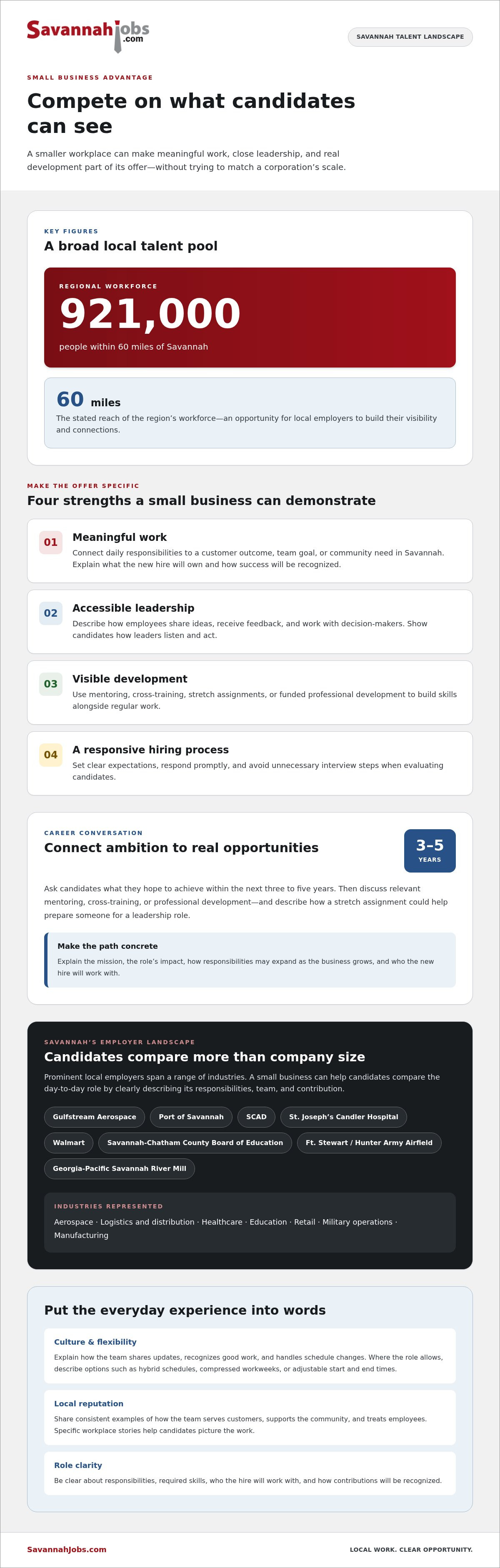
Small Savannah businesses can compete with large employers by making their local reputation, close leadership, meaningful work, and thoughtful benefits part of the offer. The answer to how to compete with large employers for talent in Savannah isn’t to copy a corporation’s scale, but to show candidates what they can gain in a smaller workplace. The region has a workforce of 921,000 people within 60 miles, giving employers a broad local talent pool to reach.
It’s understandable to think larger organizations have an edge when candidates compare job offers. But pay isn’t the only factor: people also weigh workplace culture, leadership, flexibility, and opportunities to grow.
This article shows how small businesses can turn those strengths into a clear employer story, build local hiring connections, and create a more responsive candidate experience. It also covers practical benefits and visible development opportunities that can support recruitment and retention in Savannah.
Key Takeaways
- Make the advantages of a smaller workplace clear by showing candidates how their work can matter and where they can grow.
- Build local relationships that help your business become a familiar, trusted employer in Savannah.
- Give candidates a clear picture of your culture and how leaders support employees’ contributions.
- Consider which flexible, practical benefits can make your offer more valuable and encourage employees to stay.
Advantages of small businesses over large employers
Large employers in Savannah include Gulfstream Aerospace, the Port of Savannah, SCAD, St. Joseph’s Candler Hospital, Walmart, and the Savannah-Chatham County Board of Education. Other major employers include Ft. Stewart/Hunter Army Airfield and Georgia-Pacific Savannah River Mill. Their visibility can make hiring competitive, but smaller businesses offer a different opportunity: employees may work closely with leadership and see how their contributions affect the company.
The region’s major employers span aerospace, logistics and distribution, healthcare, education, retail, military operations, and manufacturing. The Port of Savannah supports logistics and distribution jobs; Gulfstream produces business jets; SCAD provides academic employment. These employers illustrate important parts of the local economy, but they don’t establish which occupations are most in demand.
Small businesses can compete by making workplace advantages specific. Explain the company’s mission, the role’s impact, and how responsibilities may expand as the business grows. For example, an employee might take on cross-training or a stretch assignment, then use that experience to prepare for a leadership role. Describe the path during hiring instead of relying on broad promises.
- Show meaningful work: Connect daily responsibilities to a customer outcome, team goal, or community need in Savannah.
- Make leadership accessible: Describe how employees share ideas and receive feedback directly from decision-makers.
- Offer room to develop: Use mentoring, cross-training, or funded professional development to build skills alongside regular work.
- Move hiring forward: Set a clear process, respond promptly, and avoid unnecessary interview steps when evaluating candidates.
Large organizations may need policies designed for thousands of employees. A smaller Savannah workplace can communicate expectations more personally and give employees broader responsibilities across a team. Explain what the new hire will own, who they’ll work with, and how success will be recognized. These details help candidates compare the day-to-day role, not just the employer’s size.
Community reputation and local partnerships
Savannah small businesses can strengthen recruiting by showing their local contribution and building relationships with nearby schools and recruiting partners. A clear, consistent reputation helps candidates understand what it means to work for the business.
Community Reputation in Recruiting
Community reputation is the impression candidates form from a business’s actions, workplace, and local relationships. In Savannah, make that impression concrete: describe how your team serves customers, supports the community, and treats employees. Share consistent examples in job ads and interviews, such as how a team member solved a customer problem. Specific stories help candidates picture the work and decide whether the company’s values align with their own.
Local Partnerships for Employer Branding
Local partnerships connect employers with people and organizations already engaged in Savannah’s workforce. Build relationships with nearby trade schools, such as Savannah Technical College, and local recruiting partners. Share clear details about open roles, required skills, and what employees learn on the job. A school can help students understand the work, while a recruiting partner can introduce your business to candidates who may not know it yet.
Make each relationship useful, not just visible. For example, invite a trade-school instructor to discuss the skills your team uses, then show how they apply to an actual role. Keep a simple record of introductions and applications to see which partnerships bring relevant candidates. Follow up with students and partners after hiring events. Reliable communication reinforces your reputation as an organized Savannah employer.
- Share a real workplace example: Explain a role’s impact on a customer, team, or local project.
- Describe the opportunity clearly: Give partners accurate role details and the skills candidates need.
- Close the loop: Respond to introductions and tell partners when a position is filled.
Keep your message consistent across conversations and job ads. For another way to strengthen local Savannah hiring visibility, present the role in language that reflects your workplace and community.
Workplace culture and direct leadership access
Savannah employers can stand out by making flexibility, growth, and access to leadership visible. Explain how employees shape the work and contribute to company goals. For businesses considering how to compete with large employers for talent in Savannah, practical examples make the opportunity clear.
Workplace Culture and Flexibility
Workplace culture is the everyday employee experience, shaped by team habits, communication, and decision-making. In Savannah, describe those realities rather than relying on broad claims like “supportive culture.” Explain how your team shares updates, recognizes good work, or handles schedule changes. Hybrid schedules, compressed workweeks, and adjustable start or end times can offer flexibility when the role allows. Clear expectations help candidates understand the arrangement before they join.
Career Growth and Direct Leadership Access
Career growth means gaining skills and responsibility, while direct access to leadership gives employees a voice in decisions. Pair a stretch assignment with regular feedback from a manager. Ask candidates what they hope to achieve within the next three to five years, then discuss relevant mentoring, cross-training, or professional development. This connects their ambitions to real opportunities instead of vague promises of advancement.
Show candidates how leaders listen and act. A small Savannah team might invite employees to suggest improvements during meetings, then explain which ideas will move forward. When employees understand how their work supports company goals, daily responsibilities feel connected to a larger purpose. Trust also grows when managers explain decisions clearly and follow through on commitments.
- Describe flexibility: Explain which schedule options fit the role and how the team coordinates work.
- Map development: Connect a skill an employee wants to build with a practical assignment or training opportunity.
- Make access real: Clarify how employees raise ideas and receive leadership feedback.
A credible approach to how to compete with large employers for talent in Savannah starts with practices candidates can picture and employees can experience.
Benefits as a factor in recruiting and retention
Benefits can strengthen a Savannah job offer when they address employees’ practical needs. Compare the full package, not salary alone, and make its value clear.
Wages and Benefits for In-Demand Jobs
Compare compensation by role, experience, responsibilities, and schedule, then explain benefits alongside the wage offer. These factors shape how a candidate weighs opportunities at a smaller business and a large employer. Rather than relying on a general comparison, show what your position includes, such as paid time off, a development stipend, or schedule flexibility. Nearly 8 in 10 employees say benefits that meet their needs are very important when choosing a job.
Benefits can also include flexible spending or health savings accounts. A benefits broker can help a small employer consider options at different price points; a professional employer organization can support benefits access and administration.
Worker Priorities and Retention Challenges
Savannah workers may value benefits that fit their circumstances, accessible leadership, flexibility, and room to grow. Candidates assess the quality, accessibility, and flexibility of benefits, so explain eligibility and how each option works. Retention challenges often arise when an employee’s expectations don’t match the day-to-day experience. Use stay conversations and exit feedback to identify concerns, then address recurring issues through clearer communication or changes to the employee experience.
No single turnover figure describes every Savannah workplace. Track departures by role and tenure to spot patterns, such as employees leaving after a schedule change or due to limited development opportunities.
Incentives, Grants, and Training Programs
Training and development can help employers build skills while giving employees a reason to see a future with the business. Consider cross-training, mentorship, stretch assignments, or funded professional development. Georgia’s HOPE Scholarship and Zell Miller Grant are education programs for eligible students, not direct hiring incentives for employers. For a business, the practical approach is to discuss job-related training and development during recruitment, then connect employees with relevant learning options.
To present your workplace to local candidates, promote your employer brand in Savannah with a clear description of the role and benefits.
SavannahJobs.com: 30-Day Job Posting
SavannahJobs.com helps Savannah employers advertise open positions to the local workforce. If you’ve clarified your role, workplace culture, and benefits, a 30-Day Job Posting gives candidates a direct way to find the opportunity. Employers can also choose a Featured Job Upgrade to add visibility to a specific opening, or a Featured Employer Upgrade to highlight their organization.
Use a job posting to give candidates the details they need to assess fit: responsibilities, qualifications, schedule expectations, and the benefits your business provides. A clear, locally focused listing can help your distinctive offer stand out to job seekers exploring Savannah opportunities.
Visit savannahjobs.com to explore job posting options for your open role.
Turn Your Hiring Approach Into a Lasting Advantage
A practical approach to how to compete with large employers for talent in Savannah starts with treating each hiring round as a learning cycle. After each round, note what attracted strong applicants, where candidates hesitated, and which questions came up repeatedly. Use those observations to refine the next job description and clarify expectations from the start.
Keep the hiring process connected to the employee experience. Ask new hires what influenced their decision, then revisit those points during check-ins. Their feedback can show whether the opportunity described in interviews matches the work they encounter. Small, consistent adjustments help keep your hiring message credible as your business grows.
When you’re ready to put an open role in front of local job seekers, connect with SavannahJobs.com. Keep building an employer people in Savannah are proud to join.
Frequently Asked Questions
What low-cost benefits and incentives help Savannah employers attract and retain talent?
Gym membership reimbursements and time off for charitable work are practical benefits smaller employers can consider. These extras can stand out when they match employees’ priorities instead of copying a large employer’s package. Ask staff which options they’d use, define eligibility, and explain the process in writing. A modest benefit employees can access is more useful than a perk with unclear terms.
Which local colleges, technical schools, workforce programs, and job boards help recruit in Savannah?
Match each opening to a relevant Savannah-area talent pipeline. Georgia Southern University, SCAD, Savannah Technical College, and nearby trade schools can help connect you with prospective candidates whose skills suit different roles. Pair campus outreach with a local job board such as SavannahJobs.com. In each posting, spell out the skills required and how the role fits candidates at different experience levels.
What are average wages and benefits for in-demand jobs in Savannah compared with large employers?
The material provides no average wage figures or direct wage comparison with large employers. Compare pay by role, experience, responsibilities, and schedule, and present benefits such as paid time off, development stipends, and schedule flexibility alongside wages.
What are the main employee retention challenges and turnover rates in the Savannah area?
A key retention challenge is a mismatch between employees’ expectations and their day-to-day experience. The material provides no local turnover rates; use stay conversations and exit feedback to identify and address recurring concerns.


