

Hiring doesn’t have to begin the day a role opens. If you’re asking “what is recruitment marketing,” it’s the ongoing work of presenting an organization as a place to work, attracting and engaging potential candidates, and building relationships before they apply.
Filling an immediate vacancy matters, but a job post alone may not connect with people who aren’t looking right now. Recruitment marketing takes a longer view: it helps potential candidates understand what an employer offers and keeps the organization visible as they consider future opportunities.
This article explains how recruitment marketing differs from employer branding, where social media, career pages, email, and job boards fit, and how candidates move from awareness to application. It also covers the people behind the strategy: recruitment marketers develop candidate-focused messages, manage campaigns, review performance, and work with HR and marketing teams. You’ll get a clearer picture of the work and how it can support hiring in Savannah and beyond.
Key Takeaways
- Build candidate relationships before a vacancy opens, rather than relying only on last-minute recruiting.
- Separate the employer brand, what people believe about working for you, from the campaigns that communicate it to candidates.
- Choose channels that fit your target talent and create consistent touchpoints, from social content to job boards.
- Connect a recruitment marketer’s work across messaging, campaign management, performance analysis, and collaboration with hiring teams.
What is Recruitment Marketing?
Recruitment marketing starts before a vacancy appears. It applies marketing strategy to attract, engage, and nurture potential candidates. To understand what recruitment marketing is, picture an employer sharing career information before inviting someone to apply. The aim is to build awareness and relationships so future applicants already understand the organization and its opportunities.
Traditional recruiting usually responds to an immediate opening. Recruitment marketing builds a longer-term connection with people who may not be job hunting today. In the United States, 72% of the labor market is considered passive talent, while 28% is considered active job seekers. A company can reach both groups by sharing useful role information and consistent messages about its workplace. A warm talent pool can include people who have engaged with those messages before a role opens.
In the United States, recruitment marketing must account for applicable employment, privacy, and advertising requirements. The requirements depend on the campaign and its audience. Keep job descriptions accurate, make candidate-facing messages consistent, and handle contact information responsibly. For example, describe a role’s actual responsibilities instead of promoting benefits the position doesn’t provide.
There’s no single average cost for every recruitment marketing campaign. Spending depends on factors such as channels, content production, paid promotion, and campaign duration. A campaign using existing employee stories and a careers page has different cost drivers from one that also uses paid advertising. Set the objective first, then choose the channels and resources that support it.
Common mistakes include treating recruitment marketing as a one-time job advertisement, using inconsistent branding, and sending messages that don’t match candidates’ interests. These choices can weaken awareness and trust. Compare each campaign message with the actual role, workplace experience, and audience. For a critical opening, for example, explain required skills clearly and use channels that reach that talent group.
Recruitment marketing is an ongoing strategy, not a substitute for interviewing or hiring. Teams can track whether candidates engage with content, visit career pages, or apply after seeing a campaign. Those signals help refine future messages and channel choices. The aim is a clear path from first awareness to a considered application, supported by honest branding and sustained relationships.
Recruitment marketing versus employer branding
An employer brand is what current, former, and potential employees think about working for an organization. It also includes the identity and values the employer defines internally. Recruitment marketing communicates that identity outward, using candidate-focused messages and campaigns to connect people with the employer brand. One defines and shapes the experience; the other brings that experience to potential applicants.
The distinction matters because promotion can’t replace a credible employee experience. Employer-brand work identifies what the organization stands for, such as collaboration, learning, or flexibility. Recruitment marketing turns those values into clear examples. If learning is a core value, a campaign might describe how employees build skills at work. The message should reflect real workplace practices, not just a polished slogan.
Reputation can influence candidate behavior. In the United States, 63% of employees would consider leaving their current role for another company with a better reputation and learning and development opportunities. Also, 50% of candidates say they wouldn’t work for a company with a bad reputation, even for a pay increase. These figures show why messaging should address expectations honestly. Candidates use what an employer says to decide whether to explore a role, apply, or look elsewhere.
Global employer branding needs both consistency and local relevance. Keep the organization’s core identity intact, but adapt examples and messaging to local cultural contexts. Include local employee perspectives so candidates can recognize their own workplace expectations in the story. For Savannah-area employers, a Featured Employer Upgrade can add visibility to an employer profile, helping local candidates encounter the organization while exploring opportunities.
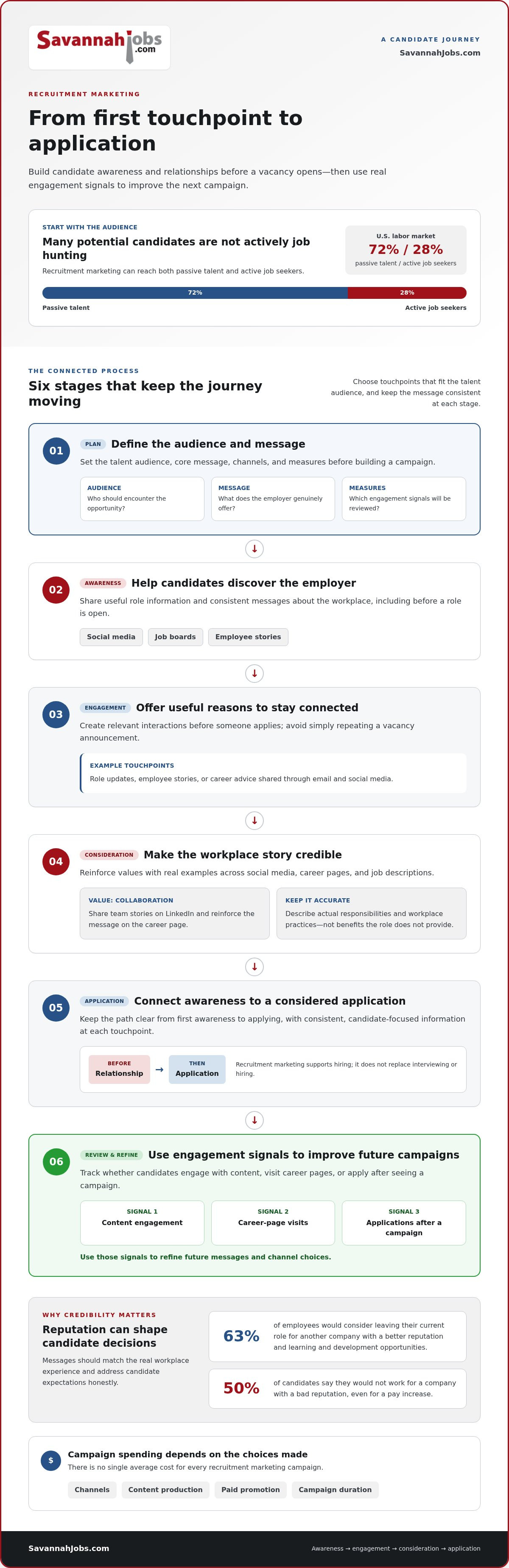
Recruitment marketing channels and candidate touchpoints
A recruitment marketing strategy defines its talent audience, core message, channels, and measures. It connects awareness, engagement, and applications through relevant touchpoints.
Candidate Engagement and Company Values
Candidate engagement means creating useful interactions that reflect an employer’s stated values. It matters because candidates compare workplace claims with the details they encounter. For example, an employer that values collaboration can share team stories on LinkedIn and reinforce the message on its career page. Consistent examples help candidates assess whether the culture and opportunities fit their expectations.
Relationships with Prospective Candidates
Building candidate relationships means communicating relevant information before someone applies. A talent acquisition team might share role updates, employee stories, or career advice through email and social media. Each touchpoint should give people a reason to stay connected, rather than simply repeat a vacancy announcement. Over time, this engagement can build a talent pool familiar with the employer’s work and opportunities.
Candidate Personas and Audience Profiling
A candidate persona is a practical profile of the experience, skills, motivations, and communication preferences relevant to a target role. Audience profiling helps employers tailor messages and choose channels that reach suitable talent. For a technical role, a team might focus on professional communities and role-specific projects. For a customer-facing position, it could emphasize service expectations and team interaction.
Talent Communities
A talent community is a group of prospective candidates who choose to receive relevant employer updates. Personas help shape its content: a community for early-career candidates might feature learning opportunities, while experienced specialists receive technical news. Career pages, newsletters, events, and social platforms can support these connections. Keep messages focused, useful, and aligned with the employer’s values.
Recruitment marketer responsibilities
To build a recruitment marketing strategy, define the hiring need, identify the audience, shape the message, select channels, then measure and refine the campaign. For example, a team hiring technicians can align role details, workplace culture, and social media content before promoting the opening.
The recruitment marketer turns hiring goals into candidate-focused communication. They work with recruiters and hiring managers to understand the role, define essential qualifications, and explain what success looks like. For a customer service position, that might mean highlighting daily responsibilities, team support, and the skills used to help customers. Clear details help candidates assess their interest before applying.
Campaign planning is another core responsibility. The marketer chooses channels suited to the audience, prepares content, and keeps messages consistent across career pages, job boards, email, and social media. They may coordinate employee stories or role-specific posts that show company culture through real examples. Each channel should serve a purpose, such as raising awareness, encouraging engagement, or prompting applications.
Recruitment marketers also analyze performance and share findings with HR, marketing, and leadership. Useful measures include application rates, click-through rates, and cost per hire. If a campaign gets clicks but few completed applications, the team can review the role information, application process, or audience match. The results show which messages attract suitable candidates and where adjustments could support future hiring.
Good work depends on collaboration, not just publishing content. Recruiters provide feedback on candidate quality, while hiring managers clarify role requirements and workplace expectations. In-house marketing colleagues or digital marketing agencies like Mark3teros can help refine creative materials and channel plans to boost visibility. Together, they can compare campaign results with the original hiring objective and decide what to keep, change, or stop.
For a local opening, put these responsibilities into practice by advertising an open role in Savannah. A focused job post gives candidates a direct way to learn about the position and apply.
SavannahJobs.com: 30-Day Job Posting
SavannahJobs.com helps employers advertise open positions to the local Savannah workforce through a 30-Day Job Posting. It’s a practical next step when you have a role to fill and want candidates in the region to find the opportunity. The posting gives your recruitment marketing a clear, job-focused destination where interested candidates can review the opening.
For employers seeking added visibility, the Featured Job Upgrade highlights a specific opening, while the Featured Employer Upgrade promotes the employer profile. Each option supports a different goal: drawing attention to a vacancy or increasing visibility for the organization. Choose the one that fits your message and hiring need.
Write a clear job description that explains responsibilities and qualifications, then choose the posting option that suits your hiring effort. Visit SavannahJobs.com to explore job posting options for Savannah employers.
Put Your Next Hiring Campaign in Motion
Choose one hiring priority and make it the focus of a clear campaign. Decide which candidates you need to reach, what they should understand about the opportunity, and what action you want them to take. Use those decisions to keep your message focused across every candidate touchpoint.
If you’ve been asking what recruitment marketing is, think of it as an ongoing way to build meaningful connections around real career opportunities. A practical local campaign can start with a job posting, with added visibility through a Featured Job Upgrade or Featured Employer Upgrade. Match the option to your immediate hiring goal, then give candidates useful details in the role description.
For employers hiring in the Savannah area, SavannahJobs.com offers these advertising options for local opportunities. Contact SavannahJobs.com today to discuss your next hiring campaign. Take the next step with a clear message and a strong connection to Savannah talent.
Frequently Asked Questions
What are the goals and benefits of recruitment marketing?
The main goals are to reach suitable candidates, build familiarity with your organization, and support hiring needs. One practical benefit is that applicants can understand the role before applying. For example, a Savannah employer hiring for a hard-to-fill shift can explain schedule expectations early, helping candidates assess fit and recruiters focus conversations on people genuinely interested in the work.
Employer branding shapes an organization’s reputation as a place to work, recruitment marketing communicates that reputation to potential candidates, and recruiting manages selection for open roles. These are connected but distinct activities. A candidate may first encounter an employer’s culture story, then see a role campaign, and later speak with a recruiter about qualifications, interviews, and the hiring decision.
What recruitment marketing channels and tools are most effective?
The right channel mix depends on where your target candidates look for work and information. A Savannah logistics employer might pair a career page and job board listing with social posts aimed at local talent. Campaign analytics can show which touchpoints prompt visits or applications, while a careers-page chatbot can answer common questions and direct interested candidates to relevant openings.
How do you measure recruitment marketing success and ROI?
Measure whether campaigns attract qualified applicants and move them toward completed applications. Track source of hire, application conversion, click-through rates, cost per qualified applicant, and campaign ROI. Compare channels by the quality and number of applicants they generate, not clicks alone. Track talent-brand awareness and recall too, since candidates may remember an employer before a suitable role appears.
What recruitment marketing laws and regulations apply in the United States?
Recruitment marketing must account for applicable employment, privacy, and advertising requirements. Which requirements apply depends on the campaign and its audience. Keep job descriptions accurate, candidate-facing messages consistent, and contact information handled responsibly.


