

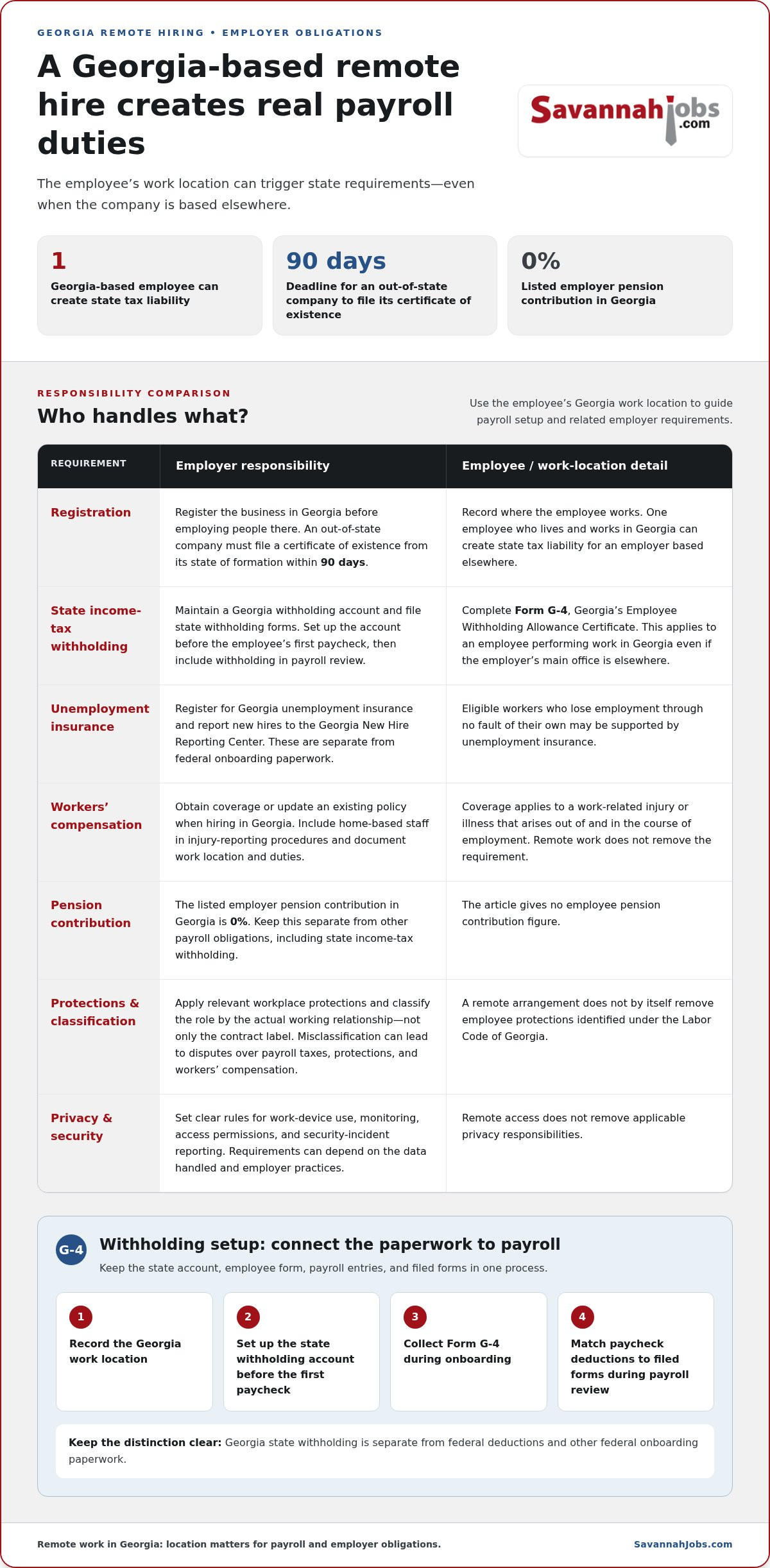
A single employee who lives and works in Georgia can create state tax liability for an employer, so a remote hire can trigger payroll duties even when the company is based elsewhere. Georgia employers need a state income-tax withholding account and must file withholding forms; employees complete Form G-4, Employee Withholding Allowance Certificate. Georgia laws governing hiring for remote work make the employee’s work location central to withholding.
Hiring for remote work in Georgia involves more than setting pay: an employee’s work location can affect payroll and other employer obligations. If you’re planning a Georgia hire, identify the state and federal requirements that apply before the role begins. Understanding the laws for hiring remote workers in Georgia helps you build those steps into your hiring process.
This guide breaks down employer and employee tax responsibilities, pension contributions, Georgia Form G-4 withholding, minimum-wage rules, and overtime. You’ll also see how unemployment insurance and workers’ compensation fit into the hiring picture, so you can plan the role and payroll with a clearer view of the rules.
Key Takeaways
- Map payroll obligations to where your remote employee works, including tax withholding and unemployment insurance.
- Use Georgia’s state withholding process to set up payroll paperwork for an employee working in Georgia.
- Understand how federal and state minimum-wage rules interact, and how overtime eligibility affects pay.
- Once you’re ready to recruit locally, a 30-Day Job Posting can advertise your open role to Savannah-area candidates.
Employer and employee taxes and pension contributions
Employer registration means recording a business with Georgia before employing people there. One employee who lives and works in Georgia can create state tax liability for an employer, even if the business is based elsewhere. An out-of-state company must file a certificate of existence from its state of formation within 90 days. Include Georgia registration in the hiring checklist before payroll begins.
Unemployment insurance is state coverage that can support eligible workers who lose employment through no fault of their own. Employers hiring in Georgia must register for unemployment insurance and report new hires to the Georgia New Hire Reporting Center. These are separate tasks from federal onboarding paperwork, so assign each to a responsible payroll or HR contact.
Workers’ compensation covers a remote employee’s work-related injury or illness when it arises out of and in the course of employment. Georgia employers must obtain coverage or update an existing policy when hiring in the state. Remote work does not remove this requirement. Document the employee’s work location and duties, and include home-based staff in injury-reporting procedures.
Pension contributions are payments into a retirement plan, distinct from tax withholding. The listed employer pension contribution in Georgia is 0%. Treat that figure as separate from state payroll obligations, including income-tax withholding, which still requires a Georgia withholding account for employees working in the state.
Georgia employment protections are workplace rights and rules that apply to covered employees. The Labor Code of Georgia is identified as the fundamental statute defining employee protections, workers’ rights, and employment relations. A remote arrangement does not by itself remove those protections. Classify the role according to the actual working relationship, not just the contract’s label. Misclassifying an employee as an independent contractor can lead to disputes over payroll taxes, employee protections, and workers’ compensation coverage.
Georgia-specific privacy, monitoring, and cybersecurity requirements can depend on the data handled and the employer’s practices. Set clear rules for work-device use, monitoring, access permissions, and reporting security incidents. Remote access does not remove applicable privacy responsibilities.
Georgia state income tax withholding
State income-tax withholding is the amount an employer deducts from an employee’s pay for Georgia income taxes. A business with an employee working in Georgia must maintain its own state withholding account and file withholding forms for that employee. One employee living and working in Georgia can create state tax liability, even if the employer is based elsewhere. For hiring for remote work in Georgia, the employee’s work location is a key payroll setup detail.
A Georgia withholding account is the employer’s state account for reporting and submitting employee income-tax withholding. Set it up before processing the employee’s first paycheck. Record the employee’s Georgia work location in payroll and assign responsibility for required state forms. Keep state withholding distinct from federal deductions and other payroll tasks.
Form G-4 is Georgia’s Employee Withholding Allowance Certificate, completed by employees for state income-tax withholding. Give the employee the form during onboarding and use the completed information to configure state withholding in payroll. For example, a fully remote employee performing work in Georgia completes Form G-4 even if the employer’s main office is elsewhere. Understanding Georgia’s laws for hiring remote workers also means distinguishing this state form from federal onboarding paperwork.
Withholding records are payroll documents showing how the employer calculated and reported state deductions. Keep the employee’s completed G-4 with onboarding records, and match each pay period’s payroll entries to the state forms filed. If the employee’s work location or withholding information changes, update the payroll record and apply the revised details to later paychecks.
Payroll reconciliation is the process of comparing paycheck deductions with filed withholding forms. Review Georgia withholding alongside each payroll run, rather than treating remote employees as outside the state system. Make the account, employee form, payroll setup, and state filings part of one onboarding checklist. Once payroll planning is underway, employers recruiting in Savannah can share an opening through local job postings to reach area candidates.
Minimum wage and overtime
Minimum wage is the lowest hourly pay an employer may owe under an applicable wage rule. The Georgia Department of Labor identifies $5.15 as a minimum-wage amount relevant to Georgia employment. The U.S. Department of Labor identifies $7.25 where the Fair Labor Standards Act applies. These figures describe different legal contexts, so don’t treat Georgia’s figure as the only rate to consider. For a remote role, assess the employee’s work location and whether federal law applies before setting the advertised wage.
Applicable wage rate means the minimum amount that governs the particular job. Start by recording the employee’s Georgia work location and the role’s pay arrangement. Then determine whether the Fair Labor Standards Act applies; the federal amount identified by the U.S. Department of Labor is $7.25 in that circumstance. The Georgia Department of Labor identifies $5.15 as relevant to Georgia employment. Build your wage decision around the applicable rules, not just the employee’s remote status.
Overtime is additional compensation that may be due when an employee’s work meets the applicable criteria. Before setting a salary or hourly rate, classify the position based on its actual duties and pay arrangement. A job title alone does not determine whether overtime applies. For example, a remote customer-support role and a role with different duties may require different assessments, even when both employees work from home. Keep the basis for the classification with the job records.
Timekeeping means recording hours worked so payroll can calculate pay correctly. Give remote employees a clear method to log their time, report schedule changes, and flag missed entries. Compare submitted hours with schedules before finalizing payroll. If duties or pay arrangements change, reassess the classification and update payroll procedures. Consistent timekeeping helps employers apply relevant minimum-wage and overtime rules across Georgia-based remote roles.
What are Georgia employer registration, withholding, and unemployment tax requirements for remote employees?
Georgia tax liability is an employer’s state tax obligation connected to work performed in Georgia. One employee living and working in Georgia can create this liability, even if the employer is based elsewhere. Treat the employee’s work location as a payroll setup detail, not merely a mailing address. Identify Georgia-based roles before determining which state accounts and filings the business needs.
A state income-tax withholding account is the employer’s Georgia account for reporting employee state tax deductions. Businesses with employees working in Georgia must have their own account and file withholding forms for those employees. Include account setup and recurring filings in the payroll workflow. Keep the employee’s work location with the withholding paperwork so payroll staff can apply the correct state setup.
New-hire reporting means sending required employee information to Georgia’s designated reporting center. Georgia employers must report new hires to the Georgia New Hire Reporting Center. Make this a separate onboarding task: the completed hiring file should prompt the responsible payroll or HR staff member to submit the report. Do not rely on withholding setup to cover it.
Unemployment insurance is a state program that may provide benefits to eligible people unemployed through no fault of their own. Employers hiring employees in Georgia must register for unemployment insurance. Keep this separate from state income-tax withholding, since the two serve different purposes. Eligible workers may claim benefits through the Georgia Department of Labor. Track unemployment obligations alongside payroll and hiring records.
Employer registration is the set of state administrative steps needed to employ someone working in Georgia. A practical sequence is to identify the employee’s work location, establish the required state accounts, configure withholding, report the new hire, and maintain payroll records. As you plan a Georgia hire, advertise your open role to Savannah-area candidates while preparing the related payroll steps.
SavannahJobs.com: 30-Day Job Posting
SavannahJobs.com offers a 30-Day Job Posting for employers ready to advertise an open role to the local Savannah workforce. Once you’ve planned the position and its payroll requirements, use a job posting to put the opportunity in front of area candidates. This is a practical next step when you’re recruiting for a role based in or serving Savannah.
Employers can choose a Featured Job Upgrade to increase visibility for a specific opening, or a Featured Employer Upgrade to highlight their organization. These recruitment advertising options do not replace payroll registration, tax withholding, or employment compliance. Before publishing, prepare a clear job description, work-location expectations, and pay details so candidates can assess whether the role suits them.
Visit Savannah job posting options to advertise your opening with SavannahJobs.com.
Turn Your Georgia Hiring Plan Into Action
Build a repeatable process before opening your next remote role. Assign responsibility for payroll setup, onboarding records, timekeeping, and position classification. Giving each task a clear owner helps your team carry compliance decisions into everyday hiring instead of revisiting them only after someone starts.
Understanding the laws that apply when hiring for remote work in Georgia is one part of planning. The next is reaching candidates who fit the role and understand its location and expectations. SavannahJobs.com offers a 30-Day Job Posting for open positions, along with Featured Job Upgrade and Featured Employer Upgrade options for added visibility.
Choose the recruitment advertising option that fits your hiring needs, then prepare a clear listing for Savannah-area candidates. Contact SavannahJobs.com today to discuss advertising your opening. With a thoughtful hiring process and a well-presented opportunity, you can take your next step toward building a strong Georgia team.
Frequently Asked Questions
What Georgia laws apply when hiring remote employees who work in Georgia?
Georgia employment protections apply to work performed in the state, even when the employer is based elsewhere. The Labor Code of Georgia is identified as the fundamental statute defining employee protections, workers’ rights, and employment relations. For a Savannah-based remote role, build a checklist around the employee’s actual work location and duties, then account for relevant state and federal wage, tax, and workplace requirements.
Does a Georgia employer need to register with the state before hiring remote workers?
Yes. A business employing someone who works in Georgia needs state payroll and unemployment registrations. For example, an out-of-state employer hiring a remote employee in Savannah should include Georgia account setup in its hiring workflow, rather than waiting for a later payroll review. The employer must also report new hires to Georgia’s New Hire Reporting Center and track state filings separately from federal onboarding documents.
What Georgia wage, overtime, minimum wage, and pay-frequency rules apply to remote workers?
Remote employees are covered by applicable wage and overtime rules based on the job and the laws that apply. The Georgia Department of Labor identifies $5.15 as a minimum-wage amount relevant to Georgia employment; the U.S. Department of Labor identifies $7.25 where the Fair Labor Standards Act applies. Payroll practices should account for applicable state requirements. Record hours and review each role’s duties when setting pay practices.
What leave, meal-break, and workplace accommodation laws apply to Georgia remote employees?
Remote work does not remove the need to account for applicable leave and workplace policies. Remote employers should review their leave and work-schedule policies to ensure they address applicable requirements. Make these policies accessible to remote employees and explain how to report schedule needs or request workplace adjustments.
What workers’ compensation and unemployment insurance rules cover remote employees in Georgia?
Georgia workers’ compensation coverage extends to remote employees with a work-related injury or illness arising out of and in the course of employment. Employers hiring in Georgia should account for workers’ compensation coverage and unemployment insurance requirements. For a home-based employee, document the work location and provide a clear incident-reporting process. Eligible workers may claim unemployment benefits through the Georgia Department of Labor.
What federal employment laws apply to remote workers hired in Georgia?
Federal employment rules apply alongside Georgia requirements when they cover the employer and role. The Fair Labor Standards Act is relevant to minimum wage, with the U.S. Department of Labor identifying $7.25 where that law applies. During onboarding, separate federal paperwork, such as Form W-4 for federal income-tax withholding, from Georgia’s state withholding forms. Keep both records organized for accurate payroll administration.


