

An employee referral program is more than a bonus: it gives employees a clear way to recommend qualified candidates and may reward them when a referral is hired. The best employee referral program ideas combine a useful incentive with straightforward rules and an easy way to submit a candidate.
Trusted employees can help introduce your organization to potential hires, but a successful program needs more than good intentions. Employees should know which roles are open, what makes a candidate a good fit, and when a reward is earned.
This guide explains how referral programs work, offers practical ways to recognize successful referrals, and outlines factors that shape incentive amounts. You’ll also find steps for keeping the process fair, easy to use, and effective alongside other recruiting methods.
Key Takeaways
- Make the referral process visible and easy to use, with clear role requirements and straightforward submission steps.
- Choose rewards that fit your hiring goals, and explain exactly when employees and referred candidates qualify.
- Keep referrals fair by using the same evaluation standards as for other applicants and protecting candidate privacy.
- Compare referral hires, retention, and hiring outcomes with other recruiting methods to see what’s working.
- Use referrals alongside other ways to reach candidates, then adjust incentives and promotion based on your results.
1. What’s an employee referral program?
An employee referral program gives staff a clear process for recommending applicants for open roles. Employers may reward an employee when a referral is hired. Internal referrals rank third among ways to fill roles, after online job sites and company career pages. They can complement those channels, not replace them: relying only on employees’ networks may limit applicant-pool diversity.
Visibility helps employees remember to participate when a suitable role opens. Promote the program through workplace posters, internal emails, staff meetings, and mailed flyers. Use a consistent message, such as “Know someone who fits? Refer them for this role,” and include the job title, key qualifications, and submission steps. A digital notice can point staff to current openings, while a meeting gives managers time to explain eligibility and answer questions.
Make each opportunity easy to share. Provide a short role summary naming required experience, education, and skills, along with a direct referral route. Encourage managers to mention relevant vacancies at team meetings, but don’t pressure staff to nominate someone. Explain the program’s principles: qualified applicants are assessed fairly, and a referral is an introduction, not a hiring guarantee.
Design the program in a clear sequence: set a measurable hiring goal, define eligible referrals and reward conditions, explain the rules in writing, and create a quick submission form. Add each referred applicant to the same applicant tracking system used for other candidates. A form, for example, can capture the applicant’s contact details, the referring employee, and the role. Assign someone to acknowledge submissions and provide process updates without disclosing private interview feedback.
Internal promotion can also support employee growth. Share career opportunities with current staff and include internal applications in the same organized hiring process. A team member may know a qualified colleague whose skills fit a new role, or may apply personally. Track internal mobility separately from external referrals so hiring teams can see how each route contributes without confusing eligibility or rewards.
Automation can reduce missed handoffs. Set up the tracking system to record referral sources, send receipts, and prompt recruiters to update application status. Use a shared calendar or internal job digest to keep openings visible. If a reward includes a charity donation, state how employees choose the organization and when the donation is made.
To reduce bias and improve diversity, assess every applicant against the same job-related qualifications and hiring standards. Keep job sites and career pages active alongside referrals, and review who applies and advances through each channel. Track referral volume, interviews, hires, and retention by role. Compare the patterns and adjust promotion or outreach where some groups remain underrepresented.
2. Bonuses for both employees and referred candidates
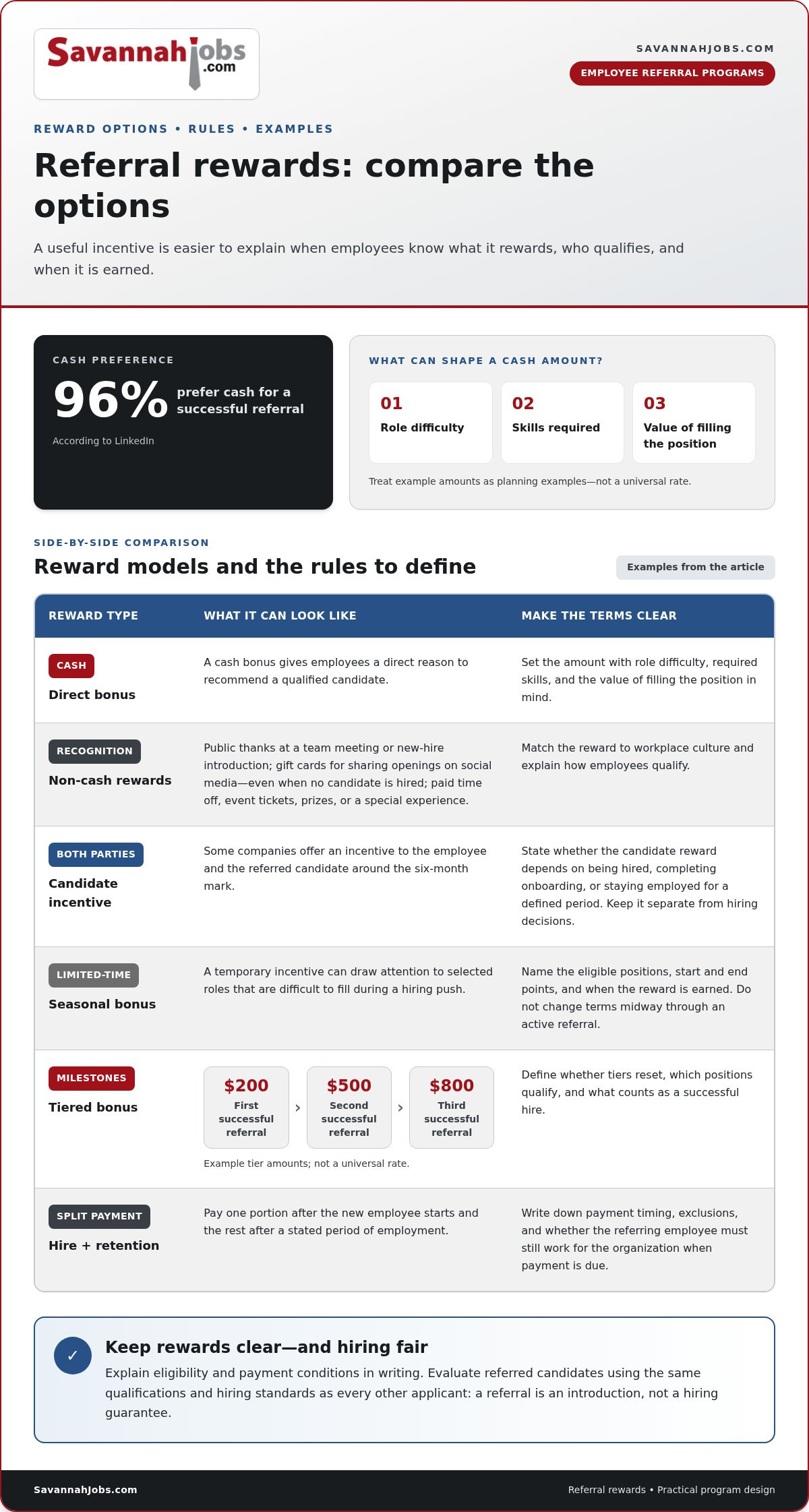
A cash bonus gives employees a direct reason to recommend a qualified candidate. According to LinkedIn, 96% of employees prefer cash for a successful referral. Bonus amounts should reflect the role’s difficulty, the skills required, and the value of filling the position. Treat these as planning examples, not a universal rate.
Recognition can complement cash without making the program harder to understand. Publicly thank employees who make successful referrals at a team meeting or when introducing a new hire. A gift card can recognize employees who share openings on social media, even when a candidate isn’t hired. Other options include paid time off, event tickets, prizes, or a special experience. Match the reward to your workplace culture and explain how employees qualify.
You can recognize referred candidates as well as the employees who introduced them. Some companies offer incentives to both parties around the six-month mark. Keep a candidate reward separate from hiring decisions, and apply the same qualifications and hiring standards used for every applicant. State whether the candidate’s reward depends on being hired, completing onboarding, or remaining employed for a defined period.
Seasonal bonuses can draw attention to roles that are especially difficult to fill during a hiring push. For example, an employer preparing for a busy operating season could announce a temporary referral incentive for selected openings. Set a clear start and end point, identify eligible positions, and explain when the reward is earned. Don’t change the terms midway through an active referral; written rules help employees understand which conditions apply.
Tiered bonuses reward progress while keeping the structure easy to follow. One example offers $200 for the first successful referral, $500 for the second, and $800 for the third. Define whether tiers reset, which positions qualify, and what counts as a successful hire. These practical employee referral program ideas work best when the amounts and milestones are visible before employees submit referrals.
For a larger reward, split payment between the hire date and a later retention milestone. For example, pay one portion after the new employee starts and the rest after the stated period of employment. You can make eligibility depend on the referring employee still working for the organization when payment is due. Include that condition in the written terms, along with payment timing and any exclusions.
Choose a reward employees can explain in one sentence, then promote it alongside the role’s requirements. If hiring locally in Savannah, local job promotion options can help extend an opening’s reach beyond employee networks.
3. Referral program success factors
A referral campaign works best when employees can explain its rules and submit a name without extra steps. Keep the process simple, share the skills and competencies sought for each role, and make referral-bonus conditions clear. A hiring manager, for example, can provide a short role profile with essential experience, key responsibilities, and the submission route. Employees can then focus on candidates whose backgrounds match the position.
Recognize a successful referral in a way that respects both the employee and the new hire. A manager might thank the referring employee during the new employee’s introduction, then share a brief note about the contribution. Get the new hire’s permission before sharing personal details or the story behind their application. Recognition should acknowledge the effort, not suggest that referrals face different hiring standards.
Referral success stories can show employees what a useful introduction looks like. An internal campaign, for instance, might describe how a referred applicant’s project experience matched a team’s needs, without revealing private application details. Keep the example factual and focused on role criteria. This helps colleagues understand what to look for, rather than encouraging referrals based only on friendship or familiarity.
Common risks include bias, conflicts of interest, privacy breaches, and overreliance on one candidate source. Reduce these risks by assessing referred applicants against the same qualifications and hiring steps as other candidates, protecting applicant information, and using multiple recruiting methods. Exclude employees in the open position’s chain of command and people involved in hiring from referral incentives to reduce conflicts of interest.
Build accountability into the program with regular reviews. Track referred-candidate hiring rates and retention, then compare the results with other recruiting methods. If referrals produce interviews but few successful hires, review whether role criteria are clear and employees understand them. If referred hires leave sooner than expected, examine job fit and onboarding instead of assuming a larger bonus will solve the problem.
Close the loop with timely updates. Tell employees when a candidate moves to another hiring stage, while protecting the applicant’s privacy and avoiding detailed interview feedback. If a candidate is no longer being considered, inform that person before notifying the referring employee. This respects the applicant and gives the employee a clear status without disclosing confidential reasons.
Keep the rules consistent across hiring campaigns. Document eligible referrals, exclusions, reward timing, and how employees can raise concerns about the process. Review the terms when roles or hiring steps change, and communicate updates before employees submit new referrals. A clear, steady process makes it easier to celebrate a successful referral while treating every applicant fairly.
4. How Much Should You Offer as a Referral Incentive?
Use these figures as reference points, then weigh role difficulty, hiring urgency, and required skills. The right incentive should fit the position and your hiring budget.
Tiered rewards can recognize repeated successful referrals without making the rules hard to follow. Set out the milestones, explain which roles qualify, and state whether tiers reset. Avoid rewarding volume alone: a leaderboard based only on candidate submissions can encourage rushed or unsuitable recommendations. Instead, track qualified referrals, interviews, and hires, then recognize contributions that meet clear criteria.
Hiring-stage incentives spread rewards across meaningful points in the process. For example, pay one portion when a referred candidate starts and the remainder after the employee reaches a stated retention milestone. Write down the milestone and payment conditions before launching the campaign. Some employers offer incentives to the referring employee and candidate around the six-month mark. Clear timing helps both people understand when rewards are earned.
Candidate-submission rewards need careful design. A gift card can recognize employees who share a job opening on social media, even if the post doesn’t result in a hire. For a cash referral bonus, connect eligibility to a successful hire or another defined hiring milestone. This distinction encourages employees to share the opening while keeping the larger reward tied to a qualified outcome.
Charitable donations offer another way to recognize a successful referral. Let the employee choose a charity from an approved list or nominate an organization under written program rules. State when the donation is made and whether it replaces or complements another reward. Offering a choice between a donation and cash can make incentives feel more personal while keeping the process consistent across employees.
Experiential rewards can stand out when cash isn't the only motivator. Guidewire, a US software company, saw total referrals increase by 260% after offering employees an experience month. New hires made by referral increased by 41% after the reward was introduced. Those results show one company’s experience, not a promised outcome for every workplace. Consider an experience employees value, then measure referral activity and hiring results.
Use a leaderboard to celebrate effort without exposing candidate details. For example, recognize employees whose referrals reached a defined hiring stage, and share their names only with permission. Pair recognition with a clear explanation of the program’s criteria. Review results after each campaign and adjust rewards based on role difficulty, candidate quality, and whether hires remain with the organization.
5. Employee referral program definition and benefits
An employee referral program invites staff to recommend candidates for open positions, sometimes with a reward for a successful hire. Its value goes beyond a cash bonus: employees can introduce talent familiar with the workplace and more likely to connect with its culture. To assess the program, track referral sources, hiring outcomes, and retention together. This gives recruiting teams a clearer view than simply counting submissions.
Referrals can help employers reach candidates through trusted personal connections. Referred candidates can be up to five times more likely to land a role than other applicants. That potential advantage is a reason to make referrals one part of recruiting, not to skip interviews or job-related assessments. Use the same hiring criteria for every applicant.
Retention is another measure to watch. Forty-five percent of hires made through employee referrals stay at a company for more than four years. Successful referred hires stay up to 1.5 times longer than other hires. Referred employees are also 18% more likely to report higher job satisfaction. Compare these outcomes with your other recruiting channels, using the same measurement period and role categories.
Employees may benefit, too. People who make referrals have a longer average tenure at their company, and a program can give them a meaningful role in welcoming new colleagues. Recognition can encourage participation, but the referral process should remain voluntary. Invite employees to share relevant openings and explain how to refer someone who meets the stated qualifications.
Referral programs can also offer employers a return-on-investment signal. Eighty-two percent of employers named referrals as the best recruitment channel for return on investment. Treat those figures as context, then calculate your own results using program expenses, hiring outcomes, and retention data.
For a balanced view, compare referrals with other sources instead of treating them as a complete recruiting plan. Seventy-eight percent of job seekers rely on employee referrals to find opportunities, but an employee’s network cannot represent every qualified applicant. Keep other channels active, then review which sources bring qualified candidates into the hiring process. These employee referral program ideas work best as part of a wider talent strategy.
Use a simple review process: record the source, compare interview and hiring outcomes, then check retention and employee feedback. If the program produces few qualified applicants, clarify role requirements or make openings easier to share. Pair employee recommendations with local job advertising to reach candidates beyond existing workplace networks.
SavannahJobs.com: 30-Day Job Posting
SavannahJobs.com helps employers advertise open positions to the local Savannah workforce through a 30-Day Job Posting. It’s a practical next step when employee referrals alone aren’t reaching enough qualified applicants or you want to broaden a role’s visibility in the region.
Choose a Featured Job Upgrade to give a specific opening added visibility, or a Featured Employer Upgrade to highlight your organization. These options complement a referral program by putting opportunities in front of local job seekers beyond employees’ personal networks. Keep referral criteria and hiring standards consistent across every applicant source.
For employers hiring in Savannah, a clear job posting gives candidates another way to discover an opportunity. Visit SavannahJobs.com to explore job advertising options for your open role.
Put Your Hiring Plan Into Motion
Make your referral program a working part of your hiring plan: choose an opening, assign an owner, and set a date to review results. Use the review to decide what to keep, what to adjust, and how to make participation easier for employees. A clear next step turns employee referral program ideas into action.
Also decide how you’ll reach qualified people who aren’t connected to your current staff. For Savannah-area hiring, a 30-Day Job Posting can advertise an open role to the local workforce. A Featured Job Upgrade or Featured Employer Upgrade provides another way to give a job or organization added visibility.
Choose the approach that fits your current recruitment needs, then make the opportunity easy for candidates to understand. Contact SavannahJobs.com to discuss hiring and take the next step with confidence.
Frequently Asked Questions
What’s an employee referral program?
An employee referral program gives employees a defined way to recommend people for open jobs. For example, a staff member who knows a qualified bookkeeper can direct them to an open position and identify themselves as the referrer. The employer sets eligibility, submission, and reward terms. Referrals still go through the regular hiring process, so a personal connection doesn’t replace an assessment of job-related qualifications.
How Much Should You Offer as a Referral Incentive?
Choose an amount based on the role’s hiring difficulty, required skills, and how long the vacancy has remained open. A hard-to-fill position may justify a stronger incentive than a role with a steady flow of applicants. Set the amount and payout conditions before employees submit candidates.
What Reward Structures Work Best?
The best structure is one employees can understand that rewards the outcome you want. You might pay a single bonus after a successful hire, split payment between the start date and a later retention milestone, or let employees choose between rewards. For instance, a choice of cash or a charity donation can suit different preferences. Write down the milestones, eligibility, and payout timing.
What are effective employee referral program ideas?
Effective employee referral program ideas make participation convenient and keep open roles visible. Share a current vacancy in an internal email with a short description of the skills needed and a direct way to submit names. Invite employees to share the opportunity with suitable contacts, and recognize useful referrals during team introductions. Review which roles receive referrals and adjust how each opening is promoted.
Which referral incentives work best besides cash bonuses?
Paid time off, event tickets, prizes, special experiences, and charitable donations are alternatives to cash. Match the reward to your workplace and describe its value clearly. You could offer a choice between an event ticket and a donation to a charity, for example. Explain whether the incentive rewards sharing an opening, submitting a candidate, or making a successful hire.
What rules should an employee referral program include?
Written rules should define who can refer, which candidates and positions qualify, how to submit a referral, and when rewards are paid. Employers may exclude previous applicants, temporary roles, or former employees from qualifying referrals. Set consistent eligibility terms and ensure they comply with nondiscrimination laws. For referrals involving close family members or romantic partners, follow HR guidance and applicable company policy.
What metrics measure employee referral program success?
Track referred applicants through the hiring funnel: submissions, interviews, offers, accepted offers, and hires. Then compare hiring rates and employee turnover with results from other recruiting methods. For example, many submissions but few interviews may signal a mismatch between referral guidance and role requirements. Reviewing performance by position can help you focus promotion and incentives where referrals contribute qualified candidates.


