

A useful exit interview is voluntary, candid, and followed by action. For Georgia employers, exit interview best practices include preparing fair, consistent questions, choosing someone other than the departing employee’s manager to lead the conversation, and reviewing feedback for patterns. The interview gives an organization a chance to hear from an employee shortly before they leave.
It’s understandable to want clear answers about why someone is leaving, especially when feedback may point to issues the business can address. The conversation works best when it isn’t used to persuade the employee to stay and they can speak openly without pressure.
This guide explains what exit interviews are and how to make them more useful. Learn how to prepare balanced questions, choose a neutral interviewer, decide when to hold the conversation, and turn employee feedback into practical next steps for your workplace.
Key Takeaways
- Invite every departing employee to take part, but keep the conversation voluntary and focused on learning rather than persuading them to stay.
- Ask consistent, fair questions about the employee experience, and look for recurring themes instead of treating one comment as the whole story.
- Choose an interviewer other than the employee’s manager to encourage a more neutral conversation and candid feedback.
- Schedule the interview near the employee’s departure, preferably before their final day when possible, and give them room to share their perspective.
- Turn useful feedback into practical follow-up; when a departure leaves a role open in Savannah, consider advertising it through a 30-Day Job Posting.
1. Analyzing feedback and acting on findings
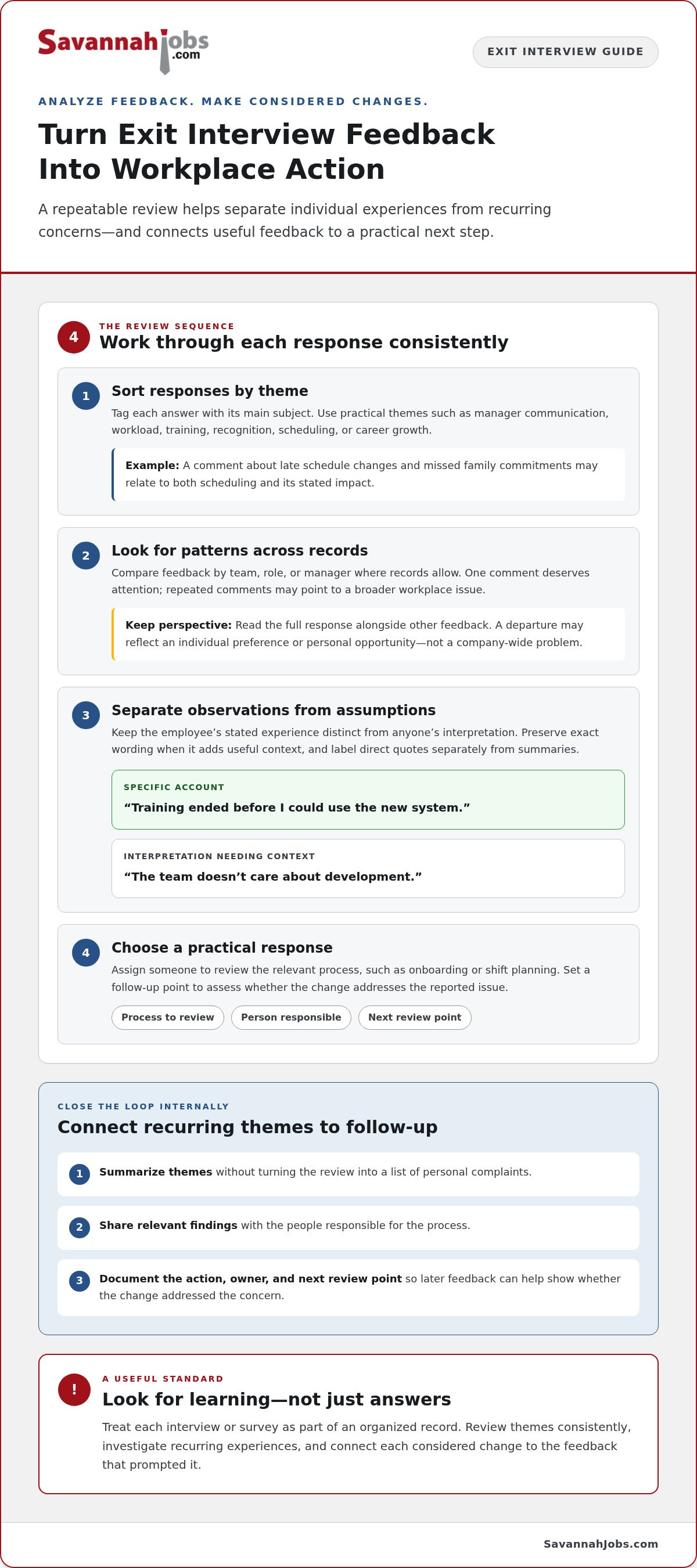
An exit interview only helps if someone reviews the answers and decides what to do next. Treat each completed interview or survey as part of an organized record. Over time, that archive helps your organization compare feedback and spot recurring workplace concerns. For example, repeated comments about unclear promotion paths may point to a process worth reviewing.
Start by recording responses in a consistent format. Group comments under practical themes such as manager communication, workload, training, recognition, scheduling, or career growth. Keep the employee’s exact wording when it adds useful context, but separate direct quotes from your summary. This distinction helps prevent an interviewer’s interpretation from being mistaken for the employee’s stated reason.
Use a repeatable review process so feedback leads to clear decisions:
- Sort responses by theme. Tag each answer with its main subject. If an employee mentions late schedule changes and missed family commitments, record both the scheduling issue and its stated impact.
- Look for patterns across records. Compare responses by team, role, or manager where your records allow. A concern raised once merits attention, but repeated comments may indicate a broader workplace issue.
- Separate observations from assumptions. “Training ended before I could use the new system” is a specific account. “The team doesn’t care about development” is an interpretation that needs more context.
- Choose a practical response. Assign a person to review the relevant process, such as onboarding or shift planning. Set a follow-up point to assess whether the change addresses the reported issue.
Don’t treat every departure as proof of a company-wide problem. An employee may leave for a personal opportunity, a different schedule, or another reason that doesn’t call for organizational change. Read the full response alongside other feedback, distinguishing individual preferences from recurring experiences. If several employees describe the same obstacle in different words, investigate the process behind it.
Close the loop internally. Summarize recurring themes without turning the review into a list of personal complaints. Share relevant findings with those responsible for the process, then document the action, owner, and next review point. For example, if several departing employees describe unclear role expectations, a manager can review job descriptions and onboarding materials. Later feedback can show whether employees still report confusion.
Apply exit interview best practices in Georgia by making analysis a regular management task, not an occasional reaction. Keep the archive organized, review themes consistently, and connect each action to the feedback that prompted it. A useful interview isn’t measured by the number of answers collected, but by whether the organization learns from them and makes a considered change.
2. Avoiding biased, personal, or gossip-focused discussions
A departing employee may describe a difficult manager or tense team relationship. Keep the interview focused on workplace experiences, not personal judgments. Ask what happened, how it affected the work, and what change might help. For example, replace “Was your supervisor unfair?” with “Can you describe a management practice that made your work harder?”
Prepare neutral wording before the conversation. Questions should invite detail without suggesting the answer you expect. Avoid asking, “Did the team’s poor communication cause you to leave?” Instead, try, “How did information flow within your team?” The second question lets the employee describe effective communication, problems, or both.
Use these steps to keep the discussion fair and professional:
- Ask for specific examples. If an employee says a colleague was “difficult,” ask which work interaction they mean and what happened.
- Separate observation from interpretation. Record “I received schedule changes after my shift began” as an experience, not proof that someone intended harm.
- Keep questions job-related. Focus on workload, communication, training, recognition, and workplace processes rather than private relationships or rumors.
- Invite balance. Ask what helped the employee succeed as well as what created obstacles, such as a useful training session or unclear handoff.
Don’t turn the interview into a complaint session about people who aren’t present. If an employee raises a concern about someone specific, listen without defending or condemning that person. Ask for relevant details, such as the work situation and its effect on the employee. Avoid speculating about motives or encouraging the employee to repeat unverified stories. The aim is to understand the work experience, not reach a verdict during the conversation.
Protect candor by explaining how you’ll handle responses before asking sensitive questions. Describe who will review the feedback and how the organization will use it. Avoid promising absolute anonymity if identifying details could reveal who spoke. In a small Georgia team, a unique role or incident may identify an employee even without their name. Share only the details needed to assess a workplace concern, and distinguish direct quotes from interviewer notes.
Finally, don’t use the meeting to argue with the employee or persuade them to stay. If they say a policy affected their decision, thank them and ask what practical change could improve the experience for others. For employers also preparing to recruit after a departure, local hiring options can support the next step without turning the interview into a pitch.
3. Exit interview question themes and employee experience measures
Exit interviews are generally voluntary workplace conversations, not a required step for every departing employee in Georgia. Invite each employee to participate, but don’t make the conversation a condition of leaving or receiving routine employment documents.
Georgia and federal employment laws on discrimination and retaliation can affect how employers respond to concerns raised during an interview. Recordkeeping rules may also apply to related personnel or wage records, so handle notes under your organization’s established retention and complaint procedures.
Risks include perceived retaliation, exposure of personal details, and lost trust if confidentiality is promised too broadly. Explain who may review answers, limit access, and don’t imply that comments will remain anonymous when details could identify the employee.
Useful questions focus on work experiences the organization can understand and improve. Prepare a consistent set for departing employees, then use neutral follow-ups to clarify their answers. For example, ask, “What influenced your decision to leave?” before exploring a particular concern. Don’t use the conversation to persuade the employee to stay.
Cover themes that reveal how work was experienced, rather than asking for general judgments about people. For example, a comment about a supervisor can lead to questions about communication, feedback, or expectations. Keep the discussion tied to specific workplace situations.
- Role clarity: Ask whether duties and expectations matched the employee’s understanding when they joined.
- Manager communication: Ask how feedback, priorities, and decisions were shared with the employee.
- Workload and support: Ask which tasks or processes made work easier or more difficult.
- Reasons for leaving: Ask what mattered most in the decision, including a better schedule, growth opportunity, or pay change. An employee might mention a 50 cent per hour raise elsewhere.
Employee experience measures become useful when you translate answers into consistent categories. Track themes such as workload, recognition, training, scheduling, and advancement. Preserve the difference between an employee’s direct statement and your interpretation. “I didn’t know how success was measured” is a specific comment; “management never communicates” is a broader judgment that needs context.
Use the same core questions across interviews, then compare responses for recurring patterns. A single concern may reflect an individual circumstance, while similar accounts across a team may point to a process worth reviewing. Keep identifying details private and share only what decision-makers need to assess the issue. This makes feedback more comparable without flattening each employee’s experience.
Close by asking what change would have improved the employee’s experience, then thank them without debating their account. These practical exit interview questions give Georgia employers clearer evidence to consider, while respectful handling helps protect trust during a sensitive transition.
4. Choosing a neutral interviewer
Employers can encourage candid answers by asking someone other than the departing employee’s manager to conduct the interview. Explain its purpose, identify who will review responses, and make clear that participation is voluntary. A departing employee may feel more comfortable discussing unclear priorities with a human resources representative than with the manager involved. That distance can help them focus on their experience rather than the manager’s reaction.
Choose an interviewer who can listen without defending a team or debating the employee’s account. A human resources professional, another trained manager, or a neutral administrator may fit, depending on the organization. The key is to be removed from the employee’s direct reporting relationship and any workplace issue being discussed. If the concern involves the usual interviewer, assign someone else. For a practical guide to exit interview best practices Georgia employers can use, start with that separation.
Before the meeting, give the interviewer a short preparation checklist:
- Review the role. Check the employee’s responsibilities and team context, so questions relate to their actual work.
- Use the same core questions. Consistent prompts make responses easier to compare across departing employees.
- Set a listening goal. Ask the interviewer to understand events and effects, not defend a decision or settle a dispute.
- Prepare neutral follow-ups. “Can you share an example?” invites detail without suggesting a preferred answer.
During the conversation, the interviewer should allow pauses instead of filling them with explanations. If an employee says, “I rarely knew which task came first,” ask when priorities were unclear and how that affected the work. This keeps the discussion focused on a concrete experience and avoids leading questions such as, “Your manager should have given clearer direction, right?”
Set expectations before asking sensitive questions. Explain how notes will be stored, who may see them, and how themes may inform workplace decisions. Don’t promise complete anonymity in a one-on-one conversation, since an example may identify the people involved. If the employee raises a serious concern, record their words accurately and follow the organization’s established process for handling workplace complaints.
Neutrality also depends on the interviewer’s conduct after the meeting. They shouldn’t share comments casually with colleagues or present an interpretation as verified fact. Instead, separate direct observations from conclusions, then pass relevant information to those responsible for review. These exit interview best practices Georgia teams can adapt keep feedback professional and focused on workplace experience.
A neutral interviewer can thank the employee, ask a clear follow-up, and close without trying to change their decision. This respectful approach gives the organization more useful feedback and keeps the conversation constructive.
5. When should an exit interview be scheduled and how long should it last?
Schedule the conversation near the employee’s last day, while there’s still time to discuss their work experience. Many HR leaders prefer the final day, but an earlier meeting may work better when the employee has deadlines, handoffs, or travel to manage. For example, meeting before the final shift may allow more focus than a rushed conversation during departure.
When possible, choose a day before the employee leaves. Departing employees may feel distracted or disengaged on their last day, especially if they’re returning equipment or completing handoffs. An earlier appointment gives both people room to talk without competing departure tasks.
Make the timing easy to understand. Include the purpose in the invitation, identify the interviewer, and say participation is voluntary. Offer a private setting or a suitable remote option. If the employee declines the scheduled time, invite them to suggest another convenient opportunity before they leave.
Allow enough time for meaningful answers without turning the meeting into an open-ended discussion. The time needed depends on the number of topics, the employee’s role, and whether a concern needs careful follow-up. A brief, consistent question set may take less time than a conversation about complex handoffs or several workplace experiences. Avoid cutting off a relevant example just to meet an arbitrary calendar limit.
Build a simple structure to keep the conversation focused:
- Open with the purpose. Explain that the goal is to understand the employee’s experience, not change their decision.
- Cover core questions. Ask about role expectations, support, communication, and the factors behind leaving.
- Allow relevant follow-ups. If the employee describes a recurring scheduling issue, ask for context and its effect on their work.
- Close with next steps. Explain how feedback will be handled and thank them for participating.
Protect the appointment from routine interruptions. A manager who accepts a meeting request during the conversation can signal that the employee’s feedback is secondary. Choose a quiet room, silence notifications, and avoid scheduling the interview between urgent handoffs. For a remote meeting, confirm that both participants can speak privately.
Keep the invitation neutral and low-pressure. For example: “We’d value your perspective before your final day. The conversation is voluntary, and you may decline or skip any question.” This makes expectations clear without implying that participation affects the employee’s departure. Thoughtful scheduling and a focused discussion help Georgia employers collect feedback while respecting the employee’s time and transition.
SavannahJobs.com: 30-Day Job Posting
SavannahJobs.com helps employers advertise open roles to the local Savannah workforce through a 30-Day Job Posting. After reviewing exit feedback and identifying a vacancy, use a posting to put the opportunity in front of local job seekers. A Featured Job Upgrade or Featured Employer Upgrade can add visibility options to your recruitment advertising.
Make the job description clear about the role, responsibilities, and expectations. This helps applicants understand the opportunity and gives your team a stronger starting point for discussing fit. A job posting supports recruitment advertising; it doesn’t replace careful exit interview practices that help you learn from employee feedback.
For your next Savannah-area opening, visit SavannahJobs.com to explore job posting options.
Make employee feedback part of your next step
Each departure offers a chance to improve how your workplace supports people. Give feedback a clear path from conversation to thoughtful review, and let the lessons guide decisions about communication, expectations, and future hiring. Applying exit interview best practices in Georgia means treating the employee’s perspective as useful input, then building a workplace where new hires can understand the role and contribute.
When a role opens, SavannahJobs.com offers a 30-Day Job Posting, Featured Job Upgrade, and Featured Employer Upgrade to help employers advertise opportunities to local job seekers. Choose the option that fits your hiring needs, and make the next opportunity clear to candidates from the start.
Contact SavannahJobs.com today to explore your recruitment advertising options. Take the next step with care, and keep building a stronger workplace for Georgia’s workforce.
Frequently Asked Questions
What is an exit interview?
An exit interview is a conversation with an employee who is leaving, held shortly before their departure. It gives the organization a chance to understand the employee’s experience and reasons for moving on. For example, an employee might explain that unclear responsibilities made a role difficult. The discussion can help employers identify workplace issues, but it shouldn’t be treated as a negotiation to reverse the employee’s decision.
What is an exit survey?
An exit survey collects feedback through written questions, often using a form employees can complete independently. Unlike a live interview, it gives respondents time to consider their answers and creates a consistent record for later review. For example, a departing employee could rate how clearly their goals were explained, then add a written comment. Surveys can complement conversations, but keep participation voluntary and explain how responses will be handled.
What are best practices for conducting an exit interview?
Invite departing employees to participate, prepare consistent questions, and keep the discussion focused on their work experience. Choose an interviewer who isn’t their direct manager, and schedule the meeting near departure while the employee can still reflect on the role. Explain who may review the feedback, and don’t promise anonymity if details could identify the speaker. Close by thanking them, not arguing against their decision.
What questions should employers ask during an exit interview?
Ask open questions about the employee’s role, support, communication, and decision to leave. Useful prompts include, “Which part of your work helped you succeed?” and “What would have made your responsibilities clearer?” Follow up by asking for a specific example. Avoid questions that assume blame or invite gossip. Give every departing employee the same core prompts, then use follow-ups to understand their particular experience.
Should exit interviews be conducted by HR, a manager, or a third party?
Someone other than the departing employee’s manager should lead the interview. An HR representative, a trained manager from another team, or a neutral third party may be suitable if they can listen impartially and protect sensitive details. For example, if the employee’s concern involves HR, assign a different interviewer. Choose someone who can document responses accurately and explain how the organization will use them.
How should employers document and analyze exit interview feedback?
Record answers in a consistent format, separating the employee’s own words from the interviewer’s interpretation. Limit access to people who need the information, and store records according to the organization’s established practices. Then group comments by topic, such as training or workload, and compare them across interviews. If several employees independently mention confusing handoffs, review that process before assuming every team has the same issue.
How should employers use exit interview findings to reduce turnover and improve retention?
Turn recurring feedback into a focused workplace review, then assign responsibility for a practical response. If departing employees describe unclear first-week expectations, for instance, review onboarding materials and ask new hires whether the guidance is useful. Compare later feedback to see whether the concern continues. Don’t treat one departure as proof of a broad problem; weigh the employee’s circumstances alongside patterns across roles and teams.


