

Nearly 80% of employees worldwide are either not engaged or actively disengaged at work. Employee engagement means people feel connected to their work, their team, and the purpose behind what they do. For small teams, practical employee engagement ideas for small teams in Savannah can include sincere recognition, easy ways to connect, community volunteering, and regular feedback.
You don’t need a large staff or elaborate event to build a stronger team culture. Consistent, thoughtful actions can help people feel heard and appreciated, while creating space for the honest conversations that keep a team connected.
This guide explains employee engagement and shares practical ideas you can adapt to your Savannah workplace. Find ways to recognize everyday contributions, make time for team connection, volunteer together, and gather feedback your team can see you act on.
Key Takeaways
- Choose engagement activities around your team’s interests, work patterns, and available time so participation feels natural.
- Make recognition specific and timely, and include peer appreciation so everyday contributions don’t go unnoticed.
- Use simple huddles, shared breaks, or informal activities to help coworkers connect without turning every gathering into another work task.
- Plan a volunteering activity around a community cause your team cares about, with clear expectations for participation.
- Ask focused questions about workload, goals, and concerns, then share what you’ll do with the feedback.
1. What is Employee Engagement?
Employee engagement describes how connected people feel to their work, coworkers, and workplace purpose. In a small Savannah team, it shows in daily actions: sharing ideas, helping solve problems, and understanding how a task supports a common goal. Engagement is more than job satisfaction or attending a social event. It reflects whether employees feel involved and able to contribute their strengths. If you’re considering employee engagement ideas for small teams in Savannah, start by noticing how people work together.
Nearly 80% of employees worldwide are either not engaged or actively disengaged at work. That figure makes regular attention to team experience worthwhile, but a large event isn’t the only answer. Notice where communication stalls, what employees enjoy, and which activities fit the workday. A brief conversation can reveal whether people prefer shared problem-solving, informal conversation, or time focused on a community cause. These details help you choose activities that suit the team rather than follow a generic plan.
Choose activities to fit both team size and culture. A close-knit group might enjoy a shared lunch, while a team with different schedules may prefer a virtual coffee break. Team lunches and virtual coffee breaks can take 10 to 60 minutes, so choose a length that respects workload and allows people to participate. For remote employees, offer a video option or a separate activity they can join without traveling. Employers exploring employee engagement ideas for small teams in Savannah can use this mix to accommodate different work arrangements.
For a Savannah outing, consider Forsyth Park or Daffin Park for outdoor time, and The Collins Quarter or The Grey for a meal. Match the setting to the group’s preferred activity, menu needs, and ability to participate comfortably.
Inclusive planning starts with asking about access needs, dietary preferences, work schedules, and whether employees prefer an in-person or remote option. Share plans early, make participation welcoming rather than compulsory, and offer a way to contribute for those who can’t attend.
Purpose-led activities can connect team culture with Savannah’s community. The City of Savannah’s Employee Engagement Team partnered with Government Operations on a city-wide cleanup day and promoted the first annual Team Savannah Kickball game, with participants from all service centers. A small business can apply the same principle by choosing an activity linked to its values and inviting employees to shape the details. When people help choose the format and purpose, an outing can strengthen alignment instead of feeling like another calendar obligation.
2. Employee recognition
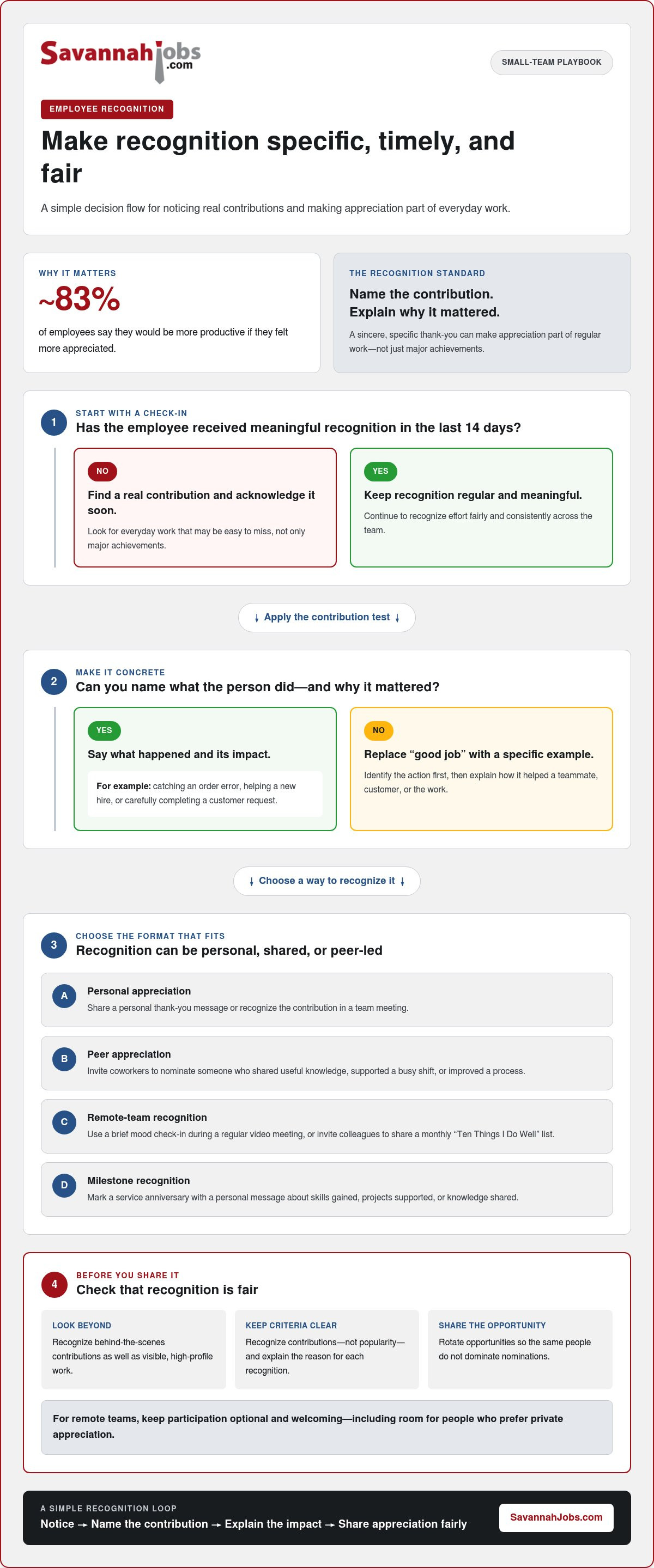
Recognition works best when it names a real contribution and explains why it mattered. Instead of saying “good job,” thank a teammate for catching an order error, helping a new hire, or carefully completing a customer request. Small Savannah teams can recognize contributions in a meeting, with a personal thank-you message, or through a milestone celebration. These practical gestures make appreciation part of regular work, not something reserved for major achievements.
Make recognition meaningful by asking employees whether they received meaningful recognition in the last 14 days. If the answer is no, find a specific contribution to acknowledge soon. Around 83% of employees say they would be more productive if they felt more appreciated. Appreciation can also support retention when it reflects effort fairly and consistently. Avoid praising only visible, high-profile work; recognize behind-the-scenes contributions, too.
A simple employee recognition program can combine manager appreciation with peer participation. Invite coworkers to nominate someone who shared useful knowledge, supported a busy shift, or improved a process. Explain the reason for each recognition, whether it’s shared in a team meeting, written in a note, or marked with a small celebration. Rotate opportunities so the same people don’t dominate nominations. Keep the criteria clear, and recognize contributions rather than popularity.
Remote teams need deliberate ways to notice progress that might otherwise go unseen. Add a brief mood check-in to a regular video meeting, asking what’s going well and where support would help. A monthly “Ten Things I Do Well” list can give remote colleagues a structured way to share strengths and recognize one another’s contributions. Keep participation optional and welcoming, with room for employees who prefer private appreciation.
Public recognition can also reflect Savannah’s civic example. The City of Savannah presented its Employee Engagement Team and recognized its 2024 Employee of the Year at a City Council meeting on April 10, 2025. A small employer can adapt the principle without copying the ceremony: acknowledge a meaningful contribution during a team gathering, explain its impact, and invite colleagues to add brief appreciation. That context helps recognition strengthen shared standards.
Service milestones are another opportunity to recognize people beyond their immediate results. The City of Savannah’s Employee Engagement Team works on Employee of the Quarter and Employee of the Year programs, and is revamping its Years of Service program into a broader recognition initiative. A small team can mark anniversaries with a personal message naming skills gained, projects supported, or knowledge shared. Pair the milestone with a conversation about the employee’s next goals, connecting past contributions with future growth.
3. In-office icebreakers and connection activities
A useful activity gives team members a simple way to interact beyond their usual tasks. Start a weekly team huddle with a 15-minute round: each person shares one priority, one win, or one request for help. For a lighter reset, ask coworkers to share a recent photo and explain its story. A clear prompt keeps the activity welcoming for new workers and people who prefer listening before speaking.
Low-cost activities can fit into ordinary workdays without special equipment. Run a photo competition that takes 5 to 10 minutes, with a theme such as “a small detail that makes your workday better.” Or try a quick in-room energizer that takes under five minutes, such as asking each person to name one useful skill they learned from a coworker. Keep competition friendly, and let employees opt for a noncompetitive role.
Build a scheduling strategy around a regular rhythm rather than a calendar full of events. A weekly huddle can support routine connection, while monthly activities give workers a change of pace. One recommendation is to organize engagement activities 2-4 times a year as a baseline; quarterly events can balance consistency with minimal disruption. Add a 10-minute energizer when the team needs a short reset, not as a substitute for useful breaks.
Remote workers can join a virtual team-building activity lasting 30 to 60 minutes. Use a shared trivia round, a collaborative problem-solving prompt, or a show-and-tell about a favorite local spot. Virtual coffee roulette can pair colleagues for a 15-minute conversation, arranged weekly or monthly. Keep video optional when possible, and offer a written way to participate so different communication styles have room.
Wellness activities should support employees without turning personal wellbeing into a performance. A guided Ready Set Relax desk stretch can use five rounds of each movement, with employees choosing whether to join. Small businesses can also support work-life balance through flexible schedules, paid time off, and mental health resources. A quiet room or protected break may be more useful than a high-energy group event during a demanding work period.
Choose activities that fit the team’s schedule, interests, and working arrangements. Ask members which formats feel useful, try one activity, and invite specific feedback afterward. If the team enjoys friendly competition, for example, rotate trivia topics chosen by different employees. If participation drops, adjust the timing or format instead of adding more events. This simple cycle helps Savannah teams keep activities relevant to their actual work culture.
4. Community volunteering
A volunteering day can connect workplace relationships with a shared community purpose. For a Savannah team, choose a practical project such as a neighborhood cleanup, sorting donations, or preparing supplies for a community program. Ask employees which causes matter to them, then select a project that suits their interests and work schedules. A meaningful choice gives people a clear way to contribute together.
Plan the activity with the same care as a work project. Name a coordinator, define the task, and explain what employees should bring or expect. For example, a cleanup team can divide tasks by area, while another group handles supplies and check-in. Share the plan in a team meeting and provide the details in writing. Clear communication helps everyone understand the purpose and their role.
Employee input should shape the program before leadership sets a date. Invite suggestions in a team discussion or through a short anonymous form, then share which idea the group selected and why. The City of Savannah’s Employee Engagement Team gathers input through city-wide surveys, feedback sessions, and employee conversations. Small employers can use the same approach: listen, communicate the decision, and explain how employee feedback influenced it.
Leadership communication matters during and after the event. Before volunteering, explain how the project connects with the organization’s values, not just its public image. During the activity, let employees lead parts of the work and solve small problems together. Afterward, ask what worked, what felt difficult, and whether the group would choose the same program again. These steps turn one event into practical insight for future planning.
For an ongoing community program, create an annual plan that leaves room for employee ideas. A Savannah business might alternate donation sorting, park care, and skills-based help for a local organization. Make participation welcoming for employees with different schedules, mobility needs, or comfort levels. Offer a workplace contribution option for those who can’t attend in person, such as organizing supplies or coordinating communication.
Measure the activity through useful observations, not publicity alone. Note whether the project met its agreed purpose, whether roles were clear, and what employees recommend changing. Share a brief recap with the team, including the community outcome and next steps. If workers suggest a different cause, bring that option into the next planning discussion. A visible response helps leadership demonstrate that volunteering is a shared commitment, not a one-off exercise.
Community programs work best when they respect the organization receiving help. Confirm the task, timing, and materials with the program coordinator, and avoid making promises on the organization’s behalf. In Savannah, a cleanup effort might need specific tools, while a donation project may need particular items. Aligning the team’s effort with actual community needs makes the activity more useful and gives employees a clearer sense of accomplishment.
5. Employee feedback and pulse surveys
Employee feedback gives managers a clearer view of workload, communication, and team concerns. A pulse survey can focus on one theme at a time and ask 3 to 5 questions. For example, ask whether priorities feel clear, which task is causing friction, and what support would help. Keep questions direct, then use the answers to guide a practical follow-up.
Managers can gather feedback through surveys, one-on-one meetings, suggestion programs, and team discussions. To recognize team members, name a specific contribution and explain its value, such as helping a coworker meet a deadline. Connect recognition with feedback by asking what support would make that work easier next time. This approach makes appreciation specific and gives employees space to raise concerns.
Stay interviews offer a focused way to understand what helps employees remain engaged. Ask what they enjoy in their role, what makes work harder, and what might improve their experience. Regular manager-employee one-on-ones create space to discuss goals, workload, and concerns. Note agreed actions, then revisit them at the next conversation. That follow-through turns one discussion into an ongoing feedback loop.
Use multiple channels so employees can choose a comfortable way to contribute. A confidential survey can surface themes, while a suggestion box makes it easy to share ideas between meetings. Team sessions help clarify issues that need shared discussion. The City of Savannah’s Employee Engagement Team uses city-wide surveys, feedback sessions, and employee conversations to gather input. A small Savannah workplace can adapt that mix to its teams and departments.
Set a steady measurement rhythm. Small businesses may assess engagement annually or semi-annually, while using pulse surveys and conversations for ongoing insight. A pulse survey can ask employees to rate workload manageability on a 1-10 scale. Share aggregated, anonymous survey results within two weeks, and explain the actions leadership will take. If a request can’t be acted on, explain the practical reason and offer another way forward.
Only 27% of employees felt their organization handled workplace changes well. Use that finding as a prompt to ask how a change affected daily work, not as a score to impose on your team. For example, after changing a schedule or process, ask what became clearer and what remains difficult. Then report back with the next step and who owns it.
Close each feedback cycle visibly: summarize the main themes, choose a manageable action, and name someone responsible. At the next meeting, report progress and ask whether the change helped. This repeatable process helps Savannah managers connect surveys, feedback sessions, and everyday recognition with decisions employees can see.
SavannahJobs.com: 30-Day Job Posting
SavannahJobs.com helps employers advertise open positions to the local Savannah workforce through a 30-Day Job Posting. If your team’s engagement efforts show a need for additional talent, a local job posting gives you a way to share the opportunity with job seekers in the region. Employers can also choose a Featured Job Upgrade to increase a job listing’s visibility, or a Featured Employer Upgrade to add visibility for their organization.
These recruitment advertising options suit employers ready to promote an open role, rather than teams seeking help with day-to-day engagement activities. Pair a clear job description with the workplace culture and expectations candidates should understand. Visit SavannahJobs.com to explore job posting options.
Build a stronger team, one step at a time
Make engagement part of how your Savannah workplace operates, not an occasional calendar event. Choose one small change your team can try, then make time to hear how it affects the way people work together. A steady habit of listening and acting helps your next step reflect what employees actually need.
When your plans also include hiring, SavannahJobs.com offers a 30-Day Job Posting to advertise an open position to the local workforce. Employers can also choose a Featured Job Upgrade or a Featured Employer Upgrade. These recruitment advertising options address a different need from employee engagement: reaching local job seekers when you have an opening to promote.
Use employee engagement ideas for small teams in Savannah to build a workplace where people can contribute and grow. For help advertising an open role, contact SavannahJobs.com today. Keep listening, keep making practical improvements, and let your team’s next success grow from there.
Frequently Asked Questions
What is Employee Engagement?
Employee engagement is how strongly employees connect with their work and feel able to contribute. It can show in initiative, collaboration, and care for work quality, not just attendance or enthusiasm at events. For example, an engaged employee might flag a recurring customer problem and suggest a fix. Managers can look for patterns in participation, ownership, and communication to understand how connected their team feels.
What employee engagement activities work best for small teams?
The best activities are relevant to employees and easy to join without disrupting essential work. A team sharing customer-facing duties might try a short case discussion, while coworkers in different roles could exchange practical tips. Ask employees to choose between a few formats, then test one and gather feedback afterward. This helps a small team avoid events that feel imposed or poorly timed.
What are low-cost employee engagement ideas for small businesses?
Use existing work routines for activities that need little or no extra setup. Invite a teammate to demonstrate a useful task, rotate who leads a short problem-solving discussion, or share customer compliments during a regular meeting. A handwritten thank-you can recognize a specific contribution without requiring a formal program. Make the activity purposeful and inclusive, rather than another obligation on employees’ schedules.
How can small teams measure employee engagement and morale?
Combine employee input with observable workplace patterns instead of relying on one score. Track survey responses, retention and turnover, participation in team initiatives, and relevant performance trends. A short pulse survey can ask 3 to 5 questions about one topic, such as communication or workload. Compare results over time, and consider team context before interpreting a change in participation or performance.
What team-building activities are available in Savannah, Georgia?
Savannah teams can plan shared activities around volunteering, friendly sports, or self-led challenges. The City of Savannah’s Employee Engagement Team partnered with Government Operations on a city-wide cleanup day and promoted the first annual Team Savannah Kickball game. A small workplace can take inspiration by choosing a cause or activity employees value, assigning practical roles, and making the purpose clear before everyone gathers.
What free or low-cost outdoor team activities can teams do in Savannah?
Consider a self-led walk, an outdoor photo prompt, or a cleanup project shaped around a community need. For a photo activity, give everyone the same theme, such as “a detail that represents Savannah,” then share images at a later team meeting. Before choosing an outdoor setting, consider accessibility, weather, shade, transportation, and whether employees can participate comfortably.
How often should small teams hold engagement activities or check-ins?
Set a cadence the team can sustain: a weekly 15-minute huddle can support regular communication, while quarterly activities offer a less frequent shared event. Small businesses may assess engagement annually or semi-annually, using conversations and pulse surveys for ongoing feedback. Adjust the rhythm when workloads or employee input point to a need for more frequent discussion or a simpler schedule.


