

A resume gap is a reason to look closer, not to reject someone automatically. A gap greater than 4 months may warrant closer consideration, but time out of work can be through no fault of the candidate. Knowing how to spot red flags on a resume means weighing that context alongside work history and evidence of results.
It’s understandable to notice short tenures or a resume that focuses heavily on hobbies and community involvement. But a potential warning sign isn’t proof that someone can’t do the job. Look at the full picture: what may explain an employment gap, whether the candidate’s experience fits the role, and whether their achievements show what they contributed. This guide explains how to distinguish specific evidence from vague claims and assess outside interests fairly, so you can decide what merits a follow-up conversation and what shouldn’t count against a candidate on its own.
Key Takeaways
- Treat employment gaps and short tenures as prompts for context, not automatic reasons to reject a candidate.
- Assess hobbies and community involvement by their relevance and balance with work experience.
- Look for specific contributions and outcomes, not just a list of duties or vague claims.
- Use focused follow-up questions to clarify dates, job titles, credentials, and resume details that need explanation.
1. Employment gaps and reasons for unemployment
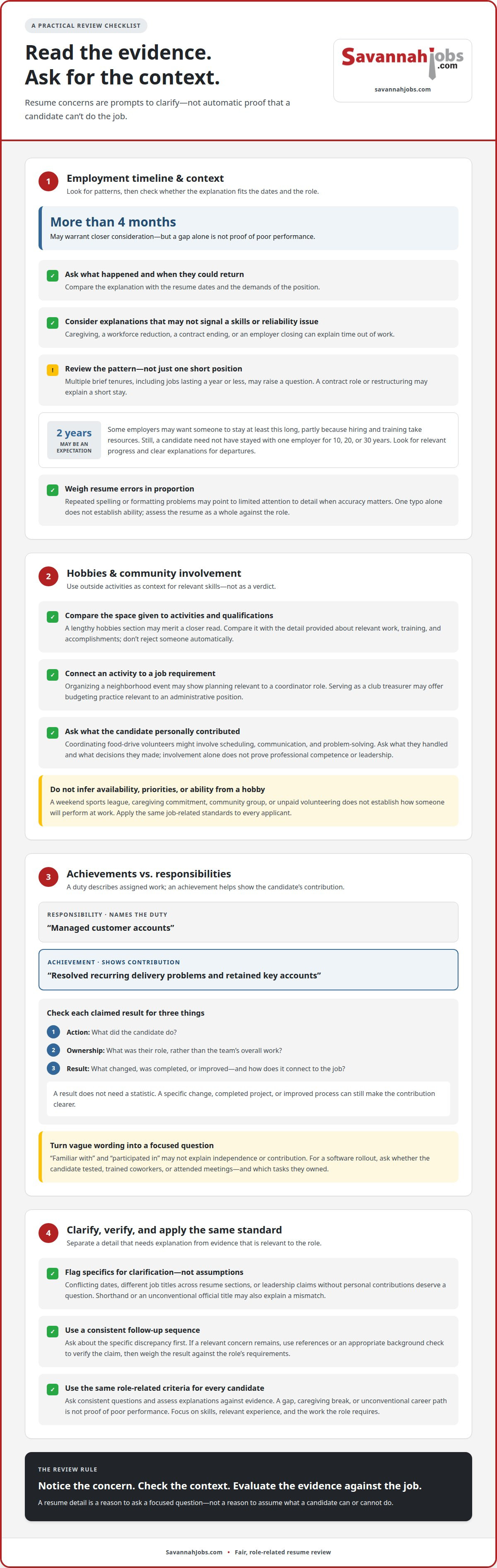
An employment gap greater than 4 months may warrant closer consideration, but it isn’t proof of poor performance. A candidate may have been out of work through no fault of their own. Ask what happened, when they were available to return, and whether the explanation fits the timeline. Caregiving, a workforce reduction, a contract ending, or an employer closing can explain a gap without indicating a skills or reliability issue. Compare the explanation with the resume dates and the demands of the role.
Look at the pattern of job changes, not just one short position. Multiple brief tenures may raise a question, and jobs lasting a year or less can be a potential red flag. But context matters: a contract role or company restructuring may explain a short stay. Employers may want someone to remain for at least two years, partly because hiring and training take resources. Still, workers may not stay with one employer for 10, 20, or 30 years. Ask whether the candidate’s experience shows relevant progress and whether each departure has a clear explanation.
Are frequent spelling and formatting errors a red flag on a resume? Repeated errors or disorganized formatting may point to limited attention to detail, especially when accuracy matters in the role. One typo alone doesn’t establish a candidate’s ability. Assess the resume as a whole and compare it with the job requirements.
How can employers evaluate resume red flags fairly and without bias? Apply the same role-related criteria to every candidate, ask consistent questions, and assess explanations against the evidence. Don’t treat a gap, caregiving break, or unconventional career path as proof of poor performance. Focus on skills, relevant experience, and the work the role requires.
When should you follow up on a resume concern through references or a background check? First, ask the candidate about a specific discrepancy, such as conflicting dates or an unclear job title. If a relevant concern remains, use references or an appropriate background check to verify the claim. Weigh the result against the role’s requirements rather than making assumptions.
2. Including hobbies and community involvement
A hobbies section can add context, but it shouldn’t outweigh evidence of role-related skills. Extensive space devoted to activities may mean the applicant is filling space or sees the job as a side activity. Treat this as a reason to read more closely, not to reject the candidate automatically. Compare the space given to activities with the detail about relevant work, training, and accomplishments.
Look for a clear connection between an activity and a job requirement. Organizing a neighborhood event, for example, may show planning experience relevant to a coordinator role. Serving as a club treasurer could demonstrate budgeting practice for an administrative position. These details offer useful interview topics, but don’t prove professional competence on their own. Ask what the candidate handled, what decisions they made, and how the experience relates to the position.
Community involvement can reveal transferable skills that job titles don’t show. A candidate who coordinated volunteers for a food drive, for instance, might describe scheduling, communication, and problem-solving. Focus on specific duties, not the organization’s name or perceived prestige. A brief mention of volunteering isn’t a concern simply because it was unpaid. Consider whether the resume gives you enough relevant evidence to assess the applicant fairly.
Use these checks to keep your review consistent:
- Compare the space given to hobbies with the space given to relevant qualifications.
- Identify any activity that demonstrates a skill required for the role.
- Ask what the candidate contributed, rather than assuming involvement means leadership.
- Apply the same job-related standards to each applicant’s outside activities.
Don’t infer someone’s availability, priorities, or ability from a hobby alone. A weekend sports league, caregiving commitment, or community group doesn’t establish how a person will perform at work. If an activity raises a role-related question, ask the same focused follow-up you’d ask about any resume detail. For Savannah employers, a clear description of the role can help candidates show relevant experience; share your opening locally.
3. Evidence of achievements versus listed responsibilities
A responsibility describes assigned work; an achievement shows what the candidate contributed. “Managed customer accounts” names a duty, while “resolved recurring delivery problems and retained key accounts” gives clearer evidence. Look for the action, the candidate’s role, and the result. The result doesn’t need a statistic. A specific change, completed project, or improved process can still help you understand the person’s contribution.
Vague phrases such as “familiar with” and “participated in” leave important questions unanswered. They don’t explain what the applicant did, how independently they worked, or what followed. “Participated in a software rollout,” for example, could mean testing, training coworkers, or simply attending meetings. Ask which tasks the candidate owned and what decisions they made, then compare the answer with the experience and skills the position requires.
What resume inconsistencies may suggest exaggeration or dishonesty? Conflicting job dates, titles that differ between sections, or claims of leading work without explaining personal contributions all deserve clarification. These details can also result from shorthand or an unconventional official title, so treat them as questions, not proof of intent.
Use a focused review to separate specific evidence from broad claims:
- Underline each claimed achievement, such as streamlining a handoff or completing a project.
- Identify the candidate’s action, rather than crediting them with a whole team’s work.
- Check whether the example connects to a requirement in the job description.
- Prepare a follow-up question where the result, ownership, or wording remains unclear.
In the interview, ask, “What part did you handle?” or “How did the process change?” A candidate who can explain a clear contribution should be able to describe the steps, collaborators, and outcome. If the answer remains general, invite a specific example rather than assuming the resume claim is false. Compare similar claims across roles, too: repeated phrases without distinct projects may need closer discussion. This approach helps you assess evidence consistently, even when applicants use different writing styles or describe comparable work in different terms.
4. How do you verify resume dates, job titles, and credentials?
Start with the exact detail that needs clarification. If a resume lists a project manager title but describes analyst duties, ask how the employer named the role and what work the candidate performed. If the resume gives only years, ask for the month and year of employment. A brief email or phone conversation can resolve uncertainty before it turns into an assumption.
Use the same sequence for each applicant: identify the discrepancy, ask a neutral question, and compare the answer with relevant records or references. For example, say, “Your resume lists this role through June, but your application says May. Which date is correct?” Keep the question specific and give the candidate room to explain. A contract ending, an internal title change, or a typo may account for the difference.
Evaluate credentials with the same focused approach. Identify the qualification required for the role, then ask the candidate to clarify its full name, issuer, or completion status. Distinguish a completed qualification from coursework in progress. If an important claim remains unclear, use an appropriate verification step and apply the same process to candidates for comparable roles.
The time required for a check depends on its type. A simple identity check can take as little as a few hours, while a worldwide criminal background check might take several weeks. A simple pre-employment check package takes around a week. These ranges can help with planning, but the scope of the check affects how quickly information comes back.
Keep notes on the original claim, the question you asked, and the response. That record helps distinguish an explained mismatch from an unresolved one. Check references when a relevant work-history detail still needs context, such as a disputed title or unclear dates. Reserve background checks for information relevant to the position, and don’t treat a discrepancy alone as proof of dishonesty.
For Savannah employers preparing to hire, explore local hiring resources as you plan your next recruitment step.
SavannahJobs.com: 30-Day Job Posting
SavannahJobs.com gives employers a practical next step when they’re ready to bring a role to the local workforce. A 30-Day Job Posting lets you advertise an open position in the Savannah region, so candidates can review the responsibilities and qualifications before applying.
Write a clear listing that describes the work, required skills, and what success looks like. That detail helps applicants judge whether their experience fits, giving you more useful information to assess during resume reviews and interviews. For additional visibility, employers can choose a Featured Job Upgrade or Featured Employer Upgrade.
Use the platform when you have a role to fill and want to reach job seekers in Savannah. Visit SavannahJobs.com to explore posting options or get started.
Make your next hiring decision with confidence
Make resume reviews a repeatable part of your hiring process. Before the next application arrives, decide which qualifications matter most, what evidence will demonstrate them, and which questions you’ll ask when details need clarification. A shared approach helps your team compare candidates using job-related criteria rather than first impressions.
Keep brief notes on the evidence behind each decision. This makes it easier to explain why an applicant moves forward and keep interviews focused on the work. As your team refines how to spot red flags on a resume, treat each concern as a prompt for a fair, specific follow-up, not a substitute for assessing the candidate’s overall fit.
Ready to reach job seekers in the Savannah area with your next opening? Contact SavannahJobs.com today to explore a local recruitment advertising option. A thoughtful process and a clear job listing can help your team take the next step toward a strong hire.
Frequently Asked Questions
What are common red flags on a resume?
To understand how to spot red flags on a resume, look for conflicting dates, unclear job titles, repeated typos, and claims that don’t explain the applicant’s contribution. Inconsistent formatting or missing context can also make a resume difficult to follow. Treat each issue as a prompt to assess role-related evidence. For example, compare the listed skills with the candidate’s work examples before deciding whether a follow-up is needed.
How can you spot employment gaps or unexplained job hopping on a resume?
Compare the dates and sequence of roles, then note gaps or repeated short stays for discussion. Look for context in the resume, such as contract work or a restructuring, and ask the same question if the timeline remains unclear. For example, ask what prompted a departure and what the candidate sought in their next role. Evaluate the answer against the position’s needs, not assumptions about career patterns.
How can you assess whether resume achievements and metrics are credible?
When deciding how to spot red flags on a resume, check whether each achievement identifies the candidate’s actions, the work involved, and a result they can explain. A claim such as “improved response time” needs context: what process changed, and how did the applicant contribute? Ask how the result was measured and whether others were involved. A clear explanation connects the claim to a specific project or responsibility, rather than relying on impressive wording alone.
What are legitimate reasons for employment gaps or short job tenures?
A contract may end, a workforce may be reduced, a company may restructure or close, or someone may take time away from work for personal responsibilities. A candidate may also have changed roles to find a better fit or respond to changing circumstances. Ask for relevant context without pressing for private details unrelated to the job. Focus on what the applicant learned and how their experience fits the position.
What resume red flags should job seekers fix before applying?
Before applying, job seekers should correct spelling and formatting errors, make sure dates and titles align across resume sections, and replace broad claims with clear examples. Tailor the resume to the target role so relevant skills appear alongside the experience that supports them. If an official job title differs from the work performed, explain the distinction accurately. Keep hobbies and community activities concise unless they demonstrate relevant experience.


