

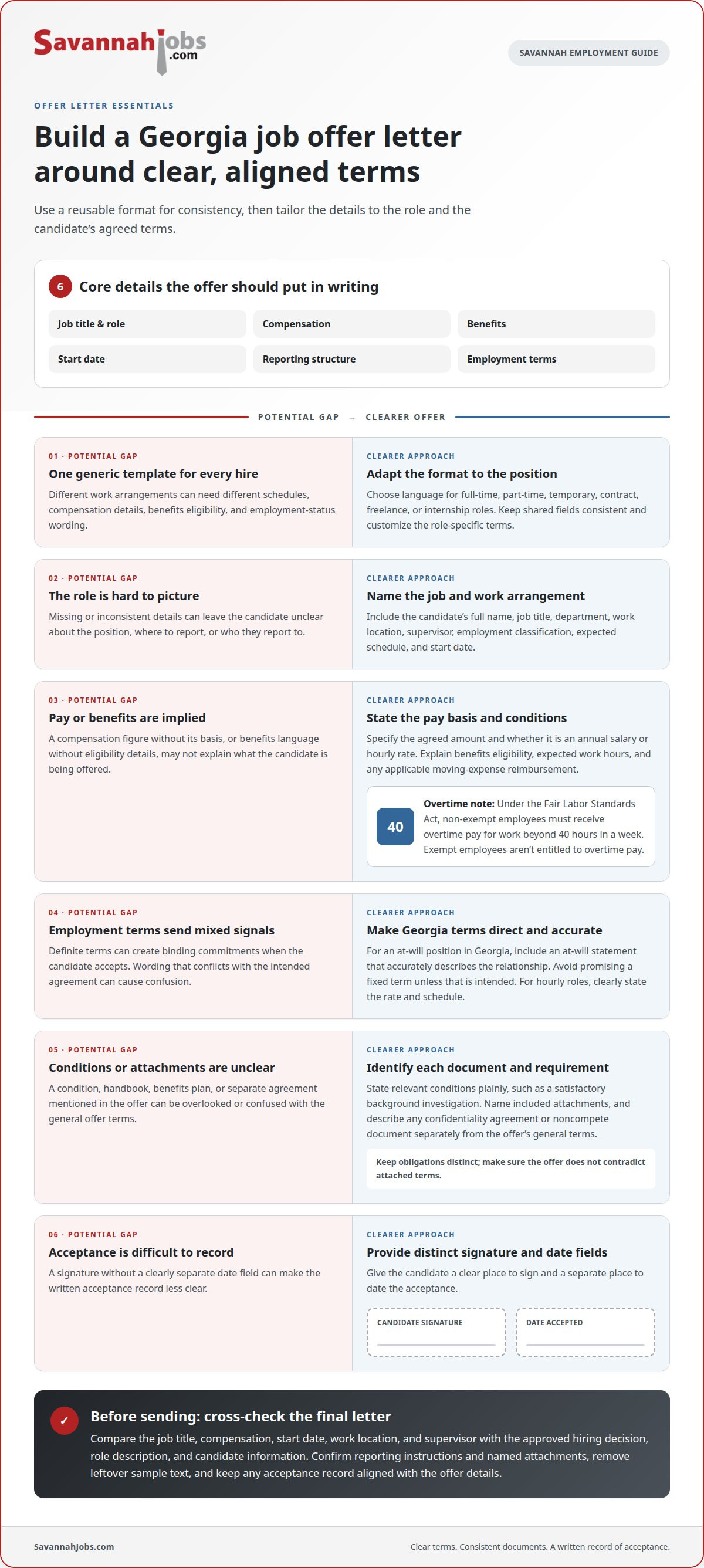
A clear offer letter puts the essentials in writing: job title, compensation, benefits, start date, reporting structure, and employment terms. When creating a job offer letter Georgia template, build it around these details, then add candidate signature and date fields so the candidate can respond in writing. Keep the language consistent with the role and the terms you’re offering.
It’s easy to focus on the offer itself and overlook details that can prevent confusion later. A reusable template provides a practical starting point for each hire while leaving room to tailor terms to the position. Here, you’ll learn what to include, how to organize key employment details, and how to add clear signature and date fields. You’ll also see when a template can save time and how Savannah employers can advertise open roles to local candidates through SavannahJobs.com.
Key Takeaways
- Set out the role, compensation, benefits, start date, reporting structure, and employment terms so candidates can understand the offer.
- Adapt the template to the position’s employment type and include any relevant conditions, policies, or supporting documents.
- Give candidates clear, separate fields for their signature and the date they accept the offer.
- Once your offer is ready, use SavannahJobs.com’s 30-Day Job Posting to advertise an open role to the local Savannah workforce.
What should a job offer letter include?
Build the letter around the position, pay, start date, reporting relationship, and employment terms. Then customize each field to match the opportunity and the candidate’s work arrangement.
-
Customize the template and text fields
Choose a format for each employment type, such as full-time, part-time, temporary, contract, freelance, or internship. Keep shared fields, such as job title and supervisor, consistent, then customize work schedule, compensation, benefits eligibility, and employment status. For example, a temporary role needs clear assignment terms, while an internship may need its own schedule and reporting details.
Use editable fields for the candidate’s name, position, pay, start date, and work location. To create a downloadable template, save an editable document as a PDF while preserving blank fields for each new offer.
-
Address Georgia offer-letter terms
State the offer’s essential terms in direct language, including compensation, benefits, work hours, supervisor, and any conditions. An offer letter can create binding commitments when it sets definite terms and the candidate accepts, so avoid wording that conflicts with the intended agreement. For hourly roles, specify the pay rate and schedule clearly.
For an at-will position in Georgia, include an at-will statement that accurately describes the employment relationship, and avoid promising a fixed term unless intended. Under the Fair Labor Standards Act, non-exempt employees must receive overtime pay for work beyond 40 hours in a week; exempt employees aren’t entitled to overtime pay.
-
Include noncompete and confidentiality agreements
Decide whether the offer requires a confidentiality agreement or a noncompete document, then explain its role separately from the general offer terms. For example, identify a separate confidentiality agreement and state that the candidate must sign it as part of the offer process. Keep each document’s obligations distinct and easy to understand.
Use precise language about protected information or restricted activities, and make sure the offer letter doesn’t contradict any attached terms. Don’t imply that signing alone makes every restriction enforceable; the wording and circumstances matter.
Essential offer letter details
Make the offer specific enough for the candidate to understand the role and terms. Before sending it, compare every detail with the approved hiring decision.
-
Add key job and employee details
Enter the candidate’s full name, job title, department, work location, and supervisor. Identify the employment classification and expected schedule so the document reflects the actual position. For example, name the Savannah office as the work location if that is where the employee will report.
State compensation clearly, including the amount and whether it’s a salary or hourly rate. Describe benefits eligibility and any applicable moving-expense reimbursement. The University of Georgia’s offer-letter template calls for applicable personal moving-expense reimbursement to appear in the letter. If the offer depends on a satisfactory background investigation, explain that condition plainly.
-
Confirm the offer details
Compare the final document with the hiring approval, role description, and candidate information before sending it. Match the job title, compensation, start date, work location, and supervisor across all records. An offer acceptance email can confirm these same details, creating a clear written record of what the candidate accepted.
Check that attachments named in the letter are included, such as a benefits plan, employee handbook, or confidentiality agreement when applicable. Make sure the start date and reporting instructions are consistent, and remove leftover sample text. For a University System of Georgia role, include relevant conditions tied to the offer rather than relying on vague references to policy.
With the written terms aligned, you can also build awareness for the open position through Savannah-area job advertising.
Purpose and benefits of job offer templates
Use a reusable offer document to keep core terms consistent across your organization. Customize each copy to match the approved position and the candidate’s agreed terms.
-
Set out compensation and benefits
Write the agreed salary or wage clearly, including whether compensation is annual or hourly. State expected work hours and explain benefits eligibility rather than implying every employee receives the same package. For vacation days, describe the applicable policy or identify where the employee can find its details.
Georgia employers should make the pay terms in each offer clear. Treat this as a way to document the agreement, not as a claim about a specific state salary-disclosure requirement. If benefits depend on employment classification or another condition, state that plainly. Attach the benefits plan or employee handbook when it explains details better than the letter.
-
Explain the template’s purpose and benefits
Build a standard format around recurring terms, with editable fields for role-specific details. A written offer can document compensation, work hours, employment classification, reporting structure, benefits eligibility, and employment status. This gives the candidate and organization a shared reference when reviewing the offer or preparing for a start date.
Before sending, compare the completed letter with the approved terms and remove irrelevant clauses. A full-time employee and a temporary worker may need different language about schedules or benefits. A consistent template helps prevent accidental differences between similar offers, while custom fields preserve details unique to each opportunity. Keep policy attachments current and name them in the letter.
Required candidate signature and signature date tokens
Make acceptance easy to record by giving the candidate distinct signature and date fields. Place the acceptance wording beside those fields, not among unrelated terms.
- Add clearly labeled fields. Include “Candidate signature,” “Printed name,” and “Date signed” as separate lines. These labels show who accepted and when. Leave room for a handwritten signature, or use clearly named electronic fields. Don’t combine the signature and date in one blank, since they record different information.
- Place the fields after the acceptance statement. Add a short sentence explaining that signing indicates acceptance of the written offer’s terms. For example: “I accept the position described in this letter.” Follow it immediately with the candidate’s signature, printed name, and date signed. This order ties the response to the actual offer document.
- Keep the response deadline separate from the signature date. If the offer expires on a stated date, identify that deadline in the offer text. The date the candidate signs records when acceptance occurred; it doesn’t automatically show whether the candidate met a separate response deadline. Review both details before filing the accepted letter.
- Check the completed copy before saving it. Confirm that the candidate signed the correct version and entered a legible date. If the offer includes an attachment, such as a confidentiality agreement, record that document separately according to your organization’s process. Keep the signed letter with the relevant hiring records so the accepted terms are easy to locate.
Once your offer process is ready for the next hire, promote your next Savannah opening to local job seekers.
SavannahJobs.com: 30-Day Job Posting
SavannahJobs.com gives employers a practical next step after preparing an offer: advertise the open position to the local Savannah workforce. Choose a 30-Day Job Posting to put the opportunity in front of local job seekers while you manage applications and prepare to send the offer.
If added visibility suits the role, consider a Featured Job Upgrade. Employers looking to highlight their organization can also choose a Featured Employer Upgrade. These advertising options don’t replace clear employment terms or careful candidate selection. Match the posting choice to your hiring goal, whether you’re filling one position or building awareness of your organization among Savannah candidates.
Visit SavannahJobs.com to explore job posting options for your next opening.
Put your next hiring step in motion
A well-prepared offer sets the tone for a candidate’s experience, but it’s only one part of bringing the right person onto your team. Once your hiring documents are ready, focus on reaching local candidates and creating a clear path from application to acceptance. A steady process helps your organization move from selecting a candidate to welcoming them with fewer avoidable gaps.
For employers creating a job offer letter template for Georgia, the next step is connecting that offer to a hiring process that fits the role and your organization. Keep your hiring materials aligned, share accurate information with candidates, and make each step easy to understand. Savannah employers can build local awareness of their openings through SavannahJobs.com’s recruitment advertising options.
Contact SavannahJobs.com today to explore a practical next step for your hiring needs. Your next great addition to the team could be closer than you think.
Frequently Asked Questions
What is a job offer template?
A job offer template is a reusable starting document for presenting employment terms to a selected candidate. It can include standard wording and placeholders while keeping role-specific details editable. For example, an employer can use the same acceptance paragraph but change the job-specific terms for each hire. Treat the template as a drafting tool, not a substitute for reviewing the completed offer before sending it.
What information should a Georgia job offer letter include?
Include the terms the candidate needs to understand the opportunity, along with relevant conditions and supporting documents. If acceptance depends on a background investigation, describe that contingency clearly. Attach or identify an employee handbook or benefits plan when the letter refers to it. A University of Georgia offer template also calls for an intrasystem recruitment statement for senior administrators currently employed at another University System of Georgia unit.
How should benefits, PTO, and bonus terms appear in a Georgia offer letter?
Describe applicable benefits and time-off policies in plain language, and point to the governing plan or handbook for operational details. For a bonus, state the amount or calculation method only when established, along with any applicable eligibility conditions and timing. Separate guaranteed compensation from discretionary incentives. For example, don’t describe a bonus as assured if the written terms make it dependent on performance or approval.
What are the steps to create and send a job offer letter in Georgia?
When creating a Georgia job offer letter template, start with the approved role and employment terms, then check every personalized field. Add relevant contingencies or attachments and send the offer through your organization’s established process. Employers may send a written offer within 24 hours of a verbal offer. After acceptance, coordinate onboarding separately. Federal law requires employees to complete Form I-9 Section 1 no later than their first business day of employment.
What are examples of Georgia job offer letters for hourly and salaried employees?
For an hourly role, sample wording could read: “Your position is Customer Service Representative, at an hourly rate of $18.00, with a schedule of Monday through Friday, 9:00 AM to 5:00 PM.” For a salaried role, use: “Your position is Marketing Manager, with an annual salary of $65,000.” When creating a job offer letter Georgia template, replace each placeholder with approved terms and make the pay basis clear. Avoid carrying hourly schedule language into a salaried offer by default.
Georgia salary and wage disclosure requirements in job offer letters
State the agreed salary or wage clearly, including whether it is annual or hourly. This documents the agreement without implying a specific Georgia salary-disclosure requirement. Resources on SavannahJobs.com can help employers understand best practices for transparent compensation communication during hiring.


