

Did you know that fully remote roles accounted for only 3% of job postings in the second quarter of 2026? Despite a national push back to the office, a large portion of our local workforce still prioritizes the flexibility of a home office. We understand that learning how to post a remote job for Savannah candidates can feel overwhelming with shifting state regulations. It's often difficult to keep track of every new compliance rule when you're busy growing your business in the Lowcountry.
Our team is here to help you master these logistics with complete confidence. This guide will walk you through the essential 2026 updates, including the new 5.19% state income tax rate and the mandatory work permits for foreign nationals that launched this March. We'll provide a clear checklist of Georgia hiring forms and explain exactly how workers' compensation applies to your remote staff. You'll gain the tools to build a successful remote team while protecting your bottom line and staying compliant with Georgia law.
Key Takeaways
- Learn the legal distinctions between remote employees and independent contractors in Georgia to avoid costly misclassification penalties and tax errors.
- Discover how to post a remote job for Savannah candidates while ensuring you use the correct 2026 Georgia Form G-4 and federal withholding documents.
- Understand your liability for home-office injuries and the latest 2026 requirements for remote lactation accommodations to stay compliant with state labor laws.
- Protect your company assets by updating your employee handbook with clear policies on remote equipment returns and Georgia's specific final paycheck rules.
- Gain a competitive edge by targeting local Savannah talent, which offers better regional alignment and easier administrative management than national hiring.
Understanding Georgia Remote Work Laws in 2026
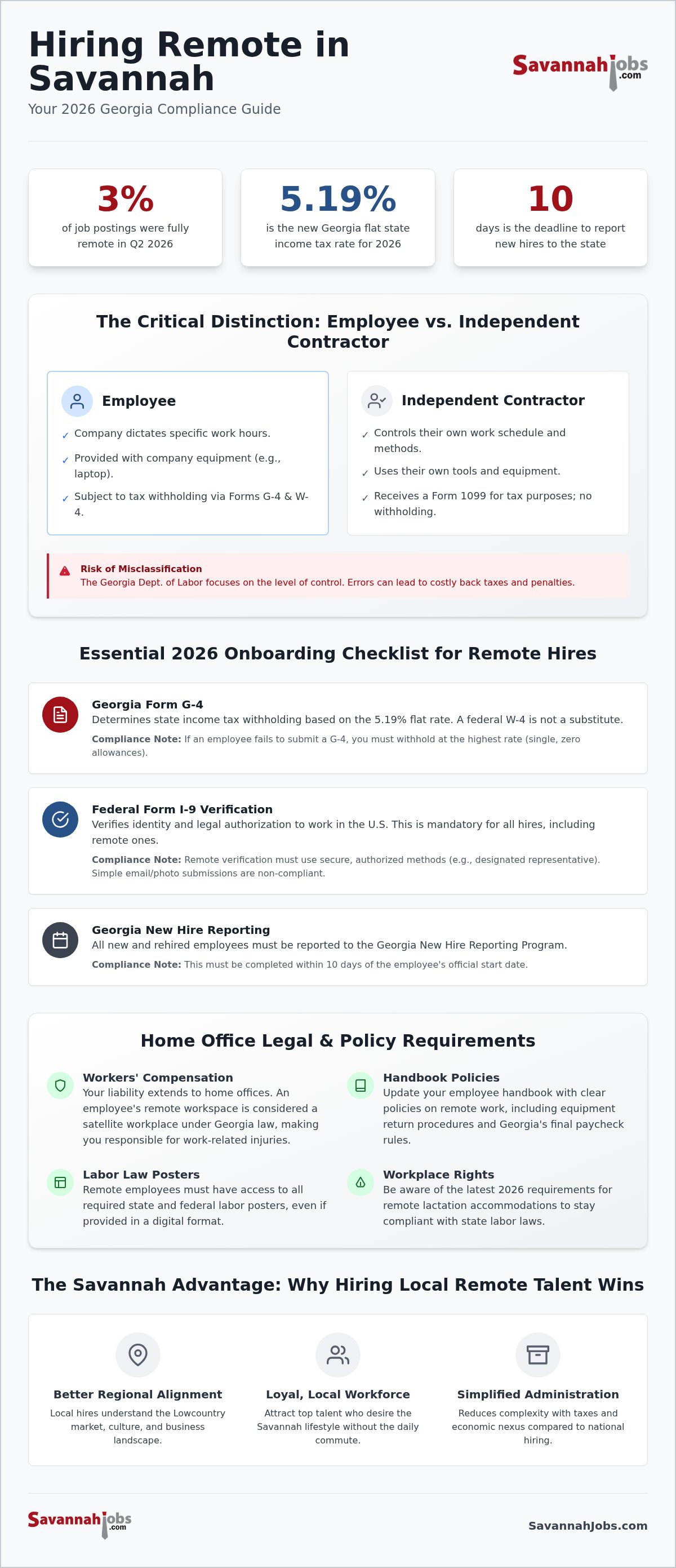
Hiring in the Hostess City has changed significantly. If you are learning how to post a remote job for Savannah candidates, you must look beyond the job description. Georgia labor laws in 2026 require a sharp distinction between employees and independent contractors. The Georgia Department of Labor (GDOL) focuses on the level of control you exert over the worker. If you dictate specific hours or provide the laptop for a staffer working in Starland District, they're likely an employee. Misclassification is a high-risk move that can lead to back taxes and stiff penalties.
Your physical office on Bay Street doesn't exempt you from home-office regulations. When a team member works from their living room, that space becomes a satellite workplace under Georgia law. You must ensure they have access to required labor posters and safety guidelines, even in a digital format. When you begin Understanding Remote Work as a legal framework rather than just a perk, you protect your company from unnecessary risk. Fully remote roles must follow all state-wide mandates, while hybrid roles require clear documentation on when the employee is under your direct supervision at the office versus at home.
Georgia Labor Law Nexus for Savannah Businesses
Hiring a single remote worker in a different Georgia county can create an economic nexus for your business. This means you might owe local taxes or have to follow specific ordinances in counties like Effingham or Bryan, even if your main shop is in Savannah. It's also vital to stay current on at-will employment Georgia standards. While the state remains at-will, remote work agreements should clearly state these terms to avoid disputes over implied contracts during a termination or equipment recovery process.
The Evolution of Remote Work in the Lowcountry
Our local economy is no longer just about the port and tourism. We see more Savannah businesses adopting remote-first policies to keep their best people from being recruited by out-of-state firms. The Savannah GA job market shows that remote salary expectations are shifting as the 2026 flat income tax rate of 5.19% takes effect. Local talent wants the Savannah lifestyle without the daily commute. When you know how to post a remote job for Savannah candidates properly, you can offer the flexibility they desire while keeping your operations legally sound.
Tax Withholding and Essential Georgia Hiring Forms
Managing taxes for a distributed team requires precision. When you are looking at how to post a remote job for Savannah candidates, your onboarding process must include specific state documentation. Georgia requires all new and rehired employees to be reported to the Georgia New Hire Reporting Program within 10 days of their start date. This rule applies to your remote staff just as it does to those working in a physical office on Broughton Street.
The primary document for state compliance is Georgia Form G-4. This form determines the state income tax withholding for your employees. For 2026, Georgia has implemented a flat income tax rate of 5.19%. This simplified rate makes calculation easier, but it doesn't remove the need for a completed G-4. If a remote employee fails to submit this form, you must withhold taxes at the highest possible rate to stay compliant with Georgia Remote Work Laws. This usually defaults to a "single" status with zero allowances.
Form G-4 and State Income Tax Compliance
Your remote team members must understand that their federal W-4 doesn't cover their Georgia state obligations. Savannah small businesses often make the mistake of assuming one form handles both. You should provide clear, step-by-step guidance during onboarding to ensure these forms are returned quickly. Using an encrypted portal for these submissions is vital for protecting sensitive employee data. If you want your remote roles to stand out in our local market, consider using a Featured Job Upgrade to highlight your professional and secure hiring process.
I-9 Verification for Remote Georgia Hires
Verifying identity is often the trickiest part of remote hiring. In 2026, the rules for remote document inspection have become more structured. You cannot simply accept a blurry photo of a Social Security card via email. Georgia employers must use secure, authorized methods for I-9 verification. This might involve hiring an authorized representative or using a designated notary in the employee's local area to witness the documents in person. Avoiding "paperwork only" violations is essential for risk management. These small clerical errors can lead to significant fines during an audit. Ensuring your remote onboarding follows these strict 2026 guidelines keeps your Savannah business safe and reputable.
Workers’ Compensation and Workplace Rights for Home Offices
Protecting your business starts with understanding that the workplace now includes your employee's spare bedroom or kitchen table. In Georgia, workers' compensation coverage is a right for all employees, including those working from home. If you are researching how to post a remote job for Savannah candidates, you must prepare for the reality that a work-related injury can happen anywhere. An injury is generally compensable if it occurs within the scope of employment. This means if a staffer in Ardsley Park trips while walking to their printer during office hours, your insurance may be liable for the claim.
Clear communication is your best defense against ambiguity. You should also stay aware of the 2026 updates for lactation accommodations. Georgia law requires you to provide reasonable break time and a private, non-bathroom space for expressing milk. For remote workers, this means respecting their break times and ensuring their home-office environment allows for this privacy without digital intrusion or scheduled meetings. Reporting work-related illnesses or repetitive strain injuries also requires a clear, documented process in your digital handbook to ensure compliance with state reporting timelines.
Defining the Home Workplace for Liability
A compensable injury in a remote setting is often harder to define than one in a local warehouse. To mitigate risk, Savannah employers should require a signed remote work agreement. This document should strictly define working hours and the designated work area within the home. We recommend using a home-office safety checklist. Ask your employees to verify they have a clear path to their desk, proper lighting, and ergonomic seating. These proactive steps show the Georgia Department of Labor that you are committed to safety, even outside your physical walls in Chatham County.
Digital Labor Law Signage and Poster Compliance
You still have a legal obligation to display labor law posters, even for employees who never step foot in your Savannah office. The 2026 Georgia Labor Law posters are available through the Georgia Department of Labor website in multiple languages. For remote staff, physical posters aren't practical. You can stay compliant by displaying these posters digitally. Post them on a company intranet, a shared drive, or email them directly during onboarding. Failure to provide this signage can lead to fines and complications during legal disputes. Make digital access a standard part of your checklist when you learn how to post a remote job for Savannah candidates.
Managing Remote Performance and Policy Compliance
Performance management in a digital environment requires more than just a Slack channel. When you are mastering how to post a remote job for Savannah candidates, your internal policies must be as robust as your recruitment strategy. A generic employee handbook won't suffice in 2026. You need specific language that addresses remote work standards, attendance in virtual meetings, and data security protocols. We recommend updating your handbook to include these digital-first expectations to avoid confusion later. When you know how to post a remote job for Savannah candidates with a focus on compliance, you reduce your long-term liability.
Georgia law is clear about final paychecks. Even for remote staff, you must deliver final wages by the next regular payday. Recovering equipment shouldn't delay this payment. To keep your reputation strong, follow our employer branding tips Savannah to ensure your remote culture feels just as supportive as an in-person office. Transparency regarding privacy is also essential. While Georgia allows for monitoring of work-related activity, you should clearly disclose what software or metrics you use to track performance to maintain trust.
The Remote Work Agreement: A Legal Necessity
Every remote hire should sign a specific agreement that supplements their offer letter. This document must define Georgia as the place of employment for legal jurisdiction. This ensures that any disputes are handled under our state’s laws. It's also vital to reiterate that at-will status remains unchanged. Your agreement should detail specific key performance indicators (KPIs) and the expected response times during business hours. This clarity prevents legal "grey areas" if performance begins to slip.
Equipment and Expense Reimbursement in Georgia
Georgia does not currently mandate that employers reimburse for home internet or utility costs. However, many successful Savannah firms choose to offer a small stipend to remain competitive. You must be explicit about the ownership of hardware. Laptops, monitors, and ergonomic chairs provided by the company remain company property. Your policy should outline a clear procedure for recovering these items if the employment ends. Consider providing pre-paid shipping labels or using a local courier service to make the return process seamless for the employee. If you want to attract professionals who value these clear standards, use a Featured Employer Upgrade to showcase your organized and professional remote infrastructure.
Finding Compliant Remote Talent in Savannah
Hiring locally for remote roles simplifies your administrative burden significantly. When you hire someone already living in the Lowcountry, you avoid the headaches of cross-state tax nexus issues or conflicting labor laws. You already know the Georgia landscape. Understanding how to post a remote job for Savannah candidates starts with recognizing that our local workforce values being part of the regional economy. They want to work for a brand they recognize from the Savannah Morning News or see active in the community. Local remote talent offers a level of cultural alignment that national hires simply can't match.
Focusing your search on the Savannah region also ensures your team shares the same time zone and regional holidays. This proximity makes occasional in-person strategy sessions at a local coffee shop or a walk through Forsyth Park possible. It builds a stronger company culture without the overhead of a full-time office. When you know how to post a remote job for Savannah candidates effectively, you tap into a pool of professionals who are already invested in our city’s success.
Writing Remote Job Descriptions That Convert
To attract the right people, you must be explicit in your ad copy. Start your job title with "Remote - Georgia Residents Only" to filter out national applicants who won't meet your 2026 compliance needs. Highlight your Savannah roots to build immediate trust. Local applicants are more likely to stay long-term when they feel a geographic connection to their employer. If you need a refresher on the basics, follow our guide on how to post a job in Savannah GA to ensure your remote roles follow the same high standards as your on-site positions.
Leveraging SavannahJobs.com for Remote Success
National platforms often drown your listing in a sea of generic, out-of-state postings. We offer a localized advantage that broad, national boards cannot provide. We connect you directly with professionals who already call this region home. As the digital recruitment portal for the Savannah Morning News and part of the USA Today Network, we provide a level of regional authority that outsiders lack. A standard 30-Day Job Posting provides the consistent visibility you need to reach qualified seekers. To truly stand out in a competitive 2026 market, use a Featured Job Upgrade. This keeps your remote role at the top of search results, beating out national competition. For companies committed to a flexible future, a Featured Employer Upgrade showcases your brand as a leader in the Savannah digital workspace. Post your remote job on SavannahJobs.com today and secure the local expertise your business deserves.
Secure Your Local Remote Future in 2026
Hiring remote staff in 2026 requires more than just a digital job board. It demands a firm grasp of Georgia's flat 5.19% tax rate and the specific reporting deadlines set by the state. You now have the checklist needed to manage Form G-4 submissions and workers' compensation for home offices with total confidence. By focusing your search on our local region, you avoid the legal tangles of multi-state compliance while building a team that understands the Savannah market.
Mastering how to post a remote job for Savannah candidates is about connecting with people who share your community pride. As the digital recruitment portal for the Savannah Morning News since 1850 and a proud member of the USA Today Network, we provide a targeted local reach that national boards simply can't match. We're here to help you navigate these changes and find the professionals your business needs to thrive.
Reach Georgia’s top remote talent-post your job on SavannahJobs.com. Let's work together to grow our regional economy and build a resilient, flexible workforce for the years ahead.
Frequently Asked Questions
Do I need a separate business license to hire remote workers in Georgia?
You don't usually need a new business license to hire remote staff if your company is already registered in Georgia. However, you should check local zoning laws in Savannah or the employee’s specific county. Some municipalities require home-occupation permits for the resident. It is best to confirm with the Chatham County Department of Building Safety or the relevant local authority where the employee resides to ensure the home-office space is legally compliant.
Is Georgia an at-will state for remote employees in 2026?
Yes, Georgia continues to be an at-will employment state in 2026. This means either you or your employee can terminate the relationship at any time for any legal reason. When learning how to post a remote job for Savannah candidates, it's vital to include at-will language in your offer letters. This protects your Savannah business while ensuring remote staff understand the nature of their employment contract from their very first day on the job.
What is Georgia Form G-4 and why is it mandatory for remote hires?
Georgia Form G-4 is the Employee’s Withholding Allowance Certificate. It's mandatory because it tells you how much state income tax to withhold from a remote worker's paycheck. Since Georgia moved to a flat tax rate of 5.19% in 2026, accurate records are essential for state compliance. Even if a candidate is working from their home in Pooler or Tybee Island, they must complete this form during their initial onboarding process.
Can a remote employee in Georgia claim workers compensation for a home injury?
Yes, remote employees can claim workers' compensation for home-based injuries. The key factor is whether the injury happened in the course of employment. If a staffer is injured while performing a work task during their scheduled hours, it's likely covered. To manage this risk, we suggest defining specific work hours and designated home-office spaces in your remote work agreements. This clarity helps the Georgia State Board of Workers’ Compensation determine the validity of claims.
How do I handle I-9 verification for a remote employee who cannot visit my Savannah office?
You can handle I-9 verification by designating an authorized representative to act on your behalf. This person meets the employee in person to inspect their original documents. Many Savannah employers use local notaries or professional verification services to complete this step. While the physical inspection must happen, the representative completes the form remotely. This process ensures you meet federal requirements without forcing a remote hire to drive into downtown Savannah for a five-minute meeting.
Does Georgia law require me to reimburse remote employees for their home internet?
No, Georgia law does not require you to reimburse remote employees for home internet or utility expenses. This is a common point of confusion when figuring out how to post a remote job for Savannah candidates. While some states have strict reimbursement laws, Georgia allows you to decide whether to provide a stipend. Many local firms offer a small monthly allowance as a competitive perk, or they share resources like Internet and Wireless Deals to help employees find affordable high-speed options, but it isn't a legal mandate for your business.
You must provide the same labor law posters required for on-site staff. This includes the 2026 Georgia Department of Labor notices regarding unemployment insurance and equal opportunity. Since remote workers won't see a physical breakroom wall, you should provide these documents digitally. Most Savannah businesses share them via a company intranet or include them in the employee handbook. Digital delivery ensures your team stays informed of their rights while you remain fully compliant with state signage laws.
How does hiring a remote worker in Georgia affect my state unemployment tax?
Hiring a remote worker in Georgia affects your State Unemployment Tax (SUTA) by adding them to your taxable wage base. For 2026, the SUTA taxable wage base is $9,500 per employee. If you are a new employer in the state, your default SUTA rate is 2.7%. You must report these wages quarterly to the Georgia Department of Labor. Keeping these payments current is essential for maintaining your status as a responsible Savannah employer.


