

A polished answer alone won’t show that you can handle workplace conflict. Strong conflict resolution interview questions reveal how you listen, stay composed, consider another person’s perspective, and work toward a practical solution. They also give you a chance to show that you can disagree respectfully instead of avoiding the issue or blaming someone else.
Workplace disagreements are part of working with a team, so it’s reasonable to want a clear way to discuss them in an interview. Learn which conflict management skills matter, how to approach a disagreement constructively, and how to shape specific, honest answers to common interview questions. You’ll also see what employers can listen for when candidates describe a difficult situation and what makes an example more convincing than a general claim.
Key Takeaways
- Use a specific workplace disagreement to show what you did, why you chose that approach, and what you learned.
- Look for signs of empathy and clear communication in how someone describes the other person’s perspective.
- Prepare for common interview prompts with a structured answer, such as the STAR method, rather than a generic claim.
- Employers hiring in Savannah can use job postings and visibility upgrades to promote open roles to local candidates.
What are conflict management skills?
Conflict management skills are behaviors that help people address workplace disagreements constructively. They include listening, explaining concerns clearly, managing emotions, and finding workable outcomes. Kimberly Best describes conflict as normal and as a signal of a problem to solve. Strong interview examples show what the candidate did about the problem, not just how difficult it felt. A candidate might explain how they heard a coworker’s concern, clarified the disagreement, and agreed on a next step.
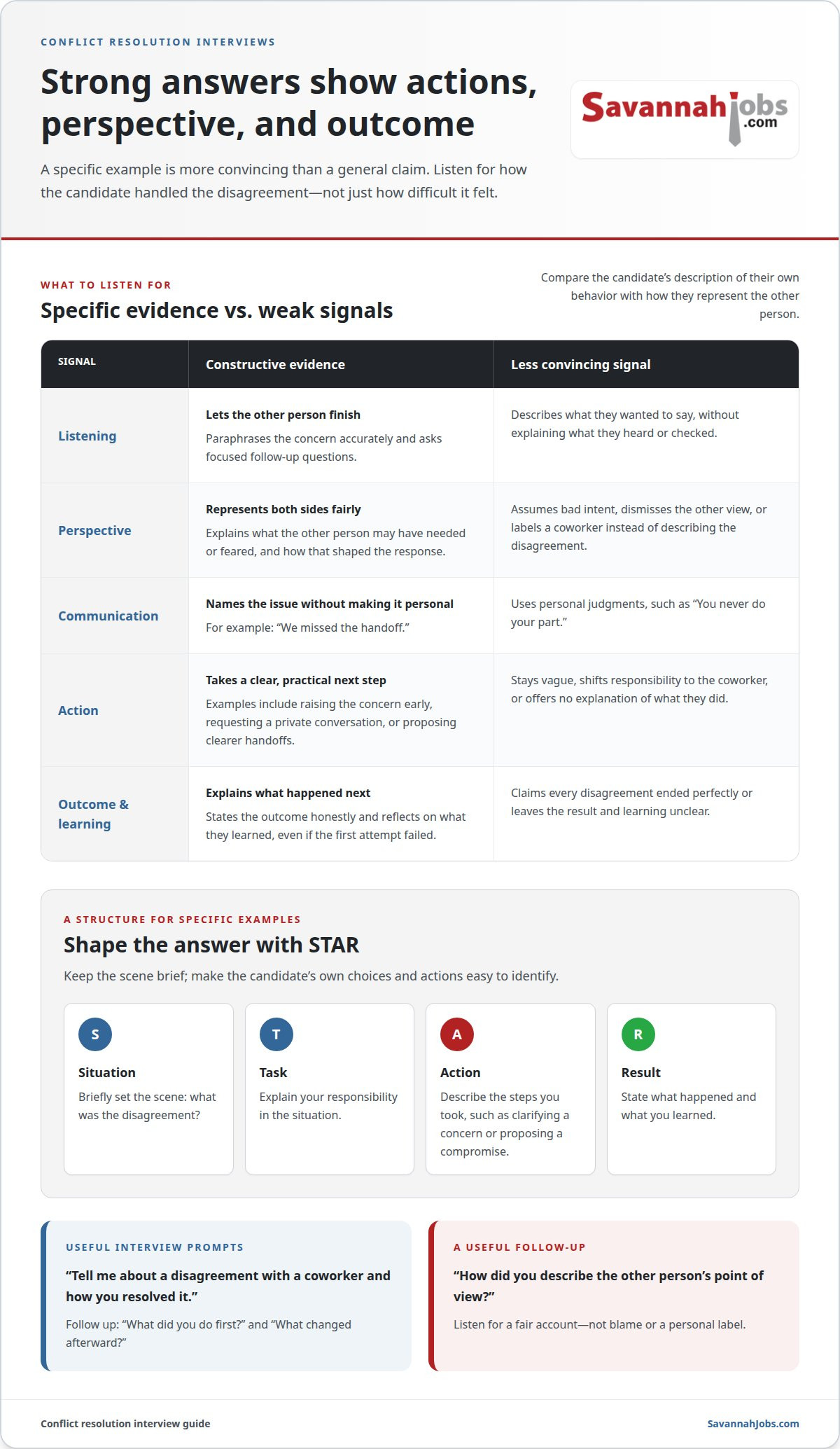
Behavioral interview questions ask candidates to describe how they handled past workplace situations. For example, ask, “Tell me about a disagreement with a coworker and how you resolved it.” Follow up with, “What did you do first?” and “What changed afterward?” These prompts help distinguish specific behavior from general claims like “I’m a good communicator.” Listen for the candidate’s own actions, a fair account of the other person’s view, and a clear outcome. Conflict resolution interview questions work best when they invite details without steering candidates toward a preferred answer.
Questions about identifying disagreements assess whether candidates notice tension before it grows. Ask how they recognized that a conversation or project was going off track. A useful answer might mention missed handoffs, repeated misunderstandings, or conflicting priorities. The candidate should explain how they checked their interpretation rather than assuming bad intent. This shows awareness and gives the interviewer a concrete example of how they handle conflict.
Workplace civility means behaving respectfully in everyday interactions, including during disagreements. Leaders influence civility by modeling calm communication and responding appropriately when incivility occurs. In an interview, ask how a candidate would respond if a team discussion became dismissive. Look for an answer that addresses the behavior clearly, keeps the discussion productive, and avoids personal attacks. Senior leaders, in particular, set an example through their actions.
Handling workplace conflict means addressing the issue directly while keeping the focus on the work. A candidate can describe raising the concern early, listening without interrupting, paraphrasing the other person’s point, and proposing a mutually agreeable solution. Ask what they learned if their first attempt failed. Specific steps and an honest account of the outcome are more convincing than blaming a coworker or claiming every disagreement ended perfectly.
How should you approach resolving conflict at work?
A strong approach combines careful listening, respectful honesty, and clear next steps. Candidates can demonstrate these skills in interviews with specific examples and thoughtful answers.
Empathy, Listening, and Communication
Empathy, listening, and communication help people understand concerns and discuss them clearly. To assess these skills, ask candidates what they heard before responding during a disagreement. Notice whether they let the other person finish, paraphrase the concern accurately, and ask focused follow-up questions. Clear communication names the issue without turning it into a personal judgment. For example, “We missed the handoff” is more constructive than “You never do your part.”
Empathy and Assertiveness
Empathy with assertiveness means acknowledging another person’s concerns while stating your own position clearly. Candidates can demonstrate both by explaining how they recognized a colleague’s pressure, then raised a concern about a missed deadline. Listen for calm, direct language and a practical request, such as agreeing on clearer handoffs. Empathy doesn’t mean agreement: a candidate can respect someone’s view while explaining why a different action is needed.
Perspective-Taking
Perspective-taking means considering how another person sees a disagreement before choosing a response. Ask candidates what they think the other person needed or feared in their example. A strong answer represents that viewpoint fairly rather than dismissing it, and explains how it shaped the candidate’s next step. This can protect a working relationship while keeping attention on the shared task. A fair account is stronger evidence than simply saying, “I understood them.”
STAR Method Responses
The STAR method organizes an example into Situation, Task, Action, and Result. For conflict resolution interview questions, candidates should briefly set the scene, explain their responsibility, describe the steps they took, and state the outcome. Keep the focus on personal behavior, such as asking a clarifying question or proposing a compromise. Avoid vague claims, blaming the other person, speaking badly about coworkers, or exaggerating your role. Acknowledge what you learned, even if the outcome was imperfect.
Addressing objections and coworker behavior
Addressing a coworker complaint means hearing the concern and choosing a fair next step. If a team member says a colleague’s interruptions prevent them from contributing, listen privately and ask for a specific example. Avoid deciding who is right before understanding the situation. Encourage the employee to speak directly with the coworker, and offer to facilitate a conversation if needed.
During hiring, ask candidates, “Tell me about a time you disagreed with a coworker’s behavior. What did you do?” Follow up with, “How did you describe the other person’s point of view?” These questions help assess whether candidates represent both sides fairly. For example, “We had different expectations about meeting deadlines” is more balanced than “My coworker was lazy.”
Strong answers explain the situation, the candidate’s response, and what happened next. Listen for a specific action, such as requesting a private conversation or clarifying a shared responsibility. Then ask what the candidate learned. A thoughtful answer might reveal that they needed to pause, ask more questions, or give a colleague time to explain. That reflection can show patience and judgment.
Objections also test how candidates respond when someone challenges their decision. Ask, “Tell me about a time a coworker pushed back on your recommendation.” The answer should explain how they considered the objection, presented their reasoning, and adjusted their approach when appropriate. For instance, a candidate might say a teammate raised a scheduling risk, prompting them to revise the project plan together.
Pay attention to how candidates speak about the people involved. Answers built on insults, blame, or claims that the other person was entirely at fault offer little evidence of constructive behavior. Candidates should be honest and specific without exaggerating their role or glossing over every difficulty. Ask what they would do differently now; a clear lesson is more useful than claiming the situation had no downsides.
Consistent prompts make hiring conversations easier to compare. Ask each candidate about a disagreement, their first response, the other person’s perspective, and the outcome. Consider whether the answer includes concrete actions and a fair account, not just a satisfying ending. A candidate who explains an imperfect result and a practical lesson may show more self-awareness than one who presents every conflict as an easy win.
Common conflict resolution interview questions
Common prompts ask candidates to describe disagreements, objections, and lessons learned. Specific examples help hiring managers assess conflict resolution skills beyond confident claims.
Interview Question Themes
Interview question themes are recurring situations that reveal how candidates respond to disagreement. Ask, “Tell me about a time you disagreed with a teammate’s approach,” or, “How did you handle critical feedback?” You might also ask how they responded when a project partner missed a deadline. Follow up by asking what the candidate did, what the other person wanted, and how the situation ended. These questions uncover actions, not just opinions.
Entry-Level Sample Responses
Entry-level sample responses can draw on real examples from school, volunteering, or early jobs. A candidate might answer, “During a group project, two classmates disagreed about dividing the research. I asked what each person preferred, then suggested splitting the topics by interest. We finished the presentation on time, and I learned to clarify responsibilities early.” This answer shows listening, a practical proposal, and an outcome without claiming extensive work experience.
Ask, “What would you do if a coworker dismissed your idea during a team meeting?” A thoughtful answer might explain that the candidate would stay calm, ask about the coworker’s concerns, and restate the idea with supporting details. Then ask, “When would you escalate a disagreement?” Listen for sound judgment: routine differences can often be discussed directly, while persistent behavior affecting work may need a manager’s attention.
Use consistent follow-ups to compare answers fairly: “What did you learn?” and “What would you change?” Strong examples include specific actions and a realistic result. Be cautious of answers that blame others, exaggerate success, or give no clear resolution. Give candidates room to explain the context, then bring the discussion back to their own behavior when details become vague.
Hiring in Savannah? Promote your open role to local candidates.
SavannahJobs.com
SavannahJobs.com helps employers advertise open positions to the local Savannah workforce. After defining the conflict management skills your team needs, use a job posting to reach candidates for your role. A 30-Day Job Posting gives employers a way to promote an opening, while Featured Job and Featured Employer upgrades provide additional visibility options.
SavannahJobs.com supports your hiring process with local recruitment advertising, including job postings and featured visibility options. Interviews remain the place to assess how candidates handle workplace disagreements. Choose the posting option that fits your hiring needs and the visibility you want for the role or organization.
Contact SavannahJobs.com to discuss promoting your open position.
Make your next hiring decision with purpose
Turn interview observations into a consistent way to evaluate how candidates approach difficult conversations. Use conflict resolution interview questions to learn about their judgment, then consider how those behaviors fit the role’s daily demands. A thoughtful answer can inform your decision and point to team practices worth reinforcing after someone joins, such as clear expectations, respectful discussion, and timely attention to concerns.
For employers in Savannah, reaching local candidates is a practical next step when a role opens. A clear job posting helps applicants understand the position before meeting your hiring team, setting the stage for focused conversations about their experience and workplace behavior.
Contact SavannahJobs.com to discuss promoting your open role. Keep building a workplace where people can raise concerns and move forward together.
Frequently Asked Questions
How do you handle conflict?
Address the issue early and calmly, keeping the focus on the work. For example, if two teammates disagree about who owns a customer follow-up, clarify the task and its deadline before discussing preferences. Ask each person what they understood, then agree on responsibility and how updates will be shared. If the agreement doesn’t hold, revisit the specific commitment rather than reopening personal criticism.
How do you manage difficult team members or colleagues for a productive outcome?
Focus on observable actions and shared expectations, not labels like “difficult.” If a colleague regularly changes a shared document without notice, explain how that affects your work and propose a simple process for edits. Invite their perspective, agree on how changes will be communicated, and review whether the process helps. If the issue continues to disrupt work, bring specific examples to the appropriate manager.
What, in your opinion, are the essential components of effective conflict resolution?
Effective resolution starts with a clearly defined issue, a fair hearing for each perspective, and an agreed next step. Separate facts from assumptions: a missed handoff is observable, while “they don’t care” is an interpretation. Identify what each person needs to complete the work, discuss realistic options, and record who will do what. A later check-in can show whether the agreement solved the original problem.
Why do interviewers ask this question?
Interviewers ask about conflict to understand how a candidate responds when priorities, opinions, or expectations differ. A detailed example can reveal judgment that a skills list alone cannot. For a customer-facing role, an interviewer might listen for how the candidate handled a complaint while keeping the conversation respectful. They can also learn whether the candidate reflects on mistakes and adapts their approach.
What are common conflict resolution interview questions?
Common prompts cover disagreements, competing priorities, critical feedback, and team tension. An interviewer might ask, “Describe a time you had to repair a working relationship,” or, “What did you do when a teammate rejected your suggestion?” Other questions use a hypothetical situation, such as balancing two urgent requests. Prepare distinct examples so each answer addresses the specific prompt.
How do you answer questions about conflict with a coworker or manager?
Choose a real example and describe your own actions without attacking the other person. For a disagreement with a manager, explain how you raised your concern respectfully, what information supported your view, and how you responded to the final decision. For a coworker conflict, show how you kept the discussion focused on shared work. Be candid about the outcome and what you’d handle differently.


