

A longer benefits list doesn’t automatically make your organization more appealing to job seekers. The strongest employee benefits to attract talent Savannah employers can offer are those that address what their teams value and that the organization can support consistently.
If you’re unsure whether employees prioritize health coverage, paid time off, retirement support, or practical wellbeing resources, a generic package can miss the mark. Savannah employers need a clear way to listen, weigh priorities against available resources, and explain benefits in plain language.
This 2026 guide shows you how to gather employee input, identify options that fit different needs, and build a balanced approach without treating every possible perk as essential. You’ll also learn how to describe benefits clearly in a local job advertisement, so Savannah-area applicants can understand what your organization offers before they apply. Start with what matters to your people, then make each benefit count.
Key Takeaways
- Build employee benefits around your Savannah team’s priorities instead of relying on a standard package.
- Use anonymous surveys, listening sessions, and themes from stay or exit interviews to guide benefits decisions.
- Compare health coverage, paid time off, flexibility, retirement, and mental health support by the needs each can address.
- Make employee benefits to attract talent Savannah applicants can understand by describing relevant offerings clearly and accurately in job postings.
- Validate benefit details, approve your wording, update job materials, and review how applicants respond.
Why employee benefits matter when attracting talent in Savannah
Salary matters, but it isn’t the whole employment offer. Employee benefits are the non-wage parts of compensation, such as health coverage, paid time off, retirement plans, flexibility, and wellbeing support. They complement salary; they don’t replace it.
For Savannah employers, benefits can show how an organization considers employees’ needs beyond the paycheck. A clear leave policy, for example, helps candidates understand how the employer approaches time away from work. Retirement support can indicate attention to longer-term financial wellbeing. These details help applicants assess whether a role fits their priorities, though no single benefit guarantees a hire.
The right approach depends on your workforce and the work itself. Savannah-area employers hire across sectors such as logistics, manufacturing, healthcare, and maintenance. A benefit that suits employees in a shift-based, on-site role may not address the needs of a team with different schedules or work arrangements. That’s why employee benefits to attract talent Savannah organizations choose should reflect their people, not a generic checklist.
What job seekers may look for beyond pay
Start with five categories: health coverage, paid time off, flexibility, retirement, and wellbeing. Each can address a different concern, from managing healthcare needs to balancing work and personal responsibilities or planning for the future. Treat these as areas to assess, not a required list of offerings.
Priorities vary by role, life stage, work arrangement, and employee feedback. Schedule flexibility, for instance, may matter to employees with different commuting or caregiving needs, while a dependable retirement plan may be a higher priority for others. Don’t assume one person’s preference represents the whole team. Listen for patterns, then weigh them against what your organization can sustain.
Why a Savannah employer should make benefits easy to understand
Job seekers need to understand what an offer includes to compare opportunities. Broad wording like “competitive benefits” leaves important questions unanswered. Specific, accurate descriptions give applicants a clearer picture and help them decide whether to explore the role. Name the benefits available and explain relevant eligibility rules or limits in plain language.
Clear wording also helps your organization present a consistent picture. Make sure job ads match the information candidates receive during the hiring process. This matters whether you’re advertising a healthcare role, a manufacturing position, or an opening elsewhere in the Savannah workforce. Your benefits story is one part of your employer identity, alongside the role, workplace, and expectations. For more on shaping that identity for local applicants, explore this Savannah employer branding guide.
This guide offers a practical framework for reviewing and communicating benefits. It isn’t benefits brokerage or legal advice, and it doesn’t prescribe one ideal package for every Savannah employer. Build from employee priorities, your organization’s resources, and accurate information about what you offer.
How to build an employee benefits strategy that fits your Savannah team
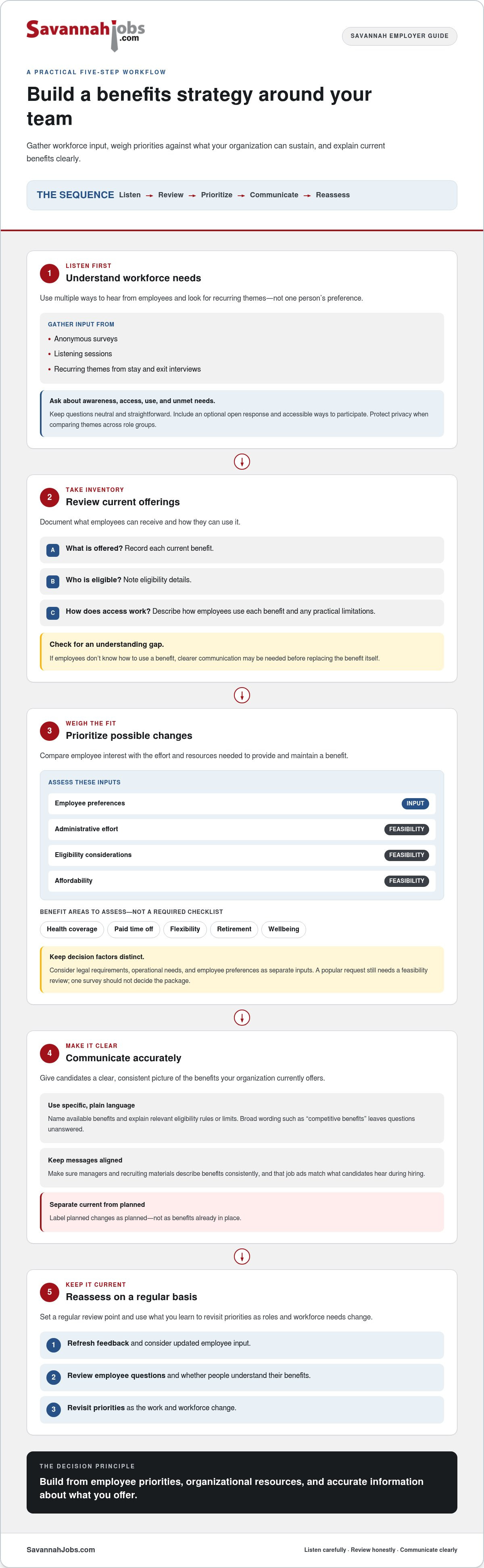
A useful benefits strategy starts with evidence about your workforce. Then compare employee preferences with what your organization can provide and maintain. This sequence helps you make deliberate decisions instead of adding perks one at a time in response to the latest request.
- Understand workforce needs. Use anonymous surveys, listening sessions, and recurring themes from stay and exit interviews. Ask what employees know about existing benefits, what they can access and use, and where they see unmet needs. Keep questions neutral and straightforward.
- Review current offerings. Document each benefit, who is eligible, how employees access it, and any practical limitations. Look for gaps between what’s available and what staff understand. If employees don’t know how to use a benefit, clearer communication may be needed before the benefit itself needs replacing.
- Prioritize possible changes. Compare employee interest with administrative effort, eligibility considerations, and affordability. Treat legal requirements, operational needs, and employee preferences as separate inputs. A popular request still needs a feasibility review, and one survey shouldn’t decide the package.
- Communicate accurately. Make sure managers and recruiting materials describe current benefits consistently. Label planned changes as planned, not as benefits already in place.
- Reassess. Set a regular review point and consider updated feedback, employee questions, and whether people understand their benefits. Revisit priorities as roles and workforce needs change.
How to identify which benefits employees value
Ask separately about awareness, access, use, and unmet needs. For example: “Which current benefits are you familiar with?” and “What makes it difficult to use the benefits you have?” Include an optional open response so employees can mention needs your choices may not capture. Offer accessible ways to participate, so feedback isn’t limited to employees who can attend a meeting or complete a long survey.
Compare themes across relevant role groups, such as work location or schedule, while protecting privacy. Avoid reporting a small group’s responses in a way that could identify individuals. Look for repeated patterns, then use listening sessions to understand the reasons behind them. Employee input helps guide priorities, but it doesn’t mean every requested change is feasible.
How to prioritize benefits without overpromising
Use a simple comparison before committing resources. Keep employee value, administration, eligibility, and affordability visible as distinct considerations. These questions can help structure the discussion:
- Need: Employees want more support managing healthcare needs. Category: Health coverage. Follow up: What gap are they describing, and who would be eligible?
- Need: Employees report difficulty balancing work and personal responsibilities. Category: Paid time off or flexibility. Follow up: What scheduling or coverage needs would implementation create?
- Need: Employees seek support planning for the future. Category: Retirement benefits. Follow up: What administrative work and ongoing resources would be involved?
For each option, record its expected value to employees, administrative effort, eligibility details, and affordability. Then identify whether it’s available now, under review, or approved for a future date. That distinction protects trust during recruiting. Once your opening and benefits language are ready, you can advertise an opening to Savannah-area job seekers with a clear, accurate offer.
Which benefits can help attract talent, including mental health support?
No single benefit category suits every employee or every Savannah workplace. Compare options by the needs they may address, then consider whether employees can access them in practice. A benefit that looks strong on paper may have less value if its schedule, eligibility rules, or communication make it difficult to use.
Useful benefits depend on employee priorities, role schedules, work arrangements, eligibility, and practical access. Apply those considerations before treating any option as a universal recommendation.
| Employee need | Possible benefit approach | Implementation consideration |
|---|---|---|
| Help managing healthcare needs | Health coverage | Explain coverage and eligibility accurately. |
| Time away from work | Paid time off | Clarify how employees request and use it. |
| More control over work schedules | Flexible scheduling or work arrangements | Consider role duties, coverage, and consistency across teams. |
| Support with future financial planning | Retirement benefits | Describe the available plan and any applicable terms. |
| Help with personal or work-related concerns | Wellbeing resources and supportive workplace practices | Make resources easy to find and explain their scope. |
How employers can approach mental health support at work
Mental health support is broader than an insurance benefit or a single program. It can include managers who know how to respond respectfully, clear time-off practices, reasonable workload conversations, and straightforward information about available support. These workplace practices can make it easier for employees to raise concerns, but they aren’t clinical treatment and shouldn’t be presented as a cure-all.
When a formal resource is available, explain what it is and how employees can access it. For a local example, the City of Savannah describes its employee assistance program as free and confidential for employees and their families, with support available 24/7. This public-sector example can help employers consider how to communicate a resource; it doesn’t mean the same program or terms apply to private organizations.
How to match benefit categories to different workforce needs
Consider access as well as the benefit itself. A flexible schedule may mean different things for a shift-based position than for an office role. Online wellbeing resources may be easier to use if employees can reach them during the workday, while workers without regular computer access may need another clear way to learn about them. Assess how each option fits actual work conditions before promoting it.
For employee benefits to attract talent Savannah employers should focus on a credible fit: which need an option addresses, who can use it, and what conditions apply. Compare employee feedback with operational requirements, then communicate the boundaries honestly. If you’re describing leave, coverage, or other matters that may involve legal obligations, verify current Georgia and federal requirements through authoritative sources before making compliance statements. This keeps the benefits discussion practical, accurate, and grounded in what your organization can provide.
How to communicate employee benefits in Savannah job postings
A job posting is often a candidate’s first detailed look at your employment offer. Make the benefits section easy to scan and precise enough to set accurate expectations. “Great benefits” or “competitive package” may sound positive, but neither tells applicants what your organization provides. Share concrete, approved details that help Savannah job seekers decide whether the role fits their priorities.
Keep the description focused. Select the benefits most relevant to the position and explain them in plain language. A long list of every policy and program can bury the details candidates need. A concise, accurate summary makes the offer easier to understand and gives the hiring conversation a reliable starting point.
What to include when describing benefits to applicants
Name the benefits that apply to the role, state who is eligible, and explain important conditions. If a benefit begins after a waiting period or depends on another requirement, say so rather than implying immediate access. Distinguish benefits available from the first day from those that begin later, and use the same description in the job ad and hiring materials.
For example, avoid a broad claim like “full health coverage” if the organization offers specific plans or eligibility varies. Instead, use approved wording that identifies the coverage category and tells candidates where they can learn more during hiring. Don’t imply that a benefit covers a service, employee group, or time period unless that’s accurate.
- Name the offering: Use clear terms such as health coverage, paid time off, retirement benefits, or flexible scheduling when they accurately describe what’s available.
- Explain access: Include relevant eligibility basics, start dates, waiting periods, or other conditions.
- Direct follow-up: Tell applicants where they can get further details during the hiring process, such as from the hiring contact or in benefits materials.
How to keep benefits messaging credible and locally relevant
Connect the description to the actual role and workplace. If a position has a set on-site schedule, don’t imply it offers remote flexibility. If scheduling options differ by department, describe the arrangement that applies to the opening rather than making a company-wide promise. Credibility depends on matching the job ad to the experience the employer can deliver.
Clear benefit descriptions help candidates compare offers using accurate information. Before publishing, ask the appropriate internal owner to review benefit names, eligibility, timing, and limitations. A human resources or benefits administrator can help ensure the wording reflects current plan documents and workplace policies. Keep an approved source of language so hiring teams don’t have to rewrite details from memory.
The same care applies to the rest of the listing. A guide to writing a good job description can help you present the role and its benefits as one clear, useful offer. Include the approved benefits summary in your Savannah job advertisement, then post your opening on SavannahJobs.com to share it with local job seekers.
Turn a stronger benefits story into a local hiring next step
Your benefits approach becomes part of the hiring offer when details are accurate, easy to find, and connected to the role. Before publishing, review the job ad from a candidate’s perspective. Look for outdated policy language, unclear application instructions, or benefit descriptions that could set the wrong expectation.
A practical checklist before publishing a Savannah job opening
Use this checklist before your next Savannah job posting:
- Validate the role: Confirm the job title, duties, location, schedule, and requirements reflect the position you’re hiring for.
- Verify benefits: Match every advertised benefit to current workplace policies and eligibility rules. Note waiting periods, role-specific conditions, or limitations applicants need to understand.
- Approve the wording: Have the appropriate internal owner review the benefits language, application instructions, and hiring contact. Keep the approved version available to anyone preparing recruiting materials.
- Update job materials: Use a clear title and concise description. Put the benefits most relevant to the role where applicants can find them without sorting through a long, generic list.
- Review the response: Track candidate questions about the role and benefits. If applicants repeatedly need clarification, consider whether the ad can explain those details more clearly next time.
A practical employee benefits to attract talent Savannah plan depends on consistency from the first job ad through the hiring conversation. Don’t describe a planned change as though it’s already available, or suggest that every employee receives a benefit if eligibility depends on role or timing. Straightforward wording helps candidates understand the offer and gives your hiring team a reliable basis for follow-up.
How local job advertising fits into a benefits-led hiring plan
A well-described offer and local visibility serve different parts of recruiting. Clear benefits language helps candidates assess the opportunity; local job advertising gives employers a place to present the opening to Savannah-area job seekers. Neither replaces the other, and advertising can’t guarantee a hiring result.
SavannahJobs.com is a local recruitment advertising platform. Employers can publish 30-day job postings and choose optional featured placement, including a Featured Job Upgrade or Featured Employer Upgrade. These options provide additional placement opportunities without promising applicant volume or hiring outcomes.
Once the role details, approved benefits language, and application path are ready, post a job for Savannah-area candidates on SavannahJobs.com. Review candidate questions and response patterns to keep improving how your organization presents opportunities in Savannah.
Put your next hiring step into motion
A benefits strategy grows stronger when you treat it as an ongoing conversation with your team. Use what you learn from applicants and employees to sharpen how you describe the role, clarify what matters, and decide what to revisit. The goal isn’t to promise every possible perk. It’s to present an honest offer that reflects your Savannah workplace and gives candidates useful information as they consider their next move.
For employers ready to put that offer in front of local job seekers, SavannahJobs.com is part of the Savannah Morning News digital recruitment portal and the USA TODAY Network. Post a job for Savannah-area candidates and share the details that make your opportunity clear. Thoughtful employee benefits to attract talent Savannah employers can support, paired with straightforward job advertising, help you take a confident next step in local hiring. Keep listening, keep refining, and build an offer your team can stand behind.
Frequently Asked Questions
Is mental health support an employee benefit?
Yes, mental health support can be provided through workplace practices, employer resources, health-plan coverage, or a combination of these. The exact meaning depends on the specific offering and who’s eligible. Supportive management and manageable workload practices can help create a healthier workplace, but they aren’t clinical care. Describe only the resources your organization provides, and explain how employees can access them without implying treatment or coverage that isn’t included.
What employee benefits attract talent in Savannah?
There isn’t one benefit that every Savannah job seeker considers decisive. Priorities can differ by position, work schedule, personal circumstances, and what employees say they need. Health coverage, paid time off, flexibility, retirement options, and wellbeing support are categories worth assessing. For employee benefits to attract talent Savannah employers should use local employee feedback and describe confirmed offerings accurately in job ads, rather than claim a particular benefit is preferred across the city.
Can small employers offer meaningful mental health support at work?
Yes. Support isn’t limited to purchasing a particular insurance product. A small employer might make time-off practices easier to understand, help managers respond appropriately when employees raise concerns, and clearly communicate resources already available. Start by identifying what your organization can maintain and how staff in different roles can access it. Describe the support accurately, and don’t promise clinical outcomes or present general workplace suggestions as legal requirements.
How do I find out which benefits my employees value most?
Use a short, accessible survey alongside listening sessions and recurring feedback from hiring and retention conversations. Ask whether employees know about existing benefits, can access them, and find them useful, as well as what they would like to see. Review responses confidentially and look for themes across relevant roles without exposing individuals. Then weigh those themes against operational needs and resources. Feedback should inform decisions, not act as a binding vote on every request.
Do Georgia employers have to provide mental health benefits?
There isn’t a single answer that applies to every Georgia employer. Obligations can depend on factors such as employer size, plan design, and applicable federal or state rules. Workplace wellbeing practices aren’t the same as insurance coverage, so don’t treat one as a substitute for understanding the other. Before making a compliance decision or describing a legal obligation to employees, consult current government guidance or qualified counsel familiar with your circumstances.
How should I list employee benefits in a job posting?
Name confirmed benefits in plain language, then include relevant eligibility, timing, or access conditions. For instance, if a benefit starts after a waiting period, avoid wording that suggests it begins on the employee’s first day. Prioritize details that fit the specific role instead of adding a lengthy list to every ad. Accurate wording helps candidates understand the offer and compare opportunities using clear information, not broad promises or vague claims.
What happens if our benefits package cannot match larger employers?
You can still present the benefits and workplace practices your organization genuinely offers, then ask employees which gaps matter most to them. Be clear about what’s available and avoid unsupported comparisons with larger organizations. Review priorities periodically, since needs and work arrangements can change. Benefits are one part of an employment offer; candidates also consider responsibilities, management, scheduling, and growth opportunities. A credible picture of the whole role can help applicants assess fit.


