

A new employee can arrive ready to work while key forms, account access, or training plans are still missing. In Georgia, that first-week scramble can also put a reporting deadline at risk: employers must report new and rehired employees to the state within 10 days of hire. This onboarding checklist for new hires Georgia employers can adapt helps keep those early tasks on track.
Onboarding takes more than collecting paperwork. A dependable process separates compliance tasks from the welcome, training, and role-specific support that help a new hire feel prepared. Use this checklist to sequence the work from pre-start preparation through the first 30 days.
Organize federal Form I-9 steps, federal and Georgia tax withholding forms, and Georgia’s new-hire report alongside practical workplace setup. Track key timing, including the employee’s Form I-9 Section 1 deadline on the first day of work and the employer’s Section 2 deadline within three business days. Then tailor orientation and early goals to the job, whether the employee works on-site, remotely, or across a Savannah-area team. The result is a repeatable start that keeps essential tasks visible and gives each new employee a clearer path into the work.
Key Takeaways
- Use an onboarding checklist for new hires Georgia employers can adapt to organize the transition from accepted offer through the first month.
- Keep compliance paperwork, workplace setup, role training, and relationship-building as distinct parts of the process.
- Adjust onboarding for office, remote, field, and shift-based roles, with local work settings in mind.
- Assign each task an owner, due point, and completion record so important steps stay visible during a busy first week.
- Review new-hire and manager feedback to improve the next onboarding cycle and connect hiring plans with a prepared first day.
What should a Georgia new-hire onboarding checklist cover?
Employee onboarding is the planned transition from an accepted job offer to supported, productive work. A practical onboarding checklist for new hires Georgia employers can adapt brings paperwork, workplace preparation, job training, and connection into one coordinated process. Give each task an owner and a clear follow-up step. For a general overview of the employee onboarding process, see how onboarding extends beyond a new hire’s first day.
Keep four kinds of work distinct. They’re connected, but each calls for different actions and follow-up:
- Administrative compliance: Gather and process required employment and payroll information, and track reporting responsibilities.
- Workplace readiness: Prepare the employee’s workspace, equipment, accounts, schedule, and the practical details they need to begin.
- Role training: Set out job duties, tools, procedures, safety guidance where relevant, and early learning goals.
- Relationship-building: Introduce coworkers and key contacts, explain team norms, and make time for questions and feedback.
The right checklist depends on the employer, the role, the worksite, and current requirements. A Savannah office employee may need access to shared systems, while a field employee may need job-specific equipment and clear reporting lines. Start with a consistent foundation, then tailor the steps to the person’s role.
Why organize onboarding by phase?
A phased timeline shows what’s due, who owns it, and what still needs attention. Separate pre-start tasks, such as preparing equipment and sharing arrival details, from first-day activities, such as introductions and reviewing immediate priorities. Keep onboarding active after forms and access are complete, too. Training, manager check-ins, and answers to early questions all need follow-through as the employee learns the work.
Who owns each onboarding task?
Assign one accountable owner to each item, even when several people contribute. HR can coordinate the overall process and explain employee paperwork. Payroll can manage payroll setup and clarify what information the employee must provide. IT can prepare access and equipment where applicable. The manager should set role expectations, plan training, and check in on progress.
Make employee actions explicit: explain what to do, how to do it, and when it’s due. Send instructions before the deadline, follow up on outstanding items, and resolve incomplete information. Don’t rely on a verbal handoff or assume a form has been finished.
Use one shared checklist as the central tracker. For each task, record its owner, due point, status, and completion date. Keep sensitive personal documents and confidential details in appropriately restricted systems, not in a broadly accessible checklist. The tracker should show progress without exposing information other team members don’t need.
Which new-hire forms and Georgia reporting steps belong on the checklist?
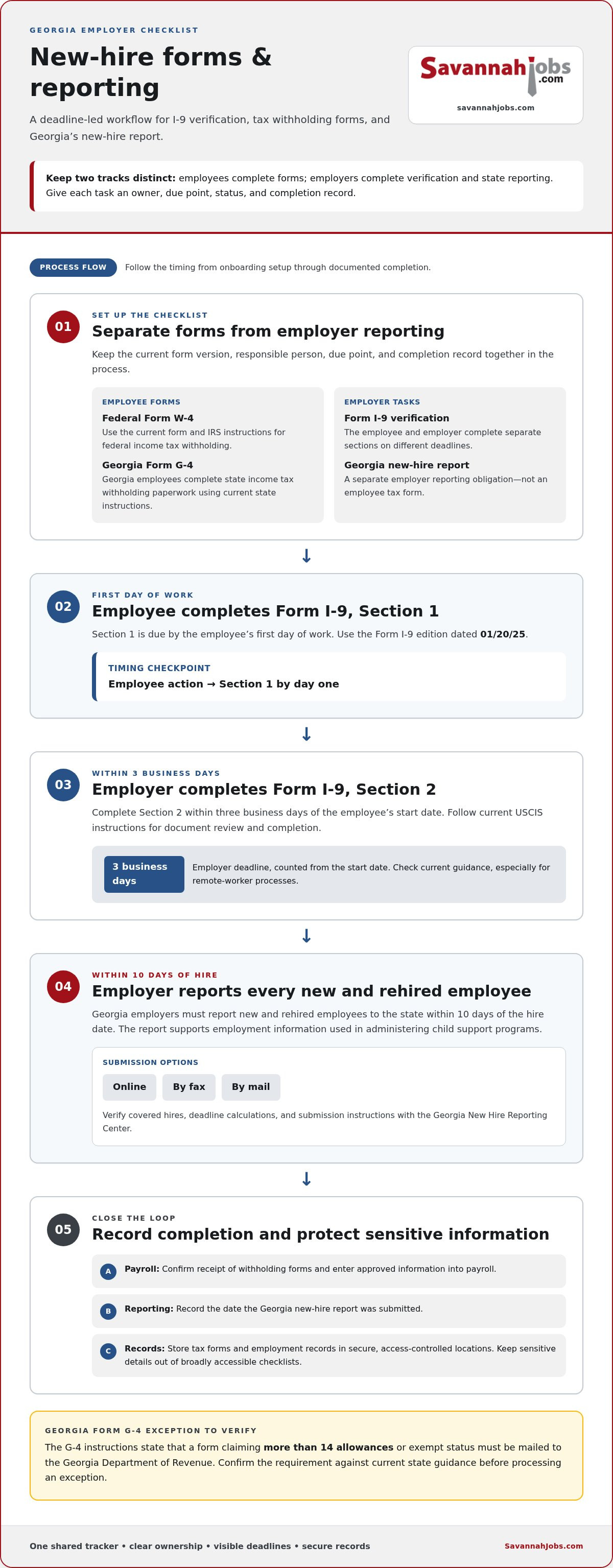
Paperwork is easier to manage when each item has a distinct purpose and owner. For an onboarding checklist for new hires Georgia employers can rely on, separate employee forms from employer reporting. Employees complete certain documents; employers use or submit information to meet separate obligations. Keep the current form version, deadline, responsible person, and completion record together in your process.
Federal employment eligibility and tax forms
Form I-9 documents employment eligibility verification. The federal Form W-4 tells the employer how to calculate federal income tax withholding. They aren’t interchangeable, and neither replaces Georgia’s state withholding paperwork.
Use the Form I-9 edition dated 01/20/25. The employee completes Section 1 by the first day of work, and the employer completes Section 2 within three business days of the start date. Review the current USCIS Form I-9 instructions for document review and completion details, especially if your process involves remote workers. USCIS guidance can change, so confirm current requirements when you hire.
For federal withholding, direct employees to the current Form W-4 and its instructions from the IRS Form W-4 page. Georgia employees also complete Form G-4 for state income tax withholding. Use the current Georgia Department of Revenue form and instructions. The G-4 instructions state that a form claiming more than 14 allowances or exempt status must be mailed to the department; confirm that requirement against current state guidance before processing an exception.
Georgia new-hire reporting and payroll setup
Georgia new-hire reporting is a separate employer task, not another employee tax form. The report helps the state maintain employment information used in administering child support programs. Georgia employers must report all new and rehired employees within 10 days of the hire date. Reports may be submitted online, by fax, or by mail. Verify covered hires, deadline calculations, and submission instructions with the Georgia New Hire Reporting Center before each reporting cycle.
Build a handoff into payroll. Assign someone to confirm receipt of the employee’s withholding forms, enter the approved information into payroll, and record the date the new-hire report was submitted. Keep tax forms and employment records in secure, access-controlled locations. Form I-9 retention rules also apply, so check current USCIS guidance for the correct retention period and storage requirements rather than relying on an old checklist.
Georgia employers can review related workplace obligations in this Georgia labor law and compliance guide. The hiring stage comes before onboarding. SavannahJobs.com helps employers reach Savannah and surrounding coastal-area candidates through local job advertising. Explore Savannah-area job advertising as part of your recruitment process.
How should onboarding change across Georgia jobs and workplaces?
A sound onboarding framework stays consistent, but the details should match where and how the employee works. An office hire, a remote employee, a port logistics worker, and a hospitality team member won’t need identical access, safety orientation, or training. Use the onboarding checklist for new hires Georgia employers build as a flexible guide, not a one-size-fits-all script.
The Savannah-area examples below show planning differences, not special legal rules for particular industries. Confirm requirements that apply to your workplace, duties, and current regulations.
| Work setting | Access and setup | Safety and training focus |
|---|---|---|
| Office | Prepare a workstation, building access, and relevant system accounts. | Cover emergency procedures, team workflows, and job-specific tools. |
| Remote | Arrange equipment and account access, and explain how to get technical help. | Set communication norms, meeting practices, and a plan for guided task training. |
| Field or port logistics | Clarify reporting locations, supervisor contacts, and the equipment needed for assigned work. | Have a supervisor explain relevant procedures and provide practical instruction before independent tasks. |
| Shift-based, including hospitality or healthcare | Confirm the schedule, handoff contacts, and how the employee accesses the worksite or systems. | Plan training around shift duties, team handoffs, and any role-specific safety or service procedures. |
What changes between on-site, remote, and field roles?
For on-site staff, make arrival straightforward: identify where to report, who will meet them, and how they’ll access the building, workspace, and equipment. Include an emergency orientation suited to the workplace. For remote staff, plan equipment delivery, account setup, communication channels, and a named person for support. A working login alone doesn’t mean someone is ready to work.
Field employees need a clear first assignment and a supervisor who can demonstrate practical procedures in context. In port logistics, for example, managers might plan around worksite access and task-specific instruction. For shift-based teams, schedule introductions and training so the employee can learn from the colleagues and supervisors they’ll actually work with.
How should managers tailor training to the job?
Start with the job description. Turn each core responsibility into an observable first-week learning goal, such as locating the right system, demonstrating a routine task, or explaining when to ask for help. Pair instruction with a named supervisor or experienced colleague, then give the new hire time to practice and ask questions. For regulated or safety-sensitive duties, verify applicable training requirements before assigning work.
Keep the shared onboarding framework, but add role-specific tasks and owners. Check whether the employee can access what they need, explain their immediate priorities, and identify who can support them. That simple review helps Georgia employers give each new hire a relevant start.
What should employers do before day one and during the first 30 days?
A practical timeline turns onboarding into manageable steps, with a clear owner, due point, and completion record for every task. Before the start date, prepare the basics. On day one, welcome the employee and clarify immediate priorities. During the first week and through day 30, build skills, answer questions, and review progress.
Use this adaptable onboarding checklist for new hires Georgia employers can tailor to each role. The check-in cadence below is a suggested routine, not a legal deadline.
Before the employee starts and on day one
Set up the employee’s workspace, equipment, accounts, and schedule before arrival, and send a welcome message. Tell them where to go, what to bring, and who will greet them. On day one, make time for introductions, communication channels, the agenda, and immediate priorities. Handle applicable employment documents using current official instructions and secure processes.
First week through the first month
Give the new hire role-specific learning goals, a named training contact, and regular time with their manager. Ask what’s clear, what’s getting in the way, and where more support would help. Close the first month with a two-way review of expectations, training gaps, and next-step goals.
- Before the start date: HR coordinates applicable paperwork and confirms the employee’s start details; IT prepares accounts and equipment where relevant; the manager finalizes the schedule, welcome, and first-week plan. Due: before the employee starts. Record: mark each task complete in the shared tracker, noting the owner and completion date.
- Day one: The manager or assigned welcome contact greets the employee, walks through the agenda, introduces key colleagues, and explains immediate priorities. HR or the designated administrator handles applicable forms through secure processes. Due: on the first workday. Record: note completed orientation items and capture questions that need follow-up.
- First week: The manager and training contact review role-specific goals, demonstrate key tasks, and check that the employee can use essential tools and find support. Schedule a brief manager check-in around the middle of the week and another at week’s end. Due: by the end of the first week. Record: log progress, open questions, and agreed next steps.
- Days 8-30: The manager holds a regular weekly check-in to discuss workload, learning progress, questions, and support needs. At day 30, review expectations together, identify training gaps, and agree on next goals. Due: weekly, with a month-end review. Record: document key decisions and follow-up owners in the appropriate personnel process.
Leave space in the tracker for employee questions, the response, and who will follow up. That small step keeps a concern raised during a busy shift or meeting from disappearing. A clear onboarding plan starts with a good hiring match. To reach local candidates before the first day, explore Savannah-area job advertising.
How can Georgia employers make onboarding repeatable and connect it to local hiring?
A repeatable onboarding process makes it easy to see what’s working and what needs attention. After each hire, review checklist completion, access readiness, training progress, and the questions the employee raised. These signals can reveal a missed handoff or unclear instruction before it becomes a recurring problem. The goal isn’t to add more tracking. It’s to make the process clearer for the next person joining your Georgia team.
How can employers improve the checklist after each hire?
Look for patterns across hires, such as accounts that weren’t ready on time, steps with no clear owner, or training tasks that repeatedly slipped. Record process issues, not unnecessary personal details. Ask the new employee which instructions, contacts, or resources were hardest to find. Their answers can point to a practical fix, such as clearer arrival directions or a better explanation of where to get help.
Invite managers and task owners to share what slowed them down, too. A short review after the first month can show whether a task belongs earlier in the timeline, needs a different owner, or can be simplified. Update the checklist when internal systems change. Review official sources when requirements or forms change, and revise compliance steps based on current guidance rather than carrying outdated instructions forward.
Keep a controlled master checklist and record the version used for each hire. That makes it easier to tell whether a gap came from the process itself or a one-time circumstance. Track useful measures such as:
- Whether planned tasks were completed by their due points.
- Whether the employee had needed access and equipment when expected.
- Which role-specific training goals were completed or still need support.
- Questions that came up more than once, without storing unnecessary sensitive details.
Use the results to make one or two focused improvements before the next start date. A clearer checklist is more useful than a longer one.
How does local recruitment fit before onboarding begins?
Recruitment advertising helps employers reach potential candidates; onboarding begins after a hiring decision and prepares the new employee to join the workplace. Linking the two stages creates a consistent path from a clear job opportunity to a well-planned first month. For employers hiring in Savannah and the surrounding coastal area, SavannahJobs.com distributes a single job posting to multiple local and national job boards and has operated as a preferred local hiring solution for the last 15 years.
For practical guidance on the earlier hiring stage, see the Savannah hiring guide. Then use your onboarding checklist for new hires Georgia employers can adapt to carry the process forward, with clear ownership, thoughtful training, and a consistent welcome.
Visit the Employers page for job-posting rates and account details to plan your next local hiring campaign.
Build a stronger start with your next hire
Make your next step simple: choose one person to maintain the onboarding checklist for new hires Georgia employers use, then review it before the next start date. A short review can catch outdated instructions, unclear ownership, or a welcome that no longer reflects how your team works. Keep the process useful by acting on employee feedback and checking official sources when compliance details need updating.
Onboarding and recruitment are connected, but they serve different stages. Once your team is ready to welcome its next employee, plan how you’ll reach candidates in Savannah and the surrounding coastal area. Explore employer job posting options on SavannahJobs.com and take the next step toward building a prepared, connected team.
Frequently Asked Questions
What paperwork does a new employee need to complete in Georgia?
A new employee generally completes Form I-9 for employment eligibility verification, federal Form W-4 for federal income tax withholding, and Georgia Form G-4 for state withholding. Depending on your workplace, you may also request items such as emergency contacts or direct-deposit details. Treat those as separate company processes, not substitutes for required forms. Use current government instructions for form versions and handling, and store personal information securely.
How soon must a new hire complete Form I-9?
The employee must complete Section 1 by the first day of work, and the employer must complete Section 2 within three business days of the start date. The Form I-9 edition dated 01/20/25 is the version identified for 2026 hires. Check USCIS instructions for current form, document review, and retention requirements. Build reminders into your hiring workflow so deadlines aren’t left to memory.
Does Georgia require employers to report new hires?
Yes. Georgia employers must report new and rehired employees to the Georgia New Hire Reporting Center within 10 days of the hire date. The state accepts reports online, by fax, or by mail, according to current guidance. Assign a specific person to submit the report and save the confirmation or other submission record. Verify current coverage and instructions with the state reporting center, as procedures can change.
What should be included in a first-day onboarding checklist?
Include a clear arrival plan, a named contact, introductions to essential coworkers, and a short explanation of how the team communicates. Make time for the employee to review immediate priorities and ask practical questions, such as where to find shared files or how to raise a scheduling issue. For a shift-based role, make sure the employee knows who handles a handoff. Keep the first day focused rather than packing it with presentations.
How long should employee onboarding last?
Onboarding should continue beyond the first day. A structured first month gives a new employee time to learn the role and raise questions as real tasks arise. The right duration depends on the job’s complexity, work setting, and training needs. Some employees may need continued support after day 30. Set milestones with the manager, then adjust them based on progress rather than treating a calendar date as proof that training is complete.
How can a small Georgia business make onboarding easier to manage?
A small business can use a concise onboarding checklist for new hires Georgia employers can adapt, with one owner and due point for each task. Reuse a core template, then add only role-specific steps. Keep sensitive forms outside broadly shared trackers, and use the tracker to show status rather than private details. A brief manager review before each start date can catch missing equipment, unclear instructions, or tasks without an owner.
What should employers review at the end of a new hire’s first month?
Review the employee’s progress against agreed role expectations, which tasks they can now handle, and where more practice or instruction would help. Ask which resources were difficult to find and whether they know whom to approach with questions. Compare planned onboarding steps with completed ones, too. Turn the conversation into a short next-month plan with clear priorities, support contacts, and follow-up dates so the employee knows what comes next.


