

What if your next trade-school hire is defined less by the school name and more by what they can do? To recruit trade school graduates Savannah employers can depend on, connect training to the role, then assess practical ability against the work itself.
It can be hard to know which local training pathways fit an opening, or whether classroom learning translates into job-ready skills. Reaching early-career candidates across several channels adds another challenge. Savannah Technical College is a local source of technical and trade education, but a credential alone shouldn’t replace job-specific criteria.
This guide will help you match position requirements with relevant training and credentials, build practical ways to evaluate candidates, and make your openings easier for Savannah-area and regional job seekers to find. You’ll also learn how clear job advertising can extend your reach, so you can spend less time guessing where qualified candidates are and more time assessing the skills your team needs.
Key Takeaways
- When recruiting trade school graduates in Savannah, focus on job-relevant skills, not school names alone.
- Connect daily duties to relevant training, then identify practical evidence that shows a candidate can perform the work.
- Use a consistent assessment sequence and separate must-have qualifications from preferences and skills you can teach on the job.
- Make openings easier to assess by clearly stating the job title, duties, schedule, location, and required credentials.
- Combine direct outreach with local advertising. SavannahJobs.com distributes a 30-day job posting to multiple local and national job boards.
Why Savannah Employers Should Recruit Trade School Graduates
Hiring starts with a clear question: can a candidate perform the work your opening requires? Practical training can be a useful starting point, but “trade-school graduate” describes a broad group, not a single skill set. Someone trained for electrical work brings different preparation from someone trained for healthcare, welding, logistics, or another technical field. For Savannah employers recruiting trade school graduates, the value comes from matching each person’s learning and demonstrated abilities to the actual duties of the job.
Savannah’s technical education landscape gives employers a local place to begin. Savannah Technical College is one example of a regional institution focused on career and technical education. Its presence highlights the connection between local training and skilled work, but it isn’t a source for every occupation or a substitute for reviewing candidates individually. Start with the role, then identify which learning pathways may be relevant.
What counts as a trade-school graduate?
For hiring purposes, the term can include people who have completed technical, vocational, certificate, or diploma training. Credentials, curricula, and time spent in training vary by program and occupation. Some candidates may have focused preparation for a particular field; others may have broader technical coursework or training across several related tasks. Don’t assume every graduate has the same depth of experience or is ready for the same level of responsibility.
Use the credential as context, not as a complete candidate profile. Review what the person learned, which tasks they practiced, and how closely that experience relates to your opening. This keeps your search open to different training routes while anchoring decisions to the job’s actual requirements.
Why practical training can matter to local employers
Hands-on learning may give candidates opportunities to work with tools, follow processes, or apply technical concepts in a structured setting. That exposure can help them understand the language and routines of a field before entering a workplace. It also gives you useful interview topics, such as how a candidate approached a task, followed instructions, or responded when a process didn’t go as planned.
Training alone doesn’t show how well someone will handle your equipment, workflow, safety expectations, or pace of work. Define the role-specific tasks and assess candidates against the same criteria. Classroom or workshop experience may be relevant evidence, but it isn’t proof of competence on every job duty.
Savannah employers recruit across a coastal region that includes communities beyond the city itself. Consider whether your role and work location may suit candidates from across the area, and describe the position clearly so applicants can judge the fit. Focus on skills and requirements, not assumptions based on where someone studied.
A training credential shows what someone studied; demonstrated job-specific competence shows what they can do for your team. This lets you value technical education without treating a school name or certificate as a hiring decision on its own.
Match Savannah Training Pathways to the Skills Your Role Requires
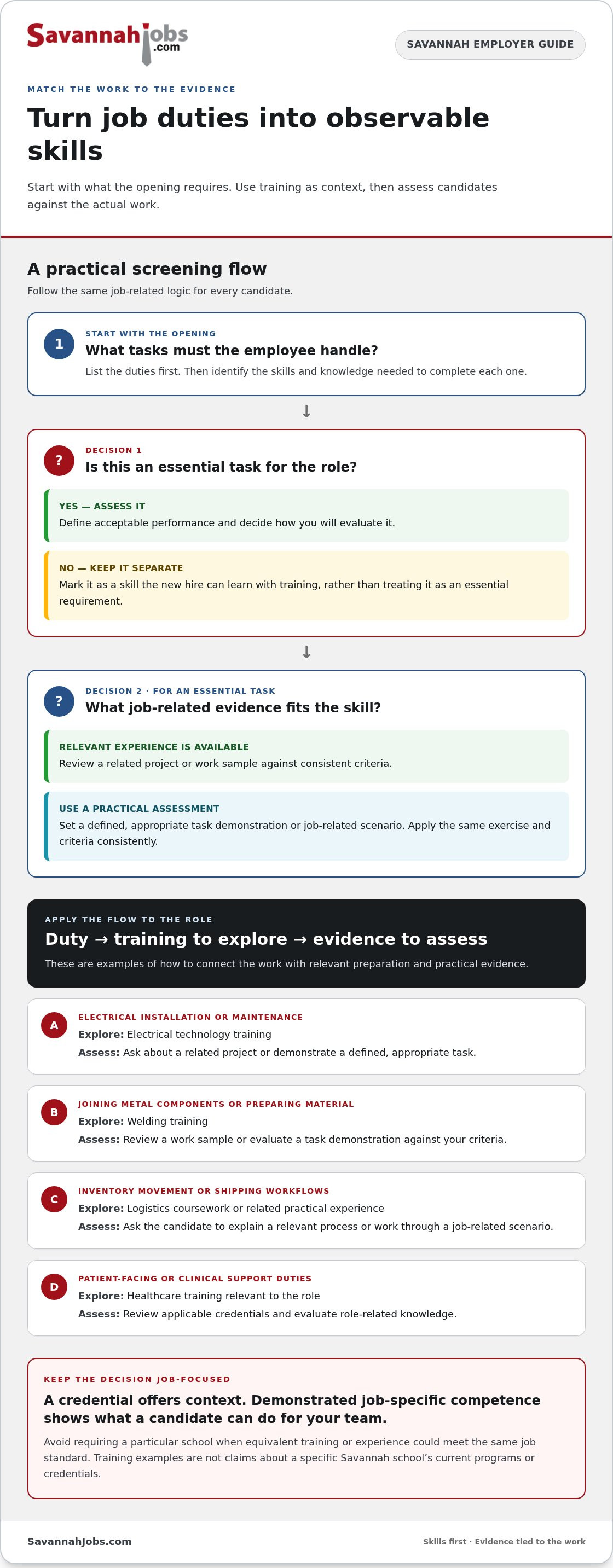
A training title can point you toward relevant candidates, but it can’t tell you whether someone is ready for a particular opening. Start with the work: list the tasks the employee must handle, then identify the skills and knowledge needed to complete them. This makes recruiting trade school graduates Savannah employers need more focused, while keeping screening criteria tied to the position rather than a school’s program labels.
Translate job duties into observable skills
Separate essential tasks from skills a new hire can learn with training. For each essential task, define acceptable performance and how you’ll assess it. Evidence might include a relevant project, a work sample, or a task demonstration using a consistent, job-related exercise. Avoid requiring a particular school when equivalent training or experience could prepare someone to meet the same standard.
| Example job duty | Relevant training area to explore | Evidence to assess |
|---|---|---|
| Assist with electrical installation or maintenance tasks | Electrical technology, as an example of a relevant training area | Explain a related project or demonstrate a defined, appropriate task |
| Join metal components or prepare material for fabrication | Welding, as an example of a relevant training area | Review a work sample or assess a task demonstration against your criteria |
| Support inventory movement or shipping workflows | Logistics coursework or related practical experience | Talk through a relevant process or use a job-related scenario |
| Assist with patient-facing or clinical support duties | Healthcare training relevant to the role | Review applicable credentials and assess role-related knowledge |
These examples illustrate how to connect duties, training areas, and evidence; they aren’t claims about a specific Savannah school’s current programs or credentials. For Savannah-area occupational context, the U.S. Bureau of Labor Statistics provides Savannah, GA labor market data. Use labor-market information to understand the local picture, then return to your own job duties to set screening criteria.
Use training examples without narrowing the candidate pool
For an electrical opening, electrical-technology training may be a useful starting point for reviewing relevant coursework or projects. For logistics work, look for experience with processes similar to the job rather than assuming a candidate is ready based on a course title. In healthcare and other safety-sensitive roles, distinguish credentials required for the position from preferred experience, and assess both consistently.
Let the job duties guide screening; treat program labels as clues, not hiring criteria. This gives candidates with equivalent preparation a fair chance to show relevant ability and keeps your team focused on the work. Once your requirements are clear, make the opening visible through Savannah-area job advertising alongside other outreach.
How to Assess Trade School Graduates Fairly and Practically
A consistent assessment helps you see what a candidate can do, what they still need to learn, and whether their experience fits the position. For Savannah employers recruiting trade school graduates, a useful process puts job requirements first and applies the same job-related standards to candidates with comparable experience. It also avoids treating a diploma or certificate as proof of every skill the role requires.
- Define the tasks. Identify the duties a new hire must handle and the skills needed to perform them.
- Review relevant evidence. Consider credentials, projects, lab work, internships, and supervised practice in relation to those duties.
- Check practical skills. Use a role-specific question or work sample when it helps assess an essential task.
- Compare consistently. Record observations against the same criteria for candidates with comparable experience.
Review credentials alongside practical evidence
Ask candidates to describe a project, lab exercise, internship, or supervised task that relates directly to the position. Use follow-up questions to understand their role, the steps they took, and how they approached a challenge. Keep questions anchored to stated duties, not general impressions. A credential can show a relevant area of study, while the candidate’s explanation and practical evidence clarify how that learning connects to your workplace.
Before interviews, divide qualifications into three groups: required credentials or skills, preferred experience, and abilities that can be developed after hiring. This keeps a preferred qualification from quietly becoming a barrier and helps you focus on what the employee must bring on day one. For regulated or safety-sensitive work, identify required credentials clearly and distinguish them from experience that would be helpful but isn’t essential.
Make interviews and skills checks role-specific
If a practical check fits the position, keep it short and tied to a real job duty. Explain what you’re assessing before the candidate begins, such as following a process, interpreting task instructions, or demonstrating a relevant technique. Use appropriate safeguards and avoid asking candidates to perform unnecessary work as part of the assessment. A focused exercise gives both sides a clearer view of the role’s expectations.
For each candidate, record observable evidence rather than broad labels such as “not experienced enough.” Note what the person explained or demonstrated, then compare that evidence with your criteria. Don’t assume recent graduates lack workplace habits, or that experienced candidates automatically have every required skill. A consistent method gives candidates a fair chance to show their preparation and helps your team make decisions you can explain.
New graduates may need onboarding, but that doesn’t mean they can’t be ready for entry-level responsibilities. Separate the ability to perform core tasks with reasonable guidance from full proficiency across every situation. Be clear about which duties require immediate capability and which can be learned through your normal training process. This helps you assess readiness realistically without expecting a new hire to arrive as a fully seasoned employee.
Reach Savannah Trade School Graduates With a Clear Recruitment Plan
A focused recruitment plan helps you reach relevant candidates without spreading your time across disconnected efforts. For recruiting trade school graduates Savannah employers should make the job easy to understand, share it through suitable local and online channels, then review which sources produce applicants who fit the role. A clear process also helps candidates decide whether the opening matches their skills and circumstances.
Write an opening that makes the job easy to evaluate
Choose a straightforward job title people are likely to recognize and search. Then describe the work plainly. Candidates need to understand what they’ll do, where the job is based, what schedule to expect, and which qualifications are required. Separate must-haves from preferred experience so applicants aren’t left guessing whether they should apply.
Be just as clear about the support you provide. If the position includes onboarding or training, describe it accurately without suggesting a guaranteed promotion or career outcome. Clear details help early-career candidates assess whether they can meet the role’s requirements and give your hiring team a more relevant applicant pool to review.
Coordinate local outreach and measure response
Use an orderly workflow. Each step makes the next one more effective:
- Define the role. Confirm the essential duties, required qualifications, schedule, location, and skills that can be learned after hiring.
- Write the posting. Use a recognizable title and concrete details, including what a typical workday involves and how candidates can demonstrate relevant preparation.
- Choose outreach channels. Share the opening through online job advertising and relevant Savannah-area education and community channels. This can include publicly available career resources or appropriate community networks, without assuming a formal school partnership.
- Track responses. Where your process allows, record how applicants found the opening and whether they meet the role’s stated requirements.
Local outreach and online advertising can complement each other. Savannah-area training institutions and community channels may help you connect with people exploring early-career opportunities, while a visible job posting gives candidates a clear place to review the full role. Keep the message consistent wherever you share it. If the title, schedule, or qualifications differ across channels, candidates may struggle to know which version is current.
After reviewing responses, look for useful patterns. If applicants misunderstand the schedule or duties, revise those details. If a required qualification screens out people who could meet the essential tasks through equivalent preparation, reconsider whether it truly needs to be mandatory. Treat the process as a practical feedback loop, not a one-time posting exercise.
A 30-day job posting on SavannahJobs.com is distributed to multiple local and national job boards, extending an opening’s visibility beyond a single channel. Advertise your Savannah-area opening with clear role details so candidates can assess fit before they apply.
Advertise Savannah Openings Where Local Candidates Can Find Them
Direct outreach can help you make connections, and a clear assessment process helps you compare candidates. But neither helps a graduate find an opening they don’t know about. Local job advertising adds visibility to your recruiting effort, giving job seekers interested in Savannah and the surrounding coastal area a place to discover and evaluate your vacancy.
SavannahJobs.com offers a 30-day job posting, with a single posting distributed to multiple local and national job boards. That reach can complement outreach through education and community channels while keeping the job details available for candidates to review. A visible, specific listing also gives your team a consistent reference point when discussing duties, required qualifications, location, and schedule with applicants.
Use local visibility to support your recruiting effort
SavannahJobs.com describes itself as the most visited job site in the region. The platform serves Savannah and the surrounding coastal area, with sister sites in Statesboro, Hilton Head Island, Bluffton, and Tybee Island. For Savannah employers recruiting trade school graduates, local visibility works best alongside relevant direct outreach and the job-related assessment standards you’ve set.
Keep the listing useful after it’s published. Make the title recognizable, explain the main responsibilities, and state the work location and schedule plainly. Describe required credentials separately from preferred experience, and be accurate about any training or onboarding you provide. These details help candidates judge fit before applying and can reduce confusion during your hiring process.
Employers can also choose a Featured Job upgrade or Featured Employer upgrade. These advertising options increase visibility on the platform. They don’t guarantee a specific number of applicants or hires, so keep evaluating candidates against the same role-specific criteria and choose the advertising option that suits your opening.
Take the next step with SavannahJobs.com
SavannahJobs.com is a recruitment advertising platform. It helps employers advertise openings rather than providing staffing or direct placement services. A job posting is one part of your recruitment plan: your team defines the role, reviews applications, and assesses candidates for the work.
Ready to make your Savannah opening easier to find? Visit the Employers page to view current posting rates and create an account. Choose a 30-day job posting, and consider a Featured Job or Featured Employer upgrade if added platform visibility fits your recruitment needs. Clear advertising paired with thoughtful assessment gives your hiring process a practical foundation.
Put Your Next Savannah Opening in Front of the Right Candidates
Your next hire can help strengthen both your team and Savannah’s skilled workforce. Make each opening a clear invitation: show candidates what the work involves, what preparation matters, and how they can demonstrate their abilities. A focused approach to recruiting trade school graduates in Savannah can become a repeatable part of your hiring process, giving your team a practical starting point each time a new role opens.
SavannahJobs.com has served as a preferred local hiring solution for the last 15 years. Use the local platform to put your opening in front of job seekers, then apply your role-specific criteria to every application and conversation. Your team stays in control of evaluating candidates, while a clear listing helps people decide whether the opportunity fits.
Post your Savannah opening with SavannahJobs.com and take the next step toward reaching local candidates. With a thoughtful job ad and a fair assessment process, you can move forward with confidence and help build the talent your Savannah team needs.
Frequently Asked Questions
Which trade schools serve the Savannah, Georgia area?
Savannah Technical College is a prominent local technical college, and online directories list additional training options in the area. Program names and availability can change, so use current school information when referring to a particular credential in a job posting. For hiring, treat school information as a starting point, then focus your requirements on the skills and tasks the position actually involves.
What kinds of jobs can trade school graduates qualify for?
Trade-school training may relate to electrical technology, welding, logistics, healthcare, transportation, and other technical occupations. A graduate’s fit depends on their specific coursework, practical experience, credentials, and the work your opening requires. For example, a logistics course may be relevant to an inventory role, but it doesn’t establish that a candidate has used your processes. Assess each person’s evidence against the job duties.
How can employers recruit recent trade school graduates?
When recruiting trade school graduates in Savannah, begin with a short list of essential duties and any credentials the job requires. Use those details to write an accurate posting, then share it through appropriate local education or community channels and online advertising. In interviews, ask candidates about relevant projects or supervised practice. Track which outreach sources bring applicants who meet the requirements, and adjust your messaging based on what you learn.
Do trade school graduates have enough experience for skilled jobs?
Some graduates bring hands-on training or project experience, but their preparation varies. Decide which tasks require day-one capability and which can be learned during onboarding. Then ask candidates to explain how they approached a related project or task. This helps you judge entry-level readiness without expecting full proficiency in every part of the job from the start or assuming that a credential alone proves practical experience.
How should I assess a trade school graduate’s practical skills?
Assess skills through evidence tied directly to the role. Ask a candidate to describe a relevant project, explain a work process, or complete a short job-related work sample when appropriate. Tell them what the exercise evaluates, then use the same criteria for candidates with comparable experience. Keep mandatory credentials separate from preferences, and record specific observations rather than relying on general impressions or the name of a school.
Can Savannah Jobs help employers reach trade school graduates?
Yes. Savannah Jobs provides recruitment advertising for employers hiring in Savannah and the surrounding coastal area. A single posting is distributed to multiple local and national job boards, and Featured Job and Featured Employer upgrades are available. This advertising can support your outreach while your team reviews applications and assesses candidates. Visit the Employers page to view current posting rates and create an account.


