

What if a candidate’s first impression of your workplace comes from a review or search result, not your careers page? Managing online employer reputation Savannah candidates encounter starts with knowing where they may see your business: job portals, professional networks, review sites, Google results, and social media.
A negative comment can feel discouraging, especially when you’re short on time and monitoring several channels. A thoughtful response doesn’t need to sound defensive, and online feedback is only one part of the picture. The goal is to make public hiring signals reflect the experience candidates can expect when they apply and meet your team.
This guide shows you how to map the online signals job seekers are likely to find, set a manageable monitoring routine, and respond to feedback professionally. You’ll also learn how to keep job ads and other candidate-facing information clear and consistent, so Savannah-area applicants can form a more trustworthy impression of your workplace.
Key Takeaways
- Workplace experience and public information together shape your reputation as an employer.
- Map where Savannah candidates may encounter your company, from job ads and search results to review platforms.
- When managing online employer reputation Savannah employers should look for recurring themes across channels, not react to one isolated rating.
- Use a calm response process: understand the concern, check the facts, reply respectfully, and address patterns behind the feedback.
- Keep job details and public information consistent, and treat job advertising as one part of building candidate trust.
What managing online employer reputation means for Savannah employers
Online employer reputation is how people perceive an organization as a place to work. That perception reflects both the reality of working with your team and the information people can find about your organization. Reviews matter, but so do job advertisements, career pages, search results, social posts, news, and the way applicants are treated during recruitment.
Savannah candidates may encounter these signals in different orders. Someone might find a job ad first, then search the employer’s name, compare the company website with public feedback, or ask people in their network. Not everyone uses the same sources, and each platform may show different details. A clear, consistent account of the role and workplace helps candidates make sense of what they find.
Employers can’t control every public comment or assumption. They can influence the information they publish, make the hiring process more respectful, and respond constructively when feedback raises a concern. A practical goal for managing online employer reputation is to make public hiring information align with the experience candidates and employees actually have. For broader brand-building ideas, explore this Savannah employer branding guide.
Employer reputation also differs from employer branding. Branding is what an organization chooses to communicate about itself. Reputation is the impression people form from that message, their own experiences, and what they hear or read from others. For organizations seeking guidance on intentional strategic communications, resources like eq4digital.com show how emotional intelligence can inform external messaging. Your message matters, but it is only part of the picture.
Which voices and experiences shape an employer's reputation?
Current employees speak from daily experience, while former employees may describe what they saw during a different period. Candidates form impressions through application instructions, interview communication, and follow-up. Public observers, including customers or community members, may add another perspective, though they may not know what working there is actually like.
“Employer reputation is the perception shaped by employees, former employees, candidates, and public information about what it’s like to work at an organization.” Treat direct accounts as useful feedback, but distinguish them from assumptions based on incomplete or outdated details. A former job ad, for example, may still appear in search results after a role has changed. Check whether information is current before treating it as a reliable picture of today’s workplace.
Why local hiring signals matter in Savannah
For employers recruiting in Savannah and the surrounding coastal area, practical details help candidates judge whether a role fits their circumstances. State the work location clearly, describe the schedule and responsibilities, and explain how to apply. If the position is outside central Savannah or has a specific work arrangement, say so directly instead of leaving applicants to infer it.
These details are more than administrative. If a job ad describes one schedule but the interview suggests another, candidates may wonder which information to trust. Review role descriptions and application instructions whenever a position changes. Consistency across your website and job advertisements gives Savannah-area job seekers a clearer, more credible view of the opportunity. Honest communication also sets expectations before the first conversation.
Where Savannah candidates encounter your employer reputation online
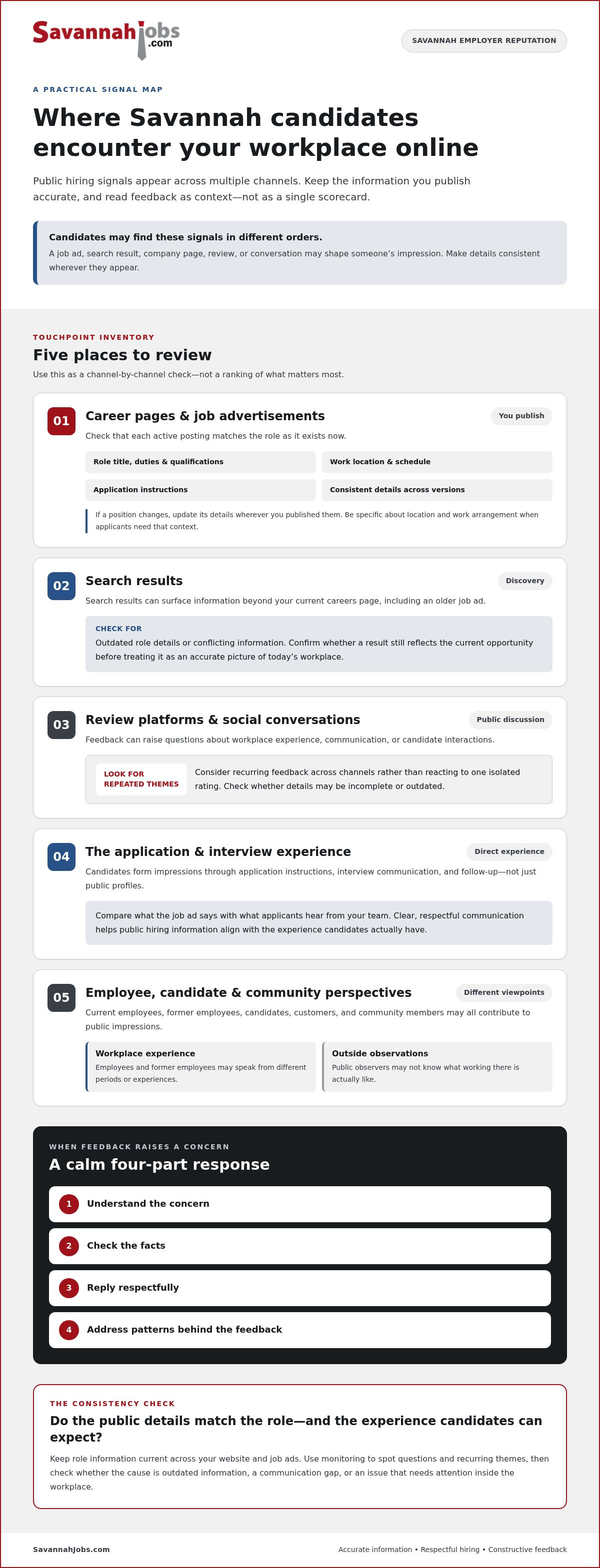
Candidates can find information about your organization in several places: your company website, job advertisements, search results, review platforms, and social channels. What appears first depends on the person, their search, and each platform’s visibility. Don’t assume every Savannah-area applicant checks the same sites. Instead, make an inventory of the public touchpoints you control and the places where people may discuss their experiences.
Think of these channels as connected parts of a candidate’s research, not interchangeable scorecards. A search result might lead to an older job ad, while a current careers page describes a different schedule. When titles, locations, duties, or application steps conflict, candidates have to guess which details are current. That uncertainty can affect their impression before they speak with your team.
Managing online employer reputation in Savannah means keeping public information accurate while improving the real interactions behind it. Reviewing a channel helps you understand what candidates may see, but it won’t fix a confusing application process or address an employee concern on its own. Use monitoring to spot questions and patterns, then determine whether the cause is outdated information, a communication gap, or an issue that needs attention inside the workplace.
Job advertisements and career pages as reputation touchpoints
Check each active job description against the role as it exists now. Confirm duties, work location, schedule, qualifications, and application steps. If the job has changed, update the details wherever you’ve published them. Clear information helps candidates assess fit and form realistic expectations before they invest time in applying. A polished advertisement can present an opportunity accurately, but it can’t make up for a workplace experience that doesn’t match its promises.
For Savannah and the surrounding coastal area, avoid relying on a broad location label if applicants need more detail to understand where or how the work is done. Consistency across your website and job advertisements makes it easier for people to compare information without wondering whether they’ve found an outdated version.
Reviews, social conversations, and employee perspectives
Review platforms and social channels can show how people describe their experiences, but a post or rating is not a complete measure of workplace quality. Read for recurring themes and context, not just the strongest praise or criticism. Protect privacy when reviewing feedback: don’t identify employees or candidates in public responses or share confidential details while trying to clarify a comment.
Separate channel activity from the work needed to improve the underlying experience. A reply can acknowledge a concern, but recurring feedback may call for an internal review of communication, expectations, or hiring practices. Use this employer review-site management checklist to guide platform-focused review practices, then connect what you learn to the appropriate people in your organization.
- Compare job titles and role details across active listings.
- Check whether location, schedule, and application instructions are current.
- Review public comments for repeated themes, while keeping private information private.
Accurate job advertising is one useful hiring touchpoint, not a substitute for a credible workplace. SavannahJobs.com distributes a single employer job posting to multiple local and national job boards. Learn about local job advertising with SavannahJobs.com.
How to assess employer reputation without relying on one review score
A single rating can point to a question, but it can’t explain every employee’s experience or show what a candidate will encounter during hiring. “One review score is a snapshot, not a complete account of every candidate or employee experience.” Look for recurring themes across public channels and your own hiring process, then decide what needs correction, clarification, or deeper follow-up.
Use a simple assessment to connect what you hear with a next step and a responsible owner. Revisit the same channels over time so you can distinguish a repeated concern from an isolated comment.
A practical listening routine for busy hiring teams
Choose a recurring time to review relevant public channels, and assign a named team or role to each one. Keep a brief log with the date, channel, theme, and next action. Avoid collecting personal details you don’t need. Separate urgent factual errors, such as an outdated job location, from longer-term workplace concerns that need internal review. This routine makes reputation monitoring more manageable than checking everything reactively.
Turn reputation signals into useful hiring questions
Compare recurring public concerns with questions applicants ask and feedback they share during or after the application process. If candidates repeatedly ask about the schedule, check whether your job ad states it plainly. If feedback points to unclear follow-up, review how your hiring team communicates next steps. For help planning where local job messages appear, use this Savannah recruitment advertising strategy guide.
Keep the assessment focused on useful action, not a target score. A pattern may call for a copy edit, a clearer answer in the hiring process, or a conversation with the team responsible for that part of the experience. Record the action and revisit the issue during your next review. This helps you determine whether the information was corrected or the same concern continues to surface.
Respond to negative feedback and improve candidate trust
A critical comment can be difficult to read, especially when it describes an experience your team doesn’t recognize. Resist the urge to answer immediately. A steady process helps you respond with care, protect privacy, and identify whether the feedback points to a broader issue. A professional response acknowledges the concern, protects privacy, and offers a useful next step.
Use this sequence before replying:
- Pause. Give the people involved time to review the comment without reacting in frustration.
- Understand the concern. Identify the specific issue being raised without assuming the account is complete or accurate.
- Check the facts. Review relevant job information or internal processes with the appropriate team. Keep personal and confidential details out of public discussion.
- Respond respectfully. Acknowledge the feedback and share a practical next step without arguing or making promises you can’t keep.
- Address recurring causes. If similar concerns appear over time, assign an owner to investigate and improve the underlying process or workplace practice.
Responding professionally when criticism is public
Keep a public reply concise, calm, and specific to the concern. You can thank someone for sharing feedback and acknowledge that their experience matters without confirming details you haven’t verified. If the issue involves an individual application or employment matter, invite them to continue through an appropriate private channel. Don’t identify the person, disclose private information, or debate their account in public.
For example: “Thank you for sharing this concern. We take feedback about the hiring process seriously. Please contact our recruiting team through the channel provided in your application so we can understand the situation.” Adapt the wording to what your team can genuinely follow through on. Avoid canned defensiveness, retaliation, or asking employees to post praise that doesn’t reflect their honest views.
Close the loop with candidates and employees
A reply is only the start. Assign an internal owner to review repeated concerns and share relevant improvements with the people responsible for the process. If a job advertisement gives incorrect information, correct it across the employer-controlled materials where candidates may encounter it. Then compare the application instructions and candidate communications with the experience your team actually provides.
If applicants are confused about how to apply, clarify the instructions and make sure recruiting messages explain the next step. If feedback describes a recurring workplace issue, a cosmetic public response won’t resolve it. Lasting trust comes from appropriate changes and consistent follow-through, not a polished sentence alone.
Clear job details are one practical part of a credible candidate experience. Explore job advertising with SavannahJobs.com to share accurate role information with candidates.
Build a stronger Savannah hiring presence through consistent public information
A trustworthy hiring presence comes from alignment. Candidates should find the same core facts about a role wherever they encounter it, and their experience applying should support the expectations those details set. Job advertising can help put an opportunity in front of candidates, but it can’t replace a credible workplace or fix a hiring process that doesn’t match the advertisement.
Use this checklist to keep your candidate-facing information current and your follow-up practical:
- Check role details. Confirm duties, location, schedule, qualifications, and application instructions before publishing or renewing a job advertisement.
- Keep employer information aligned. Compare the details on your career page and active job listings. Update outdated information wherever your organization controls it.
- Review feedback for patterns. Look for recurring questions and concerns across candidate interactions and public feedback, rather than treating one comment as the whole picture.
- Respond with care. Acknowledge feedback respectfully, protect personal information, and avoid claims or promises your team can’t support.
- Address repeat issues. Assign an owner to investigate recurring problems and follow through on improvements to the workplace or hiring process.
Make every candidate-facing detail consistent
Review the candidate journey from the first job advertisement through application follow-up. Check that role duties, work location, schedule, and instructions still reflect the opportunity. If a candidate must take a particular step to apply, make that step easy to find. Clear, consistent information helps Savannah-area job seekers understand what to expect and gives your recruiting team a reliable basis for answering questions.
Repeat the review when a role changes or application steps are updated. Even a small difference, such as one listing describing a different schedule, can prompt avoidable questions. Keep employer information straightforward across the channels you manage, and correct outdated details promptly.
Put Savannah job opportunities in front of local candidates
Local job advertising is one practical way to share opportunities with people seeking work in Savannah and the surrounding coastal area. SavannahJobs.com distributes a single employer job posting to multiple local and national job boards. Employers can also choose Featured Job and Featured Employer upgrades. These advertising options support candidate visibility, but don’t guarantee applications or hiring outcomes.
SavannahJobs.com has operated for the last 15 years and describes itself as the most visited job site in the region. Employers can learn about local job advertising with SavannahJobs.com, then visit the Employers page for current posting rates and account setup details.
Keep the fundamentals in view: accurate role information, respectful communication, and meaningful action on recurring concerns. Together, they help make your Savannah hiring signals more consistent with the experience your organization offers.
Make reputation work part of your hiring routine
Trust grows through follow-through. Make managing online employer reputation part of how your team plans, communicates, and learns from hiring. Assign responsibility, make space to act on recurring feedback, and treat each candidate interaction as a chance to show what your organization is like in practice.
You don’t need to overhaul everything at once. Choose one improvement your team can make now, such as clarifying a confusing application step or setting a regular time to review public feedback. Then build from there. Small, consistent actions can help your Savannah hiring presence feel more dependable to people considering their next opportunity.
For a practical local advertising option, visit SavannahJobs.com and go to the Employers page to view posting rates and create an account. Share opportunities with job seekers while keeping role information clear and aligned with the experience your workplace delivers.
Keep listening, keep improving, and give Savannah-area candidates a reason to approach your opportunities with confidence.
Frequently Asked Questions
How can a small business monitor its online employer reputation in Savannah?
Keep the process simple and assign one person to coordinate it. On a recurring basis, review the public channels your business uses, active job ads, questions candidates raise, and employee feedback shared through appropriate internal channels. Note dates, recurring themes, and who will follow up, without recording unnecessary personal details. Scale the routine to your team’s size, and remember that monitoring doesn’t mean every mention needs a public reply.
Can an employer remove a negative online review?
Whether a review can be removed depends on the platform’s current rules and the circumstances of the post. If you believe content violates those rules, use the platform’s reporting process and provide relevant information. Don’t use retaliation or misleading tactics to influence reviews. Where a post raises a legitimate concern, consider what your organization can learn from it. Separately, correct inaccurate details in job ads or other information your business controls.
How should an employer respond to a negative review without making the situation worse?
Pause before responding, check relevant facts, and acknowledge the concern in calm, respectful language. Avoid public arguments or sharing information that could identify a candidate or employee. For an individual matter, invite the person to use an appropriate private channel rather than discussing details online. Keep the reply brief and factual. If similar concerns keep appearing, have the responsible team investigate the hiring process or workplace issue behind them.
How often should Savannah employers check their online reputation?
Set a consistent review schedule that fits your hiring activity and available staff time. A small team with few active openings may choose a lighter cadence, while active recruitment can call for more frequent checks. Review public channels alongside current job information and feedback from applicants. You don’t need to act on every mention. Focus on changes that affect candidate understanding or point to a recurring concern, and assign follow-up clearly.
Does a job posting affect an employer’s online reputation?
Yes. A job posting helps shape the impression candidates form during recruitment. Clear duties, location, schedule, requirements, and application steps give people a better basis for deciding whether a role fits. For example, an outdated schedule can leave applicants unsure what the position involves. Accurate advertising supports a consistent candidate experience, but it can’t stand in for a credible workplace or make expectations match if the actual role differs.
What should an employer do if online feedback conflicts with its own view of the workplace?
Treat the difference as a reason to investigate, not proof that either account is automatically right or wrong. Compare the concern with input from candidates and employees, while protecting their confidentiality. Look for specific details your organization can verify, such as a step in the application process or a workplace practice. Route concerns through appropriate internal channels, and avoid dismissing criticism or making broad public claims before you understand the issue.
Can Savannah Jobs manage an employer’s reviews or reputation for them?
Savannah Jobs helps employers advertise job opportunities, with a single posting distributed to multiple local and national job boards. Employers can use that service to promote hiring in Savannah, while monitoring reviews and responding to feedback remain part of their own practices. Keep those responsibilities distinct: advertising shares an opportunity, while workplace actions shape the experience behind it.


