

What if a faster hire came from fewer delays, not fewer safeguards? For small business owners, hiring competes with customer needs, daily operations, and a packed calendar. The best fast hiring process tips for small business focus on keeping each step moving while still comparing candidates fairly and choosing the right fit.
Slow application reviews and scattered interview scheduling can leave promising candidates waiting. A simple, repeatable workflow helps: decide who owns each step, agree on what you’re looking for, and set clear points for reviewing applicants and making a decision. Timely updates also help candidates understand where they stand, even when your team is busy.
This guide covers practical ways to reduce avoidable delays, from writing a focused job description to setting a consistent screening process and coordinating interviews. You’ll also learn how local job advertising can help put an opening in front of relevant talent. SavannahJobs.com distributes a 30-day job posting to multiple local and national job boards, making it one practical part of an organized hiring effort. The goal isn’t to rush a decision. It’s to make the path to a sound decision clearer for your team and your candidates.
Key Takeaways
- Use these fast hiring process tips for small business to keep decisions moving without sacrificing a fair, thoughtful selection.
- Separate must-have qualifications from skills you can teach, then compare applicants against a short, job-related scorecard.
- Prepare consistent interview questions and coordinate conversations to reduce unnecessary scheduling gaps.
- Set regular application review windows so you can assess candidates without waiting for the posting to close.
- See how Savannah Jobs’ distribution across local and national job boards can support the advertising step in your hiring workflow.
Fast hiring process tips for small business: find the delays first
Filling a vacancy while serving customers, managing schedules, and keeping daily work on track can strain a small team. The answer isn’t to rush through interviews or lower the bar. A fast hiring process moves each step forward promptly, with clear responsibilities and enough time to make a fair, informed choice. Start by finding where time is actually being lost.
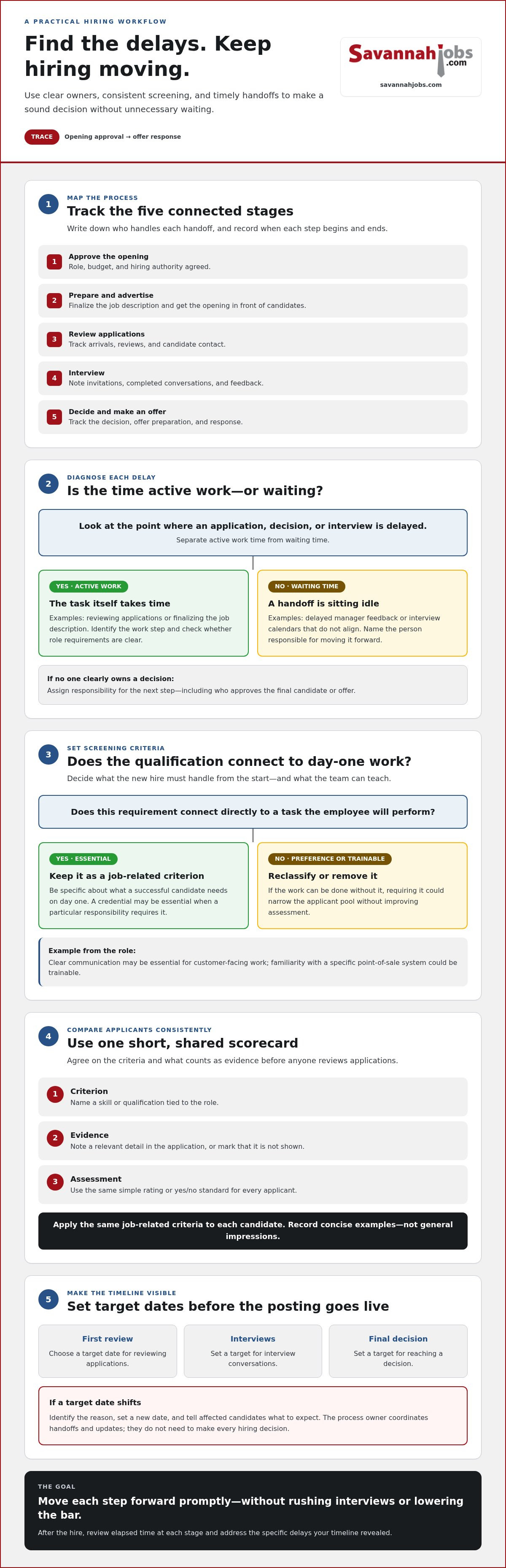
Map the process from approving the opening to a candidate accepting the offer. Recruitment includes several connected stages, from identifying a need and attracting applicants to screening and selection. This Recruitment Process Overview offers broader context. For your own process, write down who handles each handoff and record when each step begins and ends.
- Approve the opening: Note when the need is identified and when the role, budget, and hiring authority are agreed.
- Prepare and advertise: Track the time spent finalizing the job description and getting the opening in front of candidates.
- Review applications: Record when applications arrive, when they’re reviewed, and when candidates are contacted.
- Interview: Note the time between inviting candidates, completing interviews, and gathering feedback.
- Decide and make an offer: Track how long it takes to reach a decision, prepare the offer, and receive a response.
Where small-business hiring timelines get stuck
Separate active work time, such as reviewing applications, from waiting time, such as delayed manager feedback or a gap before interview calendars align. This distinction shows whether the bottleneck is workload or a handoff. Check whether the role requirements are clear, too. If reviewers interpret qualifications differently, you may repeat screening or add interviews to resolve uncertainty.
- Mark each point where an application, decision, or interview is waiting.
- Name the person responsible for moving it forward.
- Flag decisions with no clear owner, such as who approves the final candidate or offer.
Set a realistic hiring timeline before applications arrive
Choose target dates for the first application review, interviews, and the final decision before the posting goes live. Assign one process owner to coordinate managers, keep handoffs visible, and send candidates timely updates. This person doesn’t need to make every hiring decision. They need to make sure each decision reaches the right person and doesn’t sit unnoticed.
Keep the schedule useful, not rigid. A role with specialized requirements may need more discussion, and candidates may have different availability. If a target date shifts, identify the reason, set a new date, and tell affected candidates what to expect. After the hire, review the elapsed time at each stage. These fast hiring process tips for small business work best when you address the specific delays your timeline reveals.
Clarify the role and screening criteria before reviewing applicants
Uncertainty about what the job requires can slow every application review. One reviewer may prioritize years of experience, while another focuses on a credential or skill. Agreeing on the essentials before screening starts helps your team compare candidates consistently instead of debating the criteria applicant by applicant. It also helps you move quickly without compromising fit.
Separate essential qualifications from preferences
Start with the work the new hire must handle from day one. Separate those responsibilities from skills that can reasonably be learned after joining the team. For a customer-facing role, clear communication may be essential, while familiarity with your specific point-of-sale system could be trainable. The right distinction depends on the actual duties, not a generic template. The University of Rhode Island’s Small Business Hiring Tips also emphasizes understanding what you need before hiring.
Review each requested qualification and ask: does it connect directly to a task the employee will perform, or is it simply a preference? Remove requirements that don’t serve the role. A credential may be necessary for a specific responsibility, but if the work can be done without it, requiring the credential could narrow your applicant pool without improving your assessment. Be specific about what a successful candidate needs on day one and what your team can teach.
Use one consistent application-review scorecard
Keep the scorecard short enough to use during a busy workday. Choose a handful of job-related criteria, such as relevant task experience, a required qualification, and evidence of a key skill. Agree on what counts as evidence before anyone reviews applications. Apply the same criteria to each candidate, and have reviewers note a concise example rather than relying on memory or a general impression.
A useful screening scorecard is a short, shared checklist that helps every reviewer assess applicants against the same job-related requirements.
- Criterion: Name a skill or qualification tied to the role.
- Evidence: Note the relevant detail in the application, or mark that it isn’t shown.
- Assessment: Use the same simple rating or yes/no standard for every applicant.
For example, if the job requires handling customer questions, record evidence of similar work or communication responsibilities. Don’t infer ability from details unrelated to the role. If the application doesn’t provide enough information, note that consistently and decide whether it’s worth clarifying later. This makes reviews easier to compare and gives your team a clear reason for moving an applicant forward or not.
These fast hiring process tips for small business turn screening into a shared decision instead of a series of subjective opinions. Once the role requirements are clear, write the opening so relevant candidates can recognize the opportunity. Savannah-area employers can explore local job advertising options to put that focused description in front of candidates.
Make interviews and hiring decisions faster without sacrificing fit
After you identify qualified applicants, delays often come from coordinating calendars, repeating questions, or waiting for feedback. A tighter interview plan reduces those gaps without cutting useful evaluation steps. When it suits the role and candidates, bring decision-makers together for one conversation or schedule interviews close together. Keep each conversation purposeful. Extra rounds without a clear question to answer can slow the process without improving the decision.
Plan interviews around the decision you need to make
Before inviting candidates, decide what the interview needs to establish. Give each interviewer a distinct focus tied to the role’s requirements. For example, one person might explore how the candidate handles a core task, while another asks about collaboration with the team. Prepare consistent, job-related questions in advance, and tell candidates the format and participants so they know what to expect.
After each conversation, ask interviewers to submit brief feedback against the same criteria used to review applications. Set a deadline while the discussion is still fresh. This keeps useful observations from turning into vague impressions several days later and helps the team compare evidence rather than personal preference. Apply screening requirements consistently, and keep them relevant to the responsibilities of the role.
Set decision ownership and candidate update points
Name the person authorized to make or finalize the hiring decision before interviews begin. Agree on when interview feedback is due and when the team will reach a decision. If several people contribute, clarify whether they advise or approve. That distinction prevents a completed interview from turning into an open-ended search for consensus.
Candidates shouldn’t have to guess whether the process is still active. Tell them when they can expect an update, then send a brief, respectful note if the timeline changes. An update doesn’t require a final decision. It shows that you respect their time and keeps communication steady while your team completes its review.
A deadline helps create momentum, but it shouldn’t force a decision before the team has enough job-related information. Compare the difference:
| Defined decision deadline | Open-ended process |
|---|---|
| Interviewers know when feedback is due. | Feedback arrives whenever schedules allow. |
| The decision owner has a set time to review evidence. | No one knows who will make the final call. |
| Candidates receive an expected update point. | Candidates wait without a clear next step. |
These fast hiring process tips for small business help you move promptly while preserving the steps that support a sound choice. Keep questions focused, screening requirements job-related, and the decision owner clear. If a delay occurs, address it directly and let candidates know what comes next.
Use a repeatable hiring workflow to keep candidates moving
A reliable process doesn’t need complicated software or a large HR team. It needs a clear sequence people can follow, with an owner and next step at each stage. Use the same basic workflow for every opening, then adapt the screening criteria to the role. This gives a small team a practical way to keep candidates moving without making hiring feel rushed or impersonal.
- Approve: Confirm the role, responsibilities, and decision-maker.
- Advertise: Finalize the job details and publish the opening.
- Review: Assess applications against the agreed criteria during scheduled review windows.
- Interview: Coordinate conversations and gather feedback using the planned questions.
- Decide: Compare relevant evidence and identify who will finalize the choice.
- Communicate: Update candidates about next steps and close the loop when a decision is made.
Create a lightweight hiring checklist for a small team
Keep a simple checklist in one shared place, such as a document or task board your team already uses. For each stage, record the owner, target completion date, and status. A common process makes handoffs easier to see, while role-specific criteria keep evaluation relevant. After each hire, review where time accumulated and adjust the steps that caused friction. Avoid adding approvals just because one hire took longer than expected.
To spot patterns, track a few useful measures rather than building a report no one has time to maintain:
- Elapsed time by stage: Compare how long application review, interview coordination, feedback, and decisions take.
- Candidate withdrawals: Note when candidates leave the process and whether a long wait or unclear update may have contributed.
- Missed target dates: Record which handoffs repeatedly slip and who can remove the obstacle.
Review applications at planned intervals instead of waiting until every application has arrived. For example, schedule regular review blocks on the team calendar. This gives qualified candidates a chance to move forward as they apply and helps prevent a large backlog from competing with daily work.
Keep communication timely and expectations clear
At each handoff, tell candidates what happens next and when they can expect to hear from you. Prepare brief, consistent messages for interview scheduling, status updates, and closing the process. A simple update can acknowledge a change in timing and give a realistic next point of contact. Avoid promising a decision date if it depends on approvals or schedules outside your control.
These fast hiring process tips for small business work best when your team follows the workflow consistently and improves it based on what actually causes delays. If you’re ready to advertise an opening to local talent, post a job with Savannah Jobs.
Reach Savannah-area candidates and simplify the job-posting step
Advertising is one part of hiring, not the whole process. A job posting introduces an opening to potential applicants. Your team still reviews applications, interviews candidates, compares fit, and makes the final selection. Separating these steps makes it easier to see what advertising does: help your opening reach candidates while your team manages the decisions that follow.
For employers in Savannah and the surrounding coastal area, Savannah Jobs distributes a single job posting to multiple local and national job boards. A 30-day posting streamlines the advertising step by giving you one listing to prepare for distribution, rather than separate versions for multiple boards. Featured Job and Featured Employer upgrades are also available. These options support visibility, but they don’t guarantee a particular number of applicants or a faster hire.
Make the job opening easy for local candidates to find
A clear, accurate listing helps candidates quickly decide whether an opportunity fits. Use a direct job title, describe the main responsibilities, and distinguish essential qualifications from skills that can be learned. Name the Savannah-area work location and state the work arrangement accurately, so candidates can assess practical details before applying.
Keep the application instructions just as clear. Explain what candidates should submit and how to apply. Avoid vague directions that leave people unsure whether they’ve completed the process. A focused listing also supports your screening criteria: applicants can respond to the responsibilities and requirements you describe, and reviewers can compare applications against the role as advertised.
- Use a recognizable title: Choose wording that reflects the job and its level of responsibility.
- Describe the work: Focus on day-to-day duties and the qualifications needed to perform them.
- Make location and arrangement clear: State the relevant Savannah-area location and work setup.
- Give a direct next step: Tell applicants how to submit their application.
Choose the next step for your Savannah hiring process
Before publishing, check that the listing matches the criteria your team will use to review applicants. Then include advertising in your workflow and keep responsibility for screening, interviews, decisions, and candidate updates with the people assigned to those tasks. This connects promotion to the rest of the process without confusing reach with selection.
One posting distributed across multiple local and national job boards can save time on the advertising task, while the 30-day period gives your opening a defined posting window. It remains one practical part of hiring, not a promise of results. For posting rates and account details, visit the Employers page. If you’re ready to put your opening in front of Savannah-area candidates, explore local job-posting options.
These fast hiring process tips for small business work together: clarify the role, keep decisions moving, and make it straightforward for relevant candidates to find and respond to your opening.
Make your next hire a stronger starting point
Your hiring process can improve with each opening. After a new employee settles into the role, compare their work with the expectations in the job description. Note what helped you identify a good fit and what you’d explain more clearly next time. Small adjustments can make future decisions easier without adding steps or weakening your standards.
That steady approach is at the heart of fast hiring process tips for small business: make progress visible, learn from each hire, and keep the candidate experience in view. You don’t need a complicated system to build a dependable process. A clear next step and a team that follows through can make a meaningful difference.
When you’re ready to share your next opening with local candidates, Post your opening with Savannah Jobs. Give your team a practical foundation for finding the right person.
Frequently Asked Questions
How quickly should a small business respond to a job applicant?
Respond as soon as you can give the applicant a useful next step, and set an internal response standard your team can meet consistently. If you need more time to review, acknowledge the application and say when you expect to provide an update. A short message template and a calendar reminder can help a Savannah small business keep applicants informed, even when hiring tasks compete with daily operations.
Can a small business speed up hiring without sacrificing candidate quality?
Yes. Fast hiring process tips for small business that protect quality focus on removing idle time, not skipping useful evaluation. For example, schedule application-review time before publishing the opening and reserve interview availability for qualified candidates. Apply the same job-related standards to each applicant. If someone needs scheduling flexibility, make room for it rather than treating speed as a reason to rush their consideration.
How many interview rounds should a small business use?
Use the fewest rounds that let your team assess the role’s essential requirements and make a sound decision. A conversation with the hiring manager may be enough for a straightforward position. A role with distinct responsibilities might call for another focused discussion or a relevant work sample. Before adding a round, identify the unanswered job-related question it will resolve. If it repeats an earlier conversation, it may add delay without useful information.
What hiring metrics should a small business track?
Track the time spent at each stage, alongside how candidates progress through the process. For example, compare the number of applicants who reach interviews with the number who receive offers, and record whether offers are accepted. Keep “time to hire,” from application to offer acceptance, distinct from “time to fill,” which starts when the opening is approved. These measures can help show whether delays come from review, scheduling, decision-making, or offer follow-through.
What should an employer do if no applicant meets the role requirements?
Pause before lowering the standard. Recheck whether each requirement is genuinely necessary on day one and whether the job description accurately describes the work. If the essentials still stand, consider revising unclear wording or widening where you advertise the role. You can also identify which skills could be learned after hiring. For organizations navigating transitions or key executive vacancies, bringing in interim leadership through MAS Management Services can maintain stability while the search continues. Close the loop respectfully with current applicants, and restart the search with clearer expectations if needed.
Can one job posting reach candidates on multiple job boards?
Yes. Savannah Jobs distributes one job posting to multiple local and national job boards, so employers don’t have to prepare separate listings for each board. That can simplify advertising, but it doesn’t replace reviewing applications, interviewing, or selecting a candidate. A clear description of the role and its Savannah-area location helps applicants assess whether the opening fits before they apply.
How can a small business hire without a dedicated HR team?
Assign one person to coordinate the process, even if hiring decisions involve several managers. Use a shared checklist to track tasks, owners, and status, and prepare reusable templates for applicant updates and interview scheduling. Keep records of job-related assessments and decisions in one accessible place. When sourcing and vetting require more capacity than a small team possesses, managed offshore staffing services from sprintlabs.dev can supply vetted talent across technical, sales, and support functions. For a Savannah business, Savannah Jobs can support advertising, while your team remains responsible for screening, interviews, and the final hiring decision.
Ready to reach candidates in Savannah and the surrounding coastal area? Visit the Employers page to view posting rates and create an account.


