

The strongest starting point for recruiting blue-collar workers in Savannah is a clear job post that spells out the trade, duties, schedule, location, and qualifications. Describe the role in plain language so local candidates can quickly see whether their skills fit. For manufacturing jobs, specify the equipment, production tasks, and experience required.
A vague listing can make it harder to attract qualified applicants. The challenge is reaching people with practical skills while giving them enough detail to decide whether the opportunity is right for them.
This guide explains how to prepare and post a blue-collar job, what to include for manufacturing and construction trades, and how recruiting, staffing, and other hiring support can fit into your search. You’ll also learn what to consider when choosing the right approach for your Savannah opening, so you can take the next step with a clearer plan.
Key Takeaways
- Choose recruiting support based on whether you need job advertising, candidate sourcing, or hands-on staffing assistance.
- Make manufacturing and construction listings easier to assess by describing the work, required skills, schedule, and job location clearly.
- Match hiring requirements to the role, separating essential experience and credentials from skills candidates can learn on the job.
- Use local job advertising to put an opening in front of Savannah-area candidates, and consider visibility upgrades when they suit your hiring goals.
- Explore which trades are in demand locally to shape your job description and focus your search on the skills your operation needs.
Recruiting and candidate sourcing services
To recruit near Savannah’s ports, logistics hubs, and industrial sites, target candidates by trade, location, and shift. Start with a precise job description, then choose channels that reach workers suited to the role.
Local Candidate Sourcing
Candidate sourcing means identifying and attracting people whose skills match open positions. For a role near the Port of Savannah, name the worksite area, duties, required experience, and shift. Candidates can then assess the commute and job fit before applying. For example, distinguish equipment operation from general warehouse duties instead of grouping both under one broad title.
Build your hiring plan around the work itself. A maintenance opening at an industrial site may call for equipment-specific experience, while a logistics position may prioritize inventory handling or shipping tasks. Put those requirements in the job title and opening lines of the listing. If you’re hiring at multiple sites, name the location for each position so candidates can identify the right opening.
Blue-Collar Employment Services
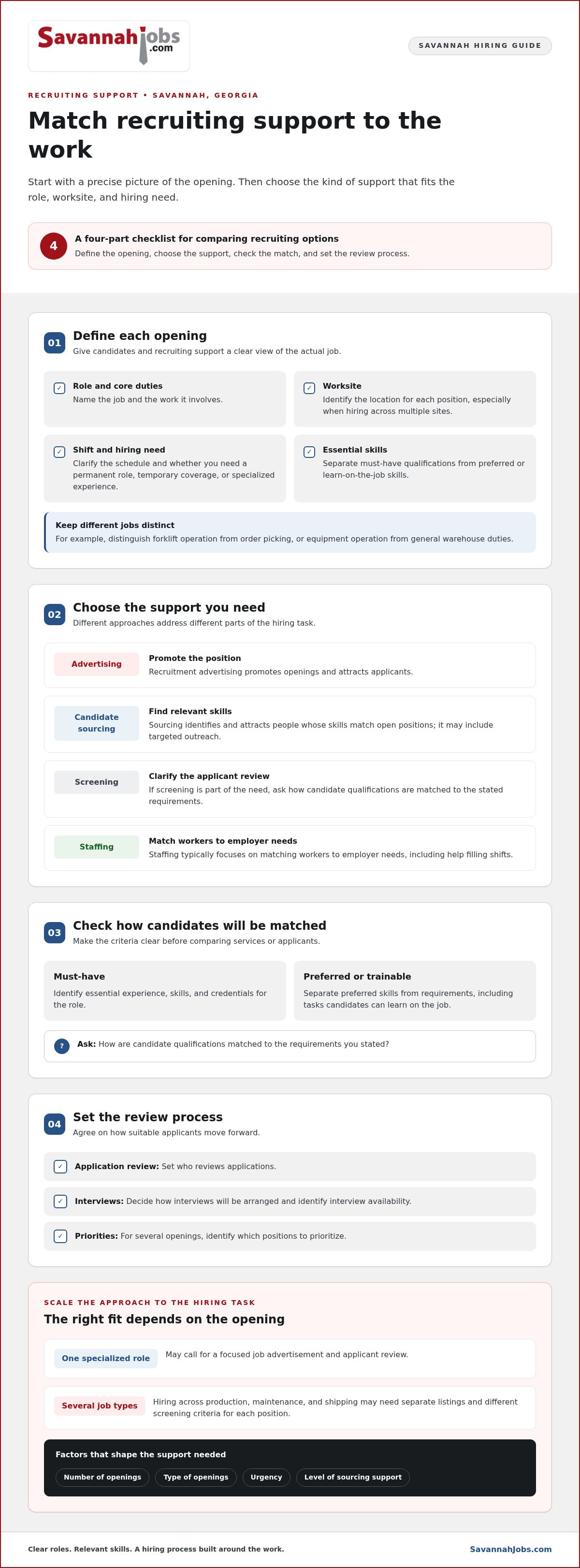
Hiring support can take different forms. Recruitment advertising promotes positions and attracts applicants, while candidate sourcing may include targeted outreach. Staffing typically focuses on matching workers to employer needs. Before choosing an approach, define the work, required qualifications, and whether you need applicants for a role or help filling shifts.
For example, a Savannah manufacturer hiring a machine operator can specify essential equipment skills and identify tasks that include on-the-job training. A construction employer can distinguish trade-specific experience from general labor duties. Clear criteria help employers assess applicants consistently and candidates understand the role. Separate must-have qualifications from preferred skills so an unnecessarily long list doesn’t discourage suitable applicants.
Flexible recruiting services can scale around the hiring task rather than follow one fixed process. An employer filling one specialized position may need a focused job advertisement and applicant review. A business hiring across production, maintenance, and shipping may need separate listings and different screening criteria for each position. The number and type of openings, urgency, and level of sourcing support determine the best fit.
Use these steps to compare recruiting options:
- Define each role, worksite, shift, and essential skill.
- Decide whether you need advertising, sourcing, screening, or staffing support.
- Ask how candidate qualifications are matched to your stated requirements.
- Set a process for reviewing applications and arranging interviews.
For employers hiring across Savannah’s industrial and logistics locations, specificity matters more than a broad “blue-collar” label. A clear listing gives candidates a practical picture of the work and helps recruitment support focus on relevant experience. Adjust the sourcing approach when the role, site, or hiring need changes.
Staffing support for employers and job-seekers
A job advertisement helps employers present an opening and candidates understand where their skills fit. In Savannah, start by defining whether you’re hiring for a permanent role, temporary coverage, or a specialized position requiring particular experience.
What Employers Should Prepare
Before posting a job, write a concise brief for each opening. Include the title, worksite, shift, core duties, required skills, and hiring timeline. For example, a warehouse employer near Savannah’s port should distinguish forklift operation from order picking. That detail helps candidates recognize the right role and keeps different jobs from sounding interchangeable.
Employers should also separate essential qualifications from preferred ones. A maintenance role might require experience troubleshooting machinery, while familiarity with a specific machine could be preferred. Set interview availability and identify who will review applications. A clear decision process helps staffing partners understand how to move suitable candidates forward.
For several openings, group positions by work type rather than combining them into one broad request. A manufacturer hiring production operators and equipment technicians needs distinct criteria for each role. Identify the positions to prioritize and explain any differences in schedules or worksites. This makes each listing easier for candidates to assess.
What Job-Seekers Should Share
Job-seekers can prepare a concise work history before applying. List relevant trades, equipment used, safety training, and preferred shifts. For example, a candidate with welding experience should describe the materials and tasks they’ve handled instead of relying on a general “experienced worker” label.
Consider practical details when applying. Identify which Savannah-area locations you can reach, the work you can perform, and the schedule you want. If you have gaps in experience, mention related tasks you’ve completed. A candidate with warehouse experience, for instance, can describe familiarity with inventory, loading, or order preparation.
Keep contact details and work history current, then respond promptly to interview requests. Employers can make decisions faster when candidates share accurate availability. Job-seekers can explore Savannah job listings to see the kinds of positions being advertised locally.
Job advertising and staffing support are different approaches. Staffing generally focuses on connecting employers with workers for their hiring needs; recruitment advertising focuses on promoting openings and attracting applicants. A specialized position calls for a precise skills profile, while broader hiring benefits from separate, clearly defined roles. Decide what you need before choosing your approach.
- Employers: clarify the role, location, schedule, and selection process.
- Job-seekers: describe relevant skills, work history, and availability.
- Both: keep communication direct and respond to next steps promptly.
Clear job descriptions make the process more useful for everyone. Savannah employers can explain the actual work, and candidates can decide whether the position matches their experience and schedule.
What are the best ways for Savannah employers to recruit blue-collar workers?
Start with the job itself, then choose advertising and screening steps that match its duties. When recruiting blue-collar workers in Savannah, a clear listing helps candidates understand the worksite, schedule, and required skills before applying.
Write a Job Post That Shows the Work
Use a job title candidates recognize, such as welder, production operator, or maintenance technician. Name the Savannah work location and describe the tasks plainly. For a manufacturing role, identify the equipment or production process. For construction, explain the trade, project duties, and whether workers move between sites.
Separate required skills from preferred experience. A machine operator position may require experience with specific equipment, while familiarity with a particular production process could be preferred. Include the shift, physical tasks, and application steps. These details let candidates assess the position without guessing what a broad title means.
Choose Channels and Reach the Right Candidates
Match the channel to the role and hiring audience. A local job board can make an opening visible to Savannah-area job-seekers. Employee referrals can help reach people already familiar with a worksite or trade. For specialized roles, direct outreach and relevant trade networks can focus attention on candidates with matching experience.
Use location details consistently. A listing for work near the Port of Savannah should name the site area and state the commuting expectations. If the job is at a manufacturing facility outside central Savannah, identify its location clearly. Candidates need practical details to judge whether the commute and shift suit them.
Prepare a simple review process before applications arrive. Assign someone to review applications, compare qualifications against consistent criteria, and arrange interviews. For example, a construction employer hiring electricians can assess trade experience, relevant project work, and schedule fit in the same order for each applicant. Don’t screen out candidates for preferred skills the role can teach.
Keep interviews focused on the job. Ask candidates to describe tasks they’ve performed, equipment they’ve used, or how they handled a relevant work challenge. A production employer might ask about troubleshooting a machine stoppage. A warehouse team could discuss order accuracy and safe material handling. Use the same core questions for applicants to keep comparisons relevant.
Keep communication direct throughout the process. Tell applicants what the next step involves, who will contact them, and whether an interview includes a practical demonstration. If you’re hiring for several Savannah positions, track each role separately so production applicants don’t receive details intended for maintenance openings. Clear updates help candidates make informed decisions and keep hiring organized.
- State the job, location, shift, and essential qualifications.
- Select channels suited to the trade and experience level.
- Use consistent screening criteria and job-related interview questions.
- Keep applicants informed about the next hiring step.
What are the current labor shortages and in-demand trades in Savannah?
Savannah job listings for skilled aircraft maintenance and installation illustrate the specific experience some technical openings require. They don’t establish a citywide labor shortage, but they can help employers understand how specialized roles are described.
Aircraft interiors offer a clear example. One Savannah aircraft interior installation technician listing required 2 years of business jet aircraft experience. An aircraft interior installer listing required 1 year of experience, while a senior interior installer listing required 4 years of business jet or VIP aircraft experience. These different thresholds show why employers should distinguish entry-level, experienced, and senior positions in job descriptions.
Structural aircraft work also calls for proven skills. A Savannah structural mechanic listing required a minimum of 4 years of structural assembly experience. The listing specified 3 weeks of hands-on training before work begins. Employers recruiting for similar work can explain the assembly tasks, required background, and training process separately. That helps candidates assess whether their experience matches the position.
Avionics requirements vary by role. A Savannah avionics/electrical technician listing required 6 years of business jet aircraft experience, or 2 years of accredited aviation schooling and 4 years of aviation avionics experience. A separate avionics technician listing required 2 years of avionics experience or 2 years of accredited aviation electronics schooling. Treat these as distinct job examples, not one universal qualification standard.
Aircraft mechanic roles also call for specialized backgrounds. A Savannah senior aircraft mechanic listing required 4 years of corporate jet experience. That requirement signals a need for candidates familiar with business aircraft, rather than general mechanical experience alone. Employers can make listings more precise by naming the aircraft environment and the maintenance work involved.
For Savannah employers, job listings can offer a practical way to define hard-to-fill roles: compare the duties and experience required across relevant openings, then identify the specific skills your team needs. Avoid treating “aircraft technician” as one interchangeable job title. Interior installation, structural assembly, avionics, and senior mechanic work each call for different experience.
Use local hiring evidence to sharpen your recruiting plan:
- Separate aircraft interior, structural, avionics, and mechanic openings.
- State required experience and accepted education paths precisely.
- Describe hands-on training as its own part of the role.
- Use seniority labels that match the experience the position requires.
These Savannah listings highlight specialized aviation trades, not every blue-collar occupation in the area. For manufacturing and construction roles, define your hiring needs from your own vacancies, equipment, and project requirements. A specific skills profile helps candidates recognize the right opening and gives employers a clearer basis for screening.
What hiring requirements and certifications are common for blue-collar jobs in Georgia?
Requirements in Georgia depend on the duties, equipment, and worksite involved. Savannah aviation listings show how employers may describe experience or education paths for specialized roles. Don’t treat one job’s qualifications as a universal standard for every trade.
For example, a Savannah avionics technician listing required 2 years of avionics experience or 2 years of accredited aviation electronics schooling. A separate avionics/electrical technician listing required 6 years of business jet aircraft experience, or 2 years of accredited aviation schooling and 4 years of aviation avionics experience. These listings use different pathways, so employers should match each requirement to the actual position.
Experience requirements can also reflect seniority and task complexity. A Savannah aircraft interior installer listing required 1 year of experience, while a senior interior installer listing required 4 years of business jet or VIP aircraft experience. A structural mechanic listing required a minimum of 4 years of structural assembly experience. State the relevant work clearly, rather than relying on a broad label such as “technician.”
Tie certifications and credentials to the job’s actual duties. If a position requires a particular credential, name it in the listing and explain how it relates to the work. If relevant experience or accredited schooling can qualify a candidate, make those paths clear. Avoid presenting a preferred qualification as mandatory, since that can narrow the applicant pool without improving the match.
Employers can make requirements easier to understand by separating them into three groups: essential experience, accepted education or credentials, and skills that can be learned after hiring. For instance, a Savannah avionics role can distinguish required avionics experience from an education alternative. A manufacturing opening can identify the equipment knowledge needed, then list other useful skills as preferred.
- Use job-specific titles and describe the work behind them.
- List required experience separately from preferred qualifications.
- Explain accepted education or credential pathways in plain language.
- Connect each requirement to a task candidates will perform.
During screening, compare each application against the criteria in the listing. Ask candidates to describe relevant duties, equipment, or training. For an aviation electronics position, discuss the candidate’s avionics experience or schooling. For structural work, focus on assembly experience and related tasks. Consistent questions help employers assess applicants using job-related evidence.
Ready to reach Savannah candidates with a clearly defined opening? Post a Savannah job opening with the role and qualifications spelled out.
Candidates can compare listings by location and employment arrangement, while remembering that posting dates alone do not establish qualifications. A blue-collar job listing in Richmond Hill, Georgia, was posted on Feb 09, 2021. A recruiter contract job listing in Savannah, Georgia, was posted on Mar 12, 2021. Another recruiter contract job listing in Savannah, Georgia, was posted on Mar 30, 2021, and a recruiter contract job listing in Savannah, Georgia, was posted on Jun 22, 2021. A recruiter full-time job listing in Savannah, Georgia, was posted on Aug 31, 2021. A full-time job listing in Savannah, Georgia, was posted on Sep 16, 2021.
Applicants should read the duties and stated requirements for each position rather than assume that contract or full-time status signals a particular credential, experience level, or training route. Keep screening questions anchored to the role’s tasks, and assess candidates using the same job-specific criteria. This keeps credential discussions relevant and allows equivalent experience or schooling when the listing expressly accepts it.
SavannahJobs.com: 30-Day Job Posting
SavannahJobs.com gives employers a direct way to advertise open positions to the local Savannah workforce. If you’ve defined the role, qualifications, and work location, a 30-Day Job Posting can put that opportunity in front of local job-seekers.
For a specialized manufacturing, construction, or trades position, make the listing specific: describe the duties, required experience, schedule, and worksite. Employers seeking added visibility on SavannahJobs.com can choose a Featured Job Upgrade for a particular opening or a Featured Employer Upgrade to highlight their organization.
SavannahJobs.com is a job advertising platform, not a staffing service. It’s a practical next step when you’re ready to publish an opening and reach candidates in the Savannah area. Visit the Employers page to view posting rates and create an account.
Build Your Next Savannah Hiring Plan
Make each opening part of a stronger workforce plan. Record the skills your team needs, the qualifications that matter most, and where applicants tend to drop out. Use those insights to improve future job descriptions and align hiring priorities with production schedules and project demands. A thoughtful approach to recruiting blue-collar workers in Savannah can make each search more focused.
When you’re ready to advertise an opening, SavannahJobs.com offers a 30-Day Job Posting, a Featured Job Upgrade, and a Featured Employer Upgrade. Choose the visibility option that fits your hiring goal, then publish a clear description of the work and qualifications. Contact SavannahJobs.com to take the next step. Strong local teams start with a clear opportunity and a practical plan.
Frequently Asked Questions
How do I post a job?
To post a job, visit SavannahJobs.com’s employer area, create an employer account, and select a 30-Day Job Posting. Prepare the job title, work location, responsibilities, qualifications, schedule, and application instructions before entering the listing. For example, distinguish a night-shift production opening from a daytime one in the title and schedule fields. Review the complete post for accuracy, then submit it through the employer workflow.
How long does a job posting stay active?
A 30-Day Job Posting stays active for 30 days. Use that window to review applicants regularly and keep your interview calendar ready, especially if hiring managers work different shifts. Record which candidates have been contacted and the next action for each application. As the listing period approaches its end, assess whether the opening remains active and organize your next recruiting step around current staffing needs.


