

A familiar résumé isn’t proof of strong management. To learn how to hire a great manager in Savannah, assess candidates on their judgment, relevant results, and ability to help a team succeed, not on whether they resemble leaders you’ve hired before. Request at least five references, including former direct reports, and follow up with each one.
It’s understandable to favor a candidate whose experience feels like a safe fit. But focusing too narrowly on that profile can mean overlooking people with the leadership skills your team needs. A consistent process helps you compare candidates using evidence rather than first impressions.
This guide covers ways to broaden your search, ask useful situational and behavioral interview questions, and learn what former team members valued or thought could improve. You’ll also find practical ways to assess how a manager may affect customer service, efficiency, and productivity in a Savannah workplace, connecting leadership qualities to the results your business needs.
Key Takeaways
- Widen your candidate pool by looking beyond familiar résumés and considering applicants from outside Savannah.
- Use realistic workplace scenarios to assess candidates’ judgment, problem-solving, and approach to managing people.
- Ask former direct reports for specific examples of how a candidate supported the team and handled challenges.
- Connect leadership behaviors to practical outcomes, including customer service, workplace efficiency, and team productivity.
- Compare candidates on relevant experience and leadership qualities, not years in management alone.
1. Avoiding bias toward familiar manager profiles
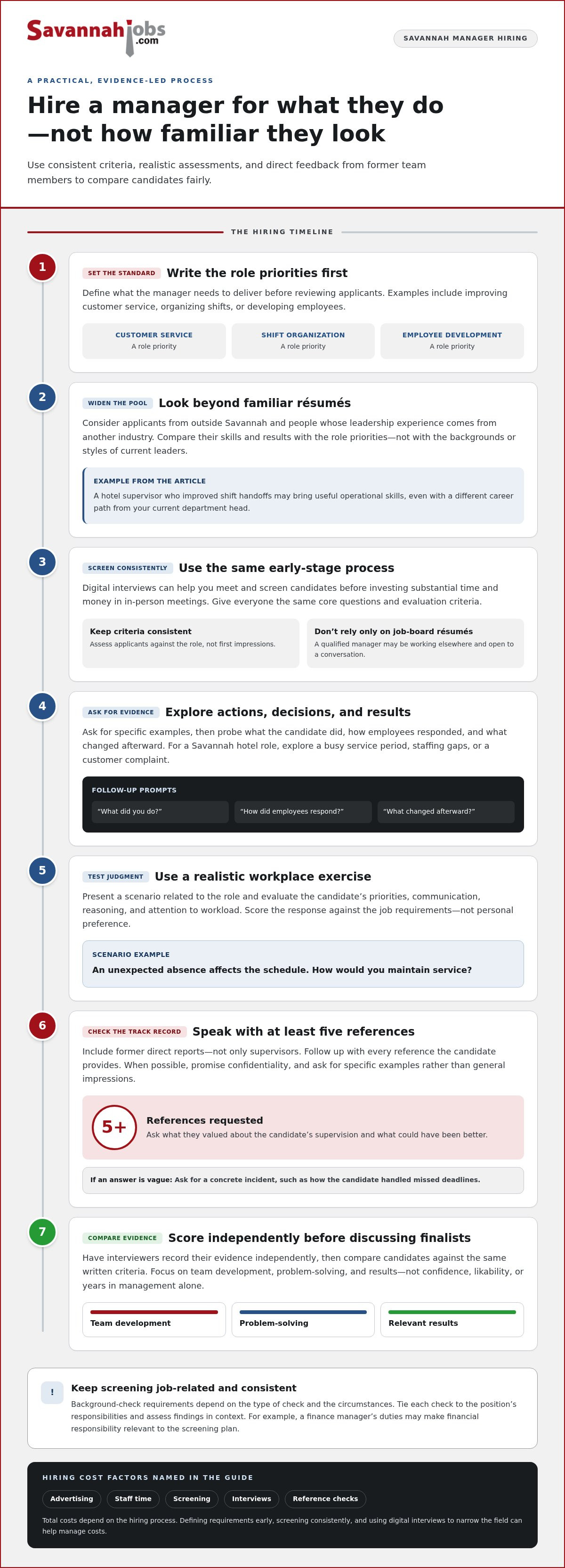
A familiar résumé can feel like the safest choice, but similarity to current leaders doesn’t prove someone can manage well. Start with a written profile of the role’s priorities, such as improving customer service, organizing shifts, or developing employees. Then compare every candidate against the same criteria. This keeps the focus on evidence, not shared backgrounds, communication styles, or career paths.
When hiring in Savannah, Georgia, follow applicable federal and Georgia employment requirements. Keep selection criteria job-related and consistent, and assess candidates on results rather than age, color, sex, disability, religion, or nationality. A written scorecard can help interviewers apply the same standards to every applicant and keep discussions focused on qualifications.
Employers can conduct background checks relevant to the role, but requirements depend on the type of check and the circumstances. Use a consistent screening process, tie each check to the position’s responsibilities, and assess findings in that context. For example, a finance manager’s duties may make financial responsibility relevant to the screening plan.
Broaden your candidate pool before deciding what a strong manager “looks like.” Consider applicants from outside Savannah and people whose leadership experience comes from another industry. A hotel supervisor who improved shift handoffs, for instance, may bring useful operational skills despite having a different career path from your current department head.
Digital interviews can help you meet and screen candidates before investing substantial time and money in in-person meetings. Use the same core questions and evaluation criteria for everyone. Don’t assume the strongest prospect is actively job hunting or has posted a résumé on a job board. A qualified manager may be working elsewhere and open to a conversation rather than a job search.
Request at least five references, including former direct reports, not just supervisors. Follow up with every reference the candidate provides, and promise confidentiality when possible. Ask what they appreciated about the candidate’s supervision and what could have been better. If an answer is general, ask for a specific example, such as how the candidate handled missed deadlines.
Recruiting and hiring costs for managers in Savannah depend on the process. Advertising, staff time, screening, interviews, and reference checks all affect the total. Manage costs by defining requirements early, screening consistently, and using digital interviews to narrow the field before arranging in-person meetings.
To reduce bias toward familiar profiles, have interviewers score evidence independently before discussing finalists. Compare examples of team development, problem-solving, and results rather than relying on confidence or a polished résumé alone. A consistent process gives candidates with different backgrounds a fair chance to show how their experience fits your Savannah team’s needs.
2. Behavioral and management-style interview questions
Ask each candidate for specific examples, then probe the decisions behind them. A polished answer about “being a team player” says little on its own. Ask what the candidate did, how employees responded, and what changed afterward. For a Savannah hotel role, explore how they handled a busy service period, staffing gaps, or a customer complaint.
Assess management skills through reference checks and a practical exercise related to the role. Ask former direct reports how the candidate handled conflict, delegated work, and helped employees improve. Then present a realistic workplace scenario and evaluate the candidate’s priorities, communication, and reasoning.
Situational questions based on real workplace challenges can reveal a candidate’s judgment and problem-solving. Ask each finalist the same core questions, then listen for clear actions and results. Useful examples include:
- “Two employees disagree about shift coverage. How would you resolve it?”
- “A customer reports repeated service delays. What would you investigate first?”
- “A strong employee misses an important deadline. How would you respond?”
- “Your team must adopt a new process. How would you explain the change?”
- “A department is over budget. What information would guide your next steps?”
Ask follow-up questions to uncover the candidate’s management style. If they say they “empower employees,” ask for an example of a decision they delegated and how they monitored the outcome. If they describe resolving conflict, ask what each employee needed and how they reached a workable agreement. Specifics help distinguish thoughtful leadership from broad claims.
A short practical exercise can show how a candidate turns judgment into action. For example, present a fictional schedule with an unexpected absence and ask how they would maintain service. Look for sensible priorities, clear communication, and attention to workload. Score responses against the role’s requirements, not personal preference.
Reference conversations offer another view of a candidate’s day-to-day behavior. Ask a former direct report what the manager did to bring out their best work and whether they would choose that person as their boss again. If an answer is general, request a concrete incident. Compare those examples with the candidate’s interview responses.
In Savannah, a consistent interview plan helps your team evaluate candidates fairly. Record each interviewer’s evidence before discussing finalists, and separate demonstrated results from likability. Once your role profile and questions are ready, share the opening through Savannah job listings to reach local applicants.
3. Manager impact on customer service and efficiency
In a Savannah hotel, a general manager’s leadership can shape customer service, efficiency, and cleanliness across departments. Front Office, Sales, Food & Beverage, Housekeeping, and Engineering all contribute to the guest experience. A manager who coordinates those teams can help prevent small service issues from becoming recurring problems.
Consider a guest who reports that a room isn’t ready. The Front Office needs an accurate update, Housekeeping needs clear priorities, and Engineering may need to address a maintenance issue. A manager who assigns responsibilities and keeps communication moving can help teams respond consistently. In interviews, ask candidates how they have coordinated departments through a similar service problem. This connects leadership to the guest experience when considering how to hire a great manager in Savannah.
Efficiency shows up in everyday work. Unclear shift handoffs, for example, can leave employees repeating tasks or missing guest requests. Ask a candidate how they identify bottlenecks, assign ownership, and confirm a process is working. Strong answers explain what the manager observed, what the team changed, and how they monitored the result, rather than relying on claims of “better operations.”
- Customer service: Ask how the candidate handled a recurring complaint and followed up with staff.
- Efficiency: Explore how they reduced confusion between departments or shifts.
- Cleanliness: Ask how they maintained consistent room or public-area standards.
- Communication: Learn how they shared urgent updates across Front Office and Housekeeping.
- Team support: Ask how they coached an employee after a service mistake.
Budget preparation also tests operational judgment. A Savannah hotel general manager prepares operational budgets for financial planning and expense control. Ask candidates how they weigh service needs against available resources. A useful answer might describe reviewing staffing demands, recurring maintenance, and guest feedback before setting priorities. Listen for a clear process, not a promise to cut costs without considering service.
Connect interview answers to the role’s daily demands. If a candidate describes improving room readiness, ask how they coordinated Housekeeping and Front Office, communicated delays, and checked whether the change lasted. If they discuss resolving a customer-service issue, ask how they supported the employee and addressed the cause. These follow-ups show whether the candidate can turn judgment into practical team action.
A manager’s career history matters most when it demonstrates relevant behaviors. Look for examples of cross-team coordination, clear expectations, and follow-through. In Savannah hospitality, a candidate who explains how they balanced guest needs with department workflows offers more useful evidence than a résumé listing titles alone. To assess how to hire a great manager in Savannah, focus on how their leadership could affect service and efficiency in your operation.
4. Manager quality and company productivity
Manager quality affects whether employees can focus, solve problems, and deliver consistent work. A Gallup survey of more than 2 million employees found that company productivity depended to a high degree on manager quality. Gallup also found that 82% of businesses make the wrong management hire. Those findings underline why hiring decisions should examine how candidates lead, not just what they have accomplished individually.
The Wall Street Journal stated that hiring the right manager accounts for nearly three-fourths of the effort toward building a superior team. That doesn’t mean a manager creates results alone. It highlights managers’ influence over priorities, delegation, communication, and employees’ ability to do their jobs. Ask candidates how they’ve kept a team focused on shared goals.
Look for evidence of strong operating habits. Effective managers organize work, delegate thoughtfully, and keep company priorities visible. Ask a candidate how they would respond when daily tasks compete with a time-sensitive business goal. Listen for how they clarify priorities, assign ownership, and keep employees informed without taking over every decision.
Productivity also depends on how managers handle change. In a large-scale business change initiative, store managers can influence whether change happens through their presence, customer contact, and authority. Ask candidates to describe a change they led. What did they communicate to employees? How did they address resistance? What did they do when the plan disrupted routine work?
Strong managers motivate teams and share credit while pursuing above-average results and positive morale. Ask for examples that show both the outcomes and how the team achieved them. A candidate who improved a process but lost capable employees may have a different impact from one who maintained strong performance while helping people succeed. Ask whether they retained strong performers after taking on a new team.
Assess the candidate’s approach to accountability, too. Ask how they set expectations, monitor progress, and respond when commitments slip. A useful answer might explain how they identify the cause, coach the employee, and agree on a clear next step. This reveals more than a general claim about being “results-driven.”
Finally, consider how much room the candidate gives employees to do their work. Managers who trust employees, remove obstacles, and stay attentive to business priorities can help a company move forward. Ask how candidates decide what to delegate and when to step in. Their examples can show whether they balance oversight with employee ownership, supporting productivity without creating unnecessary bottlenecks.
5. What qualities and experience should you look for when hiring a manager?
Start with the work, not a fixed idea of a “natural leader.” Match experience to the role’s daily responsibilities and evaluate leadership style, judgment, and results. A manager overseeing hotel operations needs evidence of coordinating teams and budgets. A manager leading a smaller department may need stronger coaching and workflow skills. Management experience provides context, but doesn’t prove someone can lead your team effectively.
For a Savannah hotel general manager, the role calls for 3 to 5 years of general manager experience. Candidates should also be prepared to forecast revenue by market segment and plan to exceed revenue goals. Explore how they’ve balanced revenue planning with employee needs and customer service. Their examples should explain the decisions they made and how they handled competing operational priorities.
Look for problem-solving and interpersonal skills in practical examples. The U.S. Department of Labor identifies professionalism, communication, teamwork, and critical thinking or problem-solving as work-readiness skills. Ask candidates how they communicated a difficult decision, handled disagreement between coworkers, or solved a recurring scheduling problem. Strong examples show how they listened, weighed options, and explained next steps.
- Team development: Ask how they helped an employee build a skill or prepare for more responsibility.
- Delegation: Explore how they matched tasks to employees’ strengths and followed progress.
- Adaptability: Ask about a controlled risk or change they introduced to improve a process.
- Accountability: Ask how they handled a commitment they couldn’t meet as planned.
Peer respect can reveal leadership potential beyond a job title. Consider whether colleagues sought the candidate’s advice and whether former direct reports felt supported. Ask those employees what the manager did to bring out their best work and whether they would choose that person as their boss again. Look for specific examples, not simple praise.
Results matter alongside relationships. A well-liked candidate may still struggle to organize work, delegate, or meet business priorities. Ask for examples that connect team actions to outcomes, such as better handoffs or retaining strong performers after taking over a department. Then ask candidates to explain their own contribution without claiming sole credit for team achievements.
Finally, assess how the candidate learns and responds under pressure. A manager who listens before acting can gather context, while confidence helps them decide once the facts are clear. Ask how they would respond to an unexpected staffing gap during a busy Savannah shift. Their answer can show whether they weigh service needs, employee capacity, and operational priorities together.
Use these qualities to shape a clear role profile and attract applicants whose experience fits your needs. Share your manager opening with Savannah job seekers and invite candidates to show how they can lead your team.
SavannahJobs.com: 30-Day Job Posting
SavannahJobs.com helps employers advertise open roles to the Savannah workforce through a 30-Day Job Posting. Once you’ve defined the manager’s responsibilities, leadership qualities, and experience requirements, use a posting to present those details clearly to local applicants. Explain the team’s priorities, key duties, and what successful performance looks like, so candidates can assess their fit before applying.
For added visibility, employers can choose a Featured Job Upgrade or Featured Employer Upgrade on SavannahJobs.com. These options support recruitment advertising when you’re ready to promote an opening or highlight your organization to job seekers in the area. Keep the job description focused on the role and the results your next manager will help deliver.
Visit savannahjobs.com to advertise your manager opening.
Put Your Manager Search in Motion
The next step in learning how to hire a great manager in Savannah is to turn your hiring criteria into a clear opportunity. A focused job description gives candidates a practical picture of the role, the team, and the work they’ll lead. It also gives your hiring team a consistent starting point for evaluating applications.
SavannahJobs.com offers a 30-Day Job Posting for employers advertising open positions to the local workforce. You can also choose a Featured Job Upgrade or Featured Employer Upgrade to add visibility to your recruitment advertising. Select the approach that fits your opening, then make the responsibilities and expectations clear to applicants.
Contact SavannahJobs.com today to take the next step with your manager opening. A thoughtful search can help you find a leader ready to contribute to your Savannah team.
Frequently Asked Questions
What interview questions help identify a great manager?
Ask questions that reveal how candidates think through competing priorities. For example: “A key employee requests urgent support while a customer issue needs attention. How would you decide what happens first?” Follow up by asking what information they’d gather and how they’d explain their decision. In Savannah, tailor scenarios to the role’s actual demands, then compare answers against consistent criteria rather than personal chemistry.
Where can Savannah employers find qualified management candidates?
Savannah employers can reach qualified candidates through local recruitment advertising, professional networks, and employee referrals. SavannahJobs.com lets employers advertise open roles to the local workforce. Make the posting specific about the team, responsibilities, and relevant experience. Referrals can broaden your reach, too, especially when you ask colleagues to share the opening beyond their closest circle.
What common mistakes and risks should employers avoid when hiring a manager?
Don’t choose based on confidence or a polished interview alone. A candidate may speak convincingly yet struggle to make decisions, communicate expectations, or follow through. A vague job description can also attract applicants whose experience doesn’t match the actual work. Before making an offer, compare evidence from interviews, work examples, and references against the role’s essential responsibilities.
What Georgia and federal employment laws apply when hiring a manager?
Follow applicable federal and Georgia employment requirements. Keep selection criteria job-related and consistent, and assess candidates on qualifications rather than age, color, sex, disability, religion, or nationality.
How does Savannah's labor market affect manager hiring and retention?
Broaden the search to candidates from outside Savannah and consider qualified people who are not actively job hunting. Full-time employee salaries in Savannah are generally 9% below the national average; the material gives no specific retention guidance.
What are the steps and timeline for hiring a manager in Savannah?
Define the role’s priorities and consistent evaluation criteria, widen the candidate pool, and use digital interviews to screen candidates. Ask the same behavioral and situational questions, use a role-related practical exercise, then request at least five references, including former direct reports, and follow up with each.
What are typical recruiting and hiring costs for managers in Savannah?
Costs depend on advertising, staff time, screening, interviews, and reference checks. Define role requirements early, screen consistently, and use digital interviews to narrow the field before in-person meetings to manage costs.


